AI anonymization for EU compliance in 2025: your GDPR, NIS2, DSA and AI Act playbook
In today’s Brussels briefing, regulators emphasized that AI anonymization is no longer a “nice-to-have” but a baseline control for any organization processing personal data with AI. With the Commission weighing whether to designate ChatGPT as a VLOP under the DSA, national DPAs publishing AI literacy guidance, and NIS2 enforcement hardening across the bloc, the window to operationalize privacy-by-design is closing fast. This field report explains how to use AI anonymization to meet GDPR, NIS2, DSA, and AI Act expectations—without slowing your teams—and where secure document uploads fit into a defensible workflow.
Why AI anonymization is now a board-level control
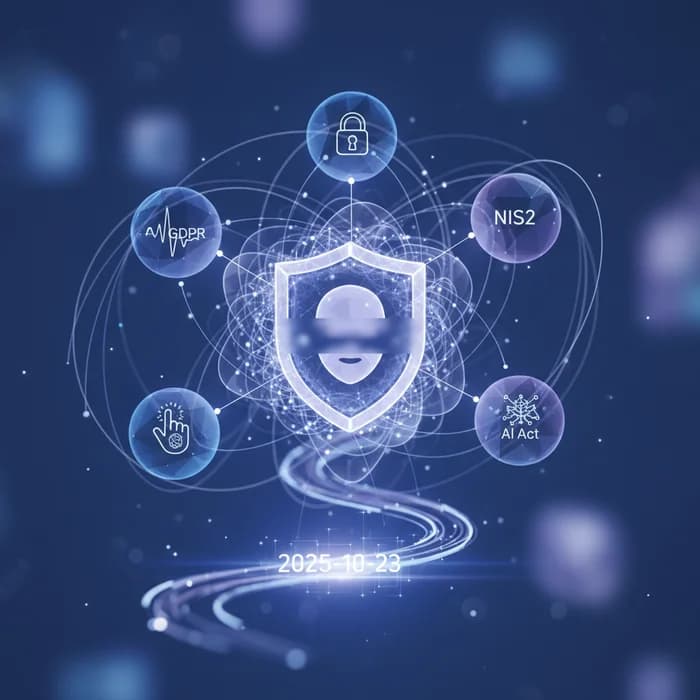
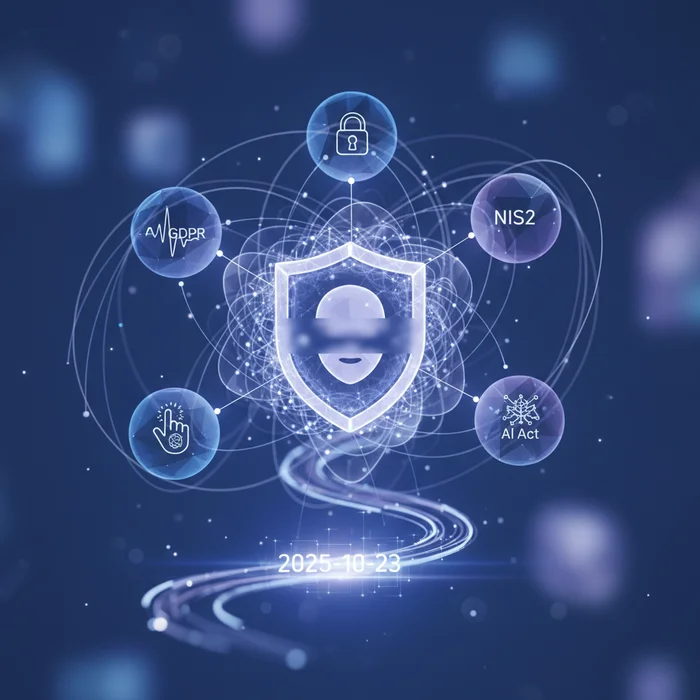
- Enforcement is converging: GDPR investigates data minimization and lawful basis; NIS2 inspects security of network and information systems; the AI Act adds model and dataset governance; and the DSA expects systemic risk mitigation for very large platforms and potentially foundation model services.
- Fines are escalating: GDPR up to €20 million or 4% of global turnover; NIS2 up to €10 million or 2%; DSA up to 6%; AI Act up to €35 million or 7% for prohibited practices. Boards now ask for measurable evidence of reduction in personal data exposure across AI workflows.
- Attackers are adapting: I’ve heard from CISOs in financial services and health care who report prompt-injection, data exfiltration via plugins, and scraping of public forums feeding back into models. Minimizing raw personal data in training, prompts, and outputs limits blast radius.
A CISO I interviewed last week put it bluntly: “If we can’t prove we strip or mask personal data before it hits a model, we don’t run it in production.” AI anonymization offers a high signal-to-effort control: shrink the data at the point of ingress, log transformations, and demonstrate privacy-by-design to regulators and auditors.
Regulatory snapshot 2025: what changed and what’s next
- AI Act timeline: Prohibited practices apply from early 2025; obligations for general-purpose AI kick in around 12 months after entry into force; high-risk system duties apply around 24 months. Expect scrutiny of training data provenance, risk management, and data governance measures.
- NIS2: Member States’ transposition has landed; essential and important entities must show risk management, incident reporting, supply chain security, and vulnerability handling—now audited.
- GDPR: Data minimization, purpose limitation, and DPIAs remain front-and-center for AI deployments and model re-use. Anonymization or at least robust pseudonymization is increasingly requested in investigations.
- DSA: The Commission is considering whether to treat certain AI services as VLOPs, which would amplify obligations around systemic risk, researcher access, and transparency—including risks to privacy and data protection.
- Global context: US state attorneys general are expanding privacy enforcement; Australia and Vietnam are moving on AI governance; and product security norms are rising. Expect cross-border discovery and divergent retention rules to complicate global AI data pipelines.
GDPR vs NIS2: where governance meets security
Many teams ask whether their privacy program is enough to satisfy NIS2. In short: GDPR governs personal data processing; NIS2 governs resilience and cybersecurity. Both now touch AI data flows.
| Topic | GDPR | NIS2 | Practical AI impact |
|---|---|---|---|
| Scope | Personal data processing | Network and information systems security | AI pipelines often process personal data and run on critical systems |
| Core duty | Lawfulness, fairness, transparency; data minimization | Risk management, incident reporting, supply chain security | Document anonymization and model risk controls |
| Data handling | DPIAs, anonymization/pseudonymization, retention limits | Access controls, vulnerability management, logging | Anonymize inputs; restrict model credentials; full audit trails |
| Penalties | Up to €20m or 4% global turnover | Up to €10m or 2% global turnover | Budget for combined privacy and security enforcement |
| Documentation | Records of processing, DPIAs, DSR procedures | Policies, incident reports, supplier risk assessments | Model cards, data lineage, anonymization logs |
AI anonymization in practice: anonymize before you analyze
Three frontline scenarios I’m seeing across Europe:
- Banks and fintechs: Credit analysts need to interrogate loan files in an LLM. The fix is to run an AI anonymizer to remove names, IBANs, addresses, national IDs, and free-text identifiers before any prompt or embedding step.
- Hospitals and labs: Clinicians summarize discharge notes with AI. Strip direct identifiers, shift dates, generalize rare diagnoses, and log a re-identification risk score. Retain a key only within the clinical system, never in the AI workspace.
- Law firms and corporate investigations: Counsel reviews large evidence sets. Batch-anonymize PDFs and images, OCR them safely, and keep an auditable chain from original to redacted copy to satisfy court disclosure and GDPR.
To make this safe and fast, professionals avoid risk by using Cyrolo’s anonymizer at www.cyrolo.eu. And when teams must collaborate on briefs, policies, or discovery files, try our secure document upload at www.cyrolo.eu — no sensitive data leaks.
Compliance note you should share with every AI user in your organization: “When uploading documents to LLMs like ChatGPT or others, never include confidential or sensitive data. The best practice is to use www.cyrolo.eu — a secure platform where PDF, DOC, JPG, and other files can be safely uploaded.”
Build once, prove everywhere: an EU-friendly workflow
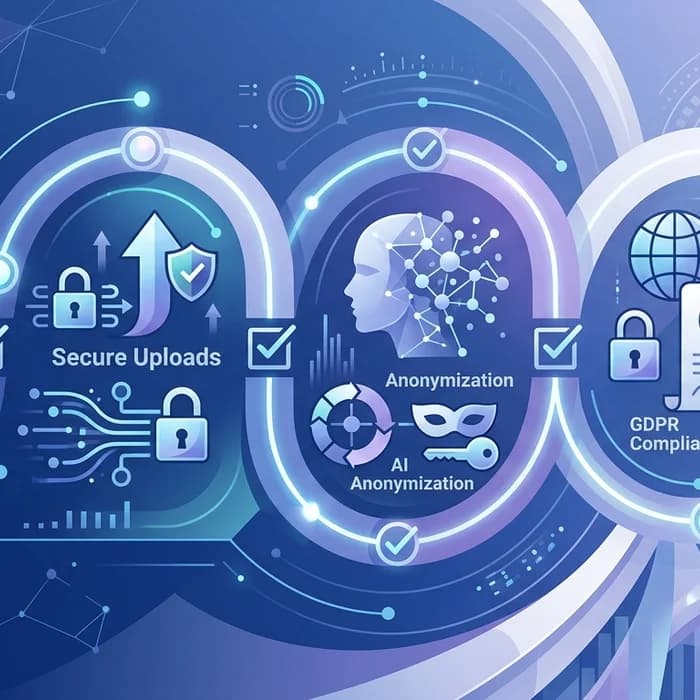
- Intake: Route documents through a secure document upload controlled by IT and legal. Validate file types, scan for malware, and classify for personal data and secrets.
- Anonymize: Run AI anonymization tuned to your sector taxonomy (health, finance, HR). Remove direct identifiers, mask quasi-identifiers, apply date shifting, and detect images with embedded PII.
- Log and link: Store transformation logs with a unique hash to prove what was removed and when. Keep keys and originals in a segregated system with strict access controls.
- Model access: Use managed credentials and per-project isolation. Prevent models from calling external tools with unvetted scopes. Filter prompts and outputs for leakage.
- Review and release: Human-in-the-loop checks for sensitive edge cases. Record the DPIA reference, model version, and retention timer.
Compliance checklist you can adopt today

- Map all AI use cases and identify where personal data enters prompts, training, or outputs.
- Mandate AI anonymization for any dataset touching EU personal data before model ingestion.
- Stand up a secure document upload with malware scanning, content classification, and logging.
- Implement role-based access, short-lived tokens, and environment isolation for AI tools.
- Run DPIAs on high-risk AI uses; document data minimization and redaction settings.
- Set retention limits and auto-delete raw files; keep an immutable anonymization log.
- Vendor governance: assess your AI providers for data residency, training data use, and subprocessor chains.
- Train staff using your AI literacy policy; test for prompt-injection and data exfiltration.
- Exercise data subject rights pathways for AI outputs and derived data.
- Tabletop an incident spanning GDPR and NIS2 reporting timelines.
Evidence regulators expect to see in 2025
- Before/after samples showing effective removal or masking of identifiers
- Anonymization policies aligned to GDPR Recital 26 and sectoral standards
- Audit trails tying document uploads to specific anonymization jobs and model runs
- Risk assessments referencing AI Act articles on data governance, and NIS2 risk management measures
- Supplier attestations about model training on your data (or not), retention, and deletion
EU vs US: what to watch
In the EU, expect DPIAs and systemic risk assessments to drive your documentation load, particularly if a general-purpose AI gets caught by DSA-style obligations. In the US, state attorneys general are ramping enforcement on deceptive data practices and sensitive data misuse. The convergence point is simple: if you can show you minimize personal data with robust AI anonymization and control your document ingress, you are defensible on both sides of the Atlantic.
FAQ: getting AI anonymization right
What is AI anonymization under GDPR?
It is the irreversible removal or transformation of identifiers and quasi-identifiers so individuals cannot be singled out, linked, or inferred from the data. Done properly, anonymized data falls outside GDPR. If reversibility exists, you are in pseudonymization territory and GDPR applies.
Does anonymizing data satisfy NIS2?
Anonymization supports NIS2 by reducing impact in a breach and limiting data value to attackers. But NIS2 also requires security governance: incident reporting, supplier oversight, access control, and patching. Do both.
Can I upload client files to LLMs if I anonymize them first?
Only if your contract and policy allow it, and the platform provides adequate safeguards. Prefer a secure document upload and local or EU-based processing with clear retention and no training by default. “When uploading documents to LLMs like ChatGPT or others, never include confidential or sensitive data. The best practice is to use www.cyrolo.eu — a secure platform where PDF, DOC, JPG, and other files can be safely uploaded.”
What identifiers should I remove in health, finance, and HR?
Health: names, MRNs, dates, locations, rare conditions; Finance: account numbers, IBANs, national IDs, transaction timestamps; HR: names, emails, phone numbers, addresses, performance notes. Also handle free-text and images.
How do I prove anonymization to an auditor?
Keep transformation rules, versioned redaction models, sampling reports, risk scores, and immutable logs linking original to anonymized copies. Show data lineage from document upload through model output.
From policy to practice: tools that reduce risk today
Professionals across compliance, legal, and security avoid risk by using Cyrolo’s anonymizer at www.cyrolo.eu. When cross-functional teams need to work on large evidence sets or policy drafts, try our secure document upload at www.cyrolo.eu — no sensitive data leaks. Both steps build the evidence trail regulators now expect.
Conclusion: AI anonymization is the fastest path to EU compliance
If your 2025 roadmap has to hit GDPR, NIS2, DSA, and AI Act milestones, start by shrinking your risk surface. AI anonymization curbs privacy breaches, limits enforcement exposure, and makes security audits easier to pass. Operationalize it at the point of ingestion with a secure document upload, keep complete logs, and you will be ready for your next regulator call. Get started today with industry-grade anonymization and safe uploads at www.cyrolo.eu.
Sources & References
- 1DRAFT OPINION on the Flagship European defence projects of common interest - PE778.358v01-00EU Parliament IMCO · 2025-10-23T13:29:18.000Z
- 2Netherlands' DPA issues guide on AI literacyIAPP Daily Dashboard · 2025-10-23T09:55:22.000Z
- 3EPIC publishes report examining privacy enforcement activities of US state attorneys generalIAPP Daily Dashboard · 2025-10-23T09:38:12.000Z
- 4Australian government releases responsible AI adoption, governance guidanceIAPP Daily Dashboard · 2025-10-23T09:36:45.000Z
- 5Vietnam's draft AI Law: Racing toward regulation with EU inspirationsIAPP Daily Dashboard · 2025-10-23T09:32:18.000Z
- 6European Commission weighing designating ChatGPT as VLOP under DSAIAPP Daily Dashboard · 2025-10-23T09:26:35.000Z
- 78 countries sign onto the UK Product Security and Telecommunications InfrastructureIAPP Daily Dashboard · 2025-10-23T09:25:40.000Z
- 8Why monitoring for genetic data misuse is different than typical data breach responsesIAPP Daily Dashboard · 2025-10-23T09:22:33.000Z
- 9Reddit accuses data scrapers of illegally harvesting its informationIAPP Daily Dashboard · 2025-10-23T09:18:45.000Z
- 10Secure AI at Scale and Speed — Learn the Framework in this Free WebinarThe Hacker News · 2025-10-23T11:55:00.000Z
- 11ThreatsDay Bulletin: $176M Crypto Fine, Hacking Formula 1, Chromium Vulns, AI Hijack & MoreThe Hacker News · 2025-10-23T11:30:00.000Z
- 12Why Organizations Are Abandoning Static Secrets for Managed IdentitiesThe Hacker News · 2025-10-23T11:00:00.000Z
- 13Pwn2Own Underscores Secure Development ConcernsDark Reading · 2025-10-22T22:30:53.000Z
- 14The Best End User Security Awareness Programs Aren't About Awareness AnymoreDark Reading · 2025-10-22T22:00:15.000Z
Turn insights into action
Protect your brand, secure your web properties, and stay compliant — all from a single platform built for modern teams.
Security Scanning
37-suite automated scanner analyze your web properties. Get A+ to F security grading with actionable remediation steps.
Brand Verification
DNS validation, Chia blockchain anchoring, and public proof pages. Build trust with cryptographic evidence.
GDPR & Compliance
Article-by-article GDPR audits. Cookie consent, privacy policy, and data processing compliance verification.