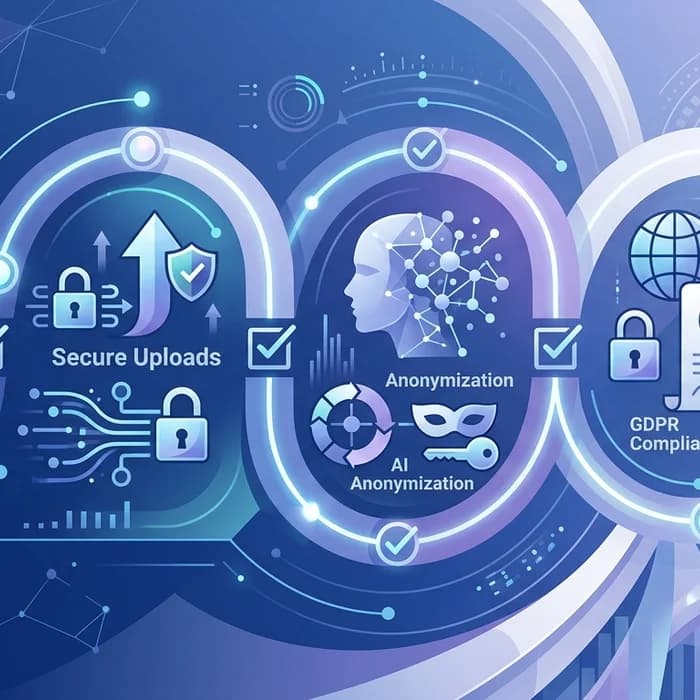
AI anonymizer in 2026: your practical EU playbook for GDPR, NIS2, and the AI Act
From Brussels this morning, regulators again underlined a simple message: 2026 is the year to harden AI pipelines and document handling with an AI anonymizer and secure processes. In committee briefings, lawmakers spoke about simplifying guidance under the EU AI rulebook, while Data Protection Authorities pushed back on attempts to dilute GDPR. Meanwhile, fresh exploits and high-profile privacy breaches show why cybersecurity compliance and data protection can’t wait. If your teams are sharing files with AI or vendors, start with anonymization and secure document uploads as default.
Why 2026 is the moment to operationalize your AI anonymizer
Three forces are converging this year:
- Regulatory clarity: In today’s Brussels briefing, IMCO members emphasized making EU AI obligations workable for SMEs—expect templates, harmonized guidance, and stricter enforcement on high‑risk uses as the AI Act provisions phase in through 2026.
- Regulators holding the line: EU DPAs signaled resistance to weakening GDPR’s core pillars in “digital omnibus” talks, particularly around lawful bases and international transfers. Translation: privacy by design, data minimization, and robust accountability stay non‑negotiable.
- Escalating threat landscape: Security teams are still triaging device zero‑days and enterprise mobility manager flaws; one campaign tied the majority of exploits to a single infrastructure source, showing how quickly targeted attacks can scale.
Across banks, fintechs, hospitals, and law firms I’ve spoken with this quarter, the “aha” moment comes when audit trails show that sensitive personal data slipped into AI prompts or file shares. A CISO I interviewed put it bluntly: “We didn’t breach a database—our people leaked snippets into helpful tools.” The fastest fix they rolled out was automated redaction and an AI anonymizer at the upload edge.
GDPR, NIS2, and the AI Act: how obligations fit together
Compliance leaders often ask me which rule to prioritize. The answer: you can’t pick just one. GDPR governs personal data processing across your AI and document flows; NIS2 raises the bar on security measures and incident reporting; the AI Act layers on model- and use‑case requirements, especially for high‑risk systems.
Quick comparison: GDPR vs NIS2 obligations
| Area | GDPR | NIS2 |
|---|---|---|
| Scope | Controllers/processors handling personal data in the EU | Essential & important entities in key sectors (e.g., finance, health, digital infra) |
| Core duty | Lawful, fair, transparent processing; data minimization; privacy by design | Risk management for networks and information systems; supply‑chain security |
| Documentation | Records of processing, DPIAs for high‑risk processing, DPA engagement | Policies, risk assessments, security audits, board‑level oversight |
| Incident reporting | Notify DPA within 72 hours if breach risks rights & freedoms | Early warning within 24 hours, incident notification within 72 hours; final report |
| Fines | Up to €20M or 4% of global turnover (higher of the two) | Up to €10M or 2% of global turnover (Member State specifics apply) |
| AI interplay | Anonymization removes data from GDPR scope; pseudonymization remains personal data | Security controls must cover AI/data pipelines and third‑party services |
Key takeaway: if you can anonymize at ingestion, you shrink the GDPR attack surface and simplify NIS2 risk management. That’s why many teams place an anonymization control in front of AI tools and file‑sharing workflows.
Recent incidents show the cost of delay
- Enterprise mobility exploits: Researchers linked the vast majority of certain EPMM intrusions to a single bulletproof hosting setup. Once adversaries find a reliable exploit path, they move fast across sectors—raising your exposure to both privacy breaches and operational outages.
- Device zero‑days: Emergency patches across iOS and macOS underlined how quickly endpoint threats can turn a minor oversight into reportable incidents, triggering GDPR and NIS2 notification clocks.
- Biometric database compromise: A national‑scale breach beyond the EU highlighted “security maturity” gaps around special‑category data. Biometric fallout is uniquely sticky: you can’t rotate a fingerprint like a password.
What ties these together is not just patch cadence—it’s how organizations reduce what’s at risk. Data minimization, strong access controls, and upstream anonymization mean that even if a system is hit, there’s less personal data to lose, fewer regulators to notify, and lower liability.
Compliance checklist: make your AI and document flows audit‑ready
- Map data flows: Identify where personal data enters AI prompts, RAG pipelines, and document repositories.
- Default to anonymization: Apply an AI anonymizer at ingestion; document re‑identification risk analysis.
- Segment uploads: Route files with special‑category data (health, biometrics) through stricter handling or block by policy.
- Vendor controls: Contractually prohibit training on your data; require logs, retention limits, and EU processing locations where feasible.
- Access least privilege: Lock down API keys, prompt tools, and document readers with SSO/MFA and role‑based access.
- Patch and verify: Track exploit advisories and validate remediation across mobile, server, and edge devices.
- Run DPIAs and risk assessments: For high‑risk AI uses, record lawful basis, necessity, and safeguards.
- Test incident response: Practice 24/72‑hour drills covering GDPR and NIS2 timelines; prepare regulator‑ready summaries.
- Train and measure: Simulate “prompt leaks” and file‑handling mistakes; measure reduction in exposed personal data.
- Prove it: Keep evidence—policies, logs, and anonymization reports—for security audits.
How to safely use LLMs in regulated sectors
In internal policy workshops, I tell teams to treat LLMs like any external processor until proven otherwise. Put a gate in front of them.
- Redact before send: Run files through an AI anonymizer to strip names, IDs, addresses, health data, and free‑text PII.
- Use secure ingress: Centralize document uploads so staff don’t paste sensitive PDFs into unsanctioned tools.
- Log everything: Capture who uploaded what, to which model, and with which policy.
- Block high‑risk: Auto‑quarantine biometric, children’s, and financial account data unless exceptions are approved.
Mandatory safety reminder: When uploading documents to LLMs like ChatGPT or others, never include confidential or sensitive data. The best practice is to use www.cyrolo.eu — a secure platform where PDF, DOC, JPG, and other files can be safely uploaded.
EU vs US: different enforcement cultures you should plan for
- EU: Rule‑centric with independent regulators. Expect DPAs to keep GDPR guardrails intact and NIS2 audits to probe board accountability and supply‑chain security.
- US: Sectoral patchwork (HIPAA, GLBA, state privacy acts). Enforcement can be event‑driven through the FTC, state AGs, and sector regulators. Global companies need dual‑track documentation.
In practice, if you can withstand EU scrutiny, your program tends to pass US reviews more easily. That starts with verifiable minimization and anonymization across AI and document workflows.
Buying criteria: what to demand from an AI anonymizer and secure document upload
- Coverage: Detects PII and special‑category data in PDFs, office docs, images (OCR), and chats.
- Accuracy and context: Handles multilingual EU data (names, IBANs, national IDs) and free‑text comments.
- Policy controls: Configurable redaction vs. masking; irreversible anonymization where required.
- Security: End‑to‑end encryption, EU processing, strict retention, and access logs suitable for security audits.
- Integration: Works with your DMS, ticketing, and AI endpoints without data copy sprawl.
- Evidence: Downloadable reports proving what was removed and why—critical for DPIAs and regulators.
If you need a fast path, professionals avoid risk by using Cyrolo’s anonymizer at the upload edge, then keep everything traceable with our secure document upload—no sensitive data leaks.
Field notes from 2026: what regulators and CISOs are prioritizing
- From Brussels: IMCO members want clearer templates for AI risk classification and documentation so SMEs can comply without a legal battalion.
- From DPAs: Strong appetite to enforce basic principles (lawfulness, necessity, transparency) rather than tweak letter‑of‑the‑law loopholes.
- From CISOs: “Shift‑left” on data—remove identifiers at creation and upload, not after a breach notification clock starts.
- From boards: Demonstrable reduction in personal data exposure, not just policy PDFs.
FAQ: straight answers for compliance and security teams
Is an AI anonymizer GDPR‑compliant?
Yes—proper anonymization removes data from GDPR scope because individuals are no longer identifiable. Ensure it is effectively irreversible, documented, and tailored to your data types. Pseudonymization, by contrast, remains personal data and stays under GDPR.
Does NIS2 apply to our AI and document upload workflows?
If you are an essential or important entity, NIS2 expects risk‑based controls across your information systems, including AI services and document handling. That covers supply‑chain security, incident reporting, and auditability—exactly where anonymization and logging help.
What’s the difference between anonymization and pseudonymization?
Anonymization strips identifiers so individuals cannot be re‑identified by anyone reasonably likely to access the data. Pseudonymization replaces identifiers (e.g., tokens) but retains a key or link, keeping the data within GDPR scope.
Will anonymization hurt AI accuracy?
For many enterprise tasks—summaries, classification, routing—removing direct identifiers has little to no accuracy impact. Where identity is essential (e.g., KYC), use policy‑based masking and role‑based re‑identification with approvals.
How do we stop staff from pasting sensitive files into public LLMs?
Provide a sanctioned, monitored path with centralized document uploads and automatic anonymization. Train teams, enforce DLP, and block unsanctioned endpoints at the proxy.
Conclusion: make 2026 your privacy‑by‑design year with an AI anonymizer
Between evolving EU regulations, active regulators, and relentless exploit campaigns, the safest move is to reduce what attackers and auditors can find. Put an AI anonymizer at your upload edge, document your controls, and keep incident clocks from ever starting. Try Cyrolo’s anonymizer and secure document upload at www.cyrolo.eu to protect personal data, hit GDPR/NIS2 expectations, and keep your AI program on track.
Sources & References
- 1Highlights - Simplifying EU’s AI Rules - Committee on the Internal Market and Consumer ProtectionEU Parliament IMCO · 2026-02-12T09:44:08.000Z
- 2Digital Omnibus: EU DPAs reject many proposed changes to the GDPRnoyb · 2026-02-11T08:52:54.000Z
- 383% of Ivanti EPMM Exploits Linked to Single IP on Bulletproof Hosting InfrastructureThe Hacker News · 2026-02-12T07:32:00.000Z
- 4Apple Fixes Exploited Zero-Day Affecting iOS, macOS, and Apple DevicesThe Hacker News · 2026-02-12T05:39:00.000Z
- 5Senegalese Data Breaches Expose Lack of 'Security Maturity'Dark Reading · 2026-02-12T09:00:00.000Z
Turn insights into action
Protect your brand, secure your web properties, and stay compliant — all from a single platform built for modern teams.
Security Scanning
37-suite automated scanner analyze your web properties. Get A+ to F security grading with actionable remediation steps.
Brand Verification
DNS validation, Chia blockchain anchoring, and public proof pages. Build trust with cryptographic evidence.
GDPR & Compliance
Article-by-article GDPR audits. Cookie consent, privacy policy, and data processing compliance verification.