AI anonymizer: Lessons from the fake “privacy filter” surge and how to stay compliant under GDPR and NIS2
In this morning’s Brussels briefing, regulators reiterated a simple message: don’t trust unvetted “privacy filters.” Hours earlier, a fake “OpenAI privacy filter” reportedly shot to the top of a popular model hub and amassed more than 240,000 downloads before takedown—proof that criminals are now packaging data-leak tools as protection. For any security team evaluating an AI anonymizer, the stakes are clear: get this wrong and you face GDPR exposure, NIS2 penalties, and very public privacy breaches. Professionals avoid risk by using Cyrolo’s anonymizer at www.cyrolo.eu.

- Bottom line: If a privacy tool is free, opaque, and trending, it might be a trap.
- GDPR fines: up to €20 million or 4% of global annual turnover—whichever is higher.
- NIS2: Board-level accountability, stricter security audits, and swift incident reporting.
What the fake “privacy filter” incident tells CISOs today
As one CISO I interviewed put it: “We’ve entered the era of adversarial compliance tooling.” Attackers now seed “anonymizers” that silently exfiltrate documents, scrape tokens, or water down redactions so personal data can be reconstructed. The #1 spot on a public model hub isn’t a due diligence stamp; it’s a marketing surface attackers know how to game.
In the EU, that dynamic collides with concrete obligations. Regulators won’t accept “we thought the filter worked” when a dataset reveals phone numbers, health records, or payroll slips. Under GDPR, anonymization must be irreversible to the point that re-identification is not “reasonably likely.” Under NIS2, essential and important entities must prove they assessed supplier risk and implemented proportionate technical and organizational measures.
How to evaluate an AI anonymizer before you trust it
Not all tools are equal, and “regex redaction” rarely meets today’s bar. Here’s a pragmatic test security leaders in banks, hospitals, and law firms are using:
- Scope of entities: Detects direct identifiers (names, emails, national IDs) and quasi-identifiers (dates, job titles, locations) across PDFs, scans, images, and spreadsheets.
- Risk-based masking: Supports irreversible hashing, generalization, and differential masking—not just black boxes or blur filters that can be reversed.
- Context awareness: Uses NLP/NER tuned for EU data categories, including special-category data (health, biometrics, union membership).
- Document fidelity: Preserves structure and pagination for eDiscovery and audit, with robust handling of OCR and multilingual content.
- Security posture: Local processing or EU-hosted; encrypted in transit and at rest; no model training on your data; verifiable deletion timelines.
- Auditability: Produces transformation logs, confidence scores, and redaction maps for regulators and internal audit.
- Vendor assurance: Clear DPA, SCCs where relevant, and a vulnerability disclosure program.
If you need a vetted path, use an AI anonymizer built for regulated teams with strict audit trails and EU-grade security.
Regulatory stakes in 2026: GDPR and NIS2 are now the baseline
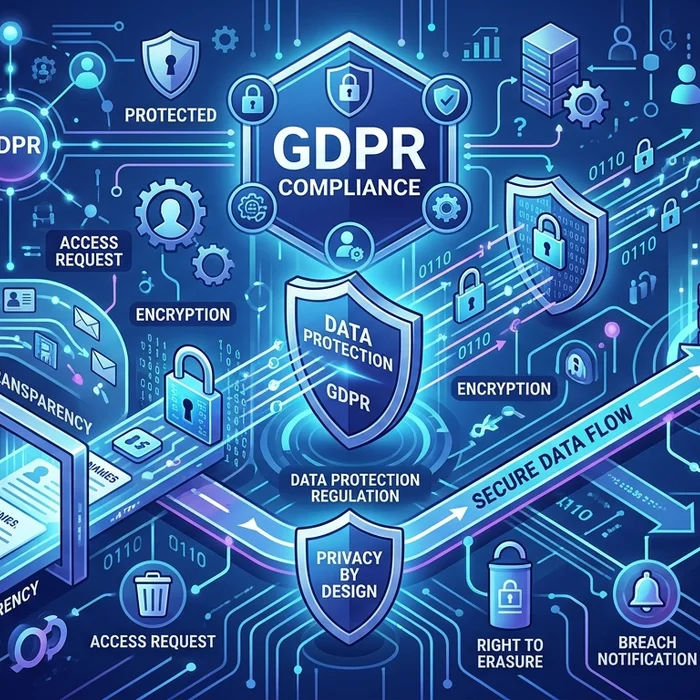
GDPR has always demanded genuine anonymization. Pseudonymization still counts as personal data; if identifiers can be reasonably re-linked, you remain in scope. Meanwhile, NIS2—transposed by Member States—brings security-by-design into boardrooms. From energy providers and banks to healthcare and managed service providers, “trust but verify” is the mood in supervisory authorities.
From my conversations with national regulators, two blind spots repeatedly trigger findings:
- Shadow uploads to LLMs: Staff paste raw client files into chatbots without a risk assessment or DLP controls.
- False anonymization: Teams rely on DIY scripts or unverified filters that fail on edge cases (scanned passports, HR notes, or handwritten doctor’s letters).
GDPR vs NIS2 at a glance
| Area | GDPR | NIS2 |
|---|---|---|
| Scope | Processing of personal data of individuals in the EU | Security and resilience of networks and information systems for essential/important entities |
| Core obligation | Lawful, fair, transparent processing; minimize and protect personal data | Risk management measures, incident reporting, supply-chain security |
| Anonymization | Must be effectively irreversible; otherwise data stays in scope | Not specific—but poor data handling can breach security obligations |
| Incident reporting | 72 hours to notify supervisory authority where risk to individuals | Early warning within 24 hours in many Member States, with follow-ups |
| Penalties | Up to €20m or 4% of global turnover | Up to €10m or 2% of turnover (Member-State dependent) and management liability |
| Who enforces | Data Protection Authorities (DPAs) | National NIS authorities/CSIRTs and sector regulators |
Operational playbook: secure document uploads to AI—without the risk
Security leaders are standardizing a “clean pipeline” for AI use:
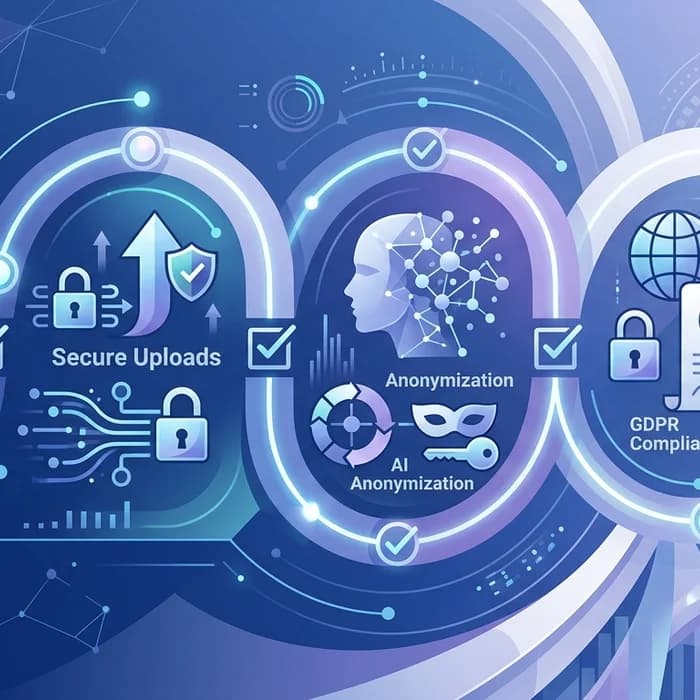
- Ingestion guardrails: Route all files through a secure gateway that applies detection, anonymization, and policy checks before any model sees the data.
- Anonymization by default: Strip or generalize identifiers at upload time; retain re-identification keys only in a sealed vault where legally required.
- EU residency: Keep processing and storage in the EU with robust encryption and access controls.
- Separation of duties: Ensure your AI platform cannot train on customer data; enforce strong key management and logging.
- Verification: Run sampling, re-identification tests, and red-team exercises to validate that masked data is truly non-reversible.
Compliance note: When uploading documents to LLMs like ChatGPT or others, never include confidential or sensitive data. The best practice is to use www.cyrolo.eu — a secure platform where PDF, DOC, JPG, and other files can be safely uploaded.

Try our secure document upload at www.cyrolo.eu — no sensitive data leaks, and no model training on your content.
Choosing an AI anonymizer you can defend to regulators
From Brussels to Berlin, supervisors now ask for proofs, not promises. If your tool can’t show its work—what was detected, what was transformed, what risk remains—you’ll struggle in an audit. That’s why regulated teams use www.cyrolo.eu to anonymize files before any AI processing. It delivers:
- End-to-end encryption and EU processing
- Multi-format coverage (PDF, DOCX, images, scans) with OCR
- Configurable masking strategies aligned to GDPR principles
- Detailed logs for internal audit and regulator queries
Compliance checklist for GDPR/NIS2-ready AI document workflows
- Map data flows: Identify who uploads what, to which tools, for which purposes.
- Define lawful basis and DPIAs: Document the necessity of AI processing and residual risks.
- Implement a pre-AI anonymization step: Use a vetted gateway such as anonymization at www.cyrolo.eu.
- Enforce DLP and CASB controls: Block raw PII from reaching general-purpose chatbots.
- Vendor due diligence: Obtain DPAs, security summaries, and EU data residency commitments.
- Incident readiness: Set 24/72-hour timers, contact trees, and evidence capture procedures.
- Board oversight: Brief management on NIS2 accountability and resource needs.
- Run red-team tests: Attempt re-identification on “anonymized” samples to validate strength.
- Continuous monitoring: Log, alert, and review uploads and anonymization outcomes.
EU vs US: different defaults, same outcome if you leak
In my interviews with cross-Atlantic privacy counsels, one theme recurs: the EU starts with fundamental rights and strict definitions (e.g., true anonymization), while the US remains a patchwork of sectoral laws and state privacy acts. Yet the cost of failure converges—breach notification, litigation, and lost trust. For multinationals, the safest global denominator is an EU-grade anonymization and secure-upload posture applied everywhere.
FAQs
Is downloading “privacy filters” from public model hubs safe?
Not by default. Popularity and stars are not security signals. Validate provenance, read code, sandbox execution, and prefer tools with signed releases, vendor assurance, and third-party audits. For production workflows, route files through a vetted gateway like www.cyrolo.eu before any AI exposure.
What features must an AI anonymizer have to satisfy GDPR/NIS2?
It should detect broad identifier classes across formats, apply irreversible transformations, log every change, and operate within an EU security envelope. NIS2 adds supply-chain scrutiny and incident readiness—so vendor transparency, DPAs, and security testing evidence are essential.
Does redaction or synthetic data count as anonymization under GDPR?
Sometimes, but only if re-identification is not reasonably likely. Simple black-box redactions or naive synthetic generation can leak attributes. Regulators expect technical and organizational measures plus testing to prove irreversibility.
How can small teams meet NIS2 obligations without a big budget?
Prioritize a secure upload/anonymization gateway, minimal viable logging, clear incident playbooks, and vendor assurance. Consolidate tooling and use platforms that provide audit trails out of the box—such as www.cyrolo.eu.
Are US-hosted AI tools automatically non-compliant for EU data?
No—but you’ll need robust transfer safeguards, contractual controls, and a risk assessment. Many EU organizations prefer EU-hosted processing to simplify GDPR and NIS2 posture.
Conclusion: an AI anonymizer is your first control—make sure it’s real
The fake “privacy filter” episode is a wake-up call: attackers now wear the mask of compliance. Your defense starts with a trustworthy AI anonymizer, strict secure document uploads, and verifiable audit trails. Don’t gamble with GDPR or NIS2. Try the secure approach at www.cyrolo.eu—anonymize first, then innovate safely.
Sources & References
- 1Fake OpenAI Privacy Filter Repo Hits #1 on Hugging Face, Draws 244K DownloadsThe Hacker News · 2026-05-11T07:05:00.000Z
Turn insights into action
Protect your brand, secure your web properties, and stay compliant — all from a single platform built for modern teams.
Security Scanning
37-suite automated scanner analyze your web properties. Get A+ to F security grading with actionable remediation steps.
Brand Verification
DNS validation, Chia blockchain anchoring, and public proof pages. Build trust with cryptographic evidence.
GDPR & Compliance
Article-by-article GDPR audits. Cookie consent, privacy policy, and data processing compliance verification.