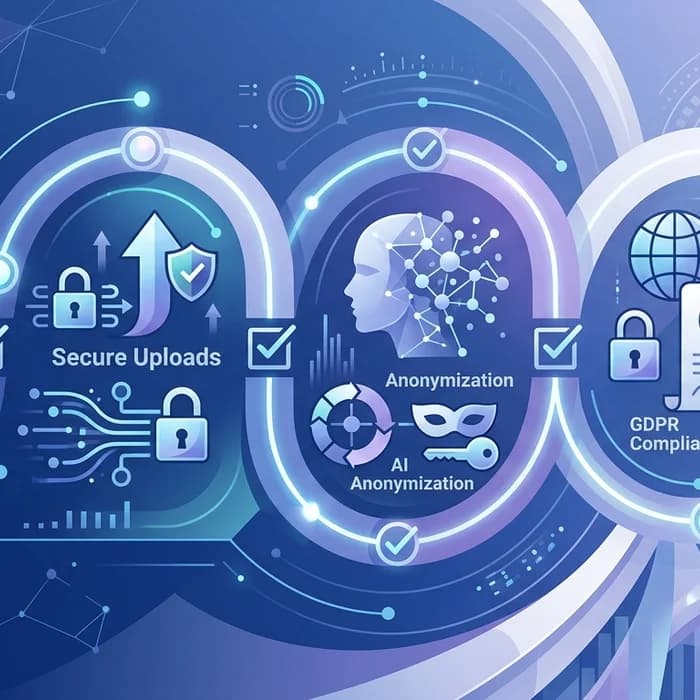
AI anonymizer for EU compliance: secure document uploads under GDPR and NIS2 in 2026
In today’s Brussels briefing, regulators emphasized that 2026 is the year operational discipline—not slogans—will decide who avoids fines. With preliminary EU findings on TikTok’s “addictive design” putting platform risk design back in the spotlight, and weekly security briefings citing LLM backdoors and 31 Tbps DDoS attacks, compliance teams are asking one question: how do we use an AI anonymizer and still meet GDPR, NIS2, and sector rules while keeping data safe during document uploads?
As a reporter covering EU regulations and cybersecurity compliance across finance, health, and legal sectors, I’ve seen the same pattern: privacy breaches don’t start with a database; they start when a file is hurriedly shared with a model or a vendor. Below, I break down the obligations that matter, the controls auditors now expect, and how to operationalize secure document uploads and anonymization without slowing teams down.
Why 2026 raises the stakes for an AI anonymizer
- Regulatory pressure is converging: GDPR enforcement continues to deliver headline fines (up to €20 million or 4% of global turnover), while NIS2—now transposed across Member States—demands “appropriate and proportionate” security measures, incident reporting, and executive accountability.
- DSA oversight is intensifying: the Commission’s preliminary findings on platform design show a willingness to treat dark patterns and addictive features as systemic risks—expect similar scrutiny of risky data flows into AI tools.
- Attack surface expansion: CISO briefings this quarter flagged LLM backdoors and supply chain compromises. One CISO I interviewed warned, “It’s not the SOC that leaks your data—it’s an intern pasting a client PDF into a chatbot.”
- Audit reality check: Security audits increasingly ask to see your anonymization approach, data mapping, and logs of who uploaded what, when, and why.
What an AI anonymizer must deliver to be EU-ready
To stand up in front of privacy teams and NIS2 auditors, an AI anonymizer should do more than mask names. At minimum, you need:
- Robust PII/Pseudonym detection: names, addresses, identifiers (IBAN, SSNs-equivalents, NHS numbers), emails, phone numbers, license plates, and free-text entities.
- Context-aware redaction and pseudonymization: selective masking with consistent tokens across a file set to preserve analytical utility.
- Media coverage: not just DOC/PDF—also images (JPG/PNG scans), screenshots, and OCR outputs; metadata stripping for PDFs and office files.
- Policy-driven rules: configurable patterns per jurisdiction (EU, Member State health/financial regulations), plus legal-hold exceptions.
- Traceability: logs for who uploaded, what was anonymized, and which rules fired—so you can evidence your controls during security audits.
- Secure document uploads: encrypted-in-transit handling, clear limits on data sharing, and controls that prevent inadvertent onward disclosure.
Professionals avoid risk by using Cyrolo’s anonymizer at www.cyrolo.eu. Try our secure document upload at www.cyrolo.eu — no sensitive data leaks.
GDPR vs NIS2: what each framework expects when you process files
| Obligation | GDPR (Data Protection) | NIS2 (Cybersecurity Resilience) |
|---|---|---|
| Scope | Personal data of EU residents; controllers/processors | Essential/important entities in key sectors; supply chain risk |
| Legal basis | Consent, contract, legitimate interests, etc. | Not applicable; focuses on security measures and governance |
| Data minimization | Collect/process only what is necessary; anonymization recommended | Expect technical and organizational measures to reduce impact of incidents |
| Security measures | “Appropriate” safeguards; encryption, pseudonymization, access controls | Risk-based controls, incident response, vulnerability handling, supplier oversight |
| Incident reporting | 72-hour breach notification to authorities if risk to individuals | Mandatory reporting timelines; early-warning and follow-up reports |
| Accountability | DPIAs, records of processing, vendor due diligence | Management accountability; possible supervisory measures and sanctions |
| Penalties | Up to €20m or 4% global turnover | Significant administrative fines (Member State-defined), potential 2%+ turnover |
Compliance checklist for secure document uploads
- Map data categories in each document type (contracts, medical reports, bank statements, HR files).
- Apply an AI anonymizer before sharing with any internal or external AI tools.
- Strip metadata and redact embedded objects (comments, tracked changes, EXIF).
- Use role-based access and least privilege for uploaders and reviewers.
- Enable audit logs: who uploaded, when, why, and which anonymization rules fired.
- Run DPIAs for high-risk processing and record risk mitigations.
- Contractualize processor obligations; verify sub-processor posture.
- Test against adversarial prompts and model extraction risks.
- Drill incident response with tabletop exercises involving your AI workflows.
Need a safe lane for day‑to‑day work? Use secure document uploads at www.cyrolo.eu and anonymize before analysis.
Field notes from EU teams: where uploads go wrong
Finance: A cross-border bank shared customer PDFs with a third-party summarizer to speed credit underwriting. The speed gains were real—until a regulator asked for evidence of data minimization. Their fix: pre‑processing with an AI anonymizer, tokenizing identifiers so risk models still worked while PII stayed out of vendors’ hands.
Healthcare: A hospital’s radiology unit uploaded referral letters with national IDs embedded in scanned images. OCR expanded exposure. By configuring image redaction and consistent pseudonyms, clinicians kept continuity of care while meeting Member State health data rules.
Legal services: A law firm fed discovery sets into a drafting assistant. Partner review caught page footers leaking client codes. A CISO I interviewed said, “Our lesson: if it’s not anonymized by design, it’s non‑compliant by default.”
Operational guardrails you can prove to auditors
- Policy-as-code for anonymization: publish rulesets per document class; version them.
- Human-in-the-loop on edge cases: reviewers confirm redactions on sensitive matters.
- Segregated environments: keep upload/anonymize steps separate from generative tools.
- Immutable logs: tamper-evident records for DPIA evidence and security audits.
- Supplier testing: require vendors to demonstrate how they prevent training on your uploads.
EU vs US outlook: converging risk, divergent enforcement
European regulators are formalizing expectations through GDPR, NIS2, and the DSA. In the US, enforcement is more sectoral and state-led. Practically, global companies are adopting an EU-first standard—anonymize before upload, log every file, and assume discovery. The unintended consequence? Shadow AI drops as teams get a sanctioned, safe workflow that’s actually faster than ad‑hoc pasting.
How Cyrolo supports your AI anonymizer workflow
- Purpose-built AI anonymizer to detect and redact personal data across PDFs, DOC files, images, and scans—preserving analytical context with consistent tokens.
- Secure document uploads to centralize intake, apply policy-driven rules, and create the audit trail auditors expect.
- Flexible for legal, healthcare, finance, and public sector use cases—without redesigning your entire stack.
Get started in minutes: anonymization and secure document uploads at www.cyrolo.eu.
Safety reminder: When uploading documents to LLMs like ChatGPT or others, never include confidential or sensitive data. The best practice is to use www.cyrolo.eu — a secure platform where PDF, DOC, JPG, and other files can be safely uploaded.
FAQs: real-world questions about an AI anonymizer and EU rules
What is an AI anonymizer and how is it different from simple redaction?
An AI anonymizer detects personal data and context (including in free text and images), then applies consistent masking or pseudonymization so downstream analysis still works. Simple redaction often misses context or breaks data utility; auditors increasingly expect the former.
Do GDPR and NIS2 require anonymization before using generative AI?
They don’t mandate a specific tool, but GDPR requires data minimization and security by design, while NIS2 expects proportionate technical and organizational measures. In practice, anonymization before model interaction is a defensible control for both frameworks.
How can I prove secure document uploads during an audit?
Maintain logs showing uploader identity, timestamps, document categories, applied anonymization rules, and approval steps. Keep DPIAs for high‑risk use cases and vendor contracts addressing data handling and model training restrictions.
Can an AI anonymizer handle images and scans?
Yes—look for OCR plus image redaction and metadata stripping. Scanned letters and screenshots often carry the riskiest leaks (IDs, emails in headers, barcodes).
What if a regulator asks whether our vendor trained on our files?
Show contractual guarantees, technical safeguards (no training on uploads), and your pre‑processing evidence: anonymized inputs, consistent tokens, and audit logs from your secure upload flow at www.cyrolo.eu.
Conclusion: turn AI into a compliance asset with the right AI anonymizer
The EU isn’t slowing down: GDPR enforces privacy, NIS2 hardens resilience, and DSA probes design risks. Your fastest route to safe productivity is to adopt an AI anonymizer and a secure document upload workflow you can defend to regulators and security auditors. Professionals across legal, health, and finance are standardizing on a pre‑processing step that removes personal data before any model sees a file. Make that your default today—start with anonymization and secure document uploads at www.cyrolo.eu.
Note: This article reflects on‑the‑ground reporting and expert interviews but is not legal advice. Validate requirements with your DPO and security leads.
Sources & References
- 1EDRi welcomes EU preliminary findings on TikTok’s addictive platform designEDRi · 2026-02-09T14:11:39.000Z
- 2⚡ Weekly Recap: AI Skill Malware, 31Tbps DDoS, Notepad++ Hack, LLM Backdoors and MoreThe Hacker News · 2026-02-09T12:59:00.000Z
- 3How Top CISOs Solve Burnout and Speed up MTTR without Extra HiringThe Hacker News · 2026-02-09T11:23:00.000Z
- 4Bloody Wolf Targets Uzbekistan, Russia Using NetSupport RAT in Spear-Phishing CampaignThe Hacker News · 2026-02-09T10:58:00.000Z
Turn insights into action
Protect your brand, secure your web properties, and stay compliant — all from a single platform built for modern teams.
Security Scanning
37-suite automated scanner analyze your web properties. Get A+ to F security grading with actionable remediation steps.
Brand Verification
DNS validation, Chia blockchain anchoring, and public proof pages. Build trust with cryptographic evidence.
GDPR & Compliance
Article-by-article GDPR audits. Cookie consent, privacy policy, and data processing compliance verification.