AI anonymizer: The 2026 EU compliance playbook for GDPR and NIS2 secure document uploads
Brussels has entered a stricter phase of supervision. After a week of headlines about AI harms, phishing kits that bypass MFA, and high-profile privacy breaches, EU regulators I spoke with reiterated a simple message: reduce risk at the source. For most organizations, that means deploying an AI anonymizer and moving to secure document uploads before documents ever touch a model or a vendor system.
When uploading documents to LLMs like ChatGPT or others, never include confidential or sensitive data. The best practice is to use www.cyrolo.eu — a secure platform where PDF, DOC, JPG, and other files can be safely uploaded.
Why an AI anonymizer is now critical under GDPR and NIS2
In today’s Brussels briefing, regulators emphasized three pressures converging in 2026:
- GDPR enforcement maturity: 72-hour breach reporting remains non-negotiable; fines can reach €20 million or 4% of global turnover—whichever is higher.
- NIS2 enforcement across essential and important entities: administrative fines up to €10 million or 2% of global turnover for essential entities; up to €7 million or 1.4% for important entities.
- AI and supply chain exposure: from model hallucinations that mishandle personal data to toolchain compromises, every uncontrolled upload can become a reportable incident.
Here’s the strategic takeaway repeated by a CISO I interviewed at a major EU bank: “Anonymize early, log everything, and assume any document leaving your perimeter will be compromised.” An AI anonymizer shrinks data exposure by removing or transforming personal data, and secure document uploads add encryption, access controls, and auditability—exactly what GDPR and NIS2 auditors now expect to see.
Real incidents show what’s at stake in 2026
- AI misuse risk: This week’s lawsuit alleging harmful AI outputs is a reminder that LLM interactions can amplify sensitive context. If your prompt or attachment includes personal data, you’re accountable.
- Supply chain attacks: A recent package compromise in the developer ecosystem shows how a single dependency can silently implant malware in AI/automation workflows—impacting data you thought was safe.
- MFA-bypassing phish kits: “Best-in-class” kits now harvest tokens in real time. If your data controls rely only on login gates, assume adversaries can still reach documents.
- High-profile leak of VIP passports: Event operations are soft targets. Scans, badges, and itineraries often get shared through unmanaged apps and AI assistants—fertile ground for privacy breaches.
- IoT as ingress: Compromised devices become collection points for files and images later funneled into AI tools without vetting.
Pattern across all five: the breach begins before the model—at upload and preprocessing. That’s the gap your AI anonymizer and secure upload layer must close.
GDPR vs NIS2: obligations you must map to your document and AI workflows
| Requirement | GDPR obligations | NIS2 obligations | Practical implication |
|---|---|---|---|
| Lawful basis & minimization | Process personal data only as needed, for defined purposes. | Risk-management measures must reduce data exposure. | Strip PII before analysis; default to anonymized datasets. |
| Data subject rights (DSARs), erasure | Enable access, correction, deletion on request. | Governance to locate and remediate risky data holdings. | Index redactions; keep reversible mappings only where legally justified. |
| Security measures | “Appropriate” technical/organizational controls; encryption recommended. | Baseline controls incl. access control, cryptography, logging. | Encrypt uploads at rest/in transit; role-based access; tamper-evident logs. |
| Incident reporting | 72-hour supervisory notification if personal data is at risk. | Timely reporting to CSIRTs and authorities for impactful incidents. | Centralize upload/anonymization logs to accelerate root cause analysis. |
| Vendor & supply chain | Due diligence and processor contracts (Art. 28). | Supply-chain security; oversight of third parties. | Keep AI anonymization on a vetted platform; avoid shadow AI tools. |
| AI usage & anonymization | Truly anonymized data falls outside GDPR scope. | Security-by-design across data flows, including AI pipelines. | Adopt an AI anonymizer upstream of any LLM or analytics. |
How to operationalize: AI anonymizer + secure document uploads, step by step
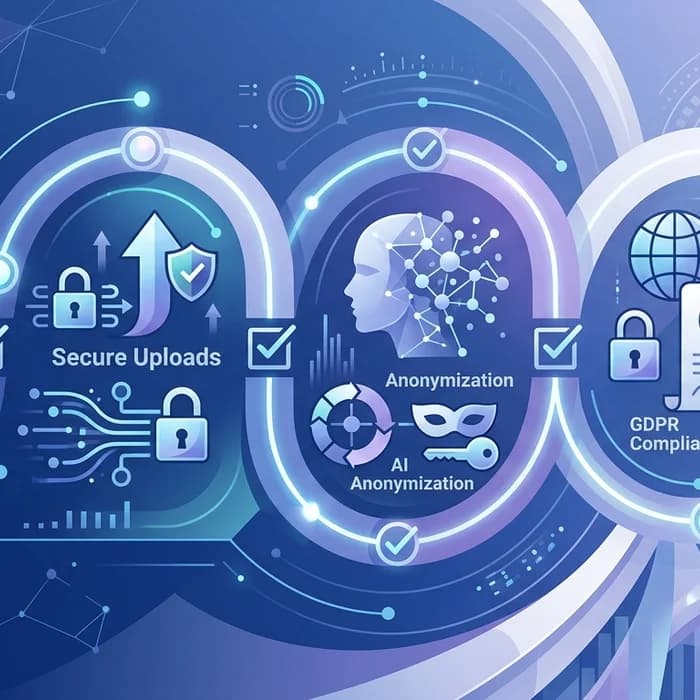
- Capture: Route all PDFs, scans, docs, and images through a secure document upload portal with encryption and SSO.
- Detect: Use named-entity recognition and pattern libraries for PII, PHI, financial identifiers, and free-text leaks.
- Decide: Map detected entities to policies—anonymize, pseudonymize, mask, or block.
- Transform: Apply irreversible anonymization where feasible; use format-preserving masking when business context requires structure.
- Validate: Human-in-the-loop review for high-risk records (health, minors, sanctions).
- Deliver: Produce safe outputs for AI assistants, search, or analytics; attach machine-readable redaction manifests.
- Audit: Store immutable logs for GDPR/NIS2 security audits and DPIAs.
Professionals avoid risk by using Cyrolo’s anonymizer and trying our secure document upload at www.cyrolo.eu — no sensitive data leaks.
When uploading documents to LLMs like ChatGPT or others, never include confidential or sensitive data. The best practice is to use www.cyrolo.eu — a secure platform where PDF, DOC, JPG, and other files can be safely uploaded.
Compliance checklist for 2026 (GDPR + NIS2)
- Data mapping: inventory all document sources feeding AI or analytics.
- Policy: define when to anonymize vs. pseudonymize; document legal bases.
- Platform: enforce secure document uploads with encryption, SSO/MFA, and DLP-style blocks.
- Anonymization: standardize entity taxonomies and redaction rules across teams.
- Logging: enable immutable, time-synced logs for every upload, transform, and export.
- DPIA: update impact assessments for AI use cases; include residual risk analysis.
- Vendors: contractually restrict training/retention; verify EU data residency options.
- Testing: red-team prompts and uploads for re-identification and leakage.
- Training: brief staff on “no raw PII in prompts” and approved workflows.
- Drills: rehearse 72-hour incident response including notification playbooks.
Procurement questions to ask AI anonymizer vendors
- Data boundaries: Can you guarantee no training on my content and zero retention by default?
- Coverage: Which PII/PHI patterns, languages, and document types are supported (PDF, DOCX, images with OCR)?
- Accuracy: What are precision/recall metrics for entity detection in multilingual EU contexts?
- Security: Do you offer EU-hosted options, end-to-end encryption, and granular RBAC with SSO?
- Audit: Are tamper-evident logs, redaction manifests, and API-level attestations available?
- Compliance: How do you support GDPR DSARs, erasure, and NIS2 risk management evidence?
- Resilience: What’s the supply-chain hardening story (package integrity, SBOM, code signing)?
Who benefits right now
- Financial services: onboarding documents and call transcripts anonymized before analyst copilots see them.
- Hospitals and clinics: lab results and referrals de-identified for research without breaching patient privacy.
- Law firms: discovery sets masked for AI search while preserving legal relevance.
- Public sector: procurement files and citizen correspondence treated before translation or summarization tools.
- Scale-ups: executive briefings and board packs uploaded safely to AI meeting assistants.
I’ve seen each of these teams cut incident risk and speed audits once they tightened uploads and adopted an AI anonymizer as a mandatory preprocessing layer.
Try it safely, then standardize
Test your highest-risk document flows with a pilot: route files through secure document uploads, apply anonymization rules, and measure leakage reduction. If you can reduce raw PII entering AI systems by >90% without harming business outcomes, you’ve found the right approach. You can start today at www.cyrolo.eu.
FAQ: EU teams searching for practical answers
What is an AI anonymizer under GDPR?
It’s a tool that detects and removes or irreversibly transforms personal data (names, IDs, addresses, health info) before processing or sharing. Truly anonymized outputs fall outside GDPR’s scope, reducing regulatory risk and breach impact.
Is anonymization better than pseudonymization?
They serve different goals. Anonymization aims to make re-identification practically impossible; pseudonymization replaces identifiers with tokens but preserves a link under controls. Regulators expect minimization first—choose anonymization when you don’t need the identity, and keep pseudonymization for operational cases with strict safeguards.
Does NIS2 require anonymization?
NIS2 doesn’t prescribe anonymization per se, but it mandates risk-managed, secure operations—including access control, encryption, logging, and supply-chain security. Anonymization upstream of AI is a strong, auditable control that supports NIS2’s outcomes.
How can I safely upload documents to AI assistants?
Use a controlled, encrypted intake with policy checks, then anonymize. Avoid ad hoc uploads or consumer tools. When uploading documents to LLMs like ChatGPT or others, never include confidential or sensitive data. The best practice is to use www.cyrolo.eu — a secure platform where PDF, DOC, JPG, and other files can be safely uploaded.
What happens if an LLM memorizes my data?
If personal data is ingested and later reproduced, you may trigger GDPR obligations (breach notifications, DSARs, erasure). Prevent this by removing personal data before model interaction and using vendors that contractually bar training on your content.
Conclusion: make the AI anonymizer your default gateway in 2026
EU supervision has sharpened, and the most reliable way to cut privacy breaches, tame supply-chain risk, and breeze through audits is to put an AI anonymizer and secure document uploads ahead of every model and vendor. Start now, prove the risk reduction, then scale it across teams. Professionals across finance, health, legal, and the public sector are already moving—and you can, too, at www.cyrolo.eu.
Sources & References
- 1Lawsuit: ChatGPT told student he was "meant for greatness"—then came psychosisArs Technica Policy · 2026-02-19T22:44:25.000Z
- 2Supply Chain Attack Secretly Installs OpenClaw for Cline UsersDark Reading · 2026-02-19T22:33:59.000Z
- 3Best-in-Class 'Starkiller' Phishing Kit Bypasses MFADark Reading · 2026-02-19T22:06:58.000Z
- 4Abu Dhabi Finance Week Exposed VIP Passport DetailsDark Reading · 2026-02-19T20:50:14.000Z
- 5Connected and Compromised: When IoT Devices Turn Into ThreatsDark Reading · 2026-02-19T15:18:23.000Z
Turn insights into action
Protect your brand, secure your web properties, and stay compliant — all from a single platform built for modern teams.
Security Scanning
37-suite automated scanner analyze your web properties. Get A+ to F security grading with actionable remediation steps.
Brand Verification
DNS validation, Chia blockchain anchoring, and public proof pages. Build trust with cryptographic evidence.
GDPR & Compliance
Article-by-article GDPR audits. Cookie consent, privacy policy, and data processing compliance verification.