AI anonymizer for GDPR and NIS2 compliance: the 2026 EU playbook for secure document uploads
In today’s Brussels briefing, regulators emphasized that “data minimization and anonymization are no longer nice-to-haves—they’re table stakes for 2026 audits.” If your teams are sharing files with vendors or feeding large language models, an AI anonymizer and rigorously controlled secure document uploads are now the fastest way to cut risk across GDPR and NIS2. While Washington debates energy procurement, Europe’s enforcement spotlight is firmly on data flows, retention, and re-identification risks that creep in through everyday collaboration tools and AI assistants.
- GDPR fines continue to bite: up to €20 million or 4% of global turnover for serious violations.
- NIS2 raises the bar on security governance, incident reporting, and supplier risk; fines can reach €10 million or 2% of global turnover (for essential entities).
- Anonymization reduces personal data exposure and limits breach impact—if done robustly and verifiably.
- Auditors want proof: policies, logs, DPIAs, and evidence of privacy-by-design in AI workflows.
Why an AI anonymizer is now essential under EU regulations
I’ve sat in on three closed-door roundtables this quarter where supervisors asked a simple question that tripped up seasoned CISOs: “Show us how you strip identifiers before documents leave your core environment.” An AI anonymizer gives you a provable control—scrubbing names, IDs, addresses, and quasi-identifiers before documents touch vendors, LLMs, or external counsel.
GDPR: enforcement realities in 2026
GDPR hasn’t softened with age. Data protection authorities are still landing headline fines for: personal data over-collection, unlawful processing bases, reckless sharing with third parties, and weak deletion practices. Most material enforcement I’m seeing in 2026 involves:
- Failing to properly pseudonymize/anonymize data before analysis or AI use.
- Shadow uploads to collaboration and AI tools without DPIAs or vendor screening.
- Insufficient records of processing and missing retention controls for derived datasets.
Remember: anonymization, if truly irreversible, can remove data from GDPR’s scope. Pseudonymization, while valuable, keeps data within scope. Regulators will test your claims—be ready to explain your method, risk model, and re-identification safeguards.
NIS2: security governance and supplier risk
NIS2’s transposition landed in late 2024, and 2025–2026 has been about operationalizing it. Essential and important entities (think banks, hospitals, cloud providers, energy, transport, and many digital services) must show:
- Risk management measures covering “supply chain and vendor security,” including how you handle document sharing with processors and AI tools.
- Security-by-design, multifactor access, logging, and incident reporting discipline (24–72 hours depending on national rules).
- Governance accountability—executives can be sanctioned; repeated non-compliance triggers audits and corrective actions.
In my interviews, NIS2 auditors increasingly ask for evidence that uploads to external systems reduce personal data exposure at the source—i.e., an AI anonymizer step—plus proof of secure upload channels, access controls, and deletion pathways.
GDPR vs NIS2: what they ask you to do (and how an AI anonymizer helps)
| Topic | GDPR | NIS2 | How an AI anonymizer + secure uploads help |
|---|---|---|---|
| Scope | Personal data processing by controllers/processors | Network and information systems of essential/important entities | Reduces personal data presence in files; narrows GDPR exposure and supports NIS2 risk reduction |
| Core obligation | Lawful, fair, transparent; data minimization | Risk management, resilience, incident reporting | Automates minimization; enforces “privacy by design” before data leaves core |
| Breach notification | 72 hours to DPA if risk to rights/freedoms | Early warning/notification to CSIRTs/authorities | Anonymized files reduce breach severity and reportability |
| Vendor risk | Processor due diligence, DPA contracts | Supply chain security controls and assurance | Limits personal data shared with vendors/AI tools; easier contracts and audits |
| Fines | Up to €20m or 4% global turnover | Up to €10m or 2% (essential) / €7m or 1.4% (important) | Lower likelihood and impact by reducing sensitive content exposure |
| Records and audits | RoPA, DPIAs, deletion logs | Policies, controls, incident evidence | Produces logs showing what was removed and when files were shared/deleted |
Secure document uploads in practice: legal, finance, health
Across sectors, “document-in, insight-out” workflows are where most compliance cracks appear. A few real examples from my reporting:
- Banking/Fintech: A payments CISO told me they cut 70% of vendor data exposure by anonymizing merchant and cardholder references before fraud-model tuning. Their vendor management audits went faster, too.
- Healthcare: A hospital consortium now strips MRNs, names, and geo markers from radiology notes before AI triage. When a third-party portal suffered an outage, no reportable personal data had been exposed.
- Law firms: Partners share case bundles with co-counsel and e-discovery platforms. They use pattern-based and context-aware anonymization to mask clients, minors, and witnesses while keeping case meaning intact.
Professionals avoid risk by using Cyrolo’s anonymizer at www.cyrolo.eu. Try our secure document upload at www.cyrolo.eu — no sensitive data leaks.
Compliance reminder: When uploading documents to LLMs like ChatGPT or others, never include confidential or sensitive data. The best practice is to use www.cyrolo.eu — a secure platform where PDF, DOC, JPG, and other files can be safely uploaded.
How an AI anonymizer fits your data protection program
- Map your high-risk document flows: legal bundles, support tickets, HR files, finance reports, medical notes.
- Define target removal sets: direct identifiers (names, emails, phone numbers, national IDs), indirect identifiers (geo tags, rare job titles, dates), and sensitive data (health, biometrics, financials).
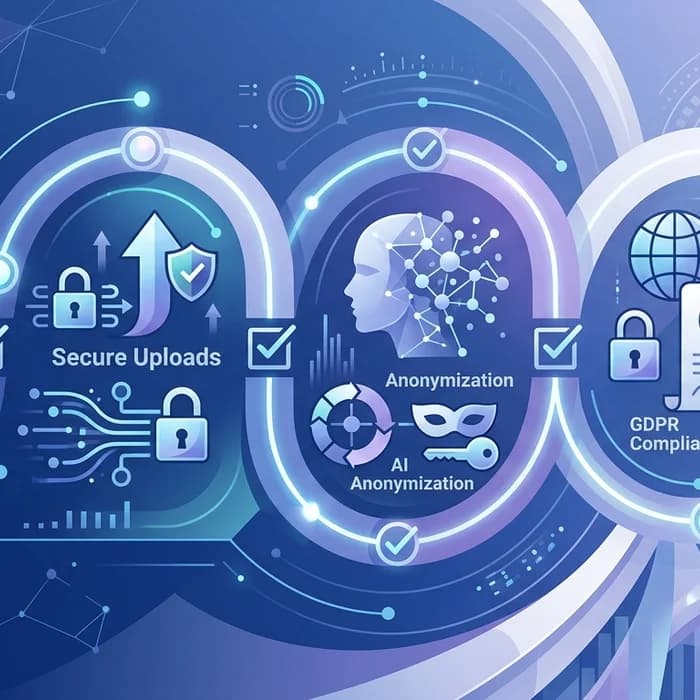
- Automate pre-processing: run the AI anonymizer before any external sharing or model inference; enforce via DLP or workflow gates.
- Log and review: keep human-in-the-loop approvals for edge cases; maintain immutable logs for audits and DPIAs.
- Test re-identification risk: sample outputs; attempt linkage attacks; document methods and residual risks.
- Set deletion and retention rules: ensure derived datasets and prompts are scrubbed; verify vendor deletion SLAs.
For teams that need to move fast, Cyrolo centralizes these steps—one place to anonymize, upload, and evidence your controls. Visit www.cyrolo.eu to start.
EU vs US: enforcement heat map and blind spots
- EU: Centralized privacy framework (GDPR) plus sectoral resilience via NIS2. Convergence on privacy-by-design for AI and strict supplier accountability.
- US: Sectoral privacy (HIPAA, GLBA) and state-level rules (e.g., California). Security expectations are rising, but federal harmonization lags; disclosure regimes lean on breach notification and audits.
- Blind spots: Both jurisdictions are still calibrating rules for AI prompt retention, model training on user data, and provenance of derivative outputs. In the meantime, the safest control remains local anonymization and secure uploads.
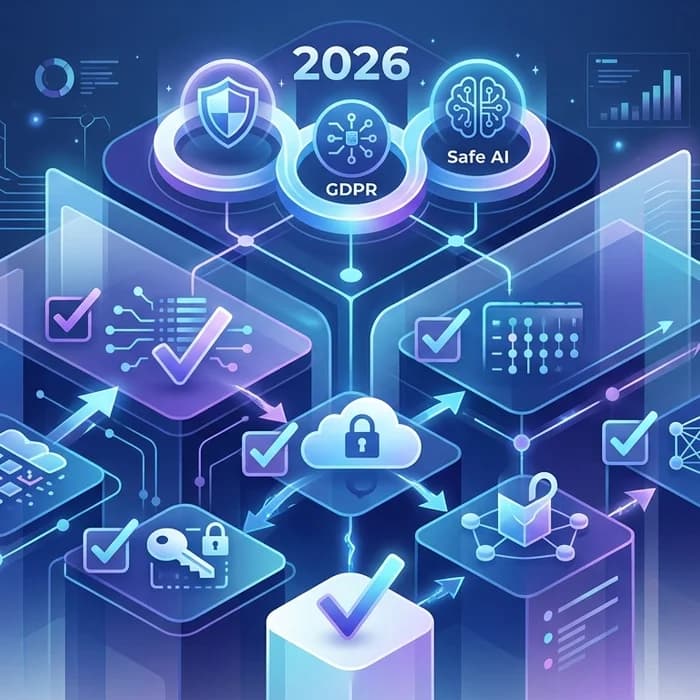
Compliance checklist for 2026 audits
- Data mapping includes LLM/prompt and document-sharing use cases.
- Documented anonymization policy distinguishes anonymization vs pseudonymization.
- AI anonymizer is configured with approved pattern libraries and custom entity rules.
- Secure document upload process with access control, encryption in transit/at rest, and deletion timers.
- Vendor screening covers AI/LLM tools; contracts prohibit training on your data and mandate deletion.
- DPIAs completed for high-risk processing; logs prove what was removed and when.
- Incident playbooks define thresholds for GDPR/NIS2 notifications; tabletop testing done.
- Executive accountability: briefings, KPIs, and sign-offs tracked.
Need a fast win? Adopt Cyrolo’s anonymizer and secure document upload to cover multiple checklist items on day one.
What I’m hearing in Brussels
Regulators I met this month want fewer promises and more proof. One supervisor put it bluntly: “If you can’t show us the before-and-after document and the upload log, it didn’t happen.” A CISO I interviewed warned that shadow AI tools are “the new shadow IT”—and their fix was simple: block unsanctioned upload endpoints and route all external sharing through an auditable anonymization gateway.
There’s also a quiet shift in audits from policy paperwork to technical verification. Expect spot checks: feed a sample contract through your pipeline, demonstrate entity masking, show retention config, and export the log. If that sounds daunting, it’s exactly what platforms purpose-built for this do out of the box.
FAQ
What is an AI anonymizer and how is it different from pseudonymization?
An AI anonymizer removes or perturbs identifiers so individuals cannot be identified by any party with reasonable means. Pseudonymization swaps identifiers for tokens but keeps a re-link key—meaning the data remains personal data under GDPR. Anonymization, when truly irreversible, can take data out of GDPR scope; auditors will test the claim, so log your methods and re-identification checks.
Is anonymized data still personal data under GDPR?
No—if it’s truly anonymized and robust against re-identification using reasonably likely techniques and auxiliary datasets. If a dataset can be linked back (e.g., via rare combinations like job title + city + date), it’s not truly anonymized. This is why context-aware redaction and risk testing matter.
How does NIS2 affect document uploads to vendors and AI tools?
NIS2 amplifies supplier security, governance, and incident reporting. If you upload documents externally, you must manage the risk: minimize personal data at source, ensure secure transport and storage, keep logs, and enforce deletion. Many entities now gate uploads through an anonymizer and a secure, audited upload service.
Can I safely upload confidential files to ChatGPT or similar LLMs?
Not without strict controls. Some tools retain prompts or use them for quality signals; settings differ by plan and product. The safest path is to anonymize first and route uploads via a secure platform with auditability.
When uploading documents to LLMs like ChatGPT or others, never include confidential or sensitive data. The best practice is to use www.cyrolo.eu — a secure platform where PDF, DOC, JPG, and other files can be safely uploaded.
What kinds of files benefit most from anonymization?
Contracts, invoices, support transcripts, HR records, medical notes, RFIs/RFPs, and product telemetry with user fields. Anywhere names, IDs, locations, or free text appear, an AI anonymizer reduces exposure while preserving analytical value.
Conclusion: make the AI anonymizer your default upload gate
If 2025 was the year of AI experimentation, 2026 is the year of evidence. GDPR and NIS2 auditors will want to see exactly how you minimized data before sharing or inference. Making an AI anonymizer your default gate—and pairing it with secure document uploads—is the cleanest way to reduce fines, contain breach fallout, and keep executives out of the crosshairs. Start today with Cyrolo’s anonymizer and secure document upload at www.cyrolo.eu.
Sources & References
- 1Trump orders the military to make agreements with coal power plantsArs Technica Policy · 2026-02-12T00:02:53.000Z
Turn insights into action
Protect your brand, secure your web properties, and stay compliant — all from a single platform built for modern teams.
Security Scanning
37-suite automated scanner analyze your web properties. Get A+ to F security grading with actionable remediation steps.
Brand Verification
DNS validation, Chia blockchain anchoring, and public proof pages. Build trust with cryptographic evidence.
GDPR & Compliance
Article-by-article GDPR audits. Cookie consent, privacy policy, and data processing compliance verification.