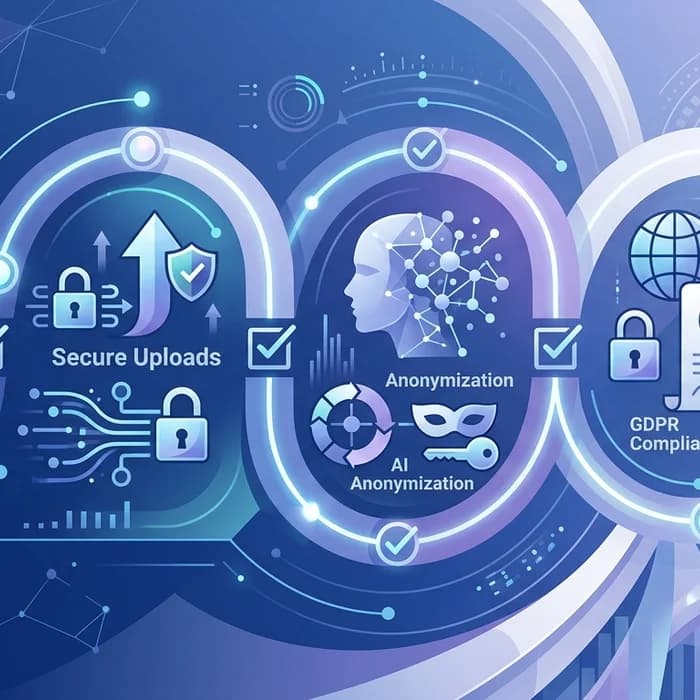
AI anonymizer: your fastest path to GDPR and NIS2-ready secure document uploads
In today’s Brussels briefing, regulators emphasized that the biggest compliance gaps sit in day‑to‑day file handling: PDFs, DOCs, scans, and screenshots flowing into AI tools. An AI anonymizer that strips personal data before analysis, combined with secure document uploads, is rapidly becoming the practical way to meet EU regulations like GDPR and NIS2 without slowing teams down. As a reporter who routinely interviews CISOs and DPOs across banks, hospitals, and law firms, I see the same pattern: privacy breaches rarely stem from policies—they come from documents that slip through controls.

Why an AI anonymizer matters now under GDPR and NIS2
- Regulatory pressure is converging. GDPR imposes fines up to €20 million or 4% of global turnover; NIS2 adds security and incident-reporting duties for “essential” and “important” entities.
- LLM-driven workflows increase risk. Drafts, claims, and case files are being uploaded to AI assistants, spreading personal data to tools that may retain or log it.
- Audits are growing tougher. Supervisory authorities and sectoral regulators are asking for proof of privacy-by-design controls, not just policies.
- Vulnerabilities are inevitable. Even hardened systems and cloud enclaves can face zero-days; anonymity by default reduces breach impact.
Professionals avoid risk by using Cyrolo’s anonymization before any review or AI processing, then enabling team-wide, secure document uploads to keep data flows contained. Try our secure document upload at www.cyrolo.eu — no sensitive data leaks.
GDPR vs NIS2: what changes for your document workflows
| Obligation | GDPR (Data Protection) | NIS2 (Cybersecurity) | What it means for documents |
|---|---|---|---|
| Scope | Personal data of individuals in the EU | Security of network and information systems for essential/important entities | Most files contain personal data and also move through critical systems |
| Legal basis | Processing must have a lawful basis; minimize data | Risk management; implement “appropriate and proportionate” measures | Default to anonymization or redaction before wider processing |
| Data minimization | Collect and process only what’s necessary | Reduce attack surface, patch, monitor | Anonymize files so only relevant, non-identifying fields remain |
| Incident reporting | 72-hour breach notification to authorities (when required) | Tight timelines for reporting significant incidents | Pre-anonymized files reduce reportable impact and investigation scope |
| Third parties | Data Processing Agreements; transfers safeguards | Supply chain risk management | Control uploads to AI tools; avoid uncontrolled external sharing |
| Penalties | Up to €20M / 4% global turnover | Management liability; fines and corrective measures | Demonstrable technical measures (e.g., anonymizer logs) mitigate enforcement |
Real-world use cases I hear about every week
Banking and fintech
- Analysts paste loan PDFs into AI to draft risk memos; those files carry IBANs, addresses, salary slips.
- Solution: Route files through an AI anonymizer that masks identifiers while preserving context for credit analysis.
Hospitals and research
- Clinicians summarize discharge notes using AI. Notes contain diagnoses, dates of birth, contact details.
- Solution: Automated redaction that keeps clinical facts while removing direct and quasi-identifiers; compliant audit trail for research ethics boards.
Law firms and in-house legal
- Discovery sets and contracts get uploaded to assistants to extract clauses and timelines.
- Solution: Pre-processing to generalize names, addresses, case IDs, and minors’ data, with reversible tokens for privileged internal work.
In interviews, a CISO at a pan‑EU insurer told me: “Our fastest win was standardizing secure document uploads and enforced anonymization before anything touches an AI endpoint.”

How to operationalize privacy-by-design in document handling
- Centralize intake: move email attachments, scans, and exports into a governed upload flow with access controls.
- Automate detection: classify personal data fields (names, IBANs, MRNs, addresses, geotags) across PDFs, DOCX, XLSX, images (OCR), and email files.
- Apply AI anonymizer rules: mask, redact, or pseudonymize based on purpose and legal basis; retain business meaning.
- Log and seal: keep immutable records of what was redacted, by whom, and why—critical for audits and incident response.
- Only then use AI: send sanitized content to internal models or external assistants with strict data handling policies.
Compliance reminder: When uploading documents to LLMs like ChatGPT or others, never include confidential or sensitive data. The best practice is to use www.cyrolo.eu — a secure platform where PDF, DOC, JPG, and other files can be safely uploaded.
Compliance checklist for GDPR, NIS2, and security audits
- Map data flows: identify every point where staff export, scan, or upload documents.
- Define minimization rules: what must be removed or generalized before processing.
- Deploy an AI anonymizer with coverage for text, tables, images, and handwriting (OCR).
- Set upload guardrails: only allow secure document uploads via an approved platform with role-based access.
- Maintain an audit trail: logs of redaction actions, retention, and access.
- Vendor governance: DPAs, AI usage policies, data residency, and deletion commitments.
- Incident playbooks: clear triggers, 72-hour GDPR steps, NIS2 reporting pathways.
- Annual testing: red-team data exfiltration paths; review anonymization accuracy and false negatives.
EU vs US: different paths, same destination
Europe leads with comprehensive privacy law (GDPR) and sector-spanning cybersecurity obligations (NIS2). The US landscape is more fragmented—state privacy laws and sectoral rules—yet pressure on organizations is similar: show documented controls, minimize personal data, and secure supply chains. In both jurisdictions, auditors increasingly want to see technical evidence that sensitive fields never leave your perimeter in the first place. That’s precisely where a robust AI anonymizer and controlled upload pipeline demonstrate maturity.
Common pitfalls—and how to avoid them

- Relying on manual redaction: human error scales with volume; automation catches edge cases like IDs embedded in images or footers.
- Assuming “private” AI means safe: even private endpoints can log requests; sanitize content before it leaves your tenant.
- Underestimating quasi-identifiers: dates, locations, or rare job titles can re-identify individuals—use generalization, not just black boxes over names.
- No reversibility strategy: for some workflows, you need reversible pseudonyms under strict key control to reconcile results later.
- Weak auditability: if you cannot prove what was removed and when, you’ll struggle in investigations or DPIAs.
Measurement that convinces regulators
From the conversations I’ve had with supervisory authorities and internal audit leaders, three artifacts regularly change the tone of an audit:
- Coverage reports: percentage of document types handled and fields detected.
- Accuracy metrics: sampling that shows very low false negative rates for personal data detection.
- Immutable logs: cryptographic sealing of redaction events tied to user identity and timestamp.
These are the kinds of outputs boards and regulators recognize as “appropriate and proportionate” under NIS2 and privacy-by-design under GDPR.
FAQ: your top questions on anonymization and secure AI
What’s the difference between anonymization, pseudonymization, and redaction?
Anonymization removes any link to a person, irreversibly. Pseudonymization replaces identifiers with tokens so data can be re-linked under strict controls. Redaction hides or generalizes specific fields. Many compliance teams combine all three depending on purpose and retention rules.

Will an AI anonymizer break downstream analysis?
Not if designed well. Good systems retain structure and business meaning (e.g., keeping loan-to-income ratios or clinical timelines) while removing direct identifiers. That enables analytics and AI summaries without exposing personal data.
Do we still need a DPA if we anonymize files before using AI?
Yes, if any personal data touches a vendor at any stage. If you truly anonymize before transfer, GDPR may no longer apply to that output—but your upstream processing and governance still do. Keep your DPAs and DPIAs current.
How do we handle images and scans?
Use OCR with entity detection for IDs, faces, stamps, and handwritten notes. Many leaks occur through images embedded in PDFs or screenshots of spreadsheets.
What proof do auditors want to see?
Policy plus evidence: configuration screens, sample redaction logs, change history, access controls, coverage/accuracy reports, and incident drill results.
Getting started in days, not months
If you need a fast, defensible improvement before your next security audit or board update, standardize how documents enter your AI and analytics workflows. Direct teams to use secure document uploads and enforce automated anonymization at the point of entry. Professionals avoid risk by using Cyrolo’s anonymizer at www.cyrolo.eu.
Final word: An AI anonymizer is the most practical way to meet GDPR data protection and NIS2 cybersecurity expectations while keeping productivity high. Start now: route every file through a privacy-by-design intake, and you’ll reduce breach impact, speed audits, and enable safe innovation. Try it today at www.cyrolo.eu.
Sources & References
- 1Subject files - E-declaration for posting of workers - Committee on the Internal Market and Consumer ProtectionEU Parliament IMCO · 2025-10-14T14:21:38.000Z
- 2EU member states pass on adopting new CSAM regulationsIAPP Daily Dashboard · 2025-10-14T09:50:30.000Z
- 3Apple loses latest appeal in UK over ADPIAPP Daily Dashboard · 2025-10-14T09:49:53.000Z
- 4OAIC issues guidance for conducting age assurance under social media lawIAPP Daily Dashboard · 2025-10-14T09:47:43.000Z
- 5The different ways US states are approaching AI governanceIAPP Daily Dashboard · 2025-10-14T09:25:15.000Z
- 62 professors sue Apple over alleged copyright violations related to AI trainingIAPP Daily Dashboard · 2025-10-14T09:20:30.000Z
- 7What to know about a recent German background check GDPR case rulingIAPP Daily Dashboard · 2025-10-14T09:15:16.000Z
- 8Engineering GDPR compliance in the age of agentic AIIAPP Daily Dashboard · 2025-10-14T09:03:09.000Z
- 9How privacy laws affect research spendingIAPP Daily Dashboard · 2025-10-14T09:01:59.000Z
- 10Moving Beyond Awareness: How Threat Hunting Builds ReadinessThe Hacker News · 2025-10-14T11:55:00.000Z
- 11RMPocalypse: Single 8-Byte Write Shatters AMD’s SEV-SNP Confidential ComputingThe Hacker News · 2025-10-14T11:45:00.000Z
- 12New Pixnapping Android Flaw Lets Rogue Apps Steal 2FA Codes Without PermissionsThe Hacker News · 2025-10-14T11:18:00.000Z
- 13What AI Reveals About Web Applications— and Why It MattersThe Hacker News · 2025-10-14T11:00:00.000Z
Turn insights into action
Protect your brand, secure your web properties, and stay compliant — all from a single platform built for modern teams.
Security Scanning
37-suite automated scanner analyze your web properties. Get A+ to F security grading with actionable remediation steps.
Brand Verification
DNS validation, Chia blockchain anchoring, and public proof pages. Build trust with cryptographic evidence.
GDPR & Compliance
Article-by-article GDPR audits. Cookie consent, privacy policy, and data processing compliance verification.