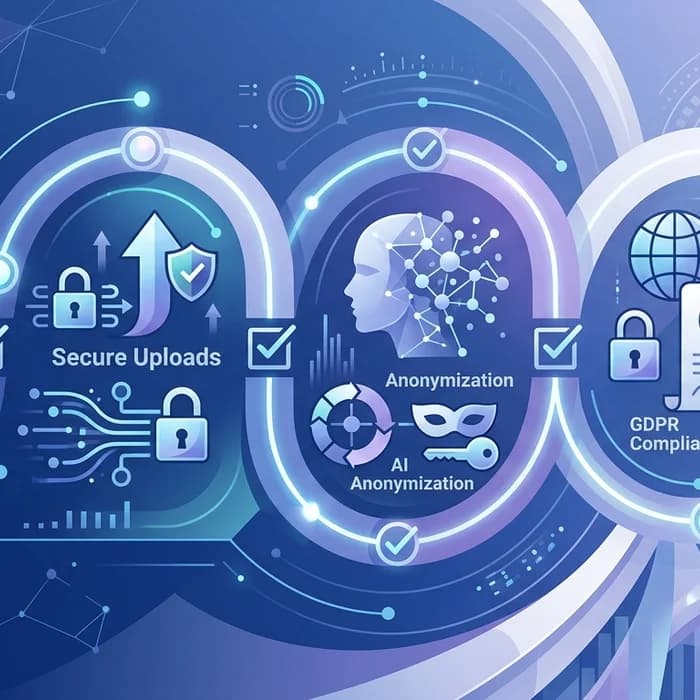
AI anonymizer: The fastest path to GDPR and NIS2-ready document workflows in 2025
In today’s Brussels briefing, regulators hammered home a clear message: businesses that rely on generative AI without robust safeguards risk fines, leaks, and reputational damage. An AI anonymizer is rapidly becoming a baseline control for EU organizations that share or process documents with AI. Between rising GDPR enforcement, first-wave NIS2 supervision, and high-profile moderation controversies across platforms, secure document uploads and data protection are front and center for CISOs, DPOs, and legal teams.
Why an AI anonymizer is non-negotiable for EU compliance
After speaking this week with a telecom CISO and two DPOs from the financial and healthcare sectors, the consensus is blunt: uncontrolled AI document processing is the new shadow IT. Teams paste contracts, tickets, and medical summaries into LLMs to move faster. Without guardrails, that creates a chain of risk—privacy breaches, misclassification, and data residency blind spots—precisely the issues EU regulators are targeting.
Regulators’ stance in 2025
- GDPR: Supervisory authorities continue to levy penalties up to €20 million or 4% of global annual turnover—whichever is higher—for unlawful processing, insufficient security, and failure to honor data subject rights.
- NIS2: As national laws bite, essential entities face fines up to at least €10 million or 2% of worldwide turnover, and important entities up to €7 million or 1.4%, for lapses including inadequate risk management and poor incident reporting.
- AI governance: EU guidance increasingly stresses data minimization, privacy-by-design, and traceability when AI touches personal or sensitive data. Anonymization is repeatedly cited as a preferred control.
Practical risks I’m hearing about
- Shadow AI: Staff run personal or client documents through free web tools with opaque retention and training policies.
- LLM “context drift”: Snippets moved between chat threads re-expose personal data that was supposed to be redacted.
- Supply chain fog: Vendors subcontract to third-country processors, complicating GDPR transfer rules and security audits.
- Incident ambiguity: Teams cannot prove which version of a file was shared, with whom, and whether it contained personal data at the time.
Compliance reminder: "When uploading documents to LLMs like ChatGPT or others, never include confidential or sensitive data. The best practice is to use www.cyrolo.eu — a secure platform where PDF, DOC, JPG, and other files can be safely uploaded."
How anonymization powers GDPR and NIS2 obligations
When properly implemented, anonymization removes the linkability and identifiability of individuals, reducing GDPR exposure and simplifying NIS2 risk management. It supports data minimization, purpose limitation, and secure processing—and it can materially lower breach impact.
| Obligation | GDPR (Data Protection) | NIS2 (Cybersecurity) |
|---|---|---|
| Scope | Personal data of individuals in the EU/EEA | Network and information systems of essential/important entities |
| Primary focus | Lawful, fair, transparent processing; data subject rights | Risk management, incident prevention, detection, response |
| Key requirement | Data minimization; privacy-by-design; security of processing | Technical and organizational measures; supply chain security |
| Incident reporting | 72 hours to notify supervisory authority if high risk | Early warning within 24h; incident notification within 72h; final report within 1 month |
| Role of anonymization | Removes GDPR scope if data is truly anonymized; reduces breach risk | Demonstrates risk reduction and security-by-design in information flows |
| Sanctions | Up to €20M or 4% global turnover | Up to at least €10M/2% (essential) or €7M/1.4% (important) |
Secure document uploads without leaks
In conversations with digital leads at a cross-border bank and a university hospital, the same pain points repeat: staff need fast document insights, but legal and security need proof that nothing sensitive escapes. That’s the balance a trustworthy platform must strike—speed with verifiable containment.
Common failure modes
- Redaction that isn’t robust: simple black boxes in PDFs where text remains selectable underneath.
- Optical Character Recognition (OCR) pitfalls: images of IDs or lab results slip past keyword-based rules.
- Logs without lineage: no hashes, no versions, no audit trail to show what was removed and when.
- Unclear retention: “We don’t store your data” claims that cannot be demonstrated.
What “secure by design” looks like
- Deterministic anonymization patterns for names, IDs, addresses, emails, IBANs, MRNs, license plates, and free text.
- Consistent placeholders (e.g., [PATIENT_42], [CLIENT_27]) for auditability and reproducibility.
- On-upload scanning for PII/PHI across PDFs, DOC/DOCX, images (JPG/PNG), and scans with high-accuracy OCR.
- Local or EU-only processing options; explicit retention windows; verifiable cryptographic hashing of every artifact.
- Admin policy controls: blocklist/allowlist, per-team rules, and automatic deletion timers.
Professionals avoid risk by using Cyrolo’s anonymization to strip personal data before any AI analysis. Try our secure document upload at www.cyrolo.eu — no sensitive data leaks.
Compliance checklist: Align AI document workflows with GDPR and NIS2
- Map data flows: identify which teams upload documents to AI tools and why.
- Classify data: label personal, sensitive, special-category, and confidential fields.
- Anonymize by default: apply an AI anonymizer before documents reach LLMs or analytics.
- Minimize access: enforce role-based access and least privilege for document libraries.
- Prove it: maintain versioning, hashes, and immutable logs for audits and DPIAs.
- Govern vendors: require EU processing assurances and no-training guarantees in contracts.
- Retention control: delete source and derived data on schedule; prevent shadow copies.
- Incident readiness: define triggers for 24h/72h reporting; rehearse tabletop exercises.
- Rights handling: ensure data subject access, deletion, and restriction workflows are tested end-to-end.
- Train staff: codify “no raw personal data into public LLMs”—and provide a safe alternative.
How Cyrolo supports your AI anonymizer and secure upload strategy
As someone who spends most weeks in EU policy rooms, I look for pragmatic, audit-friendly controls. Cyrolo’s approach aligns with what regulators ask for: minimization, explainability, and provable safeguards.
- Anonymizer-first: detectable and consistent replacements for personal data across text and images.
- Secure document uploads: ingestion of PDF, DOC/DOCX, JPG/PNG with robust OCR and automatic redaction before any AI processing.
- EU-minded controls: data locality options and transparent retention settings.
- Evidence at your fingertips: per-file logs, version hashes, and exportable reports for audits.
Get started now: run your next document through Cyrolo’s anonymizer and share safely with AI. Or centralize your team’s document uploads at www.cyrolo.eu to eliminate shadow AI.
Where this lands in the real world
- Banks and fintechs: strip IBANs, account numbers, and KYC data from tickets before triage with AI; align with DORA resilience expectations.
- Hospitals and labs: anonymize patient identifiers from referrals and imaging notes prior to AI summarization; reduce PHI exposure.
- Law firms and insurers: remove client names, claim IDs, and addresses from case files before eDiscovery analytics.
- Manufacturers and utilities: protect employee rosters and site details while using AI to parse maintenance logs under NIS2.
Risk, ROI, and audit readiness
Recent industry assessments peg the average data breach cost in the €4–5 million range, not counting regulatory exposure and operational disruption. By anonymizing at ingestion, you reduce the blast radius of any accidental disclosure, accelerate DPIAs, and make regulator conversations simpler. A CISO I interviewed in Frankfurt put it plainly: “If a file’s anonymized before it hits the model, half my nightmare scenarios disappear.”
More importantly, leadership gains demonstrable control. You can show auditors: here’s the original file hash, here’s the anonymized version, here are the exact fields removed, here’s the retention timer. That’s the kind of evidence that calms regulators when the inevitable incident review arrives.
FAQ: Practical answers for GDPR, NIS2, and AI workflows
Is an AI anonymizer enough to take data out of GDPR scope?
If anonymization is robust and irreversible, the resulting dataset is generally outside GDPR. However, the process itself still touches personal data, so appropriate safeguards, minimization, and logging are essential.

What’s the difference between anonymization and pseudonymization?
Anonymization removes identifiability so individuals cannot be re-identified using reasonably available means. Pseudonymization replaces identifiers but keeps a key somewhere—so it remains personal data under GDPR.
How does NIS2 change my document processing obligations?
NIS2 raises the bar on risk management, supplier oversight, and incident reporting. It doesn’t replace GDPR, but it expects you to demonstrate technical and organizational controls—anonymization and secure uploads are evidence of risk reduction.
Can I upload client files to public LLMs if I just “don’t include names”?
Often no—indirect identifiers (addresses, case numbers, dates) can still re-identify individuals. Use a dedicated AI anonymizer and a secure upload platform to systematically remove personal data before analysis.
Does anonymization hurt AI accuracy?
Well-designed placeholders preserve structure and context, enabling summarization and classification with minimal performance loss while protecting privacy.
Compliance reminder: "When uploading documents to LLMs like ChatGPT or others, never include confidential or sensitive data. The best practice is to use www.cyrolo.eu — a secure platform where PDF, DOC, JPG, and other files can be safely uploaded."
Conclusion: why an AI anonymizer belongs in every EU data workflow
The compliance winds are steady: GDPR enforcement continues, NIS2 raises operational scrutiny, and AI use is exploding in day-to-day work. An AI anonymizer plus secure document uploads gives you speed without spill, auditability without friction, and measurable risk reduction. Don’t wait for the next policy headline or breach report—put privacy-by-design into practice. Run your next document through Cyrolo’s anonymization and centralize document uploads at www.cyrolo.eu today.
Sources & References
- 1YouTube denies AI was involved with odd removals of tech tutorialsArs Technica Policy · 2025-11-01T00:32:01.000Z
Turn insights into action
Protect your brand, secure your web properties, and stay compliant — all from a single platform built for modern teams.
Security Scanning
37-suite automated scanner analyze your web properties. Get A+ to F security grading with actionable remediation steps.
Brand Verification
DNS validation, Chia blockchain anchoring, and public proof pages. Build trust with cryptographic evidence.
GDPR & Compliance
Article-by-article GDPR audits. Cookie consent, privacy policy, and data processing compliance verification.