AI anonymizer for GDPR compliance: your 2025 EU playbook for secure document uploads and NIS2 readiness
In today’s Brussels briefing with Internal Market officials, one theme resurfaced again and again: deploy an AI anonymizer for GDPR compliance before you ship data to any analytics, model training, or third-party support workflow. Coming into 2025, regulators are tightening expectations under GDPR, while NIS2 expands cybersecurity obligations across sectors from banking to healthcare and cloud. With fines, breach risks, and AI misuse all rising, teams need a practical, defensible way to strip personal data and maintain secure document uploads at scale—without slowing the business.

Why an AI anonymizer for GDPR compliance is now essential
Three currents are converging in Europe:
- GDPR enforcement matures: Authorities increasingly probe “data minimization” and “purpose limitation.” Reidentification risks in analytics pipelines draw scrutiny, especially when models ingest raw logs, tickets, or PDFs containing personal data.
- NIS2 expands accountability: From October 2024 transposition onward, essential and important entities face stricter risk management, incident reporting, and supplier oversight. Security of data handling—including preprocessing like anonymization—falls within audit scope.
- AI adoption accelerates: Teams rush to automate reviews, summaries, and discovery. Without guardrails, uploads to generic tools risk privacy breaches and uncontrolled data flows.
This month, lawmakers in the Parliament’s Internal Market committee stressed an “independent, open and healthy digital environment” for consumers, while industry grapples with recurring ransomware and BYOVD exploits in the wild. A CISO I interviewed warned: “We stopped arguing about whether to anonymize. We argue how fast we can anonymize and still preserve utility.”
The policy context: 2025 pressure points you can’t ignore
- GDPR fines: Up to €20 million or 4% of global annual turnover for the most serious infringements. Data minimization failures and unlawful processing remain frequent triggers.
- NIS2 enforcement: Member states set penalties, but the directive points to strong maximums—commonly cited up to €10 million or 2% of global turnover for essential entities; up to €7 million or 1.4% for important entities. Boards face oversight duties and possible temporary bans for non-compliance.
- DSA research access vs. privacy: Platforms must open more data to vetted researchers. That’s good for transparency—but risky if files contain personal or sensitive data absent robust anonymization.
- Encryption and banking: Nordic authorities and supervisors across Europe lean into stronger encryption baselines for financial services, raising expectations for in-transit and at-rest protection of uploaded documents.
- Threat landscape: Ransomware crews blend Linux payloads, BYOVD techniques, and supply chain pivots. Logs, tickets, and vendor escalations must be sanitized before sharing externally.
GDPR vs NIS2: what’s the difference and why it matters
| Topic | GDPR | NIS2 |
|---|---|---|
| Scope | Processing of personal data of individuals in the EU | Cybersecurity risk management and incident reporting for essential and important entities |
| Key obligations | Lawful basis, transparency, data minimization, purpose limitation, security, DPIAs, rights requests | Technical and organizational risk controls, supply-chain security, incident reporting (24/72h), governance oversight |
| Fines | Up to €20m or 4% global turnover | Commonly up to €10m/2% (essential) and €7m/1.4% (important), set by Member States |
| Data handling focus | Protect personal data and reduce identifiability | Ensure resilience, detect/respond to incidents, manage third-party risk |
| Implication | Use anonymization and pseudonymization to limit personal data exposure | Prove security-by-design in pipelines, including safe preprocessing and secure document uploads |
What regulators expect from you in 2025
- Evidence of data minimization: Show that personal data is removed or masked before analytics, AI inference, or vendor sharing.
- Repeatable process: Policy, tooling, and change management—backed by logs—to prove consistency during audits.
- Supplier discipline: Clear terms forbidding vendors from retaining identifiable data; secure channels for document exchange.
- Incident-ready operations: Ability to quickly redact and safely share evidence packs with regulators and CSIRTs without violating GDPR.
- Board oversight: Demonstrable governance (NIS2) and DPIAs for high-risk processing (GDPR), including AI workflows.

From problem to solution: operationalizing anonymization and secure document uploads
Common pain points I see in banks, fintechs, hospitals, and law firms:
- Analysts paste client data into generic AI tools to “speed up” summaries.
- Teams email unredacted PDFs to vendors during urgent incidents.
- Researchers upload raw datasets without a documented minimization step.
Solutions that work in practice:
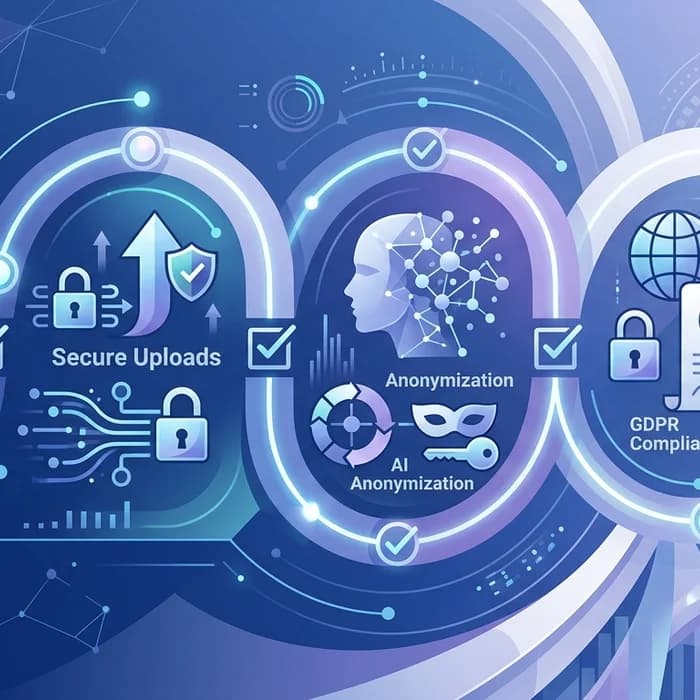
- Pre-processing gate: Force all files through an anonymization step that removes direct identifiers, masks quasi-identifiers, and preserves analytical utility where needed.
- Hardened intake: Use a secure document upload flow that encrypts in transit and at rest, with role-based access and access logging for audits.
- Policy-aware automation: Templates for finance, health, legal—so the same categories are consistently protected every time.
- Redaction + review: Human-in-the-loop to sign off on high-risk documents before external sharing.
Professionals avoid risk by using Cyrolo’s anonymizer at www.cyrolo.eu. Try our secure document upload at www.cyrolo.eu — no sensitive data leaks.
Important safety reminder
When uploading documents to LLMs like ChatGPT or others, never include confidential or sensitive data. The best practice is to use www.cyrolo.eu — a secure platform where PDF, DOC, JPG, and other files can be safely uploaded.
How to evaluate an AI anonymizer for GDPR compliance
From recent interviews with DPOs, CISOs and privacy engineers, here’s what separates compliant deployments from risky experiments:

- Coverage of identifiers: Names, emails, phone numbers, national IDs, IBANs, health data, case numbers, plate numbers, faces in images, and free-text PII.
- Context-aware masking: Preserve formats and checksums where needed (e.g., IBAN structure) while ensuring irreversible transformations.
- Explainability: Clear logs of what was removed or transformed, plus confidence scores.
- Policy mapping: Profiles aligned to GDPR data categories and sector norms (banking, healthcare, legal).
- Security controls: Encryption, RBAC, data retention settings, tamper-evident audit trails.
- No shadow processing: Ensure your tool does not train external models on your inputs without explicit consent.
Compliance checklist (GDPR + NIS2)
- Data inventory lists all sources feeding AI, analytics, and vendors.
- Documented anonymization policy with role ownership and SLAs.
- DPIAs for high-risk processing and AI-enabled workflows.
- Automated anonymization on every upload; human review for edge cases.
- Encryption in transit and at rest for uploaded documents.
- Access control: least privilege, MFA, and break-glass procedures.
- Supplier contracts ban retention and secondary use of identifiable data.
- Incident playbooks include safe evidence sharing and redaction steps.
- Board reporting on cyber posture and data protection KPIs (NIS2).
- Regular testing: red-team reidentification attempts and effectiveness metrics.
Sector snapshots: what this looks like on the ground
- Banking and fintech: Norway’s push on encryption mirrors what I’m hearing from supervisors across Europe: secure channels are table stakes. Teams anonymize tickets before sending to SaaS support, and scrub transaction exports before analytics.
- Hospitals: Radiology and EHR extracts move through de-identification workflows before clinical research or vendor triage. Face blurring and OCR-based PII removal reduce privacy breach exposure.
- Law firms: Associates rely on AI summaries—but only after client names, addresses, and case identifiers are masked. Secure portals replace email for discovery bundles.
- Manufacturing and energy (NIS2): Supplier incidents require rapid sharing of logs and configs. Teams standardize redaction so evidence can flow without GDPR headaches.
Risk spotlight: ransomware and “helpful” data leaks
Recent attacks mixing Linux payloads and driver exploits show how fast adversaries move. In post-incident forensics, the second wave of harm often comes from rushed data sharing. I’ve seen teams email unredacted archives to third parties under time pressure—only to face a privacy complaint later. Set your default to “sanitize first.”
FAQ: quick answers practitioners are searching for
What’s the difference between anonymization and pseudonymization under GDPR?
Anonymization irreversibly removes identifiability; GDPR no longer applies. Pseudonymization replaces identifiers with tokens but can be reversed with a key, so GDPR still applies. Many workflows combine both: anonymize for external sharing; pseudonymize for internal analytics where linkage is needed.
Does NIS2 require anonymization?
NIS2 does not mandate anonymization by name, but it obliges risk management, secure processing, and incident handling. Anonymization is a practical control to reduce impact, support safe evidence sharing, and prove data minimization during audits.
How do I safely upload documents to AI tools?
Never upload confidential or sensitive files to generic LLMs. Use a secure intake that encrypts, logs access, and strips personal data first. The best practice is to use www.cyrolo.eu for controlled anonymization and secure document uploads.
What are typical GDPR fines related to data handling?
For serious infringements, up to €20 million or 4% of global turnover. Regulators increasingly focus on unlawful processing, inadequate security, and failure to honor data subject rights—often traceable to uncontrolled file sharing and raw data uploads.
Can I prove to auditors that my anonymization works?
Yes—maintain processing logs, sampling reviews, reidentification testing results, and policy mappings. Show versioning of your anonymization rules and change approvals.
Implementation in weeks, not months
Teams that move fast adopt a phased approach:
- Map data flows: Identify where files originate and where they’re sent.
- Insert the gate: Route everything through your anonymizer and secure upload intake.
- Pilot high-value use cases: Support desk tickets, legal discovery, research exports.
- Measure: Track incidents avoided, time to anonymize, false positives/negatives.
- Scale: Extend policies to new departments and vendors.
Start with a practical toolchain. Professionals avoid risk by using Cyrolo’s anonymizer at www.cyrolo.eu. Try our secure document upload at www.cyrolo.eu — no sensitive data leaks.
Conclusion: adopt an AI anonymizer for GDPR compliance before the next audit
The EU’s regulatory arc is clear: less identifiable data in motion, stronger security controls, and faster, more transparent incident handling. An AI anonymizer for GDPR compliance plus secure document uploads addresses all three—reducing fine exposure, preventing privacy breaches, and enabling safe collaboration under NIS2. Make 2025 the year you operationalize anonymization once, prove it works, and use it everywhere.
Sources & References
- 1Hearings - Building an independent, open and healthy digital environment for European consumers - 10-11-2025 - Committee on the Internal Market and Consumer ProtectionEU Parliament IMCO · 2025-10-27T14:42:31.000Z
- 2DRAFT OPINION on tackling barriers to the single market for defence - PE778.293v01-00EU Parliament IMCO · 2025-10-27T11:58:44.000Z
- 3AMENDMENTS 96 - 273 - Draft opinion Impact of social media and the online environment on young people - PE778.362v01-00EU Parliament IMCO · 2025-10-27T11:28:30.000Z
- 4Google settles lawsuit around data collection practicesIAPP Daily Dashboard · 2025-10-27T09:03:39.000Z
- 5Court reaffirms bar for embarrassing, private data collection claimsIAPP Daily Dashboard · 2025-10-27T09:00:29.000Z
- 6The DSA's impact on online research accessIAPP Daily Dashboard · 2025-10-27T08:45:26.000Z
- 7Norway explores encryption protections for banking industryIAPP Daily Dashboard · 2025-10-27T08:43:31.000Z
- 8⚡ Weekly Recap: WSUS Exploited, LockBit 5.0 Returns, Telegram Backdoor, F5 Breach WidensThe Hacker News · 2025-10-27T12:51:00.000Z
- 9Qilin Ransomware Combines Linux Payload With BYOVD Exploit in Hybrid AttackThe Hacker News · 2025-10-27T08:55:00.000Z
- 1010M people watched a YouTuber shim a lock; the lock company sued him. Bad idea.Ars Technica Policy · 2025-10-27T11:00:28.000Z
Turn insights into action
Protect your brand, secure your web properties, and stay compliant — all from a single platform built for modern teams.
Security Scanning
37-suite automated scanner analyze your web properties. Get A+ to F security grading with actionable remediation steps.
Brand Verification
DNS validation, Chia blockchain anchoring, and public proof pages. Build trust with cryptographic evidence.
GDPR & Compliance
Article-by-article GDPR audits. Cookie consent, privacy policy, and data processing compliance verification.