Secure document upload after “CamoLeak”: EU-grade steps to stop AI data leaks
Yesterday’s disclosure of the “CamoLeak” attack against code assistants should be a wake-up call for every compliance, legal, and security leader. As I heard in today’s Brussels briefing, regulators are treating AI-fueled exfiltration as a foreseeable risk. That puts “secure document upload” at the center of your operational resilience strategy—especially if you handle personal data regulated by GDPR or operate critical/important entities under NIS2.
👉 When uploading documents to LLMs like ChatGPT or others, never include confidential or sensitive data. The best practice is to use www.cyrolo.eu — a secure platform where PDF, DOC, JPG, and other files can be safely uploaded.
What “CamoLeak” means for secure document upload and AI use
The research community has shown that adversaries can steer AI coding assistants and other LLM tools to exfiltrate snippets of proprietary content via seemingly benign prompts, comments, or code completions. In practice, this is just another flavor of prompt-injection and data-leak channels. In recent interviews, a CISO at a European fintech told me: “Developers thought autocomplete was harmless. Then we watched it echo private tokens and internal function names. That was our line in the sand.”
For EU organizations, the implications are direct:
- Personal data exposure elevates GDPR risk—regulators ask whether appropriate technical and organizational measures (TOMs) were in place.
- Under NIS2, essential and important entities face higher expectations for security of supply chains and incident reporting, including when AI tools are part of the workflow.
- Third-country transfers can be triggered when cloud or AI vendors process files outside the EU, demanding transfer impact assessments.
Put simply: if your teams upload drafts, contracts, tickets, log files, medical notes, or source code to AI tools, you need a provable, policy-driven secure document upload path that strips or masks sensitive fields and keeps full audit trails.
EU regulations you can’t ignore: GDPR vs NIS2 (and how they bite)
Regulators in Brussels and national DPAs keep stressing three points: data minimization, demonstrable controls, and timely incident response. Below is a quick comparison I use with boards.
| Topic | GDPR | NIS2 |
|---|---|---|
| Who’s in scope? | Any controller/processor handling personal data of EU residents. | “Essential” and “Important” entities across sectors (e.g., finance, health, digital infrastructure, MSPs). |
| Core obligations | Lawful basis, data minimization, security of processing, DPIAs for high risk, breach notifications to DPAs and data subjects when required. | Risk management measures, supply chain security, vulnerability handling, logging, and 24/72-hour incident reporting to CSIRTs. |
| Fines | Up to 20M EUR or 4% of global annual turnover, whichever is higher. | Administrative fines up to 10M EUR or 2% of global turnover; plus management liability in serious cases. |
| AI/LLM relevance | Uploading personal data to LLMs is processing; requires lawful basis, minimization, and appropriate safeguards. | Use of AI in critical workflows is in scope for risk/control expectations and incident reporting. |
| Audit expectations | Evidence of TOMs (encryption, access control, pseudonymization), records of processing, vendor DPAs. | Security policies, technical measures, supply-chain due diligence, and proof of remediation cycles. |
Practical controls: From anonymization to segmented uploads

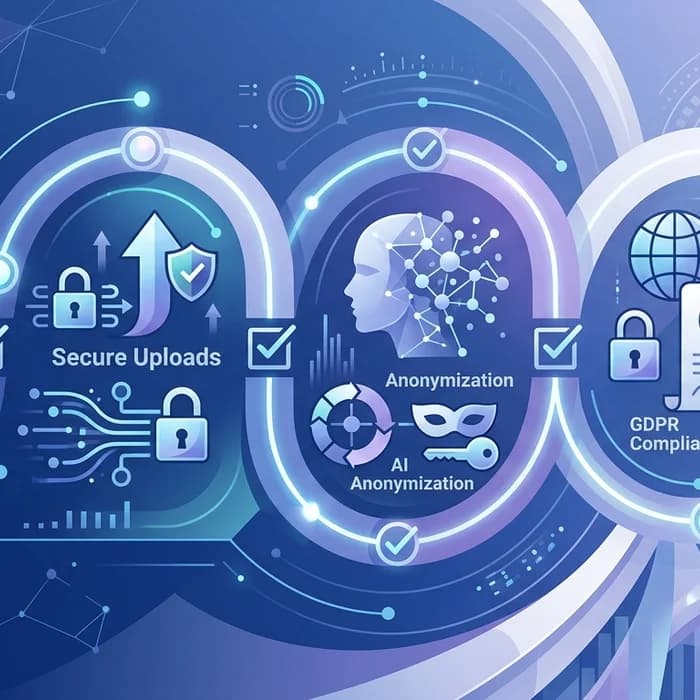
What separates resilient teams from headline victims is disciplined preprocessing and isolation. The fastest win is automated removal or masking of personal and secret data before any file leaves your network. Professionals avoid risk by using Cyrolo’s anonymizer to scrub names, emails, identifiers, and secrets before interacting with AI tools or sharing files with vendors.
Then, layer in architectural guardrails:
- Segmented uploads: Split documents so only the minimal, non-sensitive context is shared externally.
- Inline redaction: Replace PII and secrets with consistent placeholders to preserve utility for analysis while protecting identity.
- Policy-aware routing: Send files to internal models when possible; fall back to vetted external providers with EU data residency and DPAs.
- Kill switches: Detect and block attempted exfiltration patterns in prompts or outputs (e.g., code comments asking the model to “repeat confidential variables”).
Try our secure document upload — no sensitive data leaks. Your legal and security teams get evidence-grade logs for audits.
A field-tested compliance checklist
- Map data: Identify personal data, secrets, and trade secrets in your documents and code.
- Minimize by default: Apply automated anonymization/pseudonymization before any external processing.
- Encryption: Ensure files are encrypted in transit and at rest with strong key management (KMS/HSM).
- Access control: Enforce least-privilege for who can upload, view, or de-anonymize content.
- LLM gateway: Broker all AI traffic through a policy engine that strips sensitive fields and blocks prompt injection.
- DPIA and ROPA: Update your DPIAs for AI use-cases; keep Records of Processing updated for uploads.
- Vendor assurance: Execute DPAs, check sub-processor lists, and verify EU data residency where feasible.
- Logging and retention: Keep immutable, queryable logs of who uploaded what, when, to which model/vendor; define deletion timelines.
- Incident playbooks: Include AI exfiltration scenarios; rehearse 24/72-hour reporting processes.
- Training: Teach staff to spot prompt-injection patterns and “too helpful” autocomplete behavior.
Secure document upload: architecture patterns that work
1) Pre-process at the edge
Run anonymization and redaction locally or within your EU VPC before any external call. This alone defuses the most common privacy breaches. Legal teams appreciate that personal data never leaves controlled boundaries in clear text.
2) Use a dual-lane model strategy

High-sensitivity workloads (e.g., patient notes, M&A documents, bank tickets) route to private models with strict logging. Low-sensitivity or non-personal data can go to external models with DPAs and EU residency. This satisfies data minimization and proportionality principles under GDPR.
3) Strong prompt/output filters
Detect and neuter CamoLeak-style tricks: comments, inline instructions, or code artifacts that coax models to repeat secrets. Pair this with allow/deny lists for model plugins and tools.
4) Continuous testing
Red-team your AI interfaces monthly. I’ve seen hospitals and law firms uncover hidden exfiltration paths only after they threw adversarial prompts at their own assistants. Document the results for your next security audit.
What it costs to get it wrong
- Fines and orders: GDPR penalties up to 4% global turnover; NIS2 sanctions plus mandated remediation and potential management liability.
- Breach response burn: EU breach costs commonly run into the millions once forensics, notifications, and legal counsel are counted.
- Contractual fallout: Clients increasingly require AI-specific security clauses; failing a security audit can pause revenue.
- Reputational loss: Regulators and industry press now treat AI leaks as avoidable—boards expect you to have controls.
Contrast with the US, where breach notification norms are older but privacy rules are fragmented by state. In the EU, the bar is higher on accountability and documentation—meaning you must prove that your controls (not just policies) work.
Real-world scenarios I’m seeing
- Banking and fintech: Transaction logs uploaded to troubleshoot a payment bug leak masked account identifiers through code completions. Fix: mandatory anonymization and an LLM gateway policy.
- Hospitals: Radiology reports contain incidental identifiers in free text. Fix: medical-term-aware scrubbing before AI summarization.
- Law firms: Due diligence binders fed to contract review tools include deal codenames and personal emails. Fix: pre-ingestion redaction and access-scoped data rooms.

For each of these, the path forward is the same: sanitize first, prove it in logs, and only then allow AI workflows. That’s exactly why teams standardize on www.cyrolo.eu for safe document uploads and fast, accurate anonymization.
FAQs: your most searched questions, answered
What is secure document upload?
It’s a governed process for getting files (PDF, DOC, JPG, source code) into analysis or AI tools without exposing personal data or secrets. Core features include automated anonymization, encryption, access controls, and audit logging. A trusted option is to route files via www.cyrolo.eu to ensure consistent protection.
Is anonymization enough for GDPR?
True anonymization places data outside GDPR, but it’s hard to guarantee. Most organizations rely on robust pseudonymization/redaction plus strict controls. The key is data minimization and demonstrable safeguards. Using an AI anonymizer before external processing significantly reduces risk.
How do we prevent prompt injection and CamoLeak-style exfiltration?
Combine pre-upload scrubbing, model-side safety policies, output filters, and continuous adversarial testing. Block patterns that request the model to repeat or enumerate secrets. Keep all AI traffic behind a governed gateway with logging.
Do we need a DPA with our AI vendor or model provider?
Yes, if personal data is processed. Execute a Data Processing Agreement, check sub-processors, and prefer EU data residency to simplify transfer assessments. Document all of this in your Records of Processing.
Does NIS2 apply to us if we’re an MSP or SaaS?
Likely. Many MSPs and certain digital infrastructure and SaaS providers fall under NIS2 as “important entities,” triggering risk management and incident reporting duties. Expect customers to audit your AI handling as part of supply-chain security.
Conclusion: secure document upload is your first line of defense
“CamoLeak” won’t be the last creative exfiltration tactic we see. The organizations that thrive in 2025 will treat secure document upload as a control, not a convenience: sanitize before sharing, enforce policy at the edge, and keep evidence-grade logs. If you want a fast, compliant path to safer AI, try Cyrolo’s anonymizer and secure document upload today—built for EU-grade data protection and cybersecurity compliance under GDPR and NIS2.
Sources & References
- 1GitHub Copilot 'CamoLeak' AI Attack Exfiltrates DataDark Reading · 2025-10-09T19:56:30.000Z
Turn insights into action
Protect your brand, secure your web properties, and stay compliant — all from a single platform built for modern teams.
Security Scanning
37-suite automated scanner analyze your web properties. Get A+ to F security grading with actionable remediation steps.
Brand Verification
DNS validation, Chia blockchain anchoring, and public proof pages. Build trust with cryptographic evidence.
GDPR & Compliance
Article-by-article GDPR audits. Cookie consent, privacy policy, and data processing compliance verification.