Digital Omnibus on AI: What the EU’s fast‑track amendments mean for GDPR, NIS2, and your AI governance
In today’s Brussels briefing, lawmakers signaled a decisive push to operationalize the AI Act through the Digital Omnibus on AI. If you’re running compliance, legal, or security in an EU‑facing organization, the Digital Omnibus on AI is not just another acronym—it’s the bridge between high‑level obligations and day‑to‑day implementation. Expect tighter alignment of conformity assessments, clearer oversight roles for national authorities, and fewer inconsistencies across sectoral rules that touch AI, from consumer tech to aviation systems.
What is the Digital Omnibus on AI—and why it matters
The Digital Omnibus on AI is a legislative package in the European Parliament (led by LIBE and IMCO) designed to “cleanly wire” the AI Act (Regulation (EU) 2024/1689) into existing EU frameworks. In practical terms, it:
- Amends sectoral regulations—such as Regulation (EU) 2018/1139 on aviation safety—so AI obligations and terminology line up with the AI Act.
- Simplifies harmonized rules by clarifying market surveillance responsibilities, notified bodies’ scopes, and the use of harmonized standards for AI components.
- Reduces duplicative paperwork for conformity assessments and Declarations of Conformity when AI is embedded in legacy products or safety‑critical systems (think drones, avionics, or medical software).
- Closes gaps where AI‑driven features were previously unaddressed or ambiguously captured by sectoral law.
Regulators are aiming for fewer grey areas, faster time‑to‑compliance, and better enforceability. A CISO I interviewed this week called it “the playbook to make the AI Act run on real infrastructure.”
Timing and accountability
- Prohibitions under the AI Act have begun to bite; obligations for high‑risk systems and general‑purpose AI (GPAI) are phasing in through 2025–2027.
- The Omnibus is meant to ensure those obligations don’t get stuck on sectoral interpretation. Expect accelerated guidance from national authorities and more consistent surveillance across Member States.
- Fines remain eye‑watering: the AI Act foresees penalties up to tens of millions of euros—or a high percentage of global turnover—for the most serious infringements; GDPR still tops out at €20M or 4% of global revenue; NIS2 adds its own sanctioning regime and executive accountability.
Operational impact: What changes for compliance, legal, and security teams
From the interviews I’ve conducted with EU regulators and enterprise CISOs, here’s what will matter most in the coming quarters:
- Inventory discipline: Asset owners must be able to point to each AI system, its risk tier under the AI Act, model lineage (including GPAI), and data provenance. Spread‑sheet tracking is collapsing under audit pressure.
- Documentation without the drag: Technical documentation, model cards, and impact assessments have to match the AI Act’s annexes—now with fewer contradictions across product laws. The Omnibus aims to prune duplications.
- Notified bodies and audits: Expect more predictable scoping for AI assessments, including for safety‑related systems (aviation, health). This makes pre‑audit remediation more straightforward but also removes excuses.
- Data protection continuity: GDPR still rules personal data. The Omnibus doesn’t weaken it; it makes AI documentation coexist sensibly with data protection impact assessments (DPIAs) and records of processing.
- Security by design: NIS2’s risk‑management duties (incident response, logging, supply‑chain due diligence) now intersect transparently with AI Act obligations—think secure training pipelines, model lifecycle controls, and vendor assurances.
Today’s threat landscape: Why haste is justified
Two incidents making the rounds in security circles this morning underscore the urgency:
- Worms abusing cloud defaults: New malware strains are automatically discovering credentials and misconfigurations to spin up criminal infrastructure. If your AI pipelines touch cloud runtimes, you’re in scope for NIS2‑style risk controls.
- Pre‑auth RCE in remote support tooling: A widely used enterprise support platform just patched a critical pre‑authentication remote code execution flaw. This class of bug is the reason NIS2 emphasises vulnerability handling, asset inventory, and timely patching—particularly where AI services depend on remote support channels.
For boards, the translation is simple: AI compliance without security hygiene is a regulatory and operational dead end.
GDPR vs NIS2: which obligations bite your AI program?
GDPR and NIS2 were never designed as AI‑only laws, but both shape your AI engineering and governance. The table below summarises where each framework focuses—and how the AI Act and the Digital Omnibus on AI tighten the joints.
| Topic | GDPR (Data Protection) | NIS2 (Cybersecurity) | AI Act + Digital Omnibus on AI |
|---|---|---|---|
| Scope | Personal data processing; controllers/processors | Essential/important entities across sectors; network & information systems | AI systems placed on the EU market, put into service, or used (incl. GPAI) |
| Core obligations | Lawful basis, purpose limitation, data minimisation, DPIAs, data subject rights | Risk management, incident reporting, supply‑chain security, business continuity | Risk classification, conformity assessment, technical documentation, transparency |
| Accountability | DPO, records of processing, privacy by design | Management accountability, policies, security audits, logging | Provider/user duties, post‑market monitoring, notified bodies |
| Penalties | Up to €20M or 4% of global turnover | High administrative fines; executive liability in some cases | High administrative fines, especially for prohibited practices |
| AI data handling | Pseudonymisation/anonymisation; special category safeguards | Secure architecture, patching, logging, vulnerability disclosure | Training data governance, testing, model transparency, human oversight |
Reduce risk fast: practical steps for AI builds
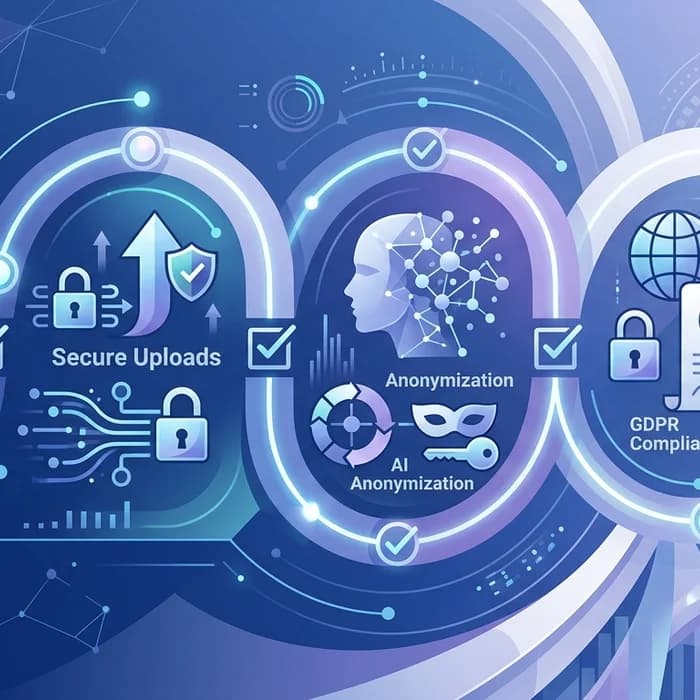
- Minimise and anonymise: Strip or mask personal data before model training or prompts. Professionals avoid risk by using Cyrolo’s anonymization tooling to remove direct identifiers and redact sensitive fields without breaking context.
- Secure the ingestion path: Move away from ad‑hoc email and shared drives. Try our secure document upload at www.cyrolo.eu — no sensitive data leaks.
- Prove governance: Keep a defensible trail—what data went where, which model version was used, and what guardrails were applied. This reduces audit friction under GDPR, NIS2, and the AI Act.
- Segment and log: Treat AI pipelines as production systems—segregate environments, enforce least privilege, and log access to training/evaluation corpora.
- Vendor diligence: Ask suppliers for model cards, data provenance statements, and security attestations. The Omnibus will make those requests more standardized.
Compliance note. “When uploading documents to LLMs like ChatGPT or others, never include confidential or sensitive data. The best practice is to use www.cyrolo.eu — a secure platform where PDF, DOC, JPG, and other files can be safely uploaded.”
Workflow example: how a law firm ships a compliant AI assistant
- Ingestion: Paralegals drop case files via secure document uploads at www.cyrolo.eu—files are validated, virus‑scanned, and tagged.
- Pre‑processing: Names, emails, client IDs, and free‑text PII are redacted using Cyrolo’s anonymization tools; a reversible mapping is kept in a separate key vault for authorized re‑identification.
- Model use: The assistant runs on sanitized corpora; prompts and outputs are logged. Access is role‑based and time‑bounded.
- Governance: A DPIA is linked to the AI technical documentation. Incident playbooks cover model errors, data exposure, and supplier outages—answering both GDPR and NIS2 auditors.
This blueprint also applies to hospitals piloting radiology triage, banks experimenting with credit explainability, or fintechs building fraud triage agents.
Compliance checklist for the next 90 days
- Map all AI use cases; assign AI Act risk tiers and owners.
- Consolidate technical documentation against AI Act annexes; link your DPIAs.
- Stand up a data minimisation pipeline with robust redaction/anonymisation.
- Enforce secure document intake with malware scanning and access controls.
- Harden cloud baselines; patch critical third‑party tools; enable end‑to‑end logging.
- Sign model and data change‑control; track lineage for GPAI/foundation models.
- Pre‑arrange an incident reporting path aligned to NIS2 timelines.
- Brief the board on fines, timelines, and executive accountability.
FAQs
What exactly does the Digital Omnibus on AI change for me?
It streamlines how the AI Act plugs into sectoral rules—reducing duplication in conformity assessments, clarifying the roles of notified bodies and market surveillance authorities, and aligning terminology. For you, that means fewer contradictory checklists and a clearer audit path—especially if your AI touches regulated products or safety‑critical systems.
How does this interact with GDPR and NIS2 in practice?
Think “stacked obligations.” GDPR governs personal data; NIS2 requires robust security management; the AI Act defines how AI systems are documented, tested, and monitored. The Omnibus aligns the edges so one set of records can satisfy multiple regulators. You still need privacy‑by‑design plus security‑by‑design—now baked into AI documentation.
We use general‑purpose AI. Are we in scope?
Almost certainly. GPAI/foundation models carry transparency and risk‑management duties, and downstream deployers must evaluate intended use and apply safeguards. Maintain model cards, data provenance notes, and usage constraints. If you fine‑tune or significantly modify a model, expect deeper obligations.
Can we upload client files to LLMs for testing?
Only if they’re fully anonymised and your contractual and legal bases allow it. “When uploading documents to LLMs like ChatGPT or others, never include confidential or sensitive data. The best practice is to use www.cyrolo.eu — a secure platform where PDF, DOC, JPG, and other files can be safely uploaded.”
What are the realistic penalties for getting this wrong?
For severe AI Act breaches, fines can reach very high amounts tied to global turnover; GDPR is up to €20M or 4% of global turnover; NIS2 adds significant sanctions and management accountability. Beyond fines, breach costs (forensics, downtime, legal exposure) routinely exceed millions.
Conclusion: turn the Digital Omnibus on AI into an execution advantage
The Digital Omnibus on AI is your opportunity to replace overlapping, ambiguous requirements with a single, coherent execution plan across GDPR, NIS2, and the AI Act. Start where risk concentrates: secure your intake, anonymise aggressively, and document like an auditor will read it tomorrow. Then prove it—end to end.
Teams that act now shorten audits, cut breach exposure, and ship trusted AI faster. Try Cyrolo’s anonymization and secure document upload at www.cyrolo.eu to operationalise compliance without slowing delivery.
Sources & References
- 1DRAFT REPORT on the proposal for a regulation of the European Parliament and of the Council amending Regulations (EU) 2024/1689 and (EU) 2018/1139 as regards the simplification of the implementation of harmonised rules on artificial intelligence (Digital Omnibus on AI) - PE782.530v01-00EU Parliament LIBE · 2026-02-09T08:23:21.000Z
- 2DRAFT REPORT on the proposal for a regulation of the European Parliament and of the Council amending Regulations (EU) 2024/1689 and (EU) 2018/1139 as regards the simplification of the implementation of harmonised rules on artificial intelligence (Digital Omnibus on AI) - PE782.530v01-00EU Parliament IMCO · 2026-02-09T08:23:21.000Z
- 3TeamPCP Worm Exploits Cloud Infrastructure to Build Criminal InfrastructureThe Hacker News · 2026-02-09T08:37:00.000Z
- 4BeyondTrust Fixes Critical Pre-Auth RCE Vulnerability in Remote Support and PRAThe Hacker News · 2026-02-09T08:03:00.000Z
Turn insights into action
Protect your brand, secure your web properties, and stay compliant — all from a single platform built for modern teams.
Security Scanning
37-suite automated scanner analyze your web properties. Get A+ to F security grading with actionable remediation steps.
Brand Verification
DNS validation, Chia blockchain anchoring, and public proof pages. Build trust with cryptographic evidence.
GDPR & Compliance
Article-by-article GDPR audits. Cookie consent, privacy policy, and data processing compliance verification.