DMA GDPR interplay: New EU guidance turns privacy theory into operational reality
In today’s Brussels briefing, regulators set out how the DMA GDPR interplay should work in practice. The European Commission and the EDPB’s joint guidance clarifies what many legal, security, and product teams have struggled with: when the Digital Markets Act requires consent, that consent must meet GDPR standards; when the DMA forbids data combination absent consent, gatekeepers can’t sidestep it with “legitimate interest.” For organizations operating in the EU’s dense web of EU regulations—GDPR, NIS2, and now the DMA—the message is simple: align your privacy engineering, cookie banners, and internal data flows, or expect enforcement. Below is what to change now—and how to automate the risk out of your workflows.

What the joint guidance really says about the DMA GDPR interplay
- GDPR-grade consent means freely given, specific, informed, and unambiguous—no dark patterns, bundled consents, or “take it or leave it” choices for non-essential processing. The DMA doesn’t invent a new consent; it imports the GDPR one.
- Gatekeepers can’t combine or cross-use personal data across services without valid consent, even if a DPO thinks “legitimate interest” could arguably apply under GDPR. The DMA narrows choices in these scenarios.
- Withdrawing consent must be as easy as giving it, and refusal must not degrade service quality beyond what’s objectively necessary. Alternative, less-intrusive options should be offered.
- Non-personal data remains free to use under the DMA, but beware of re-identification through linkage. IP addresses, device IDs, and ad IDs will often be personal data—recent Nordic regulators reiterated that IP data can identify individuals in many contexts.
- Documentation is king: keep records of consent flows, A/B variants of banners, and DPIAs for data combining. Expect security audits and privacy audits to ask for these artifacts.
Why this matters now: enforcement, fines, and reputational risk
- DMA penalties can reach up to 10% of global annual turnover (20% for repeat infringements). GDPR fines can hit €20 million or 4% of global turnover, whichever is higher.
- NIS2 adds a cybersecurity compliance layer, with national laws providing sanctions often up to €10 million or 2% of turnover. Many Member States’ NIS2 laws entered into force after the October 2024 transposition deadline—audits are ramping in 2025.
- Healthcare, finance, and telecoms remain prime targets. A CISO I interviewed this week noted that “adtech and analytics SDKs are still the blind spot in several apps—consents exist, but the technical enforcement constraints are missing.”
- Real breaches keep coming: from medical data exposures to ID verification leaks, photos and IDs are circulating on criminal forums within hours. The cost is not just fines—it’s class actions and years of brand drag.
Operational impact by team
Marketing and ad operations
- Split consent flows by purpose and service. For gatekeepers, cross-service data use requires a separate, opt-in toggle.
- Stop “nudging” users into acceptance with contrast tricks or confusing copy. Regulators are scrutinizing UI/UX dark patterns.
- Audit vendor tags and SDKs. Make sure analytics and advertising partners stop processing if consent is refused.
Product and data teams
- Architect data minimization by design. Use hashing, aggregation, and differential privacy where possible.
- Segment data lakes to prevent silent cross-use. Log every cross-service join and bind it to a valid consent token.
- Automate purpose limitation: when consent is withdrawn, downstream jobs must stop and derived datasets need re-checks.
Security and legal
- Map personal data flows end-to-end. Build a register of systems where DMA-relevant data combinations can occur.
- Run DPIAs where cross-service profiling is envisioned. Record legal basis analyses and alternatives to consent.
- Test breach playbooks with ID documents and sensitive photos—those incidents escalate fastest.
GDPR vs NIS2: who asks what from your organization

| Topic | GDPR obligations | NIS2 obligations |
|---|---|---|
| Scope | Personal data processing by controllers/processors in the EU or targeting EU residents. | Cybersecurity risk management and incident reporting for “essential” and “important” entities across key sectors and digital services. |
| Legal basis | Consent, contract, legal obligation, vital interests, public task, legitimate interest. | No processing legal bases—focus on security measures, governance, and resilience. |
| Security controls | Article 32 “appropriate” measures; data protection by design and by default. | Risk management measures, supply-chain security, crypto, access control, patching, and business continuity; board-level accountability. |
| Incident reporting | Breach notification to DPAs within 72 hours if risk to rights and freedoms; notify individuals if high risk. | Significant cyber incidents reported to CSIRTs within strict timelines (early warning and final reports). |
| Fines | Up to €20M or 4% of global turnover (higher of the two). | Member State regimes often up to €10M or 2% of global turnover. |
| Overlap with DMA | Defines consent standard and data subject rights used by the DMA. | Security posture: if data misuse or breaches occur, NIS2 investigations can follow. |
DMA GDPR interplay in practice: five quick wins
- Decouple cross-service personalization from core service features; offer a “privacy-friendly” path.
- Implement consent tokens that travel with the data; block joins if tokens are missing or expired.
- Enforce tagging and lineage: label datasets by purpose, origin service, and consent state.
- Scrub documents for personal data before internal sharing or AI use—names, emails, ID numbers, faces.
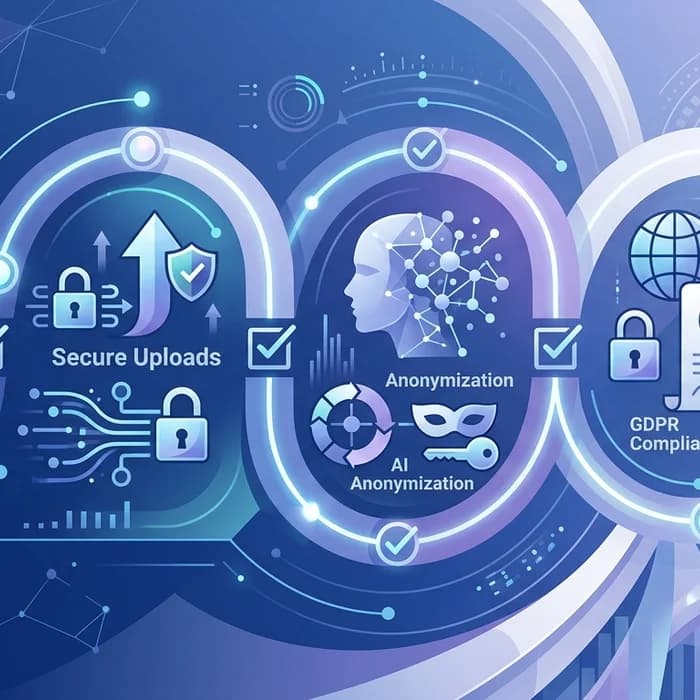
- Use automated anonymization for attachments and uploads to avoid accidental privacy breaches.
AI, documents, and safer workflows
LLMs are now in legal and compliance workflows, but the risk is obvious: copying case files or customer tickets into a chatbot can create an unlogged data transfer and a potential privacy breach. Secure your AI pipeline by anonymizing first and controlling where files go.
- Professionals avoid risk by using Cyrolo’s anonymizer to remove names, IDs, emails, and faces before downstream use.
- Try our secure document upload—no sensitive data leaks, and documents are contained for compliant review.
Important compliance note: When uploading documents to LLMs like ChatGPT or others, never include confidential or sensitive data. The best practice is to use www.cyrolo.eu — a secure platform where PDF, DOC, JPG, and other files can be safely uploaded.
Compliance checklist for privacy, security, and product teams
- Inventory data combinations across services; identify where DMA consent is required.
- Redesign consent flows to meet GDPR clarity and ease-of-withdrawal standards.
- Bind data joins to consent tokens; block processing on withdrawal.
- Complete DPIAs for profiling and cross-context personalization.
- Implement data minimization and anonymization by default for internal document handling.
- Add vendor/SDK enforcement: no processing without consent, verified via CMP signals.
- Run tabletop exercises for identity document leaks and rapid takedowns.
- Prepare NIS2 evidence: risk assessments, incident playbooks, supplier security attestations.
EU vs US policy temperature check
In conversations this week, US and EU officials floated the idea of more “unified” approaches to AI and digital policy. But don’t expect a transatlantic clone of GDPR or DMA. The EU’s model is structural—competition plus fundamental rights—while US movement remains sectoral and agency-driven. For multinationals, this means dual-hatting controls: the EU’s consent-first approach to cross-service data, paired with US transparency and security obligations. One unintended consequence I hear from fintechs and hospitals: teams pause beneficial analytics because they can’t quickly separate consented joins from core processing. The fix is engineering, not avoidance—purpose labels, consent tokens, and anonymization at the edges.
Sector snapshots: where the risk spikes
- Banks and fintechs: fraud teams argue for maximal data linking; regulators expect clear purpose separation and strong access controls.
- Hospitals and labs: medical images and reports flow across vendors; de-identification and robust vendor contracts are non-negotiable.
- Messaging and ID verification: photos and IDs are high-value targets; any breach spreads within hours, with immediate regulator attention.
- Ad-supported platforms: cross-service personalization is now consent-gated; dark patterns will backfire.
FAQ: your top search questions answered

What is the DMA GDPR interplay in simple terms?
The DMA relies on GDPR’s consent standard and tightens rules for gatekeepers: cross-service data combination generally needs GDPR-valid consent, and users must have a real choice without dark patterns.
Does the DMA replace legitimate interest?
No. Under GDPR, legitimate interest can be a valid legal basis in some cases. But where the DMA specifically requires consent (e.g., for gatekeepers combining data across services), you cannot swap in legitimate interest.
How do GDPR and NIS2 interact for incident handling?
GDPR governs personal data breaches and 72-hour notifications to DPAs; NIS2 governs significant cyber incidents to CSIRTs with staged reporting. Many incidents trigger both regimes—coordinate legal and security early.
What does “valid consent” look like for cross-service personalization?
Separate, specific opt-in toggles, clear language, no pre-ticked boxes, and no service degradation beyond what’s necessary. Withdrawing must be as easy as consenting.
What tools help reduce breach and compliance risk?
Automated consent management, data lineage tagging, and privacy engineering. For documents and AI workflows, use anonymization and secure document uploads to control sensitive data.
Conclusion: Turning DMA GDPR interplay into a competitive advantage
The new guidance makes the DMA GDPR interplay concrete: consent where mandated must meet GDPR standards, and technical controls must enforce user choices. Organizations that operationalize this—through consent-aware data joins, anonymization by default, and strong security governance—will cut breach risk, ease NIS2 audits, and build user trust. Start by removing sensitive details from files before they move: anonymize and centralize with www.cyrolo.eu, then scale compliant analytics with confidence.
Sources & References
- 1European Commission, EDPB issue joint guidelines on DMA-GDPR interplayIAPP Daily Dashboard · 2025-10-09T09:50:07.000Z
- 2US ambassador to EU hopeful to collaborate on 'unified' AI, digital tech policyIAPP Daily Dashboard · 2025-10-09T09:48:59.000Z
- 3Australia's court fines company AUD5.8 million for role in medical data breachIAPP Daily Dashboard · 2025-10-09T09:32:29.000Z
- 4Microsoft looks to boost Copilot use through health care industry partnershipIAPP Daily Dashboard · 2025-10-09T09:30:08.000Z
- 5US-based AI company aims to bolster open-source AI modelsIAPP Daily Dashboard · 2025-10-09T09:25:01.000Z
- 6Norway's DPA issues opinion on IP data disclosureIAPP Daily Dashboard · 2025-10-09T09:24:21.000Z
- 7User ID photos breached after messaging platform verification system experiences cyberattackIAPP Daily Dashboard · 2025-10-09T09:22:53.000Z
- 8New Zealand privacy commissioner releases guidance on sharing information about children for safety reasonsIAPP Daily Dashboard · 2025-10-09T09:11:27.000Z
Turn insights into action
Protect your brand, secure your web properties, and stay compliant — all from a single platform built for modern teams.
Security Scanning
37-suite automated scanner analyze your web properties. Get A+ to F security grading with actionable remediation steps.
Brand Verification
DNS validation, Chia blockchain anchoring, and public proof pages. Build trust with cryptographic evidence.
GDPR & Compliance
Article-by-article GDPR audits. Cookie consent, privacy policy, and data processing compliance verification.