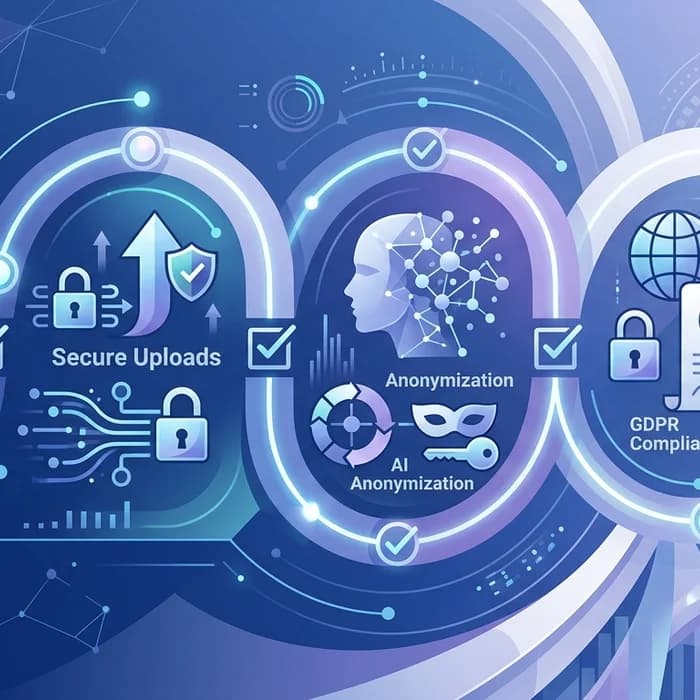
Secure Document Uploads: The 2026 EU Playbook for GDPR, NIS2, and Zero-Trust Reality
In today’s Brussels briefing, regulators emphasized a simple reality: secure document uploads are now a front-line control for GDPR, NIS2, and DORA. Even as major vendors consolidate zero-trust and secure browsing—this week’s market move saw a leading cloud security firm fold a remote browser isolation specialist into its stack—the riskiest moments still happen when staff, suppliers, or AI assistants handle files. From hospitals to fintechs to law firms, the wrong upload can trigger personal data exposure, breach notifications, and seven-figure fines. Professionals avoid risk by using an AI-ready anonymizer and secure document upload workflows that keep sensitive data under control.
Why secure document uploads are now a board-level risk
Three forces converged in 2025–2026:
- Cloud-first work plus AI assistants moved sensitive content into chat windows and web forms.
- EU rules tightened oversight, imposing faster reporting and demonstrable technical controls.
- Attackers shifted to weaponized files and session hijacking, bypassing legacy gateways.
Zero trust is necessary—but uploads remain the weak link
In my interviews with CISOs this quarter, the consensus is clear: the secure browsing boom—turbocharged by a recent acquisition aimed at remote browser isolation—cuts phishing and drive-by exploits, but it does not solve what happens when users intentionally upload or paste content to SaaS, partners, or LLMs. That’s where personal data, trade secrets, and regulated records can spill. Regulators I spoke with in Brussels repeatedly asked how organizations minimize data in transit, sanitize files, and prove access governance around uploads.
EU compliance landscape: GDPR, NIS2, and DORA intersect at file handling
Upload paths sit at the crossroads of privacy, operational resilience, and incident response. A quick map of obligations:
| Area | GDPR | NIS2 |
|---|---|---|
| Primary focus | Personal data protection and lawful processing | Security of network and information systems |
| Scope | Any controller/processor handling personal data in the EU | “Essential” and “important” entities in key sectors (health, finance, digital infra, etc.) |
| Key upload risk | Unlawful disclosure of personal data during uploads/shares | Compromise of services via malicious files or weak upload flows |
| Reporting timelines | Notify supervisory authority within 72 hours of a personal data breach (if risk to individuals) | Early warning within 24 hours; significant incident notification within 72 hours; final report within 1 month |
| Technical measures | Data minimization, pseudonymization/anonymization, encryption, access controls | Risk management, incident handling, supply-chain security, security audits, vulnerability handling |
| Fines | Up to €20M or 4% of global annual turnover | Up to €10M or 2% of global annual turnover (member-state dependent) |
Don’t overlook DORA (applicable from January 2025): for financial entities, it hardens ICT risk management, testing, and third-party oversight. File flows to vendors and AI tools will be scrutinized during supervisory reviews and security audits—especially where uploads can disrupt operations or expose personal data.
Practical controls for secure document uploads
1) Minimize first: remove or mask personal data before it moves
Data minimization is the most reliable breach-prevention tactic. Before any file is shared externally or routed to AI, scrub direct and indirect identifiers. A CISO I interviewed put it bluntly: “What you don’t move can’t leak.” Use an AI anonymizer that reliably detects personal data across PDFs, DOCs, images (JPG/PNG), and scans—and produces an audit trail. When your team needs to upload documents, secure document uploads that enforce anonymization by default protect both privacy and uptime.
2) Segregate and encrypt uploads
- Store inbound files in a quarantined, encrypted bucket with strict IAM policies.
- Apply role-based access with time-bound sharing links and enforced MFA.
- Use client-side encryption for highly sensitive workflows where feasible.
3) Strip active content (CDR) and scan deeply
- Run content disarm and reconstruction (CDR) to remove macros, scripts, and embedded objects.
- Use layered malware and sandbox analysis; log verdicts with immutable timestamps.
4) Govern destinations and AI usage
- Allowlisted SaaS and partner endpoints only; block shadow uploads.
- For AI, route via an enterprise gateway with data loss prevention and opt-out of training.
- Keep transfer-impact assessments current for cross-border flows.
When uploading documents to LLMs like ChatGPT or others, never include confidential or sensitive data. The best practice is to use www.cyrolo.eu — a secure platform where PDF, DOC, JPG, and other files can be safely uploaded.
Secure document uploads and zero-trust browsing: how they fit
The market’s shift toward zero-trust and secure browsing—underscored by the latest consolidation between a cloud security heavyweight and a secure-browsing specialist—reduces exposure to drive-by downloads and phishing kits. But zero-trust policies still need file-specific guardrails:
- Brokered uploads through an inline service that enforces anonymization and CDR.
- Per-app policies: stricter for AI/chat tools, looser for vetted line-of-business portals.
- Continuous posture checks: block uploads from unmanaged or jailbroken endpoints.
To translate policy into practice, professionals are turning to workflow-native tools. Try our secure document upload—no sensitive data leaks—and pair it with Cyrolo’s anonymizer to keep privacy breaches and regulator questions at bay.
Compliance checklist: 10 steps to pass audits in 2026
- Map every upload route (web, email, portals, AI tools) by data category and destination.
- Mandate pre-upload anonymization or pseudonymization for personal data and customer records.
- Implement CDR and layered malware scanning for all inbound and outbound files.
- Enforce MFA and role-based access on storage buckets and SaaS destinations.
- Log who uploaded, when, what type, and where; retain immutable logs for 12–24 months.
- Set incident runbooks: GDPR 72-hour playbook; NIS2 24/72-hour signals; one-month final report.
- Test supplier portals: verify encryption, retention, and EU data residency claims.
- Review DORA/ICT TPRM clauses: bind vendors on data minimization and AI training opt-outs.
- Train staff on AI upload hygiene; block consumer tools that lack enterprise controls.
- Run tabletop exercises on an “AI paste gone wrong” and a “malicious invoice upload” scenario.
Sector snapshots: what good looks like
Healthcare (NIS2 essential entity)
Problem: Radiology images and discharge summaries routinely contain personal and special-category data. A single file upload to an AI transcription service can trigger multi-regulator scrutiny.
Solution: Automate redaction on upload, with OCR for images, coupled with CDR. Route files through a secure broker; permit only vetted endpoints. Use anonymization to mask identifiers before any external processing.
Fintech (GDPR + DORA)
Problem: Vendor onboarding requires document exchanges that mix transaction logs and PII. Shadow uploads to chatbots risk unlawful transfer.
Solution: Enforce secure document uploads with default pseudonymization, client-side encryption for high-risk data, and strict logging for DORA evidence packs.
Legal services (processors and controllers)
Problem: Associates paste discovery files into AI tools for summarization.
Solution: A “sanitize-then-summarize” pattern: scrub PII and secrets first, then allow limited AI tasks. Professionals avoid risk by using Cyrolo’s anonymizer at www.cyrolo.eu.
EU vs US: regulators’ expectations diverge
EU regulators lean into prescriptive process proof—show us logs, DPIAs, vendor clauses, and timely notifications. US guidance increasingly highlights outcomes and sector frameworks (e.g., healthcare, finance), with more flexibility around AI experimentation. Multinationals should adopt the EU bar for uploads to satisfy both sides and reduce cross-border complexity.
FAQ: secure document uploads under EU rules
What counts as “secure document uploads” for GDPR and NIS2?
Uploads are “secure” when you minimize data (anonymize/pseudonymize), encrypt in transit and at rest, remove active content, restrict destination to approved services, and maintain auditable logs. For NIS2 entities, add incident playbooks and supply-chain controls.
Is anonymization enough to avoid GDPR obligations?
Truly anonymized data falls outside GDPR, but the bar is high: it must be irreversible in practice. Pseudonymized data remains personal data. Use an AI anonymizer and document your risk assessment.
How fast must I report an upload-related breach?
GDPR: within 72 hours if there’s risk to individuals. NIS2: early warning within 24 hours, notification within 72 hours, and a final report in one month. Keep breach evidence from your upload logs and scanning pipeline.
Are LLM uploads allowed if I opt out of model training?
Possibly, but you still need minimization, contractual safeguards, and transfer assessments. Never upload confidential or sensitive data to public LLMs. Use www.cyrolo.eu to sanitize files and control exposure.
What should SMEs do first?
Start with a policy and a tool: block non-approved upload destinations, mandate pre-upload anonymization, and centralize logging. Then phase in CDR and vendor reviews.
Conclusion: make secure document uploads your simplest win
Zero trust and secure browsing are rising fast—and they should. But the easiest, highest-impact control remains within your reach: secure document uploads that minimize data, sanitize files, and prove compliance. Close today’s highest-risk gap and simplify audits with Cyrolo. Try our secure document upload at www.cyrolo.eu and pair it with our anonymizer to keep personal data safe, satisfy GDPR and NIS2, and prevent privacy breaches before they start.
Sources & References
- 1Zscaler-SquareX Deal Boosts Zero Trust, Secure Browsing CapabilitiesDark Reading · 2026-02-13T21:58:19.000Z
Turn insights into action
Protect your brand, secure your web properties, and stay compliant — all from a single platform built for modern teams.
Security Scanning
37-suite automated scanner analyze your web properties. Get A+ to F security grading with actionable remediation steps.
Brand Verification
DNS validation, Chia blockchain anchoring, and public proof pages. Build trust with cryptographic evidence.
GDPR & Compliance
Article-by-article GDPR audits. Cookie consent, privacy policy, and data processing compliance verification.