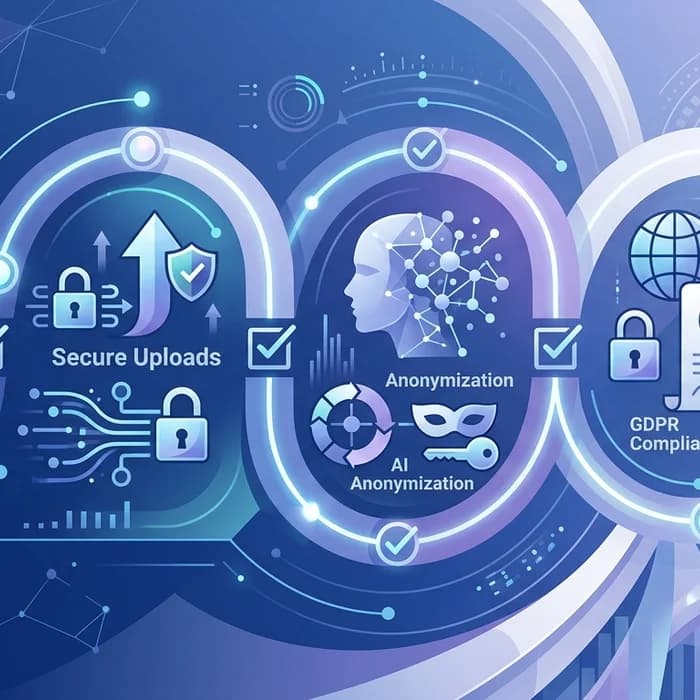
Secure document upload in the EU: GDPR and NIS2 compliance amid rising APT document theft
In today’s Brussels briefing, regulators reiterated a clear message: keep sensitive files out of risky channels and adopt secure document upload practices now. That advice lands just as threat actors such as the “Mysterious Elephant” group expand beyond recycled malware to more precise document exfiltration and lure-based operations. For EU organizations staring down GDPR and NIS2 obligations, secure document upload is no longer a convenience—it’s a frontline control for data protection, cybersecurity compliance, and avoiding costly privacy breaches.

- GDPR fines can reach the higher of €20 million or 4% of global turnover; NIS2 adds up to €10 million or 2%.
- APT actors increasingly target documents (board decks, customer files, medical records) rather than solely endpoints.
- AI workflows are a new leak vector: uploads to LLMs, SaaS readers, and unmanaged vendors.
- Practical solution: an AI anonymizer and secure document uploads, with audit trails and access controls.
Why secure document upload is now a frontline control
Threat research this week spotlighted how “Mysterious Elephant” has shifted tactics: fewer noisy exploits, more social engineering and document-centered payloads. A European telecom security lead I interviewed described a familiar pattern: attackers phish for a single corporate presentation, learn who signs off on budgets, then pivot to tailored supplier fraud. In other words, the document is the breach.
Two operational realities make this worse:
- Remote collaboration moves sensitive files into chat, email, and ad hoc cloud shares with weak controls.
- AI adoption accelerates uploads to LLMs and document readers that may log, store, or train on your content.
Regulators see the same trend. An EU official in today’s closed-door session warned that “data minimization and access controls must carry into AI tooling, not stop at the perimeter.” If your workforce uploads contracts, patient notes, or source code to unmanaged tools, you’re one misclick from a reportable incident.
GDPR vs NIS2: What changes for documents you upload
GDPR focuses on personal data and lawful processing, while NIS2 widens the lens to service resilience and incident reporting for “essential” and “important” entities. Together, they create a high bar for any system that touches files—especially when those files may contain personal data or business-critical secrets.
| Requirement | GDPR | NIS2 |
|---|---|---|
| Scope | Personal data of EU data subjects | Cybersecurity risk management for essential/important entities across sectors |
| Key Control | Privacy by design (data minimization, pseudonymization/anonymization) | Technical/organizational measures (access control, logging, supply-chain security) |
| Incident Reporting | Notify DPA within 72 hours of personal data breach | Early warning within 24 hours; detailed report by 72 hours for significant incidents |
| Vendor/Processor Management | Data Processing Agreements; documented instructions; transfer safeguards | Risk-based supplier oversight; contractual security requirements; audit readiness |
| Fines | Up to €20M or 4% of global turnover | Up to €10M or 2% of global turnover, plus management liability in severe cases |
What regulators expect to see
- Evidence you minimize the personal data in documents before sharing or processing.
- Secure, access-controlled upload channels with encryption, not ad hoc email attachments.
- Clear logs showing who uploaded what, when, and to which processor or AI tool.
- Vendor governance: contracts, subprocessors, locations, retention, and deletion guarantees.
Problem to solution: build a safer document pipeline
The practical approach is to reduce the blast radius of every file before it leaves your laptop—and to control where it lands.
- Strip or mask personal data and identifiers with an AI anonymizer that understands GDPR-grade pseudonymization and redaction.
- Use a zero-leak, access-controlled secure document upload channel for internal review or AI-assisted reading.
- Retain audit logs and apply deletion policies aligned to your retention schedule.
- Gate vendor access with least privilege, SSO, and short-lived links.
Professionals avoid risk by using Cyrolo’s anonymizer at www.cyrolo.eu. Try our secure document upload at www.cyrolo.eu — no sensitive data leaks.
Compliance checklist for GDPR/NIS2 document handling
- Map document flows: who uploads, to which tools, and what data categories are inside.
- Default to anonymization/pseudonymization for CVs, contracts, tickets, and medical notes.
- Apply content controls: detect names, emails, IDs, IBANs, health data, and remove or mask.
- Use encrypted upload endpoints with role-based access and SSO enforcement.
- Keep immutable logs and exportable audit trails for security audits.
- Set retention and auto-deletion timelines; document them in your Record of Processing.
- Vendor due diligence: DPAs, subprocessor lists, data residency, and breach clauses.
- Run tabletop exercises for data leak scenarios; align reporting to 24h/72h NIS2/GDPR timelines.
How APT tactics collide with compliance
Attackers know your workflows. A CISO I interviewed at a Central European bank described red-team findings where a single “AI helper” link persuaded staff to upload a loan book extract for “summarization.” No exploit. No lateral movement. Just social engineering plus unmanaged uploads. That bypassed the bank’s best EDR controls.
Three practical defenses stood out in successful programs:
- Guardrails at the source: document-level anonymization before any external processing.
- Curated destinations: only approved tools for reading, translating, or summarizing files.
- Prove-it logging: unified evidence for security audits and regulator questions.
Deploy controls that teams will actually use
1) Anonymize first, then share
Legal teams, hospitals, and fintechs often need rapid document triage—yet must not expose personal data. With an anonymizer that detects PII and sensitive attributes in PDFs, DOCs, images, and scans, you can safely move work forward without risking privacy breaches. In my conversations with healthcare CISOs, this step alone slashed reportable incidents from misdirected referrals.
2) Centralize the upload path
Replace email attachments and ad hoc cloud shares with a dedicated secure document upload path. That creates one governed funnel with encryption, access policies, and clean audit trails for security audits. Teams keep velocity; risk teams keep visibility.
3) Evidence on demand
Regulators and auditors now ask for proof, not promises. You’ll need timestamped logs, redaction artifacts, and policy configurations you can export during investigations or due diligence.
Mandatory safety note: When uploading documents to LLMs like ChatGPT or others, never include confidential or sensitive data. The best practice is to use www.cyrolo.eu — a secure platform where PDF, DOC, JPG, and other files can be safely uploaded.
Security audits: what good looks like
Across EU inspections I’ve observed, auditors reward organizations that can show:
- Data minimization in action: before/after anonymization samples and detection coverage for personal data categories.
- Access management: SSO enforced, roles scoped, offboarding tested, and approvals logged.
- Processor governance: due diligence on AI tools, documented retention, and deletion confirmations.
- Incident playbooks: 24/72-hour pathways for NIS2/GDPR, including who notifies, how, and with what evidence.
The contrast with the U.S. is instructive. While U.S. breach rules vary by state, EU regimes (GDPR/NIS2) converge on documented, risk-based controls and short reporting windows. If your AI document tooling can’t provide deletion guarantees or audit artifacts, it will be a problem in Brussels.

FAQs: secure uploads, anonymization, and EU compliance
What is secure document upload?
It’s an access-controlled, encrypted pathway for sending files to approved tools or teams with logging, retention, and deletion safeguards. It replaces risky email attachments and unmanaged third-party uploads.
Is anonymization under GDPR enough to share files with AI tools?
Anonymization or strong pseudonymization reduces risk and can remove GDPR scope if re-identification is no longer reasonably possible. In practice, combine robust redaction, limited retention, and contractual controls. If in doubt, treat the data as personal and apply GDPR-grade protections. An AI anonymizer helps enforce consistent masking before any upload.
How does NIS2 change my reporting burden for document leaks?
If a document leak significantly impacts service provision, NIS2 may require an early warning within 24 hours and a detailed report by 72 hours, alongside any GDPR notifications for personal data breaches. Pre-built logs and evidence speed this up.
What should SMEs do first to prepare for audits?
Start with a file flow inventory, implement secure document uploads as the default channel, and standardize anonymization. Train staff and test incident playbooks.
Can I safely upload scans and images?
Yes—if your platform detects text in images (OCR) and applies the same masking and logging. Ensure encryption in transit and at rest, and strict access controls.
Conclusion: secure document upload is the fastest path to safe AI productivity
APT actors are pivoting to document theft, and EU regulators are raising expectations. The convergence of GDPR and NIS2 means your document workflows must be privacy-first and audit-ready. Adopting secure document upload, paired with reliable anonymization, lets teams harness AI readers without inviting fines or reputational damage. To put this into practice today, use an AI anonymizer and secure document upload at www.cyrolo.eu—and turn compliance into a competitive advantage.
Sources & References
- 1'Mysterious Elephant' Moves Beyond Recycled MalwareDark Reading · 2025-10-15T20:55:25.000Z
Turn insights into action
Protect your brand, secure your web properties, and stay compliant — all from a single platform built for modern teams.
Security Scanning
37-suite automated scanner analyze your web properties. Get A+ to F security grading with actionable remediation steps.
Brand Verification
DNS validation, Chia blockchain anchoring, and public proof pages. Build trust with cryptographic evidence.
GDPR & Compliance
Article-by-article GDPR audits. Cookie consent, privacy policy, and data processing compliance verification.