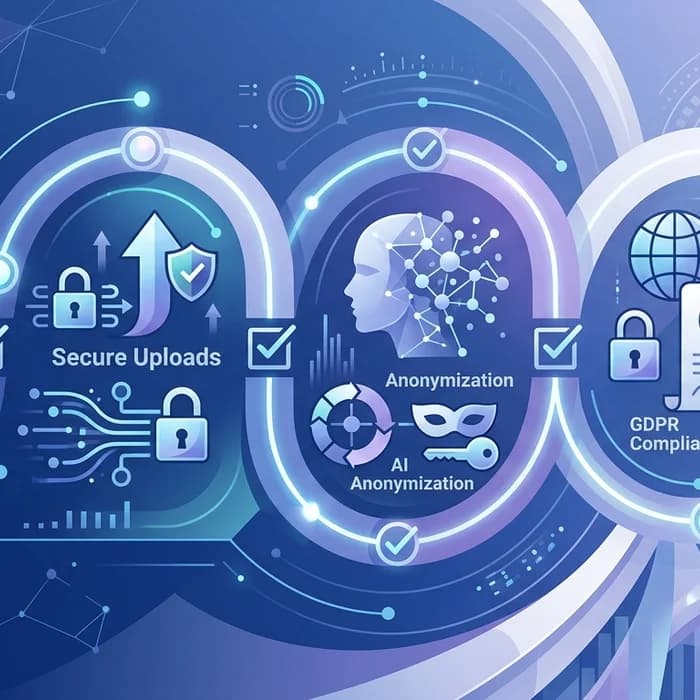
GDPR AI anonymizer: 2026 guide to compliant, secure document uploads under GDPR, NIS2 and the EU AI Act
Brussels, today: in a cross-committee huddle, MEPs from LIBE and IMCO advanced amendments to the so‑called Digital Omnibus on AI, a package meant to streamline how the EU’s new AI rules fit with existing data protection and sector laws. For legal, risk, and security teams, the message was blunt: controls around training data, documentation, and data minimisation are tightening. If your workflows touch personal data, a GDPR AI anonymizer and secure document uploads are no longer “nice to have”—they’re the fastest route to defensible compliance across GDPR, NIS2, and the AI Act.
Below I break down what's changing, where enforcement is heading, and practical steps to de‑risk everyday tasks like sharing case files with an LLM or routing customer tickets through AI assistants—without tripping over regulators or security audits.
What a GDPR AI anonymizer does — and why it matters in 2026
In interviews this month, a CISO at a European bank told me their biggest late‑2025 surprise wasn’t a zero‑day; it was the “mosaic effect” from employees pasting seemingly harmless snippets into AI tools. One log export, a few email headers, a support transcript—and suddenly a data subject becomes identifiable. A robust GDPR AI anonymizer removes or masks personally identifiable information (PII) and other sensitive attributes across text and images before content leaves your boundary, and before it is processed by AI systems.
- Prevents privacy breaches by stripping direct identifiers (names, IBANs, national IDs), quasi-identifiers (job title + city + timestamp), and sensitive categories (health, ethnicity, union membership).
- Supports GDPR data minimisation and purpose limitation, and aligns with AI Act requirements that datasets be appropriately governed and, where feasible, anonymised.
- Reduces NIS2 incident exposure by containing what attackers can exfiltrate from collaboration tools or prompt histories.
- Speeds legal sign-off: anonymised material often falls outside GDPR’s personal data scope when re-identification is not reasonably likely.
Meanwhile, defenders face shrinking response windows. European incident responders I spoke with describe AI-accelerated exploitation collapsing “exposure-to-breach” from days to hours. The quickest wins this year are at the data layer: prevent sensitive content from ever being ingested, indexed, or leaked by applying anonymisation at upload.
Professionals avoid risk by using Cyrolo’s anonymizer at www.cyrolo.eu. And when you must share files with AI or collaborators, try our secure document upload—no sensitive data leaks.
GDPR, NIS2, and the AI Act: who’s on the hook?
Three pillars define your 2026 compliance posture:
- GDPR: Governs personal data. Fines up to €20 million or 4% of global turnover. Regulators increasingly scrutinize unlawful data sharing with AI tools, weak DPIAs, and inadequate anonymisation claims.
- NIS2: Expands cybersecurity obligations to more sectors and suppliers. Essential entities face fines up to €10 million or 2% of global turnover; important entities up to €7 million or 1.4%. Management liability and mandatory remediation are in play. Controls must be risk-based, including secure development, incident reporting, and supply chain security.
- EU AI Act: For high-risk AI systems, strict data governance, logging, and transparency duties apply. Even outside “high-risk,” general-purpose AI use triggers expectations on data protection by design. The Digital Omnibus on AI now under debate aims to simplify overlaps across EU digital laws, but not to lower the bar.
GDPR vs NIS2: obligations you can’t ignore
| Area | GDPR | NIS2 |
|---|---|---|
| Scope | Processing of personal data by controllers/processors | Cybersecurity risk management for essential/important entities and critical suppliers |
| Trigger | Any handling of personal data (incl. AI preprocessing) | Entity classification + provision of essential services |
| Core duties | Lawful basis, minimisation, DPIAs, rights handling, security of processing | Risk management policies, incident handling, secure supply chain, logging, business continuity |
| Incident reporting | Notify DPA within 72h for personal data breaches | Early warning within 24h and detailed report within 72h for significant incidents (Member State rules apply) |
| Fines | Up to €20m or 4% global turnover | Up to €10m/2% (essential) or €7m/1.4% (important) |
| Anonymisation | Encouraged to remove data from scope when truly irreversible | Part of risk reduction and data exposure control; supports breach impact minimisation |
Compliance checklist: from DPIA to secure document uploads
- Map data flows for AI use cases (prompts, outputs, logs, embeddings, screenshots).
- Run DPIAs where AI processing may present high risk; document residual risks and mitigations.
- Apply anonymisation/pseudonymisation by default on ingestion—especially for uploads to third-party tools.
- Enforce secure document uploads with encryption in transit/at rest and zero-retention guarantees.
- Control outbound channels: block paste-to-web where needed; broker access through vetted gateways.
- Set role- and purpose-based access; purge logs containing personal data on a fixed schedule.
- Vendor diligence: DPAs, SCCs, and clear data residency; verify training on your data is opt‑out by default.
- Red-team prompts and outputs for leakage; monitor for unexpected identifiers in model responses.
- Prove it: keep audit trails of anonymisation actions and policy versions for regulators and security audits.
- Train staff on “mosaic effect” risks and what constitutes personal data in unstructured content.
Try our secure document upload at www.cyrolo.eu—safe handling for PDF, DOC, and image files, with anonymisation before any downstream processing.
Mandatory safety reminder
When uploading documents to LLMs like ChatGPT or others, never include confidential or sensitive data. The best practice is to use www.cyrolo.eu — a secure platform where PDF, DOC, JPG, and other files can be safely uploaded.
Field notes: how teams are using anonymisation now
Bank/fintech
Use case: triaging customer disputes with an AI assistant. Risk: card numbers, IBANs, addresses inside dispute emails and attachments. Solution: route every attachment through an anonymizer that redacts PANs and tokens quasi-identifiers (timestamp + branch + initials) before the LLM sees it. Outcome: faster case handling without storing personal data in third‑party logs. A security lead told me they cut breach near‑misses by half after anonymisation-at-upload became policy.
Hospital
Use case: summarising radiology notes and exporting insights to analytics. Risk: sensitive health data and rare disease identifiers. Solution: policy-based masking with clinical dictionaries across 24 EU languages; image redaction for DICOM overlays and scanned forms. Outcome: analytics on de‑identified cohorts, fewer GDPR breach notifications, smoother DPO sign‑off.
Law firm
Use case: drafting litigation strategy with precedent search via AI. Risk: client names, opposing counsel metadata, settlement figures in scanned exhibits. Solution: secure document uploads that strip parties’ names and amounts, swap them with stable placeholders, and log a reversible mapping kept strictly on‑prem. Outcome: productivity without risking client confidentiality or violating court orders.
Ready to reduce risk like these teams? Professionals avoid fines and leaks by using an AI anonymizer at www.cyrolo.eu.
Buying criteria for a GDPR AI anonymizer
- Coverage: Detects PII across text, tables, emails, PDFs, scans, and images (OCR) in major EU languages.
- Accuracy: Low false positives/negatives, with context-aware detection (e.g., “Paris” as person vs location).
- Modes: Irreversible anonymisation, reversible pseudonymisation (with secure vault), and selective redaction for legal holds.
- Policy engine: Map masking policies to legal bases, retention, and sector codes (finance, health, public sector).
- Security: End-to-end encryption, zero retention by default, audit logs suitable for regulators and security audits.
- Deployment: Options that align with your risk appetite—cloud with EU residency or on‑prem/hybrid.
- Integration: Works with email, ticketing, data lakes, and AI gateways; supports secure document uploads.
EU vs US: different playbooks, same exposure
In the EU, enforcement leans on GDPR and NIS2 with DPO/DPA engagement and sector CSIRTs. In the US, privacy remains state-led, and incident rules intersect with sectoral laws and public-company disclosure expectations. But attackers don’t care which side of the Atlantic you’re on. The universal control that travels well is the same: anonymise before you share, and log what you did.
FAQ: practical answers for legal, risk, and security teams
Is anonymisation under GDPR enough to share data with AI tools?
If anonymisation is robust and re-identification is not reasonably likely, the data may fall outside GDPR’s scope. In practice, regulators look for evidence: methods used, risk assessment, and whether indirect identifiers remain. Default to anonymise, and keep an audit trail.
What’s the difference between anonymisation and pseudonymisation?
Anonymisation irreversibly removes the link to an individual. Pseudonymisation replaces identifiers with tokens but keeps a key somewhere. Pseudonymised data is still personal data under GDPR; anonymised data is not—provided re-identification isn’t reasonably possible.
Does NIS2 require anonymisation?
NIS2 doesn’t prescribe anonymisation explicitly, but it mandates risk-based controls to limit impact. Anonymising what leaves core systems meaningfully reduces breach severity and reporting headaches—especially for collaboration and AI workflows.
How do I prove to regulators that my AI anonymizer works?
Document your policy, detection patterns, test datasets, false positive/negative rates, and change logs. Keep before/after samples where lawful, and show how controls bind to roles and purposes. During security audits, present audit trails and versioned policies.
Can I upload documents to ChatGPT or similar tools safely?
Only after robust anonymisation and with strict data handling settings. Or better, use a secure upload workflow that enforces masking before any external processing. When in doubt, don’t paste raw data into public tools.
What is the safest way to upload documents for AI processing?
Use a secure document upload that enforces encryption, zero retention, and policy-based anonymisation at ingress. You can try one at www.cyrolo.eu.
Brussels briefing: what to watch next
MEPs’ current Digital Omnibus on AI discussions aim to smooth how AI Act obligations interact with sector rules and GDPR. Expect clearer documentation requirements for datasets, more prescriptive logging for high-risk AI, and closer scrutiny of claims like “we anonymised” during investigations. For CISOs and DPOs, that means: show, don’t tell—your logs, not your slide deck, will carry the day.
Conclusion: why a GDPR AI anonymizer belongs in every 2026 compliance stack
The EU’s regulatory triad—GDPR, NIS2, and the AI Act—demands proof that you minimise personal data exposure, secure your supply chain, and govern AI responsibly. A GDPR AI anonymizer and secure document uploads are the most direct, defensible ways to meet those expectations while keeping teams productive. Don’t wait for the next audit or breach to force the change. Start now with Cyrolo: try the anonymizer and safe uploads at www.cyrolo.eu.
Sources & References
- 1AMENDMENTS 318 - 450 - Draft report Proposal for a Regulation of the European Parliament and of the Council amending Regulations (EU) 2024/1689 and (EU) 2018/1139 as regards the simplification of the implementation of harmonised rules on artificial intelligence (Digital Omnibus on AI) - PE784.309v01-00EU Parliament LIBE · 2026-02-19T10:03:02.000Z
- 2AMENDMENTS 318 - 450 - Draft report Proposal for a Regulation of the European Parliament and of the Council amending Regulations (EU) 2024/1689 and (EU) 2018/1139 as regards the simplification of the implementation of harmonised rules on artificial intelligence (Digital Omnibus on AI) - PE784.309v01-00EU Parliament IMCO · 2026-02-19T10:03:02.000Z
- 3ThreatsDay Bulletin: OpenSSL RCE, Foxit 0-Days, Copilot Leak, AI Password Flaws & 20+ StoriesThe Hacker News · 2026-02-19T14:35:00.000Z
- 4From Exposure to Exploitation: How AI Collapses Your Response WindowThe Hacker News · 2026-02-19T11:55:00.000Z
- 5Fake IPTV Apps Spread Massiv Android Malware Targeting Mobile Banking UsersThe Hacker News · 2026-02-19T10:24:00.000Z
- 6Threat Intelligence Has a Human-Shaped Blind SpotDark Reading · 2026-02-18T20:56:22.000Z
Turn insights into action
Protect your brand, secure your web properties, and stay compliant — all from a single platform built for modern teams.
Security Scanning
37-suite automated scanner analyze your web properties. Get A+ to F security grading with actionable remediation steps.
Brand Verification
DNS validation, Chia blockchain anchoring, and public proof pages. Build trust with cryptographic evidence.
GDPR & Compliance
Article-by-article GDPR audits. Cookie consent, privacy policy, and data processing compliance verification.