GDPR and NIS2 Compliance Checklist: 2025 Guide for AI Document Uploads and Anonymization
Brussels is tightening the screws on operational security and privacy. With cross-border enforcement being streamlined and NIS2 moving from transposition to real-world supervision in 2025, teams are asking for a single, practical GDPR and NIS2 compliance checklist they can share with legal, security, and data teams. In today’s Brussels briefing, regulators emphasized faster complaint handling and coordinated investigation powers—meaning paper compliance won’t cut it. This guide translates the rules into action, with privacy-by-design workflows for AI document processing and secure uploads that won’t leak personal data.

What changed in 2025—and why it matters
- Enforcement velocity is up. Parliament and DPAs are aligning tools to resolve cross-border cases faster, a long-standing pain point for multinational firms.
- NIS2 is live. Member States transposed NIS2 in October 2024; 2025 is the year regulators begin asserting supervisory expectations, from supply chain risk to incident reporting.
- Higher exposure from AI and automation. The volume of documents fed into AI assistants and LLMs continues to surge—often without proper anonymization, logging, or DPIAs.
- Operational resilience is in the spotlight. Recent platform outages and DNS incidents reminded boards that availability is a security objective under EU rules—NIS2 is explicit about this.
Bottom line: EU regulators expect measurable security controls, documented risk assessments, and provable data minimization—especially when using AI for document handling.
Your GDPR and NIS2 Compliance Checklist
- Data mapping and classification
- Inventory personal data and special categories (Article 9 GDPR) in documents, emails, images, and scans.
- Tag business-critical and service-essential assets required under NIS2.
- Lawful basis and purpose limitation
- Document lawful basis for processing (contract, legal obligation, legitimate interests) and ensure purpose alignment for AI-assisted processing.
- Minimization, anonymization, and pseudonymization
- Remove identifiers before analysis. Prefer full anonymization where possible; use robust pseudonymization when linkage is necessary.
- Apply irreversible hashing or masking for direct identifiers and consistent tokens for quasi-identifiers.
- Security measures (NIS2 + GDPR Article 32)
- Harden access control, MFA, and least privilege on document repositories.
- Encrypt data in transit and at rest; enforce secure document uploads only.
- Backups and continuity plans tested against realistic outage scenarios.
- Vendor and LLM governance
- Assess AI providers for data retention, training usage, and model isolation.
- Ensure EU/EEA processing or appropriate transfer mechanisms if personal data is involved.
- DPIA and risk management
- Run a DPIA for high-risk AI use cases. Record residual risk and mitigating controls.
- Under NIS2, include supply chain and service continuity risks; define incident thresholds.
- Incident detection and reporting
- Establish monitoring, playbooks, and 24/7 escalation. Time-box breach assessments.
- Prepare to notify DPAs within 72 hours (GDPR) and meet NIS2 early-warning timelines for significant incidents.
- Training and accountability
- Role-based training for data handling and AI usage. Executive accountability is explicit under NIS2.
- Keep audit trails for uploads, prompts, anonymization steps, and access events.
GDPR vs NIS2: obligations at a glance
| Area | GDPR | NIS2 | Practical Tip |
|---|---|---|---|
| Scope | Personal data processing by controllers/processors | Cybersecurity for “essential” and “important” entities in key sectors | Many organizations fall under both—map data processing and critical services together |
| Core duty | Lawful, fair, transparent processing; data minimization | Risk management, incident reporting, supply chain security | Align data minimization with NIS2 risk-reduction controls |
| Security standard | “Appropriate” security (Art. 32), privacy by design | “State of the art” measures, business continuity and crisis management | Demonstrate technology choices and test results in audits |
| Reporting | Notify DPA of personal data breaches within 72 hours | Early warning for significant incidents, more prescriptive follow-ups | Integrate GDPR/NIS2 reporting into one playbook |
| Sanctions | Up to €20m or 4% global turnover | Up to €10m or 2% global turnover (Member State specifics apply) | Board-level KPIs on both privacy and resilience |
| Vendors | Processor contracts, data transfer controls | Supply chain risk, assurance of critical providers | Score vendors on privacy and security together; audit AI toolchains |

From policy to practice: a safe workflow for AI document processing
- Decide the legal basis and scope. Define the precise purpose for AI-supported review (e.g., eDiscovery, incident analysis, contract summarization).
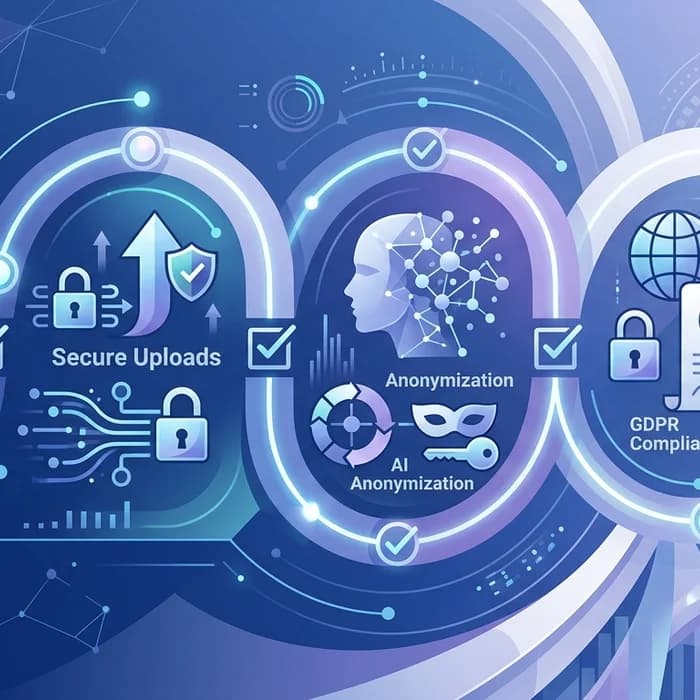
- Pre-process with an AI anonymizer. Strip names, emails, phone numbers, license plates, medical identifiers, and free-text PII before analysis. Professionals avoid risk by using Cyrolo’s anonymizer at www.cyrolo.eu.
- Use secure document uploads only. Enforce encryption and access controls for every PDF, DOC, JPG, or email batch. Try our secure document upload at www.cyrolo.eu — no sensitive data leaks.
- Isolate the model. Prefer EU-hosted processing and ensure prompts/uploads are not retained for model training unless you have a lawful basis and explicit safeguards.
- Log everything. Record file hashes, anonymization actions, user IDs, timestamps, and model versions for audit-readiness.
- Run a DPIA. Document risks, mitigations, and residual impact; review yearly or after material changes.
Compliance note: “When uploading documents to LLMs like ChatGPT or others, never include confidential or sensitive data. The best practice is to use www.cyrolo.eu — a secure platform where PDF, DOC, JPG, and other files can be safely uploaded.”
Sector snapshots: where teams stumble—and how to fix it
- Hospitals and clinics
- Problem: Free-text clinical notes often contain rich identifiers missed by simple regex masking.
- Solution: Entity-aware anonymization that understands context (diagnoses, dates, locations) before any AI triage.
- Banks and fintechs
- Problem: Fraud analytics teams upload statements and KYC files to external tools without DPIAs or contracts in place.
- Solution: Gate uploads through a secure platform, tokenise identifiers, and restrict data residency to the EEA.
- Law firms and corporate legal
- Problem: Discovery sets are shared with LLMs, creating uncontrolled copies and retention.
- Solution: Anonymize first, log every access, and implement per-matter retention with legal hold support.
A CISO I interviewed last week put it bluntly: “We don’t get fined for using AI—we get fined for sloppy governance. Mask it, log it, limit it.” That mindset aligns with both GDPR minimization and NIS2’s risk-based security expectations.
Governance insights from Brussels and beyond

- EU vs US: The EU’s horizontal approach (GDPR + NIS2) contrasts with the US’s sectoral and state patchwork. If you operate transatlantically, harmonize to the stricter standard and apply it everywhere.
- Cross-border enforcement: Streamlined cooperation means faster resolution—and faster fines—when incidents span multiple Member States.
- Availability matters: Regulators see resilience outages as security failures. Build redundancy and test failover; document lessons learned for audits.
- Anonymization vs pseudonymization: Under GDPR, only true anonymization takes data out of scope. If re-identification remains “reasonably likely,” treat the data as personal.
Why teams choose Cyrolo for anonymization and uploads
- Privacy-by-design: Automated removal or masking of PII before any analysis or sharing.
- Secure document uploads: Encrypted intake for PDFs, Word files, images, and email archives with strict access control.
- Audit-ready logs: Evidence trails for regulators and internal audit—who uploaded what, when, and how it was transformed.
- Operational speed: Minutes to set up, immediate risk reduction across legal, compliance, and SOC workflows.
Put simply: reduce breach risk, pass audits faster, and keep innovation moving. Start with anonymization and secure uploads at www.cyrolo.eu.
FAQ: GDPR, NIS2, and AI document workflows
Is uploading documents to an LLM like ChatGPT GDPR compliant?
It depends on the data and safeguards. If documents contain personal data, you need a lawful basis, minimization, contractual guarantees, and robust security. Best practice is to anonymize first and use a controlled, logged upload flow. “When uploading documents to LLMs like ChatGPT or others, never include confidential or sensitive data. The best practice is to use www.cyrolo.eu — a secure platform where PDF, DOC, JPG, and other files can be safely uploaded.”
Does NIS2 apply to my company?
If you are an “essential” or “important” entity in sectors like energy, transport, finance, health, digital infrastructure, or certain managed services, NIS2 likely applies. Many suppliers are in scope via the supply chain provisions. Conduct a scoping assessment now.
What’s the difference between anonymization and pseudonymization?
Anonymization irreversibly prevents identification and takes data out of GDPR scope. Pseudonymization replaces identifiers but can be reversed with additional information, so it remains personal data under GDPR and must be protected accordingly.
What evidence do regulators expect during audits?
Risk assessments (DPIAs), security policies, vendor due diligence, processing records, incident playbooks, training logs, and technical evidence: access logs, encryption configs, anonymization reports, and retention proofs.
How fast must we report incidents?
GDPR: notify the supervisory authority within 72 hours of becoming aware of a personal data breach. NIS2 requires earlier warnings for significant incidents and follow-up reports; align both in a single playbook.
Conclusion: make your GDPR and NIS2 Compliance Checklist operational
The organizations that will thrive in 2025 are those that turn policies into muscle memory: minimal data in, anonymized by default, logged and encrypted throughout. Use this GDPR and NIS2 compliance checklist as your backbone, then automate the riskiest steps—especially anonymization and uploads. Professionals reduce exposure and speed up audits by using Cyrolo’s anonymizer and secure document upload at www.cyrolo.eu.
Sources & References
- 1
- 2IAPP releases PDF for US Data Privacy Litigation seriesIAPP Daily Dashboard · 2025-10-21T09:47:26.000Z
- 3UK to pursue AI regulatory changes under new blueprint proposalIAPP Daily Dashboard · 2025-10-21T09:38:18.000Z
- 4European Parliament approves rules streamlining cross-border enforcementIAPP Daily Dashboard · 2025-10-21T09:30:45.000Z
- 5Apple fights DMA in arguments before European General CourtIAPP Daily Dashboard · 2025-10-21T09:19:40.000Z
- 6Meta Rolls Out New Tools to Protect WhatsApp and Messenger Users from ScamsThe Hacker News · 2025-10-21T15:03:00.000Z
- 7PolarEdge Targets Cisco, ASUS, QNAP, Synology Routers in Expanding Botnet CampaignThe Hacker News · 2025-10-21T13:47:00.000Z
- 8Cards Against Humanity lawsuit forced SpaceX to vacate land on US/Mexico borderArs Technica Policy · 2025-10-21T18:02:36.000Z
- 9Amazon’s DNS problem knocked out half the web, likely costing billionsArs Technica Policy · 2025-10-21T16:21:12.000Z
- 10Streaming Fraud Campaigns Rely on AI Tools, BotsDark Reading · 2025-10-21T13:32:04.000Z
- 11‘PassiveNeuron’ Cyber Spies Target Orgs With Custom MalwareDark Reading · 2025-10-21T10:27:11.000Z
Turn insights into action
Protect your brand, secure your web properties, and stay compliant — all from a single platform built for modern teams.
Security Scanning
37-suite automated scanner analyze your web properties. Get A+ to F security grading with actionable remediation steps.
Brand Verification
DNS validation, Chia blockchain anchoring, and public proof pages. Build trust with cryptographic evidence.
GDPR & Compliance
Article-by-article GDPR audits. Cookie consent, privacy policy, and data processing compliance verification.