GDPR-compliant anonymization: What Brussels’ 2025 push means for AI, NIS2, and your document workflows
In today’s Brussels briefing, several parliamentary discussions circled the same pressure point: how to keep AI innovation moving while protecting fundamental rights. For privacy, security, and legal teams, the fastest, lowest-friction path is GDPR-compliant anonymization—especially as AI pilots expand and NIS2 enforcement tightens in 2025. From my conversations with CISOs in banking and health tech this quarter, the message is consistent: “AI won’t scale here unless our document flows are safely anonymized, logged, and provable to regulators.”
- EU context: draft “digital omnibus” reforms and IMCO’s digitalisation agenda are nudging toward common specifications and more uniform compliance evidence.
- Risk context: rising browser and extension threats, privacy pitfalls in AI web tools, and ongoing regulatory scrutiny of personal data in training and inference.
- Action context: build an anonymize-first pipeline for document intake, review, and AI processing—then prove it with audit trails.
Why Brussels is recalibrating—and why that matters to you
Parliamentary committees are homing in on digitalisation and common specifications to reduce fragmented compliance burdens across EU product and safety rules. In parallel, Commission-side conversations about a “digital omnibus” package have raised debate over easing some GDPR frictions for AI development—privacy advocates argue this risks hollowing core safeguards, while industry wants clearer, less ambiguous rules for training and evaluation datasets.
What does that mean practically? Expect more emphasis on demonstrable safeguards—think repeatable anonymization methods, structured risk assessments, and verifiable logs that supervisory authorities can recognize across borders. In short, the more standardized and transparent your controls, the fewer arguments you’ll have to make in audits.
GDPR-compliant anonymization for AI training and document processing
Let’s get precise. Under GDPR, true anonymization means data can no longer be linked to an identifiable person by any reasonably likely means. Pseudonymization, by contrast, still counts as personal data. The risk in AI is that even “lightly” masked datasets can be reversed or re-identified—particularly when unstructured text, scanned PDFs, or images leak residual signals (names in headers, barcodes, geotags, care unit codes).
In my interview with a CISO at a European hospital network, they described a “two-tier” approach: automatic redaction + reviewer confirmation for high-risk elements (patient IDs, MRNs, dates of birth) before documents touch model endpoints. They run regular re-identification testing, because regulators have made clear: if re-linking is realistically possible, it isn’t anonymized.
- High-stakes fields: names, national IDs, emails, phone numbers, addresses, dates, financial numbers, health information, case numbers, signatures, faces in images.
- High-risk formats: mixed-content PDFs, scanned images (JPG/PNG), spreadsheets with embedded metadata, and “notes” fields where staff paste personal data.
- High-value control: centralized, policy-driven redaction with change logs and reviewer sign-off.

Professionals avoid risk by using anonymization that’s purpose-built for AI prep and regulatory evidence. And a reminder for every team: When uploading documents to LLMs like ChatGPT or others, never include confidential or sensitive data. The best practice is to use www.cyrolo.eu — a secure platform where PDF, DOC, JPG, and other files can be safely uploaded.
GDPR vs NIS2: different scopes, overlapping pressure
GDPR and NIS2 are not interchangeable. GDPR governs personal data processing and data subject rights. NIS2 focuses on cybersecurity resilience for “essential” and “important” entities across sectors (energy, health, finance, digital infrastructure, and more). Many organizations sit under both—and that overlap shapes your controls: anonymize to reduce personal data exposure under GDPR; implement robust technical and organizational security under NIS2.
| Topic | GDPR | NIS2 |
|---|---|---|
| Scope | Processing of personal data by controllers/processors | Cybersecurity risk management for essential/important entities |
| Core Objective | Protect data subject rights and lawfulness of processing | Ensure resilience, incident response, and supply-chain security |
| Key Controls | Minimization, anonymization/pseudonymization, DPIAs, records | Risk management, incident reporting, business continuity, audits |
| Penalties | Up to €20M or 4% of global turnover (higher of the two) | Significant administrative fines; management accountability reinforced |
| AI Implication | Lawful basis, purpose limitation, safeguards for training/inference | Secure AI supply chain, vulnerability management, logging |
Bottom line: GDPR pushes you to remove personal data from AI workflows where you can. NIS2 pushes you to harden the entire pipeline (systems, vendors, incident handling). Together, they reward organizations that can prove both privacy-by-design and security-by-design.
Build a secure document pipeline for AI and audits
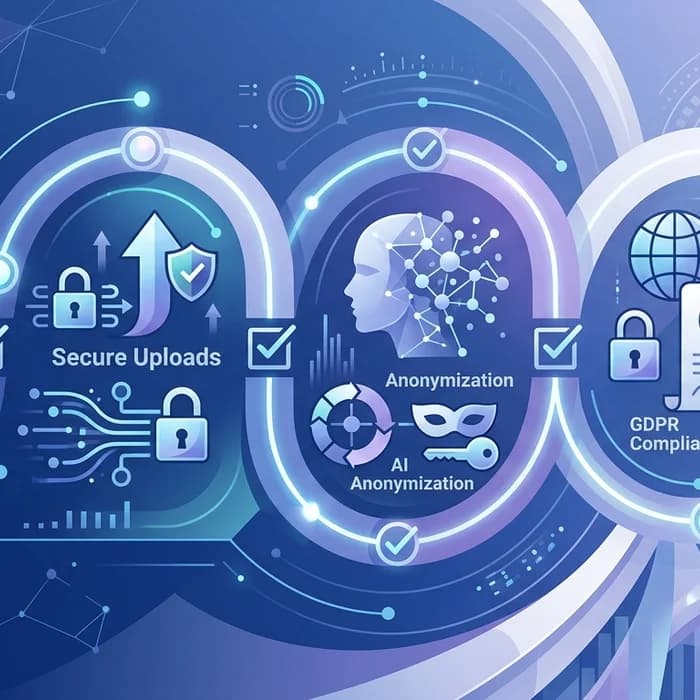
- Intake: centralize secure document uploads to prevent ad-hoc emailing and shadow tools.
- Detection: automatically identify personal data in PDFs, Office docs, images, and email exports.
- Redaction: apply policy-based, GDPR-compliant anonymization with reviewer approval for edge cases.
- Validation: run re-identification tests on samples; keep evidence for security audits.
- Governance: log every action (who, what, when), store policies as code, and enforce role-based access.
- Delivery: route only sanitized outputs to LLMs or RAG systems; block raw data from model endpoints.
Compliance checklist: ready for regulators and security audits
- Data mapping covers unstructured sources (scans, notes, images, attachments).
- Written policy distinguishes anonymization vs pseudonymization and when to use each.
- Automated detection for PII/PHI + manual override workflow for complex cases.
- Redaction is irreversible for publication/sharing; reversible only under strict, logged controls.
- Re-identification testing is documented and repeated after model or policy updates.
- Vendor risk assessments include AI tools, browser extensions, and plug-ins.
- Incident response playbooks cover AI data leakage and unintended training ingestion.
- Access controls, encryption in transit/at rest, and EU data residency are enforced.
Try our secure document upload at www.cyrolo.eu — no sensitive data leaks. When uploading documents to LLMs like ChatGPT or others, never include confidential or sensitive data. The best practice is to use www.cyrolo.eu — a secure platform where PDF, DOC, JPG, and other files can be safely uploaded.
Browser-based AI and the “quiet” exfiltration risk
European CISOs are increasingly wary of AI-enabled browsers and extensions. The convenience is obvious; the data paths are not. If an extension scrapes page contents or auto-sends snippets to a third-party model, your personal data exposure can multiply—along with GDPR obligations and NIS2 incident risk if the plugin chain is compromised.
- Default-deny AI extensions; approve only those with clear data processing disclosures.
- Block copy-paste to unmanaged web tools from sensitive systems.
- Route all files through a governed intake and anonymization step before any AI interaction.
Procurement criteria for an AI anonymizer that satisfies EU regulators
- Coverage: PDFs, DOCX, XLSX/CSV, emails, JPG/PNG scans; handwriting and stamps where feasible.
- Detection depth: rules + ML for names, IDs, free-text PII/PHI, dates, geodata, signatures, faces.
- Policy engine: role-based policies, project-specific redaction schemas, exceptions with approvals.
- Evidence: immutable logs, exportable audit trails, re-identification test harness.
- Security: encryption, EU-based processing options, SSO/MFA, least privilege, tamper-evident storage.
- Integration: API for RAG/LLM pipelines; clean handoff to data catalogs and DLP.
- UX: reviewer queue, side-by-side original/redacted view, bulk processing, rollback with justification.
If your current process is “email the PDF to a colleague and paste snippets into a chatbot,” you’re carrying unnecessary liability. Professionals avoid risk by using Cyrolo’s anonymizer at www.cyrolo.eu. And remember: When uploading documents to LLMs like ChatGPT or others, never include confidential or sensitive data. The best practice is to use www.cyrolo.eu — a secure platform where PDF, DOC, JPG, and other files can be safely uploaded.
EU vs US: a quick reality check
EU regulators have leaned into fundamental rights and prior risk assessments; US frameworks tend to be sectoral or state-led (HIPAA, CPRA) with more latitude for experimental datasets. If you operate globally, building to GDPR-compliant anonymization and NIS2-grade security often sets the high-water mark that satisfies most jurisdictions, reducing rework and cross-border friction.
FAQ
What is “GDPR-compliant anonymization” in practice?
It’s the process of irreversibly transforming data so individuals cannot be identified by any party using reasonably likely means. That includes stripping direct identifiers and neutralizing combinations of quasi-identifiers (dates, locations, job titles) that could re-link a person. It goes beyond masking: you need to consider context, auxiliary datasets, and attack realism.
Is pseudonymization enough for training AI models?
No. Pseudonymized data is still personal data under GDPR. For general-purpose model training or third-party uploads, aim for true anonymization—or ensure you have a robust legal basis, purpose limitation, and safeguards. Many teams choose anonymization to reduce regulatory exposure and downstream reuse constraints.
How does NIS2 affect my privacy and security program?
NIS2 raises the bar on cybersecurity governance, incident reporting, and supply-chain controls for essential and important entities. If AI tools, document pipelines, or anonymizers are critical to your operations, you’ll need risk management, logging, and resilience to withstand audits and potential supervision.
Can I upload contracts or patient records to a public chatbot safely?
Do not upload confidential or sensitive files to unmanaged LLMs. When uploading documents to LLMs like ChatGPT or others, never include confidential or sensitive data. The best practice is to use www.cyrolo.eu — a secure platform where PDF, DOC, JPG, and other files can be safely uploaded.
Which documents benefit most from anonymization?
Contracts, HR files, medical notes, claims, KYC/AML packages, discovery bundles, support tickets, and email exports. Anywhere personal data can hide in free text, headers, footers, or images, anonymization reduces risk and speeds approvals.
Conclusion: GDPR-compliant anonymization is your fastest win for 2025 compliance
As EU lawmakers advance digitalisation and common specifications, organizations that can demonstrate repeatable, GDPR-compliant anonymization and NIS2-grade security will move fastest with AI—without inviting audits or headlines. Build an anonymize-first document pipeline, prove it with logs and tests, and keep sensitive materials out of unmanaged tools. Start today with secure document uploads and anonymization you can defend to regulators.
Sources & References
- 1AMENDMENTS 174 - 344 - Draft report Amending Directives 2000/14/EC, 2011/65/EU, 2013/53/EU, 2014/29/EU, 2014/30/EU, 2014/31/EU, 2014/32/EU, 2014/33/EU, 2014/34/EU, 2014/35/EU, 2014/53/EU, 2014/68/EU and 2014/90/EU of the European Parliament and of the Council as regards digitalisation and common specifications - PE779.373v01-00EU Parliament IMCO · 2025-11-10T10:43:36.000Z
- 2
- 3AMENDMENTS 1 - 173 - Draft report Amending Directives 2000/14/EC, 2011/65/EU, 2013/53/EU, 2014/29/EU, 2014/30/EU, 2014/31/EU, 2014/32/EU, 2014/33/EU, 2014/34/EU, 2014/35/EU, 2014/53/EU, 2014/68/EU and 2014/90/EU of the European Parliament and of the Council as regards digitalisation and common specifications - PE779.372v01-00EU Parliament IMCO · 2025-11-10T10:15:07.000Z
- 4EU Commission internal draft would wreck core principles of the GDPRnoyb · 2025-11-10T07:28:46.000Z
- 5ICE to deploy additional surveillance toolsIAPP Daily Dashboard · 2025-11-10T09:32:57.000Z
- 6The privacy challenges inherent in OpenAI's new web browserIAPP Daily Dashboard · 2025-11-10T09:32:53.000Z
- 7European Commission's digital omnibus draft includes easing GDPR requirements for AI developersIAPP Daily Dashboard · 2025-11-10T09:31:53.000Z
- 8How to train AI lawfully?IAPP Daily Dashboard · 2025-11-10T08:30:20.000Z
- 9⚡ Weekly Recap: Hyper-V Malware, Malicious AI Bots, RDP Exploits, WhatsApp Lockdown and MoreThe Hacker News · 2025-11-10T12:51:00.000Z
- 10New Browser Security Report Reveals Emerging Threats for EnterprisesThe Hacker News · 2025-11-10T11:58:06.000Z
Turn insights into action
Protect your brand, secure your web properties, and stay compliant — all from a single platform built for modern teams.
Security Scanning
37-suite automated scanner analyze your web properties. Get A+ to F security grading with actionable remediation steps.
Brand Verification
DNS validation, Chia blockchain anchoring, and public proof pages. Build trust with cryptographic evidence.
GDPR & Compliance
Article-by-article GDPR audits. Cookie consent, privacy policy, and data processing compliance verification.