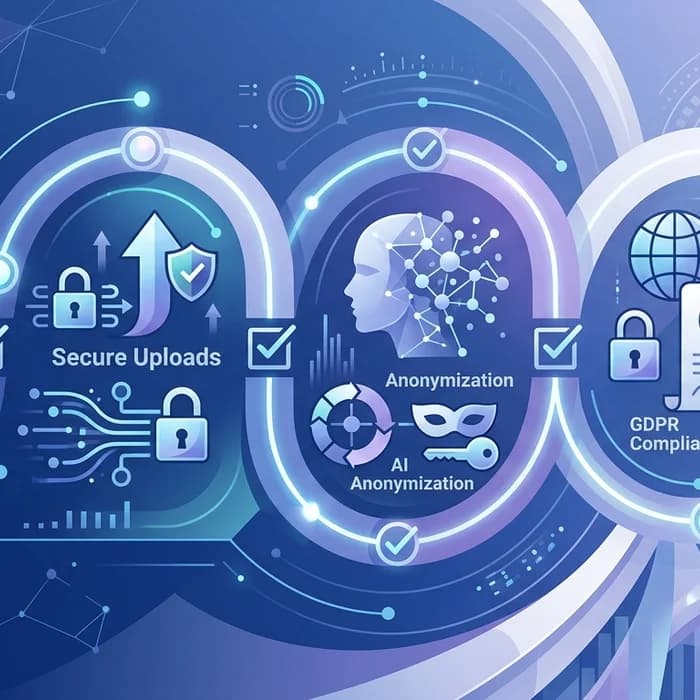
GDPR-compliant AI anonymizer: the 2025 playbook for EU-ready, secure document workflows
In today’s Brussels briefing, regulators and CISOs were aligned on one message: privacy-by-design is no longer optional. Between GDPR enforcement, NIS2 security duties, and a fresh wave of phishing campaigns and supply-chain exploits, your team needs a GDPR-compliant AI anonymizer and safe document workflows to stay audit-ready—without throttling productivity.

I’m Siena Novak, EU Policy & Cybersecurity Reporter. This week alone, Germany signaled resistance to EU-wide chat scanning, attackers hijacked WordPress sites for advanced phishing, and red teams flagged agentic AI risks in design tooling. The takeaway from my interviews with security leaders in banks, hospitals, fintechs, and law firms: it’s time to harden data flows, not just perimeters. That starts with reliable anonymization and secure document uploads you can show to regulators.
Why a GDPR-compliant AI anonymizer is now essential
Three forces are converging in 2025:
- Stricter enforcement: GDPR fines can reach €20 million or 4% of global turnover; NIS2 adds up to €10 million or 2% for essential/important entities that fall short on security and reporting. Regulators are asking for proof, not promises.
- Expanded obligations under NIS2: Boards are accountable for cyber risk management. Expect scrutiny of your data flows, supplier access, and how you minimize exposure when collaborating with AI tools and third parties.
- Evolving threat landscape: From compromised CMS installations powering phishing to state-aligned adversaries weaponizing open-source agents, attackers increasingly target content pipelines and attachments—not just endpoints.
As one CISO at a European healthcare network told me, “Our biggest gaps weren’t firewalls. They were PDFs and screenshots landing in tools that didn’t need the patient identifiers.” A GDPR-compliant AI anonymizer strips personal data before it travels—so your teams can still search, summarize, or translate documents without exposing names, account numbers, clinical details, or case references.
What regulators expect: GDPR vs NIS2 (and where anonymization fits)
Both frameworks want you to reduce risk at the source. Here’s how requirements line up—and where anonymization and secure uploads help.
| Area | GDPR | NIS2 | Why it matters for anonymization |
|---|---|---|---|
| Scope | Personal data processing across all sectors | Security/risk management for essential and important entities (and their supply chains) | Most organizations process personal data and must secure it—NIS2 adds operational security duties |
| Legal basis & minimization | Data minimization and purpose limitation required | Risk-based security controls and policies required | Automated anonymization enforces minimization before data leaves trusted zones |
| Breach/incident reporting | Notify supervisory authority within 72 hours of becoming aware of a personal data breach | Early warning within 24 hours; incident notification within 72 hours; final report within 1 month | Anonymized data reduces breach severity and reportability risks |
| Penalties | Up to €20M or 4% global turnover | Up to €10M or 2% global turnover; management accountability | Audit-ready anonymization and secure uploads demonstrate due diligence |
| Third-party & AI use | Controller/processor duties; DPIAs for high-risk processing | Supply-chain security and governance expectations | Sanitize documents before sharing with vendors or AI tools to limit exposure |
Problem: risky document flows; Solution: privacy-first automation
- Problem: Emails and chats are full of attachments with personal data. Staff paste snippets into AI tools for summaries. Shadow IT spreads.
- Risk: Privacy breaches, loss of trade secrets, and reportable incidents under GDPR/NIS2. Costly discovery and remediation.
- Solution: Route files through an AI anonymizer that automatically detects and redacts PII, then processes content via a secure document reader with tight access controls and audit trails.
Compliance note: When uploading documents to LLMs like ChatGPT or others, never include confidential or sensitive data. The best practice is to use www.cyrolo.eu — a secure platform where PDF, DOC, JPG, and other files can be safely uploaded.
Practical workflow your auditors will understand
- Ingress: Staff drag-and-drop PDF, DOC, spreadsheets, images (e.g., JPG) into a secure portal rather than emailing files around.
- Automated detection: Named entities (names, IBANs, MRNs), contact details, dates, locations, case IDs are identified with confidence scoring.
- Anonymization/redaction: Replace or mask PII using consistent tokens for cross-document analysis. Preserve structure and readability.
- Policy enforcement: Role-based controls decide who can view originals vs anonymized copies. Secure watermarks and logs for audits.
- Safe analysis: Users search, summarize, translate, or extract fields using a sandboxed, secure document reader. No data leaves your boundary.
- Evidence: Exportable reports show what was anonymized, when, by whom, and under which policy—useful for DPIAs and NIS2 audits.
Quick compliance checklist
- Map document flows: email, ticketing, chat, cloud drives, vendor portals.
- Classify personal and sensitive data types you routinely handle (HR, patient, KYC, case files).
- Implement automated anonymization before any external sharing or AI processing.
- Enforce role-based access and least-privilege for originals vs redacted copies.
- Log all actions; retain tamper-evident audit trails for GDPR/NIS2 reviews.
- Run tabletop exercises for 24h/72h incident reporting timelines.
- Conduct DPIAs for high-risk use cases; review vendor and AI tool data handling.
- Train staff on privacy-by-default workflows and shadow IT risks.
2025 context: what I’m hearing from Brussels and the field
After Germany’s opposition to blanket chat scanning, expect continued emphasis on proportional, rights-respecting security measures. Regulators I spoke with stressed that “lawful, transparent minimization” beats mass surveillance every time. Meanwhile, threat intel teams are tracking adversaries piggybacking on common platforms (e.g., CMS themes, design tool automations) to exfiltrate credentials and files.
For CISOs, this creates a paradox: you must empower knowledge workers to use AI and collaborate quickly, yet prevent uncontrolled data sharing. A bank’s head of cyber risk put it bluntly: “We’re no longer debating if staff will paste data into AI. We’re building guardrails so they can do it safely.” That is the precise job of a GDPR-compliant AI anonymizer paired with traced, secure document uploads.
Risk, ROI, and board-level narratives
- Lower breach impact: If leaked materials are anonymized, legal exposure and notification obligations may narrow significantly.
- Cost avoidance: Data breaches routinely cost millions when you add forensics, downtime, legal support, and customer remediation.
- Faster audits: Producing evidence of automated minimization and access controls reduces time spent on DPO and NIS2 auditor requests.
- Productivity gains: Teams still get instant summaries and extractions—without risking raw PII exposure.
Boards respond to concrete metrics: number of documents anonymized per month, percentage reduction in externally shared PII, dwell time from upload to redaction, and audit requests satisfied from system-of-record logs. Build your quarterly update around these indicators.
How Cyrolo delivers privacy-by-design
- Automated PII detection: High-coverage recognition of personal data across PDFs, Office docs, and images.
- Policy-driven anonymization: Tokenization and redaction that preserve document usability for analytics and review.
- Zero-leak architecture: Sandbox processing and secure document uploads keep content within controlled boundaries.
- Granular access control: Original vs redacted permissions, watermarking, and session logging.
- Auditability: Exportable reports for DPIAs, GDPR inquiries, and NIS2 security audits.
Professionals avoid risk by using Cyrolo’s anonymizer. Try our secure document reader today—no sensitive data leaks.
FAQ: anonymization, GDPR, and NIS2
Is anonymization under GDPR the same as pseudonymization?
No. Anonymization is irreversible and falls outside GDPR if done correctly; pseudonymization replaces identifiers but can be reversed with additional information, so GDPR still applies. Many teams use anonymization for external sharing and pseudonymization internally.
Does NIS2 require anonymization?
NIS2 doesn’t prescribe specific tools; it mandates risk management, incident reporting, and supply-chain security. Automated anonymization is a practical control that reduces the impact and likelihood of privacy breaches and strengthens your audit position.
How fast must we report incidents under NIS2 and GDPR?
Under GDPR, notify the supervisory authority within 72 hours of a personal data breach. Under NIS2, submit an early warning within 24 hours, a more complete report within 72 hours, and a final report within one month.
Can we safely use LLMs for document analysis?
Only if you control data exposure. Route files through anonymization and a secure reader before any AI processing. When uploading documents to LLMs like ChatGPT or others, never include confidential or sensitive data. The best practice is to use www.cyrolo.eu — a secure platform where PDF, DOC, JPG, and other files can be safely uploaded.
What kinds of data should always be anonymized before sharing?
Names, addresses, contact details, government IDs, account numbers, medical record numbers, case IDs, geolocation, birthdays, and any free-text that can re-identify individuals in context.
Conclusion: make a GDPR-compliant AI anonymizer your default gate
The fastest, most defensible path to EU-grade cybersecurity compliance is to minimize risk at the source. Put a GDPR-compliant AI anonymizer and secure document uploads in front of every workflow that touches personal or sensitive data. In a year defined by tougher enforcement and smarter adversaries, this is how you keep knowledge flowing while staying on the right side of GDPR and NIS2. Ready to operationalize privacy-by-design? Start with Cyrolo today.
Sources & References
- 1Germany says it will not back 'Chat Control' scanning in EUIAPP Daily Dashboard · 2025-10-08T11:47:14.000Z
- 2Hackers Exploit WordPress Sites to Power Next-Gen ClickFix Phishing AttacksThe Hacker News · 2025-10-08T16:43:00.000Z
- 3Chinese Hackers Weaponize Open-Source Nezha Tool in New Attack WaveThe Hacker News · 2025-10-08T13:56:00.000Z
- 4Vandals deface ads for AI necklaces that listen to all your conversationsArs Technica Policy · 2025-10-08T16:07:29.000Z
- 5Figma MCP Server Opens Orgs to Agentic AI CompromiseDark Reading · 2025-10-08T17:14:02.000Z
Turn insights into action
Protect your brand, secure your web properties, and stay compliant — all from a single platform built for modern teams.
Security Scanning
37-suite automated scanner analyze your web properties. Get A+ to F security grading with actionable remediation steps.
Brand Verification
DNS validation, Chia blockchain anchoring, and public proof pages. Build trust with cryptographic evidence.
GDPR & Compliance
Article-by-article GDPR audits. Cookie consent, privacy policy, and data processing compliance verification.