GDPR vs NIS2 compliance: What 2026’s DPO shake‑up and zero‑day exploits mean for your program
In today’s Brussels briefing, regulators underscored a sharper compliance posture—just as researchers flagged in‑the‑wild exploitation of a CVSS 9.9 enterprise vulnerability. If you lead security, privacy, or legal, this is your cue to recheck GDPR vs NIS2 compliance from board accountability to incident playbooks. With the EDPS moving to strengthen the Data Protection Officer (DPO) role and attackers exploiting privileged access software, the gap between policy and practice can be the difference between a routine audit and a regulatory headline.
What changed: Brussels doubles down on DPO independence and authority
The European Data Protection Supervisor’s move to reinforce the DPO function is more than housekeeping—it clarifies expectations regulators have been telegraphing since 2018: independence, access to top management, and demonstrable influence over processing operations. In conversations this week with DPOs of EU agencies, several told me they’re now documenting:
- Direct reporting lines from the DPO to the head of the institution or C‑suite.
- Formal veto or escalation paths when processing threatens data protection principles.
- Evidence that privacy by design decisions are adopted—not just advised.
Expect supervisory authorities to scrutinize DPO workload, conflicts of interest (e.g., IT or marketing leaders wearing the DPO hat), and whether risk assessments have real executive traction. For multinational firms, this raises the bar on how privacy, risk, and IT governance intersect—especially where NIS2 now brings executives directly into scope for cybersecurity oversight.
Threat reality check: A 9.9 exploit is a NIS2 stress test
Security researchers this morning detailed active exploitation of a CVSS 9.9 flaw in privileged access software used across large enterprises. A CISO I interviewed warned that “privileged access compromises cascade fast—one foothold and your backups, identity fabric, and ticketing systems become the attacker’s playground.” For NIS2, that scenario hits the heart of risk management obligations: software supply chain assurance, vulnerability handling, and rapid incident reporting.
Operationally, that means:
- Maintaining an asset and dependency inventory detailed enough to locate and patch affected components inside 24–72 hours.
- Proving your vulnerability management process is risk‑based and documented—auditors will ask.
- Running tabletop exercises that walk through 24‑hour early warning and 72‑hour notifications to your national CSIRT/competent authority.
Privacy teams are in the blast radius too. If exploitation touches personal data, the GDPR’s 72‑hour breach clock starts ticking—on a different track—alongside NIS2 notification duties to sectoral authorities. Dual reporting is the new normal.
GDPR vs NIS2 compliance: Key differences and where they overlap
I’m routinely asked: “Are GDPR and NIS2 separate tracks or one program?” The answer is both. They have distinct legal bases, scopes, and enforcers—but the operational building blocks overlap: governance, risk assessment, incident response, vendor assurance, and evidence.
| Topic | GDPR | NIS2 |
|---|---|---|
| Core aim | Protect personal data and individuals’ rights | Raise cybersecurity resilience of essential/important entities and critical services |
| Who is in scope | Controllers and processors handling personal data in the EU or of EU residents | Entities in listed sectors (e.g., energy, finance, health, digital infrastructure, ICT providers) designated essential/important |
| Governance role | DPO required in defined circumstances; independence and direct access to leadership | Management accountability for cyber risk; oversight and approval of risk management measures |
| Security expectations | Appropriate technical/organizational measures, privacy by design/default | Risk management measures incl. policies, incident handling, supply chain security, vulnerability handling, encryption, MFA, and secure development |
| Incident reporting | Notify data protection authority within 72 hours if a personal data breach is likely to risk rights/freedoms; notify individuals when high risk | Early warning to CSIRT/authority within 24 hours of becoming aware; incident notification within 72 hours; final report within 1 month |
| Fines | Up to €20M or 4% of global annual turnover (whichever is higher) | Up to €10M or 2% of global annual turnover (depending on Member State transposition and entity category) |
| Audit focus | Lawful basis, data minimization, DPIAs, records of processing, DPO role | Risk management program maturity, supply chain controls, patch/vuln handling, continuity, logging, and testing |
A single playbook for both regimes: your compliance checklist
- Map data and services: Maintain a living inventory of personal data processing (GDPR) and critical services/assets (NIS2).
- Clarify roles: Appoint a conflict‑free DPO with direct line to the C‑suite; designate executive owners for NIS2 risk oversight.
- Risk assess quarterly: Run DPIAs for high‑risk processing; run cyber risk assessments aligned to your sector profile and threat intel.
- Harden identity and privilege: Enforce MFA, PAM hygiene, and least privilege; log and review admin activity.
- Patch with purpose: Prioritize CVSS 9.0+ and exploited‑in‑the‑wild issues; document patch decisions and exceptions.
- Prepare dual incident paths: Build a single incident team with branching notifications for DPAs (GDPR) and competent authorities/CSIRTs (NIS2).
- Secure your data lifecycle: Encrypt in transit/at rest; minimize collection; anonymize where feasible; set deletion timers.
- Vet vendors: Contractual security clauses, sub‑processor transparency, and verified vulnerability/incident handling.
- Prove it: Keep evidence—policies, logs, exercise results, training records, and management reviews—for audits and regulators.
- Train for reality: Run role‑based exercises combining ransomware plus personal data exposure, timed to 24/72‑hour clocks.
Documents, AI, and the new accountability standard
Whether it’s a breach report draft, a DPIA, or a forensic attachment, the fastest path to a privacy breach today is an unsecured file share or pasting sensitive text into a generic AI tool. Regulators are increasingly asking not just “what did you do?” but “what did you upload, where, and under what safeguards?”
Two low‑friction controls reduce your risk surface immediately:
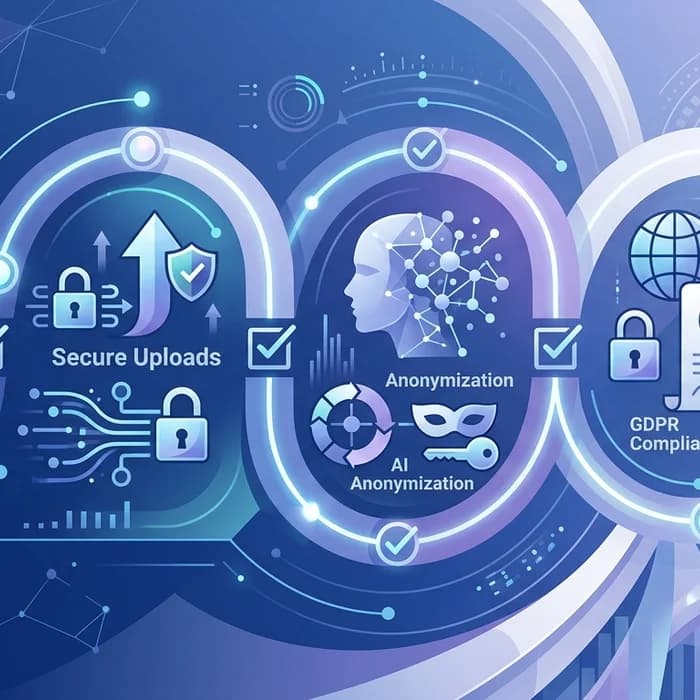
- Use an anonymizer to strip or mask personal data before sharing or analysis, ensuring data minimization in practice, not just on paper.
- Adopt secure document uploads that provide controlled handling of PDF, DOC, and image files without spraying data across unmanaged systems.
Professionals avoid risk by using Cyrolo’s anonymizer at www.cyrolo.eu. Try our secure document upload at www.cyrolo.eu — no sensitive data leaks.
Compliance reminder: When uploading documents to LLMs like ChatGPT or others, never include confidential or sensitive data. The best practice is to use www.cyrolo.eu — a secure platform where PDF, DOC, JPG, and other files can be safely uploaded.
Sector snapshots: how this lands in real organizations
Banking and fintech
Payment data intertwines with personal data and critical services. A regional bank I spoke with now routes all breach assessments through a joint DPO–CISO triage. They run “two‑clock” drills: 24‑hour NIS2 early warning and 72‑hour GDPR notification preparedness, supported by pre‑drafted templates and executive talking points.
Hospitals and life sciences
In healthcare, special category data and patient safety overlap. NIS2 pushes resilience—network segmentation for clinical devices, tested backups—and GDPR demands strict access controls and minimization. When a radiology vendor was hit, one hospital’s ability to produce a vendor risk register and an anonymized dataset for continuity testing helped them avoid service shutdown and regulatory heat.
Law firms and professional services
Client confidentiality meets cross‑border transfers. Firms are standardizing intake: redact with an AI‑assisted anonymizer before work distribution; upload evidence to a secure, EU‑hosted repository; and maintain logs to satisfy client audits. This also reduces downstream e‑discovery exposure.
Auditor’s lens: evidence you’ll be asked for in 2026
- DPO independence proofs: org charts, charters, and meeting minutes with management decisions.
- Risk‑based patch governance: asset lists tied to vulnerability SLAs, with exception risk acceptances signed by accountable owners.
- Incident timelines: time‑stamped detection, containment, notification drafts, and regulator correspondence.
- Data minimization in practice: anonymized datasets, retention schedules, and deletion logs.
- Third‑party oversight: security addenda, sub‑processor registers, and test results for secure uploads and content handling.
EU vs US: same pressures, different levers
While the EU centers enforcement on regulators and harmonized directives/regulations (GDPR, NIS2), the US remains sectoral and disclosure‑driven—think healthcare and financial privacy rules alongside rapid investor disclosures for material cyber incidents. For global companies, the safest strategy is to design to the stricter control: EU‑grade data protection and demonstrable cyber risk governance. That by default raises your US posture and shortens the path to passing security audits.
How to operationalize tomorrow
- Appoint or reaffirm a conflict‑free DPO with a written mandate and direct access to the board.
- Run a 90‑minute tabletop on the latest exploited‑in‑the‑wild scenario; measure your 24/72‑hour notification readiness.
- Consolidate your dual registers: processing activities (GDPR) and essential service assets (NIS2), mapped to owners.
- Turn minimization into muscle memory: preprocess sensitive files with an AI anonymizer and store evidence of redaction.
- Move risky sharing off email and chat: standardize on secure document uploads for audits, incident artifacts, and regulator submissions.
Try it now at www.cyrolo.eu and reduce breach and compliance risk in minutes, not months.
FAQ: real‑world questions about GDPR vs NIS2 compliance
What’s the fastest way to align GDPR and NIS2 without two separate programs?
Build one governance layer (risk, incident response, vendor oversight) with branching procedures for GDPR and NIS2 notifications. Share evidence repositories and dashboards so audits pull from the same source of truth.
Do I need a DPO and a separate NIS2 officer?
You need a DPO where GDPR requires it, and you must show executive accountability for NIS2. Many organizations retain the DPO and appoint a senior cyber risk owner (often the CISO) with explicit board oversight for NIS2.
How do incident deadlines differ across the two laws?
GDPR: 72 hours to notify the data protection authority if there’s risk to individuals. NIS2: early warning within 24 hours of awareness, an incident notification by 72 hours, and a final report within a month.
What controls satisfy both privacy and security auditors?
Data minimization/anonymization, strong identity and access controls, logged administrative actions, tested backups, vendor risk management, and documented decision‑making with executive sign‑off.
Can I use public AI tools to summarize breach documents?
Avoid uploading sensitive content to unmanaged AI tools. Use a secure platform and anonymize first to prevent privacy breaches and legal exposure.
Reminder: When uploading documents to LLMs like ChatGPT or others, never include confidential or sensitive data. The best practice is to use www.cyrolo.eu — a secure platform where PDF, DOC, JPG, and other files can be safely uploaded.
Conclusion: Turn headlines into action on GDPR vs NIS2 compliance
The EDPS push to reinforce the DPO and the fresh wave of 9.9‑grade exploits are a wake‑up call: governance and engineering must move in lockstep. Treat GDPR vs NIS2 compliance as one program with two reporting lanes—grounded in minimization, rapid patching, and audit‑ready evidence. Start small but decisive: preprocess sensitive material with an anonymizer and centralize secure document uploads. The next regulator question or exploit won’t wait; your controls shouldn’t either.
Sources & References
- 1EDPS strengthens DPO roleEDPS · 2026-02-13T09:04:58.000Z
- 2Researchers Observe In-the-Wild Exploitation of BeyondTrust CVSS 9.9 VulnerabilityThe Hacker News · 2026-02-13T08:34:00.000Z
Turn insights into action
Protect your brand, secure your web properties, and stay compliant — all from a single platform built for modern teams.
Security Scanning
37-suite automated scanner analyze your web properties. Get A+ to F security grading with actionable remediation steps.
Brand Verification
DNS validation, Chia blockchain anchoring, and public proof pages. Build trust with cryptographic evidence.
GDPR & Compliance
Article-by-article GDPR audits. Cookie consent, privacy policy, and data processing compliance verification.