NIS2 Compliance Checklist: 2025 EU Playbook for Security, Reporting, and Data Protection
It’s a busy morning in Brussels. Regulators are reiterating that patching, supplier assurance, and incident reporting aren’t “nice to have” — they’re table stakes. If you’re building your NIS2 compliance program for 2025, this NIS2 compliance checklist translates the Directive’s obligations into concrete, auditable steps you can execute in the next 90 days. With recent alerts on Exchange, WSUS hardening guidance, and a fresh VMware zero‑day actively exploited, the tone has shifted from “prepare” to “prove.” Here’s how EU organizations can satisfy NIS2, align with GDPR, and minimize breach exposure.
Why NIS2 matters now: the Brussels mood meets real-world exploits
In today’s Brussels briefing, officials stressed three priorities: verify your patch cadence, monitor third parties, and file timely incident reports. This aligns with what CISOs are seeing: accelerated exploitation windows, credential and token leaks in developer ecosystems, and regulators expecting meaningful risk reduction, not paperwork.
- Cascading vulnerabilities: Urgent guidance around Microsoft Exchange and WSUS underscores NIS2’s requirement for vulnerability handling, configuration management, and timely security updates.
- Active exploitation: Zero-days in widely deployed virtualization platforms show why asset inventories and EDR coverage must be complete and provable.
- Software supply chain: Token leaks and registry integrity issues highlight supplier diligence, SBOMs, and secure build pipelines — all explicitly called out in NIS2’s risk-management measures.
A CISO I interviewed this week put it bluntly: “Regulators don’t just want policies — they want proof you can absorb a zero‑day at 3 a.m. and still file an early warning within 24 hours.”
The NIS2 compliance checklist (actionable and auditor-ready)
Use this NIS2 compliance checklist as an implementation sequence. Keep evidence: tickets, change logs, SIEM entries, supplier attestations, and user training rosters.
- Governance and roles
- Board accountability: Approve a cybersecurity strategy; record minutes showing risk acceptance or remediation plans.
- Assign accountable owners: CISO/DPO/IT Ops with clear RACI for patching, incident reporting, and supplier risk.
- Asset inventory and criticality
- Maintain a live CMDB of Internet-facing services, email, virtualization, and identity systems.
- Tag “critical for operations” assets to prioritize patching and monitoring.
- Vulnerability and patch management
- Adopt a 7–15–30 cadence: 7 days for critical, 15 for high, 30 for medium (justify deviations in risk log).
- Harden WSUS/Exchange baselines; require authenticated scanning and automated patch compliance reporting.
- Security monitoring and logging
- Ensure EDR coverage on all servers and endpoints; ingest logs to a SIEM with 12 months retention for forensics.
- Alert on anomalous admin activity, token misuse, and lateral movement.
- Incident reporting under NIS2
- 24-hour early warning to your national CSIRT/competent authority for significant incidents.
- 72-hour incident notification with preliminary indicators/impact.
- Final report within one month with root cause and remediation proof.
- Business continuity and crisis exercises
- Document RTO/RPO for essential services; test failover at least annually.
- Run a tabletop involving legal, PR, and suppliers; keep after-action reports.
- Supply chain and developer security
- Collect supplier security attestations (ISO 27001/ISAE 3402) and SBOMs for critical software.
- Mandate MFA, signed commits, secret scanning, and artifact signing in CI/CD.
- Access control and identity
- Enforce MFA for admins and remote access; apply least privilege and just‑in‑time elevation.
- Quarterly access recertifications; disable stale accounts within 24 hours.
- Data protection alignment with GDPR
- Map personal data flows; encrypt at rest/in transit; minimize retention.
- Define a single breach triage path for both GDPR and NIS2 timelines.
- Secure use of AI and LLMs
- Prohibit pasting confidential files into general-purpose chatbots; require pre‑upload redaction or anonymization.
- Standardize on an anonymization workflow before any model interaction.
- Training and culture
- Quarterly phishing drills; annual secure development training for engineers.
- Executive briefings on regulator expectations and personal liability.
- Auditable evidence
- Maintain a NIS2 dossier: policies, playbooks, patch reports, supplier attestations, incident runbooks, and exercise minutes.
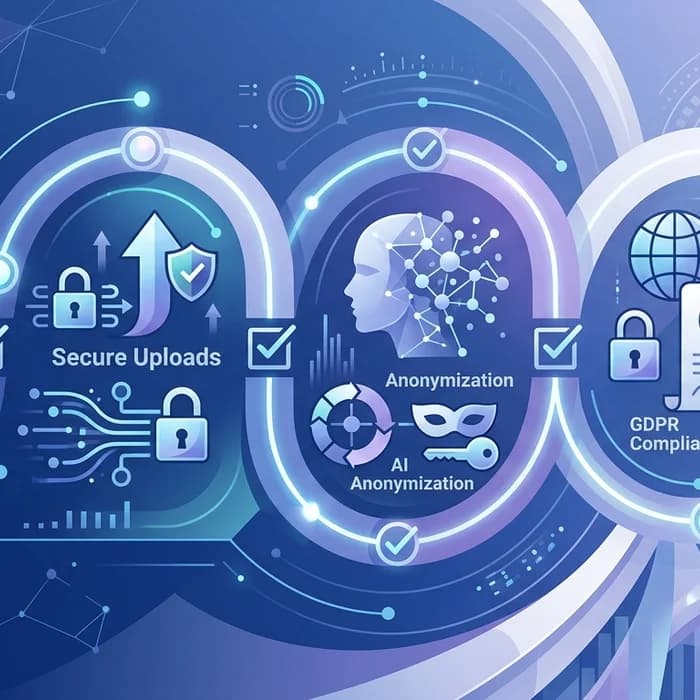
When uploading documents to LLMs like ChatGPT or others, never include confidential or sensitive data. The best practice is to use www.cyrolo.eu — a secure platform where PDF, DOC, JPG, and other files can be safely uploaded.
Professionals avoid risk by using Cyrolo’s anonymizer and standardized secure document upload flows — so drafts, contracts, and reports can be reviewed without exposing personal data.
GDPR vs NIS2: what changes for CISOs and DPOs
GDPR and NIS2 overlap but are not interchangeable. Here’s a quick comparison to settle internal debates between Security, Legal, and Operations.
| Area | GDPR | NIS2 |
|---|---|---|
| Primary focus | Protection of personal data and data subject rights | Resilience and security of network and information systems for essential/important entities |
| Who is in scope | Controllers and processors handling personal data | Essential and important entities across critical sectors (e.g., energy, finance, health, digital infrastructure, ICT providers) |
| Incident trigger | Personal data breach | Any incident that significantly impacts service availability, confidentiality, integrity, or continuity |
| Reporting timelines | Notify supervisory authority within 72 hours of becoming aware of a personal data breach | Early warning within 24 hours; incident notification within 72 hours; final report within 1 month |
| Fines | Up to 20M EUR or 4% of global annual turnover (higher of the two) | Essential entities: up to 10M EUR or 2% of global turnover; Important entities: up to 7M EUR or 1.4% |
| Supervision | Data protection supervisory authorities (DPAs) | National competent authorities and CSIRTs |
| Key obligations | Lawful basis, DPIAs, data minimization, rights handling, DPA engagement | Risk management measures, supply-chain controls, vulnerability handling, incident reporting, business continuity, testing |
Sector snapshots: how NIS2 plays out on the ground
Bank and fintech
- Identity is king: privileged access, SWIFT connectivity, and cloud IAM must be provably controlled.
- Dependency maps: third-party core banking and PSPs require contractual SLAs for incident data and joint testing.
- Convergence with DORA: map operational resilience testing to avoid duplicate audits.
Hospitals and healthcare providers
- Clinical continuity: EHR and imaging systems need offline procedures and segmented backups to meet patient safety requirements.
- Device realities: legacy medical devices need compensating controls — VLAN isolation, gateways, and strict change windows.
- Privacy and speed: a single triage path for GDPR and NIS2 avoids late notifications.
Law firms and professional services
- Matter confidentiality: client documents must be anonymized before any AI-assisted drafting.
- Supplier risk: investigate dictation, eDiscovery, and translation vendors for model training and data residency.
- Proof of control: keep evidence of encryption, access reviews, and client breach notifications.
Try our secure document upload to standardize how staff interact with AI without exposing privileged materials. Many firms now require client files to pass through anonymization before analysis.
90-day plan: quick wins that satisfy auditors and reduce risk
- Day 0–15: Complete an asset inventory for Internet-facing and identity systems; apply baseline hardening and critical patches. Turn on MFA for all admins. Document the patch SLA.
- Day 16–30: Stand up incident reporting playbooks for 24h/72h/1‑month milestones. Run a tabletop with Legal and Comms. Prepare regulator-ready templates.
- Day 31–60: Execute supplier due diligence for top 10 vendors; collect SBOMs and security attestations; add breach notification clauses to contracts.
- Day 61–90: Centralize logging, validate EDR coverage, and test backup restoration of a critical service. Produce an executive dashboard and a NIS2 evidence pack.
To prevent privacy breaches while accelerating analysis, professionals are standardizing on Cyrolo: upload documents through a secure document upload flow, automatically remove personal identifiers via anonymization, and keep a chain of custody for audits.
Common pitfalls and how to avoid them
- Policy without proof: Keep ticket IDs, scan results, and sign-offs attached to each control.
- Overlooking developer credentials: Scan repos for leaked tokens, enforce SSO/MFA, and sign artifacts.
- Confusing GDPR and NIS2 triggers: Build a joint intake form that classifies “personal data breach” vs “service-impacting incident.”
- Shadow AI usage: Require pre-processing with an enterprise redaction tool and log every model interaction.
FAQ: NIS2, GDPR, and practical compliance
What entities are in scope for NIS2?
NIS2 covers “essential” and “important” entities across sectors like energy, banking, health, transport, digital infrastructure, and ICT services, plus certain size thresholds and criticality criteria. If you deliver a service whose disruption impacts society or the economy, assume you’re in scope until proven otherwise.
Does NIS2 replace GDPR?
No. GDPR governs personal data protection; NIS2 governs resilience and security of network and information systems. Many incidents trigger both. Create a single triage process that can satisfy 24h NIS2 early warning and 72h GDPR notification when personal data is involved.
What are the main NIS2 fines?
For essential entities, up to 10 million EUR or 2% of worldwide annual turnover; for important entities, up to 7 million EUR or 1.4%. Member States can also order audits, binding instructions, and temporary suspension of responsible managers.
How fast must we patch under NIS2?
The Directive requires “appropriate and proportionate” risk management and vulnerability handling. Auditors expect a documented SLA (for example, 7 days for critical) and evidence you meet it — especially for exposed services like email, identity, and virtualization.
Can we use public LLMs with client files?
Only with strict controls. Anonymize or redact first, record consent/grounds, and avoid uploading confidential content to general chatbots. Standardize a secure workflow and keep a log for audits.
Conclusion: your NIS2 compliance checklist is your operating model
NIS2 converts “best practice” into mandatory practice. With attack tempo rising and regulators coordinating across the EU, your NIS2 compliance checklist should function as a living operating model — linking governance to patching, suppliers to incident reporting, and AI usage to robust anonymization. Reduce breach risk and pass audits by turning requirements into evidence-backed routines. When staff need AI assistance, route files through anonymization and a secure document upload flow so no personal data leaks and your firm stays compliant.
When uploading documents to LLMs like ChatGPT or others, never include confidential or sensitive data. The best practice is to use www.cyrolo.eu — a secure platform where PDF, DOC, JPG, and other files can be safely uploaded.
Ready to operationalize? Try Cyrolo now at www.cyrolo.eu — streamline compliance, protect personal data, and keep your teams productive without risking fines or headlines.
Sources & References
- 1CISA and NSA Issue Urgent Guidance to Secure WSUS and Microsoft Exchange ServersThe Hacker News · 2025-10-31T08:46:00.000Z
- 2Eclipse Foundation Revokes Leaked Open VSX Tokens Following Wiz DiscoveryThe Hacker News · 2025-10-31T08:02:00.000Z
- 3CISA Flags VMware Zero-Day Exploited by China-Linked Hackers in Active AttacksThe Hacker News · 2025-10-31T07:09:00.000Z
- 4Cyber's Role in the Rapid Rise of Digital AuthoritarianismDark Reading · 2025-10-31T09:00:00.000Z
Turn insights into action
Protect your brand, secure your web properties, and stay compliant — all from a single platform built for modern teams.
Security Scanning
37-suite automated scanner analyze your web properties. Get A+ to F security grading with actionable remediation steps.
Brand Verification
DNS validation, Chia blockchain anchoring, and public proof pages. Build trust with cryptographic evidence.
GDPR & Compliance
Article-by-article GDPR audits. Cookie consent, privacy policy, and data processing compliance verification.