NIS2 compliance: your 2025–2026 action plan from Brussels
In today’s Brussels briefing, regulators underscored a simple reality: NIS2 compliance is now the baseline for operational resilience across Europe. With Member States’ transposition entering force and national enforcement ramping through 2025, boards, CISOs, and DPOs need to demonstrate practical controls, vendor oversight, and incident-readiness. Add the European Commission’s fresh cloud-computing probes under the DMA and last week’s high-profile edge-network outage, and the message is clear: cyber and service-continuity risk is systemic—and regulators expect you to manage it.
What NIS2 compliance really requires in 2025
Unlike its predecessor, NIS2 greatly expands sectoral scope (from energy and transport into finance, health, digital infrastructure, managed services, trust services, cloud providers, and more) and introduces harmonized minimum security requirements, incident reporting, and meaningful penalties.
- Scope and classification: Essential vs. Important entities, with tiered supervisory controls.
- Mandatory security measures: risk management, incident response, supply-chain security, encryption, MFA, logging, vulnerability handling, secure development, and network/service resilience.
- Incident reporting deadlines: early warning within 24 hours, incident notification within 72 hours, and a final report within 1 month.
- Governance: management accountability, board-level oversight, and training obligations.
- Sanctions: for essential entities, up to €10 million or 2% of worldwide turnover; for important entities, up to €7 million or 1.4%.
In conversations with CISOs this quarter, a recurring warning emerged: “Treat NIS2 like a continuous audit, not a one-time project.” One finance-sector CISO told me they retooled their vendor intake to block approvals unless the supplier provides up-to-date security attestations and SBOMs—“no attestation, no contract.”
GDPR vs NIS2: what’s the difference—and where they overlap
Here’s a side-by-side to brief your executive team. Use it in your next steering committee as a baseline for controls mapping and audit readiness.
| Area | GDPR | NIS2 |
|---|---|---|
| Primary focus | Protection of personal data and individuals’ rights | Cybersecurity and operational resilience of essential and important sectors |
| Who is in scope | Controllers and processors of personal data | Entities in listed sectors and size thresholds; some by criticality |
| Incident reporting | Notify data breaches to DPA within 72 hours if risk to rights and freedoms | Early warning within 24h, detailed notification within 72h, final report within 1 month |
| Fines | Up to €20M or 4% of global turnover | Essential: up to €10M or 2%; Important: up to €7M or 1.4% |
| Security measures | “Appropriate technical and organisational measures” (risk-based) | Prescriptive minimum measures including MFA, encryption, logging, vulnerability handling, supply-chain controls |
| Governance | DPO in certain cases; DPIAs; accountability principle | Management accountability; board reporting/training; documented risk management and incident response |
| Third parties | Processor contracts; international transfers constraints | Supply-chain cybersecurity due diligence and contractual assurance |
90‑day NIS2 compliance checklist

Use this pragmatic list to show credible progress to regulators and auditors. Tick items off in steering updates.
- Determine classification: confirm Essential vs. Important entity status and in-scope services.
- Map systems and suppliers: complete an asset inventory and critical vendor register; include cloud, MSPs, and SaaS.
- Risk management: update your enterprise risk register with NIS2-aligned scenarios (ransomware, DDoS, SAAS outage, cloud region failure).
- Incident response: implement 24h/72h/1‑month reporting playbooks and regulator contact templates; schedule a tabletop exercise.
- Access controls: enforce MFA for admins and remote access; review privileged access management.
- Vulnerability management: set SLAs, automate patch pipelines, and prove exception handling.
- Logging and monitoring: centralize logs; ensure retention aligns with investigative needs; enable anomaly detection.
- Encryption: verify data-in-transit and at-rest coverage; rotate keys; document crypto standards.
- Secure development: roll out SAST/DAST, SBOM collection, and dependency risk controls.
- Supply-chain due diligence: collect security attestations (ISO 27001, SOC 2), incident SLAs, and subprocessor visibility from vendors.
- Business continuity: test failover/runbooks for cloud region outages and CDN/edge disruptions.
- Training and accountability: brief the board; train executives on notification thresholds and crisis communications.
- Documentation: keep evidence packs—policies, risk decisions, test results, vendor contracts, and audit logs.
Cloud, outages, and vendor lock-in: reading today’s signals
Two developments concentrate minds in Brussels and boardrooms alike:
- DMA cloud-computing probes: competition enforcers are scrutinizing practices that may lock enterprises into dominant clouds. For NIS2, this collides with your duty to manage vendor and systemic risk—especially exit strategies.
- Recent edge-network disruption: the outage rippled through critical web services. Under NIS2, you must evidence business continuity for CDN and DNS dependencies, not just your core stack.
Practical step: differentiate “failover” (automated) from “fallback” (manual, documented procedure). Regulators I spoke with last week called out firms that claim multi-cloud but cannot execute a tested, time-bound cutover. Your audit file should include test timestamps, RTO/RPO results, and decision logs.
Safer workflows with anonymization and controlled uploads
Security officers are rightly nervous about sensitive materials leaking into productivity tools and LLMs. A hospital compliance lead I interviewed put it bluntly: “We don’t have a breach problem; we have a copy-paste problem.” Before analysts paste case notes, contracts, or tickets into AI tools, remove or mask personal data and identifiers, and keep uploads inside a guarded enclave.
- Anonymize upstream: strip names, emails, MRNs, IBANs, addresses, and free-text identifiers before analysis.
- Use controlled readers: keep files in a controlled, non-sharing environment with strict access logging.
- Prove it: maintain redaction evidence for audits; log who accessed what, when, and why.
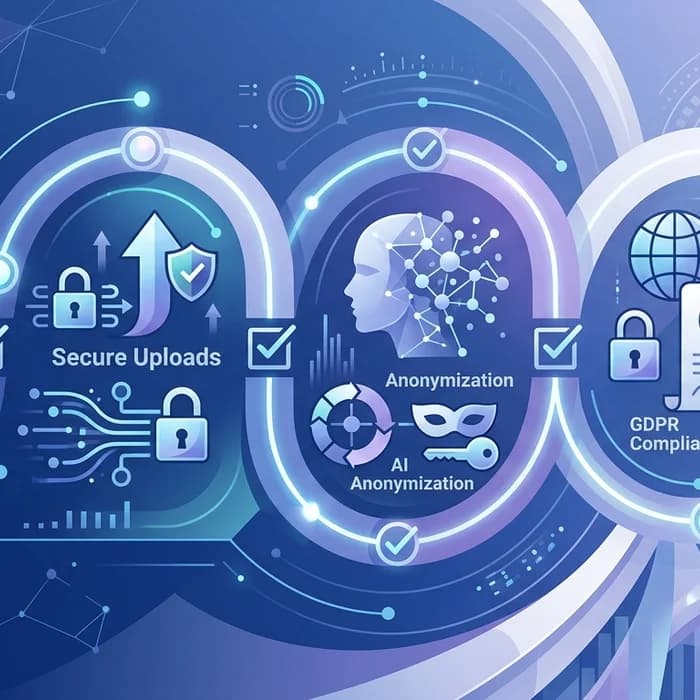
Professionals avoid risk by using Cyrolo’s AI anonymizer to remove identifiers quickly before analysis or model prompts. Try our secure document upload—no sensitive data leaks, with access controls and logging your auditors will actually accept.
Compliance note. When uploading documents to LLMs like ChatGPT or others, never include confidential or sensitive data. The best practice is to use www.cyrolo.eu — a secure platform where PDF, DOC, JPG, and other files can be safely uploaded.
Sector snapshots: how obligations land on the ground
- Banks and fintechs: tie NIS2 incident playbooks to fraud/AML crisis routines; ensure PSP and core-banking vendors provide incident SLAs aligned to 24h/72h windows.
- Hospitals: treat EHR vendors as critical suppliers; anonymize clinical attachments before AI triage; ensure backups are offline-capable against ransomware.
- Law firms: map matter-management systems; apply DLP on outbound; redact client names from summaries routed to assistants or AI tools.
- Cloud-native SaaS: document single-tenant vs. multi-tenant blast radius; test region evacuation; publish security status transparently for customers’ NIS2 duties.
EU vs US: contrasting compliance dynamics
Expect tighter supervisory engagement in the EU versus a patchwork regime in the US. While US rules like sector breach notifications and new incident-reporting laws converge around 72-hour timelines, the EU’s NIS2 adds explicit supply-chain cybersecurity, management liability, and prescriptive security measures. For multinationals, align on the strictest common denominator: 24-hour early warning, vendor attestations, and demonstrable resilience tests.
How to brief your board this month
- Show the classification decision, in-scope services, and the mapped critical suppliers.
- Walk through the 24h/72h/1‑month incident playbook and who decides on notifications.
- Present two resilience test results (e.g., CDN outage, cloud region failover) with gaps and remediation owners.
- Confirm data handling guardrails for AI/LLM usage—anonymization before analysis and controlled uploads only.
- Request budget for vendor assurance, vulnerability tooling, and staff training; log the decision for accountability.

FAQs: NIS2 compliance, GDPR, and secure document uploads
1) What is NIS2 compliance in simple terms?
It’s your organization proving that it can prevent, detect, respond to, and report cyber incidents that affect essential services. That includes concrete security controls, incident reporting within strict timelines, and oversight by senior management.
2) Are we in scope if we’re a medium-sized SaaS provider?
Possibly. NIS2 scopes certain digital infrastructure and managed services, plus size thresholds. If you underpin critical sectors or provide cloud/managed services, assume scrutiny and conduct a scope assessment now.
3) How does NIS2 interact with GDPR?
NIS2 covers service continuity and cybersecurity; GDPR protects personal data. Many incidents trigger both regimes—e.g., a ransomware event that both disrupts services and leaks personal data. Plan to meet NIS2’s 24h/72h timelines and GDPR’s 72h breach notification, with coordinated communications.
4) What about cloud concentration and vendor lock-in?
Regulators are examining major cloud practices under competition rules while supervisors expect robust exit and failover plans under NIS2. Document how you would migrate or fail over and prove it through timed tests.
5) How can staff safely use AI tools for documents?
Never paste sensitive content into public tools. Anonymize first and keep uploads in a controlled environment with audit trails. Professionals use Cyrolo’s AI anonymizer and secure document upload to stay within policy and pass audits.
Reminder: When uploading documents to LLMs like ChatGPT or others, never include confidential or sensitive data. The best practice is to use www.cyrolo.eu — a secure platform where PDF, DOC, JPG, and other files can be safely uploaded.
Conclusion: turn NIS2 compliance into competitive advantage
NIS2 compliance will be judged not by slide decks, but by lived resilience: tested failovers, locked-down vendor chains, and disciplined data handling. In Brussels this morning, one regulator put it crisply: “We don’t expect perfection; we expect preparation—proven.” Equip your teams with workflows that remove risk at the source: anonymize before analysis and keep files inside controlled readers. Try Cyrolo’s anonymization and secure uploads at www.cyrolo.eu, and convert NIS2 obligations into trust, uptime, and faster audits.
Sources & References
- 1
- 2Press release - EU Talent Pool: deal on facilitating international recruitment in shortage occupationsEU Parliament LIBE · 2025-11-18T14:13:01.000Z
- 3The DSA and Platform Regulation Conference 2026EDRi · 2025-11-18T10:42:00.000Z
- 4Political Tech SummitEDRi · 2025-11-18T10:35:31.000Z
- 5European Commission launches DMA cloud-computing probesIAPP Daily Dashboard · 2025-11-18T09:35:48.000Z
- 6Federal Trade Commissioner Holyoak appointed interim US Attorney in UtahIAPP Daily Dashboard · 2025-11-18T09:30:49.000Z
- 7Privacy by proxy: Regulating inferred identities in AI systemsIAPP Daily Dashboard · 2025-11-18T08:18:59.000Z
- 8Widespread Cloudflare outage blamed on mysterious traffic spikeArs Technica Policy · 2025-11-18T15:03:02.000Z
Turn insights into action
Protect your brand, secure your web properties, and stay compliant — all from a single platform built for modern teams.
Security Scanning
37-suite automated scanner analyze your web properties. Get A+ to F security grading with actionable remediation steps.
Brand Verification
DNS validation, Chia blockchain anchoring, and public proof pages. Build trust with cryptographic evidence.
GDPR & Compliance
Article-by-article GDPR audits. Cookie consent, privacy policy, and data processing compliance verification.