NIS2 compliance in 2025: your practical EU playbook for CISOs, DPOs, and legal teams
In today’s Brussels briefing and industry chatter, one phrase keeps circling every board agenda: NIS2 compliance. With national transpositions bedding in across the EU and regulators signaling stricter security audits, organizations can’t afford gaps in incident reporting, supply chain controls, or data protection when using AI or handling unstructured files. Below is a field-tested plan to operationalize NIS2 alongside GDPR while minimizing privacy breaches and avoiding costly fines.
Why NIS2 compliance just jumped to the top of your risk register
I listened in as Internal Market policymakers debated enforcement pacing this morning, while privacy circles noted Big Tech lobbying for delays across key EU digital regulations. The signal is consistent: regardless of political noise, compliance deadlines are here, and regulators expect demonstrable governance now.
- NIS2 expands scope to essential and important entities (energy, transport, health, finance, digital infrastructure, and more), elevating cybersecurity compliance expectations.
- GDPR and NIS2 now intersect operationally: data protection by design meets risk management, incident reporting, and business continuity.
- Fines can reach millions of euros or a share of global turnover (Member State–specific for NIS2; up to €20 million or 4% for GDPR), with personal and board-level accountability on the rise.
- Real-world risks keep escalating: recent warnings over critical software vulnerabilities and the rapid adoption of AI assistants widen the attack and exposure surface.
As one CISO I interviewed put it: “We didn’t fail our security audit due to firewalls; we failed on documents and data leaving the perimeter via AI tools.”
GDPR vs NIS2: where they overlap and where they diverge
Both regimes are EU regulations that can trigger painful enforcement. But their mechanics differ—and getting this right avoids duplicate work and audit fatigue.
| Area | GDPR | NIS2 |
|---|---|---|
| Primary focus | Personal data protection and privacy rights | Network and information systems security, resilience, incident reporting |
| Who’s covered | Controllers and processors handling personal data | Essential and important entities across critical and digital sectors |
| Key obligations | Lawful basis, transparency, DPIAs, DSRs, breach notification (72h) | Risk management measures, incident reporting timelines, supply chain security, business continuity, testing |
| Sanctions (headline) | Up to €20m or 4% global turnover | Member State–set; significant fines and potential management liability |
| Incident reporting | Personal data breaches to DPAs and affected individuals | Significant incidents to competent NIS authorities/CSIRTs under strict timelines |
| Supply chain/third parties | Processor contracts, SCCs, TIA, vendor assessments | Explicit third-party and supply chain security governance and oversight |
| Evidence of compliance | Records of processing, DPIAs, policies, training proof, breach logs | Risk registers, policies, testing results, incident artefacts, supplier risk evaluations |
| Anonymization relevance | Truly anonymized data falls outside GDPR scope | Security measures still required; anonymization reduces incident impact/exposure |
NIS2 compliance meets the real world: the unstructured data gap
In interviews across banks, hospitals, and law firms this quarter, I saw a recurring blind spot: sprawling unstructured data—PDFs, scans, contracts, medical notes—flowing into collaboration suites and, increasingly, into AI assistants. That’s where privacy breaches and regulator questions arise.
- Unstructured files often carry personal data and special category data.
- Staff paste snippets into chatbots; engineers upload logs; counsel share drafts for quick summaries.
- Once uploaded to external tools, control and auditability erode.
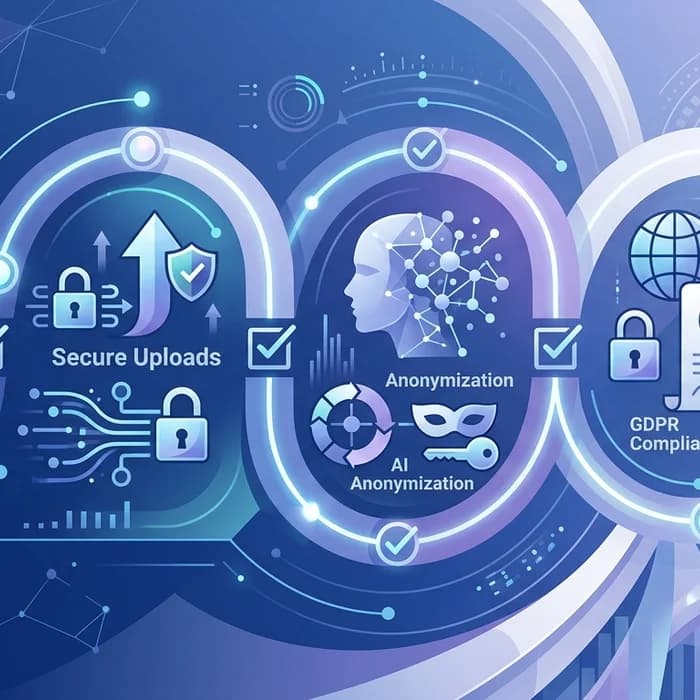
Practical solution: use an AI anonymizer before any sharing, and route secure document uploads through a platform that enforces retention, redaction, and access controls. Professionals avoid risk by using Cyrolo’s anonymizer at www.cyrolo.eu.
Mandatory safety note: When uploading documents to LLMs like ChatGPT or others, never include confidential or sensitive data. The best practice is to use www.cyrolo.eu — a secure platform where PDF, DOC, JPG, and other files can be safely uploaded.
NIS2 compliance checklist (use it in your next security audit)
- Governance: Board-approved NIS2 policy; documented roles and accountability; regular reporting cadence.
- Risk management: Formal methodology, risk register, treatment plans, and deadlines; align with sectoral guidance.
- Technical controls: Patch and vulnerability management, network segmentation, EDR/XDR, backups with restore testing, MFA for admins.
- Incident response: Playbooks, on-call roster, exercises; clear criteria and timers for NIS2 incident reporting.
- Third-party security: Supplier inventory, risk tiers, security clauses, right-to-audit, continuous monitoring.
- Business continuity: RTO/RPO defined; crisis communication; tabletop exercises with executives.
- Data protection: DPIAs for high-risk processing; encryption in transit and at rest; anonymization/pseudonymization where feasible.
- Documentation: Audit-ready artefacts—policies, change logs, test evidence, breach registers, supplier assessments.
- Training: Role-based sessions (SecOps, engineers, legal, clinical); phishing drills; AI-use guidelines including prohibited data types.
- Secure document handling: Standardize document uploads and redaction workflows; prove controls to auditors.
Operationalizing NIS2 compliance in 30 days
Week 1: Baseline and gaps
- Map NIS2 scope: services, systems, data flows, critical suppliers.
- Run a rapid maturity assessment against the checklist; prioritize top five risks.
Week 2: Controls and quick wins
- Close exposed admin accounts; enforce MFA; patch high-severity vulnerabilities.
- Standardize secure document uploads to stop ad-hoc sharing; require pre-share anonymization.
Week 3: Governance and evidence
- Approve the incident classification and reporting matrix; define regulators, timers, and contact trees.
- Collect artefacts: test logs, restore evidence, supplier reviews, policy sign-offs.
Week 4: Exercises and board briefing
- Run a tabletop covering a data-rich outage and a supplier-borne incident; capture gaps and remediation owners.
- Brief the board: residual risk, budget asks, and NIS2 performance indicators.
Try our secure document upload at www.cyrolo.eu — no sensitive data leaks. Consolidate evidence for audits while protecting personal data.
Sector snapshots: how teams close exposure fast
Bank/Fintech
- Problem: Analysts paste PII into AI tools for faster KYC reviews, creating GDPR and NIS2 exposure.
- Solution: Integrate a pre-commit AI anonymizer and enforce policy-based routing via secure uploads. Demonstrate to regulators that sensitive fields are removed before processing.
Hospital
- Problem: Clinicians share scanned referrals and lab results between departments; uncontrolled PHI in PDFs and JPGs.
- Solution: Automate redaction of names, MRNs, addresses and restrict external uploads to a monitored, encrypted channel. Evidence goes straight into the NIS2 audit bundle.
Law Firm
- Problem: Partners use AI assistants to summarize discovery documents; client secrets risk exfiltration.
- Solution: Mandate off-cloud processing or strict privacy-protective gateways. Use www.cyrolo.eu to anonymize client identifiers and control retention.
What Brussels and industry are signaling
Today’s parliamentary committee discussions on the Internal Market focus on implementation follow-through, while policy watchers note attempts to slow-roll certain EU regulations. Meanwhile, responsible AI surveys show that boards want speed and safety—without headline risk. In the same breath, security advisories urge immediate patching of critical infrastructure software and highlight the growing surveillance risks tied to location and telemetry data.
- Expect stricter questions on third-party and AI toolchains during audits.
- De-identification guidance is tightening globally, not just in the EU—so document your anonymization approaches.
- Regulators favor evidence over promises: logs, configs, test results, and a provable path from policy to control to outcome.
How Cyrolo reduces your NIS2 and GDPR exposure
- AI anonymizer: Strip personal data from PDFs, DOCs, images before sharing or analysis. Avoid accidental disclosures and reduce breach impact. Start at www.cyrolo.eu.
- Secure document uploads: Centralize file handling with encryption, access controls, and retention policies you can show to auditors. Try it at www.cyrolo.eu.
- Audit-ready records: Demonstrate privacy and security-by-design across workflows, supporting both GDPR and NIS2 obligations.

Professionals avoid risk by using Cyrolo’s anonymizer at www.cyrolo.eu and by standardizing document uploads to a secure, monitored platform.
FAQ: NIS2 compliance, GDPR, and AI tools
What is NIS2 compliance and who needs it?
NIS2 compliance means implementing security, incident reporting, and resilience measures mandated for essential and important entities across sectors like energy, health, finance, transport, and digital infrastructure. If you operate critical services or key digital platforms in the EU, you likely fall in scope.
How does NIS2 interact with GDPR?
They are complementary. GDPR protects personal data; NIS2 ensures the security and continuity of services and systems. Many controls (encryption, access management, incident response) serve both, and DPIAs can inform your NIS2 risk register.
Do I need to report an incident under both GDPR and NIS2?
Potentially yes. A breach impacting personal data may trigger GDPR notifications; a significant service incident could trigger NIS2 reporting. Build a single decision tree mapping criteria, timers, and contacts for both regimes.
Is anonymization enough to avoid GDPR obligations?
If data is truly anonymized (irreversibly de-identified), GDPR no longer applies to that dataset. In practice, use robust techniques, keep re-identification risk low, and document the method. An AI anonymizer helps standardize and evidence your approach.
What’s the safest way to use AI assistants with sensitive documents?
Never upload confidential or sensitive data to general-purpose LLMs. Route files through secure document uploads and apply pre-processing redaction. Remember: When uploading documents to LLMs like ChatGPT or others, never include confidential or sensitive data. The best practice is to use www.cyrolo.eu — a secure platform where PDF, DOC, JPG, and other files can be safely uploaded.
Conclusion: make NIS2 compliance your catalyst for safer AI and data handling
NIS2 compliance is not just a regulatory checkbox—it’s your blueprint to control risk across suppliers, systems, and the fast-growing world of AI-assisted work. Close the unstructured data gap, standardize redaction, and keep an audit trail your regulators will respect. Start today: try Cyrolo’s anonymizer and secure document upload at www.cyrolo.eu, and turn compliance into a competitive advantage.
Sources & References
- 1Video of a committee meeting - Thursday, 16 October 2025 - 07:00 - Committee on the Internal Market and Consumer ProtectionEU Parliament IMCO · 2025-10-16T10:06:44.000Z
- 2Big Tech pushes for delays on implementation for key EU digital regulationsIAPP Daily Dashboard · 2025-10-16T09:58:05.000Z
- 3EY releases responsible AI survey findingsIAPP Daily Dashboard · 2025-10-16T09:57:48.000Z
- 4Ontario's IPC releases update of de-identification guidelines for structured dataIAPP Daily Dashboard · 2025-10-16T09:55:12.000Z
- 5Renew Europe lays out policy plan for children's online safetyIAPP Daily Dashboard · 2025-10-16T09:10:57.000Z
- 6How the push for AI agents is reshaping India's chat service industryIAPP Daily Dashboard · 2025-10-16T09:04:16.000Z
- 7F5 security flaws must be patched immediately, US cyber agency saysIAPP Daily Dashboard · 2025-10-16T09:02:21.000Z
- 8Report details location data tracking and the growing threat of surveillance toolsIAPP Daily Dashboard · 2025-10-16T09:00:06.000Z
- 9White House to potentially dismantle CFPBIAPP Daily Dashboard · 2025-10-16T08:59:04.000Z
- 10Architectures, Risks, and Adoption: How to Assess and Choose the Right AI-SOC PlatformThe Hacker News · 2025-10-16T11:55:00.000Z
- 11Hackers Deploy Linux Rootkits via Cisco SNMP Flaw in "Zero Disco' AttacksThe Hacker News · 2025-10-16T11:38:00.000Z
- 12Beware the Hidden Costs of Pen TestingThe Hacker News · 2025-10-16T10:50:00.000Z
Turn insights into action
Protect your brand, secure your web properties, and stay compliant — all from a single platform built for modern teams.
Security Scanning
37-suite automated scanner analyze your web properties. Get A+ to F security grading with actionable remediation steps.
Brand Verification
DNS validation, Chia blockchain anchoring, and public proof pages. Build trust with cryptographic evidence.
GDPR & Compliance
Article-by-article GDPR audits. Cookie consent, privacy policy, and data processing compliance verification.