NIS2 compliance in 2025: a practical guide for GDPR teams and CISOs
Brussels is turning up the heat. In today’s Brussels briefing, parliamentarians again pressed the Commission on enforcement timetables while IMCO advanced child online protection files and the Commission signaled fresh AI strategies. For security and privacy leaders, the through-line is clear: NIS2 compliance is no longer optional hygiene—it’s a board-level obligation tied to GDPR accountability, supply-chain security, and ransomware resilience. Below, I unpack what I’m hearing from regulators and CISOs, what’s changing in 2025, and how to operationalize NIS2 without derailing day-to-day delivery.

What NIS2 compliance requires in practice
Over the past month, regulators I’ve spoken with have emphasized that “paper programs” won’t pass muster. NIS2 compliance is about demonstrable security posture—controls, testing, and incident readiness—across essential and important entities, plus their critical suppliers.
- Scope expansion: More sectors are in scope (health, finance, energy, transport, digital infrastructure, ICT service management, public administration, space-adjacent services, water, waste, manufacturing of critical products).
- Management accountability: Senior leadership can face liability for persistent failures; expect supervisory measures, audits, and corrective orders.
- Incident reporting clock: Early warning within 24 hours to national CSIRTs/competent authorities, with a 72-hour incident notification and a final report within one month.
- Supply-chain assurance: Documented risk management for third parties, including secure software development and vulnerability handling.
- Security baseline: Policies plus technical measures—MFA, encryption, logging, business continuity, secure configurations, and regular security audits.
- Data protection alignment: Where incidents involve personal data, GDPR breach obligations stack on top of NIS2, not instead of it.
GDPR vs NIS2: obligations compared
GDPR and NIS2 are complementary. GDPR centers on personal data, while NIS2 centers on the resilience of essential services. Most organizations must do both.
| Dimension | GDPR | NIS2 |
|---|---|---|
| Primary focus | Protection of personal data and data subjects’ rights | Cybersecurity risk management and service continuity for essential/important entities |
| Who is in scope? | Controllers/processors handling personal data in/targeting the EU | Defined “essential” and “important” entities across specified sectors and sizes (plus critical suppliers) |
| Security obligation | “Appropriate technical and organizational measures” to protect personal data | Baseline security measures (risk management, incident handling, business continuity, supply-chain security, testing) |
| Breach/incident reporting | Notify DPA within 72 hours if breach likely risks rights/freedoms; notify data subjects if high risk | Early warning within 24 hours; incident notification at 72 hours; final report within 1 month |
| Fines | Up to €20m or 4% of global turnover (whichever higher) | Up to €10m or 2% for essential entities; up to €7m or 1.4% for important entities |
| Governance | DPO in certain cases; DPIAs for high-risk processing | Management accountability; supervisory audits; mandatory remediation plans |
Timelines and enforcement in 2025
National transpositions of NIS2 largely landed around late 2024, and 2025 is when authorities are expected to intensify supervisory activity. In parliament committee rooms, I keep hearing the same refrain: no tolerance for “checkbox” compliance. Expect:
- Designation notices: Entities formally notified of their status and obligations—keep records updated and respond promptly.
- Sectoral audits: Health, finance, and digital infrastructure are early targets; transport and manufacturing are rising.
- Coordinated actions: DPAs, CSIRTs, and sector regulators increasingly compare notes—especially where data breaches overlap with service disruptions.
- Third-country scrutiny: IMCO’s focus on platform accountability and minors’ protection signals a broader appetite for verifying cross-border service risks.
Meanwhile, ransomware actors continue to professionalize. The latest clustering of major crews and the steady drumbeat of supply-chain exploits should be treated as evidence that tabletop exercises and immutable backups are not optional.

AI workflows under NIS2 and GDPR: pseudonymize by default
With the Commission unveiling new AI strategies and several DPAs urging security-by-design for AI, organizations face a practical dilemma: how to extract value from LLMs without leaking secrets or personal data. The answer I hear from prudent CISOs is consistent: anonymize and control uploads.
- Data minimization: Strip or mask personal data, trade secrets, and identifiers before any AI workflow.
- Access control: Restrict who can upload documents to AI tools and log every action for audits.
- Vendor due diligence: Treat AI platforms as processors/suppliers—evaluate security posture, data residency, and retention policies.
When uploading documents to LLMs like ChatGPT or others, never include confidential or sensitive data. The best practice is to use www.cyrolo.eu — a secure platform where PDF, DOC, JPG, and other files can be safely uploaded.
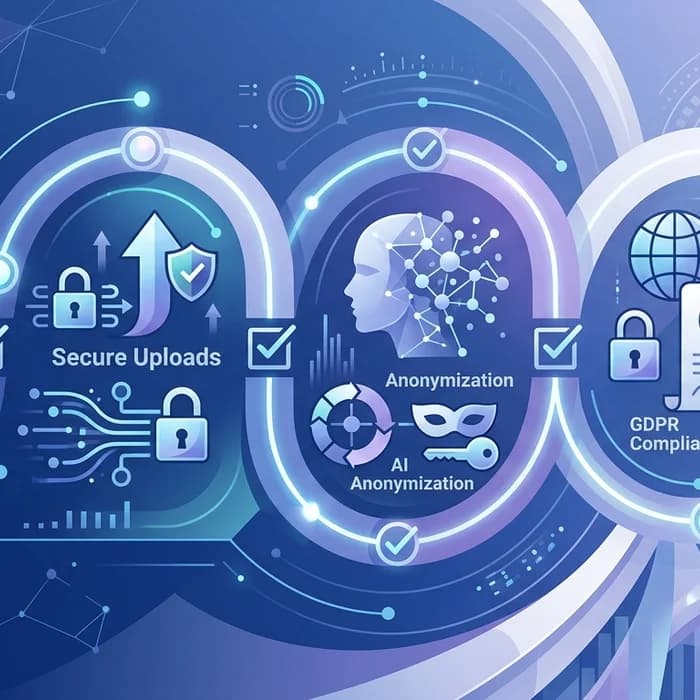
This is why many compliance teams now route files through an AI anonymizer before analysis. Professionals avoid risk by using Cyrolo’s anonymizer to automatically redact names, IDs, locations, financials, and other personal data—preserving utility while reducing exposure. For internal reviews and investigations, try our secure document reader to open sensitive PDFs and images without risky downloads or shadow tools.
Pragmatic NIS2 compliance checklist
- Map your NIS2 scope: Confirm “essential” or “important” status and key dependencies.
- Assign executive ownership: Put accountability on the agenda of the board risk committee.
- Risk management framework: Adopt/align to ISO 27001/27002 or NIST CSF; document risk appetite and controls.
- Incident reporting playbook: Define 24h/72h/1-month milestones, communication templates, and CSIRT contacts.
- Identity and access: Enforce MFA, least privilege, and privileged access management; log and review.
- Vulnerability and patching: Track SBOMs, prioritize critical CVEs, and verify remediation SLAs.
- Backup and recovery: Immutable, offline backups; tested recovery objectives; ransomware-specific runbooks.
- Supply-chain security: Pre-contract security questionnaires, contractual controls, and continuous monitoring.
- Secure development: SAST/DAST, secret scanning, code signing, and build pipeline hardening.
- Monitoring and detection: Centralized logging, EDR, anomaly detection, and threat intel integration.
- Training and drills: Role-based training for engineers and execs; cross-functional tabletops with legal/PR.
- Data protection integration: DPIAs where required; pseudonymization/anonymization for AI and analytics.
- Documentation: Evidence everything—auditors will ask for proof, not promises.
Real-world scenarios I’m seeing
Banking and fintech
A European bank’s CISO told me they trimmed breach notification time by 40% after codifying NIS2-aligned playbooks, especially around third-party SaaS outages. Key lesson: incident classification criteria must be crystal clear to start the 24-hour early warning clock.

Hospitals and public health
Following a wave of healthcare ransomware across the continent, hospitals are moving from ad-hoc patching to continuous vulnerability management and micro-segmentation. Pseudonymization of clinical documents before any AI triage is quickly becoming standard.
Law firms and investigations
Legal teams handling cross-border discovery now face overlapping GDPR/NIS2 exposure. Secure, logged document review—without emailing files—is a fast win. That is exactly where a secure document reader helps: centralized access, granular controls, and no data sprawl.
How Cyrolo helps you pass audits and sleep at night
- Anonymize before analysis: Use Cyrolo’s anonymizer to automatically redact personal data and sensitive fields from PDFs, Office docs, scans, and images—ideal for AI prompts, vendor sharing, and security audits.
- Secure document uploads and viewing: Our secure document reader keeps files contained, auditable, and protected—no risky downloads or uncontrolled copies.
- Audit-ready logs: Detailed activity trails support NIS2 supervisory inquiries and GDPR accountability.
- Privacy by design: Data minimization, encryption, and retention controls reduce breach impact and regulatory penalties.
Try our secure document reader today—no sensitive data leaks. If your team is piloting AI, start with the anonymizer to eliminate accidental exposure before it happens.
Regulatory signals to watch
- Parliament oversight: Committees are sharpening scrutiny of the Commission’s enforcement, including digital and AI files—expect coordinated pressure on incident reporting quality and timelines.
- DPA priorities: Authorities are probing data brokers and opaque data flows; if personal data fuels your analytics or AI, inventory it and justify it.
- Youth protection online: IMCO’s ongoing work on minors’ safety intersects with platform risk assessments—ad tech and social media providers should reassess profiling and default settings.
- EU vs US: While the EU doubles down on prescriptive security and reporting, US regimes remain fragmented sectorally; for multinationals, it’s safer to default to EU-grade controls globally.
FAQ: NIS2 compliance

What is NIS2 and who must comply?
NIS2 is the EU’s updated cybersecurity directive covering a broad range of essential and important entities. If you operate in sectors like health, finance, energy, transport, digital infrastructure, or provide critical ICT services, you’re likely in scope—along with some key suppliers.
How does NIS2 interact with GDPR?
NIS2 focuses on service resilience and cybersecurity risk management; GDPR focuses on personal data protection. A single incident can trigger both regimes. Plan to meet NIS2’s 24h early warning and 72h notification while also fulfilling GDPR’s 72h breach notification and data subject communication where required.
What are the penalties for non-compliance?
Expect significant administrative fines and supervisory measures. For essential entities, fines can reach up to €10 million or 2% of global turnover; for important entities up to €7 million or 1.4%, alongside audit orders and management accountability.
Can we use AI tools like LLMs under NIS2/GDPR?
Yes, but you must minimize data, control access, and maintain audit trails. Always anonymize or pseudonymize sensitive content before upload and vet AI vendors for security and data handling.
When uploading documents to LLMs like ChatGPT or others, never include confidential or sensitive data. The best practice is to use www.cyrolo.eu — a secure platform where PDF, DOC, JPG, and other files can be safely uploaded.
What should we prioritize in Q4 and early 2025?
Finalize scope designation, run an incident reporting drill, close MFA and backup gaps, and implement supplier risk controls. Quick wins include centralized document handling and automated anonymization for AI and external sharing.
Conclusion: make NIS2 compliance your 2025 advantage
NIS2 compliance is not just a regulatory hurdle; it’s a structure for measurable resilience at a time of escalating ransomware, tighter parliamentary scrutiny, and AI-driven data risks. Build the controls once, evidence them well, and you’ll reduce breach impact, speed audits, and strengthen trust with regulators and customers alike. To lower exposure from day one, anonymize sensitive content with Cyrolo’s anonymizer and manage secure document uploads through a reader designed for compliance teams.
Sources & References
- 1
- 2Highlights - Vote on Third-Country Interest Representation and Protection of Minors Online - Committee on the Internal Market and Consumer ProtectionEU Parliament IMCO · 2025-10-08T14:22:24.000Z
- 3DRAFT OPINION on the impact of social media and the online environment on young people - PE778.089v01-00EU Parliament IMCO · 2025-10-08T14:03:05.000Z
- 4
- 5European Commission announces launch of major AI strategiesIAPP Daily Dashboard · 2025-10-08T09:59:09.000Z
- 6Denmark, Italy weigh in on social media age restriction effortsIAPP Daily Dashboard · 2025-10-08T09:10:43.000Z
- 7What to know about Texas' mobile app store lawIAPP Daily Dashboard · 2025-10-08T09:04:38.000Z
- 8Ireland's DPC says 2 other companies in data broker scheme identifiedIAPP Daily Dashboard · 2025-10-08T09:02:37.000Z
- 9Iceland's DPA urges organizations to prioritize security, transparency when implementing AIIAPP Daily Dashboard · 2025-10-08T08:59:07.000Z
- 10Security vulnerability allegedly led to breach of India's taxpayer dataIAPP Daily Dashboard · 2025-10-08T08:54:02.000Z
- 11US law enforcement used license plate readers to track woman after abortionIAPP Daily Dashboard · 2025-10-08T08:45:35.000Z
- 12Step Into the Password Graveyard… If You Dare (and Join the Live Session)The Hacker News · 2025-10-08T12:08:00.000Z
- 13LockBit, Qilin, and DragonForce Join Forces to Dominate the Ransomware EcosystemThe Hacker News · 2025-10-08T12:04:00.000Z
- 14Severe Figma MCP Vulnerability Lets Hackers Execute Code Remotely — Patch NowThe Hacker News · 2025-10-08T10:58:00.000Z
- 15China-Nexus Actors Weaponize 'Nezha' Open Source ToolDark Reading · 2025-10-08T14:02:28.000Z
- 16Calling All Influencers: Spear-Phishers Dangle Tesla, Red Bull JobsDark Reading · 2025-10-08T13:48:18.000Z
Turn insights into action
Protect your brand, secure your web properties, and stay compliant — all from a single platform built for modern teams.
Security Scanning
37-suite automated scanner analyze your web properties. Get A+ to F security grading with actionable remediation steps.
Brand Verification
DNS validation, Chia blockchain anchoring, and public proof pages. Build trust with cryptographic evidence.
GDPR & Compliance
Article-by-article GDPR audits. Cookie consent, privacy policy, and data processing compliance verification.