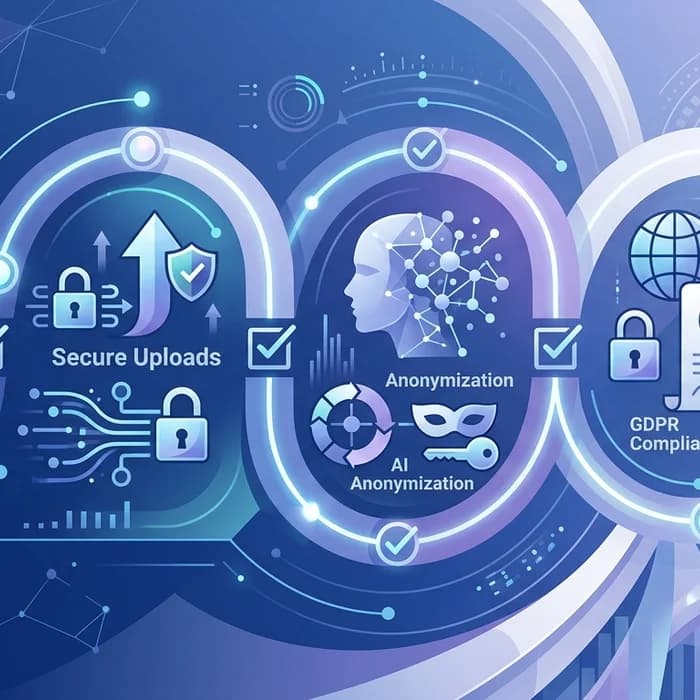
NIS2 compliance in 2025: The practical guide for EU security and legal teams
Brussels is turning the screws on critical infrastructure risk, and NIS2 compliance is now the defining benchmark for operational resilience across Europe. In today’s Brussels briefing, officials tied next-cycle budget plans to internal security and cyber posture, while fresh threat reports—from actively exploited software flaws to targeted phishing of policy influencers—underline why boards can no longer treat cyber as an IT line item. If you handle regulated personal data, run essential services, or rely on third-party platforms, this is the moment to close gaps—and to adopt safer workflows like anonymizer-first reviews and secure document uploads in your compliance operations.

What NIS2 compliance really demands in 2025
In interviews this week, a CISO at a pan-EU healthcare network told me their biggest shift under NIS2 is “treating business disruption and data leaks as a single risk surface.” That’s a useful lens. NIS2 expands the scope of the original NIS Directive to more sectors (health, finance, energy, transport, water, digital infrastructure, public administration, space, and more) and imposes tougher governance, supply-chain, and incident reporting duties.
- Governance and accountability: Executives must approve and oversee cybersecurity risk management. Training and personal liability expectations are rising for directors.
- Risk management measures: Policies for asset inventory, patching, crypto, multi-factor authentication, secure development, vulnerability disclosure, and business continuity are expected, not optional.
- Supply chain diligence: You must assess critical suppliers and managed service providers, with security clauses, assurance, and termination paths baked into contracts.
- Incident reporting: Early warning within 24 hours, an incident notification within 72 hours, and a final report within one month are the emerging norm across the EU.
- Enforcement and fines: For “essential” entities, penalties can reach up to €10 million or 2% of global turnover; for “important” entities, up to €7 million or 1.4%.
Most Member States completed transposition in late 2024, so 2025 is the real-world test. Supervisors are moving from guidance to audits; security audits and regulator check-ins will probe whether risk controls are operating, not just documented.
Budget signals from Brussels: internal security and the MFF 2028–2034
At the European Parliament’s civil liberties committee today, lawmakers spotlighted budgets tied to asylum, borders, visas, and internal security ahead of the next multiannual financial framework (2028–2034). The subtext for CISOs and DPOs: expect continued funding for cross-border cyber capacity, information sharing, and crisis response exercises. A senior EU official I spoke with warned that “future funds will increasingly align with measurable outcomes—incident reporting discipline, supply-chain assurance, and sector-wide drills.” If your roadmap for 2025–2027 is thin on these fronts, this is a heads-up.
Threat reality check: KEV additions and nation-state phishing
Beyond policy, the threat tempo is a weekly metronome. Today, US cyber authorities added newly exploited vulnerabilities in enterprise software (including remote access and hosting panels) to the Known Exploited Vulnerabilities catalog—a curated list widely used by EU teams to prioritize patching. In parallel, security researchers flagged a sophisticated Iranian APT campaign targeting policy analysts through tailored phishing. These two stories, viewed together, point to a stubborn truth:

- Unpatched internet-facing systems are still the cleanest initial foothold for attackers.
- High-value human targets—policy staff, legal teams, executives—are increasingly phished with credible lures.
NIS2 compliance maps directly to both issues: asset visibility and timely patching for the first, and strong identity controls plus user awareness for the second. For regulated entities, auditors will ask for proof: remediation SLAs, KEV-aligned prioritization, phishing simulation outcomes, and evidence that secrets never leave approved environments.
GDPR vs NIS2: what changes for your program?
GDPR and NIS2 are complementary: one protects personal data; the other protects service continuity and network security. Most organizations need both. Here is a side-by-side view I use with boards:
| Topic | GDPR | NIS2 |
|---|---|---|
| Primary focus | Personal data protection, data subject rights, lawful processing | Network and information systems security, service continuity, resilience |
| Who is in scope | Controllers and processors handling personal data | Essential and important entities across specified sectors and sizes |
| Reporting timelines | Notify supervisory authority within 72 hours of a personal data breach | Early warning in 24 hours; incident notification in 72 hours; final report within 1 month |
| Supply chain obligations | Processor due diligence and contracts | Explicit security expectations for critical suppliers and managed services |
| Security controls | “Appropriate” technical/organizational measures (risk-based) | Enumerated controls across patching, MFA, crypto, secure development, BCM |
| Penalties | Up to €20m or 4% global turnover | Essential: up to €10m or 2%; Important: up to €7m or 1.4% |
| Board accountability | Implicit via controller obligations | Explicit executive oversight and possible personal liability mechanisms |
Your 90-day NIS2 compliance checklist
- Map scope: Identify if you are “essential” or “important,” and list in-scope services and critical assets.
- Inventory exposure: Build a complete, continuously updated inventory of internet-facing systems and software versions.
- Patching policy: Align remediation SLAs to a KEV-like prioritization and document exceptions with compensating controls.
- Identity hardening: Enforce MFA everywhere feasible, particularly for admins, VPNs, cloud consoles, and email.
- Incident reporting drill: Rehearse 24h/72h/1-month workflows with legal, PR, and operations; pre-draft regulator notification templates.
- Supply chain assurance: Tier suppliers by criticality; insert NIS2-aligned security clauses, audit rights, and termination triggers.
- Secure development: Implement SBOMs for key apps, code signing, and vulnerability disclosure processes.
- Backups and continuity: Test offline/immutable backups and failover; document RTO/RPO and evidence of exercises.
- Data protection by design: Bridge GDPR and NIS2 by minimizing personal data, using pseudonymization, and segregating secrets.
- Board engagement: Schedule quarterly risk reviews; train directors on incident decisions and liability exposure.
Working with documents and AI without leaking sensitive data
Security and legal teams increasingly use AI to summarize audits, parse policies, and triage incidents. But uploading unredacted files to general-purpose LLMs risks privacy breaches and regulator scrutiny. The safest pattern is to anonymize before analysis and to keep files within a controlled, EU-hosted workflow. That is why many professionals now rely on an AI anonymizer and secure document upload tools for day-to-day compliance tasks.
When uploading documents to LLMs like ChatGPT or others, never include confidential or sensitive data. The best practice is to use www.cyrolo.eu — a secure platform where PDF, DOC, JPG, and other files can be safely uploaded.
How Cyrolo helps reduce breach and compliance risk
- Rapid de-identification: Strip names, IDs, addresses, and free-form PII from audits, contracts, logs, and tickets before analysis using an anonymizer-first workflow.
- Controlled review: Conduct document uploads in a secure environment designed to prevent accidental sharing with unauthorized third parties.
- Operational speed: Summarize long PDFs, scan security policies, and extract obligations without exposing raw personal data.
- Audit-ready evidence: Keep a record that sensitive content was minimized prior to processing—useful in security audits and regulator dialogues.
Professionals avoid risk by using Cyrolo’s anonymizer at www.cyrolo.eu. Try our secure document upload at www.cyrolo.eu — no sensitive data leaks.
EU vs US: different paths, shared outcomes
From my conversations with regulators on both sides of the Atlantic, the EU’s approach (NIS2 + GDPR + sectoral rules like DORA for finance) is more prescriptive and audit-oriented, while the US model leans on sector-specific regulations and public advisories (such as the KEV list) to drive patching and risk reduction. For multinational enterprises, this means two practical steps: harmonize your control set to the stricter requirements (often EU), and ensure your global SOC consumes US/EU threat advisories in the same playbook.
Blind spots and unintended consequences to watch
- Vendor sprawl: Adding “more tools” without central governance creates new attack surface and audit confusion.
- Shadow AI usage: Staff quietly paste contract excerpts into public chatbots. Without a sanctioned, secure alternative, data loss is inevitable.
- Incident “definition” drift: Teams under-report because they fear fines; regulators will judge maturity by transparency as much as by outcomes.
- Paper over practice: Policies that say the right things but lack timestamps, logs, and artifacts will not pass security audits.
Real-world scenarios I’m seeing
- Banks and fintechs: DORA heatmaps meet NIS2 supply-chain reviews; third-party risk teams now ask for SBOMs and KEV remediation proof.
- Hospitals: Legacy imaging servers and VPNs showing up on the KEV list; patch windows coordinated with clinical schedules and contingency plans.
- Law firms: Confidential matter files summarized with AI, but only after redaction; partners briefed on reporting thresholds under GDPR and NIS2.
- Municipal services: Email and identity hardening to counter phishing of senior officials; incident playbooks aligned to 24/72/30-day deliverables.
FAQs: your NIS2 compliance questions answered
What is NIS2 compliance and who is in scope?
NIS2 compliance means implementing the security, governance, and reporting requirements of the updated EU Network and Information Systems Directive. It applies to “essential” and “important” entities across defined sectors (energy, transport, health, finance, digital infrastructure, public administration, and more), generally based on size and criticality.
What are the incident reporting timelines under NIS2?
Most implementations expect an early warning within 24 hours of becoming aware of a significant incident, an initial incident notification within 72 hours, and a final report within one month, with updates as needed.
How does NIS2 interact with GDPR?
NIS2 focuses on service resilience and security controls; GDPR focuses on personal data and privacy rights. A single incident (e.g., ransomware with data exfiltration) can trigger both regimes. Coordinate legal, DPO, and CISO functions so reporting and remediation are consistent.
What proof do regulators expect during a security audit?
Evidence of controls in operation: asset inventories with timestamps, patch timelines mapped to high-risk advisories (such as KEV), MFA coverage, backup tests, supplier assessments, training logs, and incident drill artifacts. Paper policies without artifacts are insufficient.
Is it safe to use AI and LLMs for compliance work?
Yes—if you minimize data first and use controlled environments. Do not upload confidential files to public chatbots. An AI anonymizer and secure document upload workflow lets you analyze content without exposing personal data or secrets. “When uploading documents to LLMs like ChatGPT or others, never include confidential or sensitive data. The best practice is to use www.cyrolo.eu — a secure platform where PDF, DOC, JPG, and other files can be safely uploaded.”
Conclusion: make NIS2 compliance your operational North Star
The policy winds in Brussels, the steady drumbeat of KEV-listed exploits, and state-backed phishing all point to the same message: resilience and privacy must be engineered into daily work. Treat NIS2 compliance as your operational North Star—connecting board oversight, supplier assurance, rapid patching, and safe document handling. Start by minimizing sensitive data in your workflows: use an anonymizer before analysis and keep your document uploads inside a secure, auditable environment at www.cyrolo.eu.
Sources & References
- 1Highlights - The MFF 2028-2034: Asylum & migration, borders & visas, and internal security - Committee on Civil Liberties, Justice and Home AffairsEU Parliament LIBE · 2025-11-05T09:07:04.000Z
- 2CISA Adds Gladinet and CWP Flaws to KEV Catalog Amid Active Exploitation EvidenceThe Hacker News · 2025-11-05T06:12:00.000Z
- 3Elusive Iranian APT Phishes Influential US Policy WonksDark Reading · 2025-11-05T10:00:00.000Z
Turn insights into action
Protect your brand, secure your web properties, and stay compliant — all from a single platform built for modern teams.
Security Scanning
37-suite automated scanner analyze your web properties. Get A+ to F security grading with actionable remediation steps.
Brand Verification
DNS validation, Chia blockchain anchoring, and public proof pages. Build trust with cryptographic evidence.
GDPR & Compliance
Article-by-article GDPR audits. Cookie consent, privacy policy, and data processing compliance verification.