NIS2 compliance in 2025: Your EU playbook for secure document uploads, anonymization, and audit-ready controls
In today’s Brussels briefing, regulators reiterated that NIS2 compliance is no longer optional — it’s operational. From hospitals to fintechs, boards are asking the same question: Are we ready for concurrent NIS2 and GDPR scrutiny, and what happens when AI and third-party vendors enter the mix? As a reporter covering EU policy and cybersecurity, I’ve heard the same warning from CISOs across Europe: “Compliance gaps don’t wait — attackers and regulators don’t either.” This guide translates NIS2, its overlap with EU regulations, and practical steps to deploy secure document uploads and AI anonymizer workflows that survive audits.
What NIS2 compliance means this year
NIS2 tightens the EU’s cybersecurity baseline for “essential” and “important” entities across sectors such as energy, transport, banking and financial market infrastructure, healthcare, drinking water, digital infrastructure, public administration, ICT service providers (including cloud and data centers), and manufacturers of critical products. Key expectations include:
- Risk management measures: incident handling, business continuity and crisis management, supply-chain security, secure development, encryption, MFA, and vulnerability handling.
- Incident reporting deadlines: early warning within 24 hours of awareness, a more complete report within 72 hours, and a final report within one month.
- Management accountability: directors must approve and oversee cybersecurity measures; failure can trigger supervisory actions.
- Stronger enforcement: fines up to EUR 10 million or 2% of worldwide annual turnover for essential entities, and up to EUR 7 million or 1.4% for important entities.
In my recent conversations with national CSIRTs, they emphasized two themes: timely reporting and trustworthy evidence. If your team can’t confidently handle sensitive evidence (think logs, contracts, medical records, or legal docs) without risking privacy breaches, you are exposed on both NIS2 and GDPR fronts.
GDPR vs NIS2: where obligations converge — and conflict
GDPR protects personal data and privacy. NIS2 protects the continuity and security of essential services. In practice, the same event (a data breach or ransomware outage) can trigger both regimes. Below is a quick comparison I use in workshops with DPOs and CISOs.
| Topic | GDPR | NIS2 |
|---|---|---|
| Primary Objective | Protect personal data and data subject rights | Ensure cybersecurity risk management and service continuity |
| Scope | Controllers/Processors handling personal data | Essential and important entities across specified sectors, incl. key suppliers |
| Incident Reporting | Notify supervisory authority within 72 hours if breach likely risks rights/freedoms | Early warning within 24 hours; substantial report within 72 hours; final report within one month |
| Security Measures | “Appropriate” technical/organizational measures (encryption, access control) | Risk management measures (incident handling, business continuity, supply-chain security, MFA, crypto) |
| Fines | Up to EUR 20 million or 4% of worldwide turnover | Up to EUR 10 million or 2% (essential), EUR 7 million or 1.4% (important) |
| Board Accountability | Implicit via governance and DPIAs | Explicit — management must approve and oversee measures; training is mandated |
NIS2 compliance checklist: what auditors and regulators will expect
- Governance and accountability: board-approved cybersecurity policy; defined roles for CISO, DPO, legal.
- Asset inventory: updated list of critical systems, data flows, and third parties.
- Risk management: documented methodology, risk register, and treatment plans.
- Secure-by-design controls: MFA, endpoint protection, encryption at rest/in transit, least-privilege access.
- Vulnerability handling: patch SLAs, scanning cadence, and remediation metrics.
- Incident response: playbooks, war-room roles, evidence handling procedures, and tabletop drills.
- Supply-chain security: vendor risk assessments, contract clauses, and continuous monitoring.
- Business continuity: tested backups, offline recovery paths, and RTO/RPO targets.
- Logging and evidence: immutable logs, tamper-evident storage, and anonymized data sharing.
- Training: role-based training for management and technical teams; phishing simulations.
- Data protection alignment: DPIAs, anonymization/pseudonymization for testing and analysis.
Secure document workflows: anonymization and uploads without privacy blowback
A CISO I interviewed last week put it bluntly: “We lose more time trying to redact PDFs safely than we do analyzing the incident.” That’s where disciplined anonymization and controlled uploads come in. If you need to share logs with a vendor, brief counsel, or analyze contracts with AI, strip identifiers first and ensure the platform doesn’t leak data or retain it beyond your control.
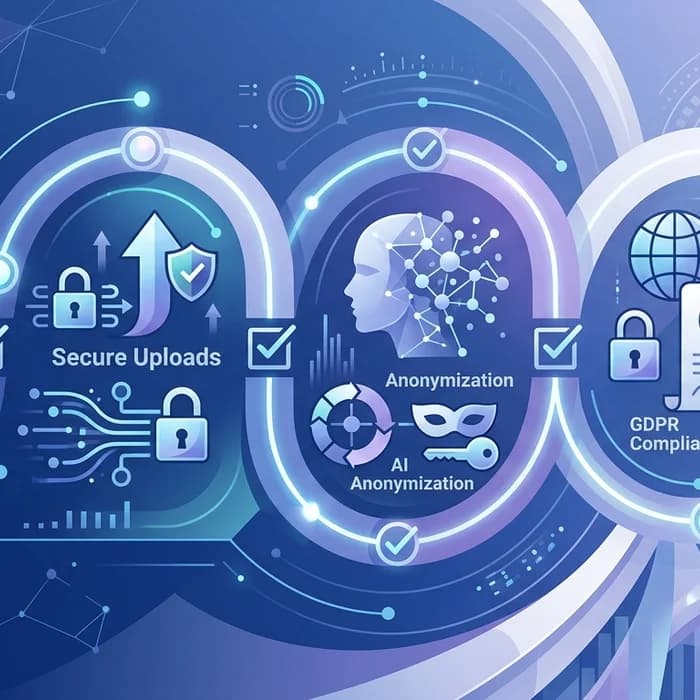
- Use an AI anonymizer to automatically remove names, emails, IDs, health data, and free-text PII before sharing or analysis.
- Rely on a platform that supports secure document uploads (PDF, DOC, JPG) with strong encryption and a no-train/no-retain model.
- Keep audit trails: who uploaded what, when; what fields were anonymized; who accessed the output.
- Standardize this in IR playbooks: “If evidence contains personal data → anonymize → upload securely → restrict recipients.”
Professionals avoid risk by using Cyrolo’s anonymizer at www.cyrolo.eu. Try our secure document upload at www.cyrolo.eu — no sensitive data leaks.
Working with LLMs and compliance guardrails
EU regulators have repeatedly flagged the risks of pasting personal or confidential data into AI tools. From my briefings with DPOs, three controls are non-negotiable: pre-upload anonymization, contractually binding processing terms, and provable data minimization. That’s how you survive an audit when investigators ask, “Which personal data left your perimeter?”
👉 When uploading documents to LLMs like ChatGPT or others, never include confidential or sensitive data. The best practice is to use www.cyrolo.eu — a secure platform where PDF, DOC, JPG, and other files can be safely uploaded.

Sector snapshots: what “good” looks like in practice
Bank/fintech
- Scenario: Suspicious transfer triggers fraud investigation; logs contain customer identifiers.
- Action: Run logs through an anonymizer, then perform model-assisted analysis with secure document uploads to prevent leakage to third parties.
- Outcome: Evidence shared with payment processor and counsel without exposing personal data; NIS2 early warning sent within 24 hours.
Hospital/healthcare
- Scenario: Ransomware on radiology systems; DICOM images and reports contain health data.
- Action: Anonymize patient identifiers and clinician notes; use secure uploads to coordinate with incident responders and vendors.
- Outcome: Meets GDPR confidentiality, accelerates forensics, and documents safeguards for both NIS2 and GDPR inquiries.
Law firm/public administration
- Scenario: Reviewing procurement files with personal identifiers; considering AI summarization.
- Action: Anonymize bidders’ PII and staff data; restrict access to audit-logged secure workspace.
- Outcome: Efficient review without privacy breaches; demonstrable compliance during audits.
Board and regulator expectations I’m hearing in Brussels
- Show your work: produce evidence of risk assessments, training, and incident handling — not just policies.
- Minimize data in AI workflows: anonymize first, limit retention, and ensure no training or cross-customer leakage.
- Vendor clauses matter: ensure contract terms for breach notification, data location, and subprocessor controls align to NIS2 and GDPR.
- Cross-border awareness: if you operate in the EU and US, remember US discovery risks and state privacy laws; keep EU personal data safeguarded and minimized.
Practical steps to accelerate NIS2 compliance
- Map critical services and data flows; identify “essential” vs “important” exposure.
- Close basics: MFA everywhere, endpoint hardening, encryption at rest/in transit, patch SLAs.
- Formalize incident reporting: 24h/72h/1-month timelines with communication templates.
- Harden evidence handling: anonymize personal data before sharing with any third party.
- Run quarterly tabletop exercises including AI and vendor response paths.
- Adopt tools that produce audit logs for uploads, redactions, and access control.
- Align DPO-CISO-legal on joint playbooks that satisfy both GDPR and NIS2.
FAQs: quick answers teams are searching for
What is NIS2 compliance and who must meet it?
NIS2 applies to “essential” and “important” entities across designated sectors in the EU, including key suppliers. Compliance means implementing risk management, incident reporting, supply-chain controls, and governance requirements mandated by national transpositions.
How is NIS2 different from GDPR?
GDPR protects personal data and data subject rights. NIS2 protects service continuity and cybersecurity resilience. One incident can trigger both — hence the importance of anonymization and secure evidence handling.
What are the NIS2 incident reporting deadlines?
Early warning within 24 hours, a substantial report within 72 hours, and a final report within one month. Prepare templates and decision trees ahead of time.
Do small companies need to comply with NIS2?
Yes, if they fall into covered sectors and meet thresholds or act as critical suppliers. Always check national rules and sector-specific guidance.
How do we anonymize documents before using AI or sharing with vendors?
Use an AI anonymizer to remove personal data, then rely on secure document uploads that provide encryption and audit trails. This reduces GDPR risk and strengthens NIS2 evidence handling.
Conclusion: Make NIS2 compliance your competitive advantage
NIS2 compliance is more than an obligation — it’s a chance to prove resilience to customers, partners, and regulators. Teams that standardize anonymization, adopt secure document uploads, and document their controls will move faster in crises and fare better in audits. If you’re ready to operationalize this, start with Cyrolo’s anonymizer and secure upload at www.cyrolo.eu — and turn compliance into confidence.
Sources & References
- 1MISSION REPORT following the IMCO mission to Copenhagen, Denmark and Gothenburg, Sweden, 15-17 September 2025 - PE778.269v01-00EU Parliament IMCO · 2025-10-28T14:23:37.000Z
- 2Infographic: Guidance for Early Career Professionals in Privacy LawIAPP Daily Dashboard · 2025-10-28T10:27:30.000Z
- 3Florida enters the privacy chat: Why Roku should be a wake-up callIAPP Daily Dashboard · 2025-10-28T10:00:33.000Z
- 4Multiple US states are contracting third-party firms for data privacy litigationIAPP Daily Dashboard · 2025-10-28T09:34:47.000Z
- 5EDPS updates report on generative AI for EU institutionsIAPP Daily Dashboard · 2025-10-28T09:30:15.000Z
- 6China's new cyber reporting rules go into effect 1 Nov.IAPP Daily Dashboard · 2025-10-28T09:15:32.000Z
- 7OPC reminds employees of proper privacy risk minimization practicesIAPP Daily Dashboard · 2025-10-28T09:14:00.000Z
- 8NOYB files complaint against Clearview AIIAPP Daily Dashboard · 2025-10-28T09:11:45.000Z
- 9How someone's ChatGPT history could be used in criminal investigationsIAPP Daily Dashboard · 2025-10-28T09:02:27.000Z
- 10Why Early Threat Detection Is a Must for Long-Term Business GrowthThe Hacker News · 2025-10-28T11:55:00.000Z
- 11Is Your Google Workspace as Secure as You Think it is?The Hacker News · 2025-10-28T10:30:00.000Z
- 12Trump’s UCLA deal: Pay us $1B+, and we can still cut your grants againArs Technica Policy · 2025-10-28T11:30:16.000Z
- 13Trump and Republicans join Big Oil’s push to shut down climate liability effortsArs Technica Policy · 2025-10-28T11:15:50.000Z
- 14Attackers Sell Turnkey Remote Access Trojan 'Atroposia'Dark Reading · 2025-10-27T19:10:22.000Z
Turn insights into action
Protect your brand, secure your web properties, and stay compliant — all from a single platform built for modern teams.
Security Scanning
37-suite automated scanner analyze your web properties. Get A+ to F security grading with actionable remediation steps.
Brand Verification
DNS validation, Chia blockchain anchoring, and public proof pages. Build trust with cryptographic evidence.
GDPR & Compliance
Article-by-article GDPR audits. Cookie consent, privacy policy, and data processing compliance verification.