NIS2 compliance in 2026: Your practical EU playbook for security, AI, and data protection
In Brussels this week, the conversation returned to fundamentals: NIS2 compliance. With EU regulators probing AI-generated harm from consumer chatbots and deepfake tools, the message to CISOs and DPOs is blunt—security, privacy, and AI governance now live under one roof. If you process personal data, run essential services, or rely on LLMs, your NIS2 compliance posture will determine whether you pass audits—or face fines, notification obligations, and reputational damage.
- Key takeaway: NIS2 is live across the EU and actively enforced alongside GDPR. Expect supervisory scrutiny on AI-related risks.
- Risk hotspot: Uploading unredacted documents to LLMs can trigger both GDPR and NIS2 exposures.
- Action: Use an AI anonymizer and a secure workflow for document uploads to reduce breach and audit risk.
What NIS2 compliance means in 2026
NIS2 compliance is no longer a project; it’s an operating model. By 2026, essential and important entities across sectors like finance, health, energy, transport, digital infrastructure, and managed services are expected to demonstrate “appropriate and proportionate” security—plus tight incident reporting and supply-chain controls. Fines can reach up to €10 million or 2% of global turnover (whichever is higher), with management accountability on the table.
From interviews with bank CISOs and hospital CIOs across the bloc, three audit themes keep recurring:
- Supply-chain risk: Show that your SaaS, MSPs, and AI vendors meet equivalent controls, including data handling and model-governance assurances.
- Logging and forensics: Prove you can reconstruct an incident—especially when AI tools are in the loop—without exposing personal or confidential data.
- Rapid reporting: NIS2’s 24-hour early warning and 72-hour incident notification windows are tight. Have pre-approved templates and decision trees.
The AI twist: how generated content and LLM workflows affect NIS2 compliance
EU authorities have opened formal scrutiny into AI-generated harm, including sexualized deepfakes and disinformation. Civil society groups have urged swift enforcement, and regulators are signaling that poor guardrails around generative AI could amount to weak security and governance under NIS2. In practice, that means:
- Using LLMs without proper redaction is a supply-chain risk and a possible data breach vector.
- AI outputs that mislead operations or customers (e.g., hallucinated instructions) can escalate into reportable incidents if they impact service continuity or safety.
- Model training or fine-tuning with personal data is a GDPR issue; operational reliance on AI without controls is a NIS2 resilience issue.
A CISO I interviewed last quarter put it simply: “If your engineers paste production logs or client PDFs into a chatbot, you’re gambling with both GDPR and NIS2. Fix the workflow, not the headlines.”
Scenario: a fintech, unredacted PDFs, and a preventable audit finding
A mid-size payments firm let teams paste customer statements into a public LLM to speed reconciliations. The logs were indecipherable, PII had not been anonymized, and there was no vendor risk assessment. Auditors flagged three deficiencies: poor data minimization (GDPR), uncontrolled third-country transfers (GDPR), and inadequate supplier control (NIS2). The remediation was straightforward—an anonymization gateway and a locked-down document pipeline—but the reputational cost lingered.
Compliance reminder: When uploading documents to LLMs like ChatGPT or others, never include confidential or sensitive data. The best practice is to use www.cyrolo.eu — a secure platform where PDF, DOC, JPG, and other files can be safely uploaded.
GDPR vs NIS2: how the regimes intersect (and where most companies stumble)
| Requirement | GDPR | NIS2 | Overlap / Action |
|---|---|---|---|
| Scope | Personal data processing by controllers/processors | Cybersecurity for essential/important entities and their supply chains | Dual coverage is common in finance, health, cloud, MSPs |
| Legal basis & data minimization | Lawful basis, purpose limitation, minimization | Not explicit, but excessive data increases risk and impact | Implement default anonymization before AI tools |
| Security measures | “Appropriate” technical and organizational measures (Art. 32) | “State of the art” risk-based measures, governance and policies | Adopt encryption, MFA, segmentation, logging, vendor controls |
| Incident reporting | 72 hours to notify supervisory authority where risk to rights | 24h early warning, 72h notification, final report timelines | Unify playbooks and evidence collection |
| Vendor & AI risk | DPIAs, processor contracts, international transfers | Supply-chain risk mgmt, contractual security obligations | Integrate DPIA with supplier security reviews and AI governance |
| Penalties | Up to €20m or 4% global turnover | Up to €10m or 2% global turnover | Executives accountable; board reporting essential |
NIS2 compliance checklist you can execute this quarter
- Map applicability: Confirm if you are an essential or important entity (or a critical supplier) under national NIS2 transposition.
- Board ownership: Assign a director-level owner; brief the board on accountability and fines.
- Risk assessment refresh: Include AI-assisted attacks, prompt injection, data exfiltration via LLMs, and deepfake-enabled fraud.
- Supplier re-baselining: Re-paper contracts with explicit security, logging, incident, and AI-governance clauses.
- Data flow hardening: Enforce data minimization and built-in anonymization for analytics and AI uses.
- Secure document pipeline: Route all uploads through a protected gateway with redaction and audit logs.
- Detection and response: Validate EDR/XDR coverage for SaaS, cloud, and developer tooling; rehearse AI-related incident scenarios.
- Reporting drills: Pre-build 24h/72h templates and decision matrices for cross-regime notifications (NIS2 + GDPR).
- Evidence capture: Preserve chain-of-custody for logs, prompts, and model outputs without retaining personal data.
- Staff training: Include “never paste sensitive data into public AI” in mandatory courses; test with simulated prompts.
Secure document workflows without the compromise
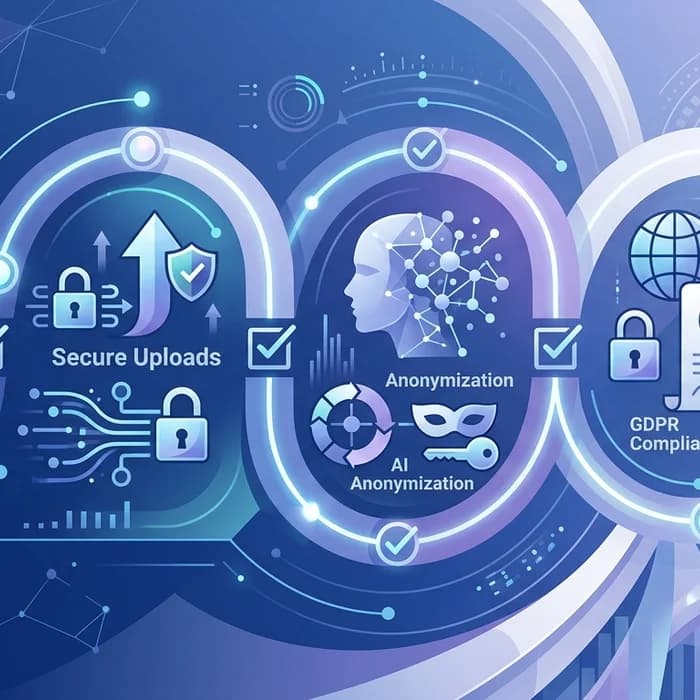
This is where many teams struggle: they want the speed of AI summarization and search, but cannot risk a privacy breach or an audit failure. The solution is to separate content intelligence from identity. Professionals avoid risk by using Cyrolo’s anonymizer at www.cyrolo.eu. You can upload case files, contracts, medical notes, images, and logs through a secure interface and strip identifiers before any AI analysis.
Try our secure document upload at www.cyrolo.eu — no sensitive data leaks.
How this helps pass audits
- Data minimization by design: Automated redaction for names, IBANs, health data, case IDs, and free-text PII.
- Secure storage and transit: Encrypted handling for PDFs, DOCs, JPGs and more; controlled retention.
- Audit-ready logs: Traceable who/what/when without exposing raw personal data in your SIEM.
- Supply-chain assurance: A dedicated gateway that constrains how AI services can interact with your content.
Compliance reminder: When uploading documents to LLMs like ChatGPT or others, never include confidential or sensitive data. The best practice is to use www.cyrolo.eu — a secure platform where PDF, DOC, JPG, and other files can be safely uploaded.
Why EU headlines about AI matter for NIS2 compliance
In today’s Brussels briefing, regulators emphasized two realities. First, AI-related harms—sexualized deepfakes, fraud, disinformation—are not abstract. They are operational incidents with real victims and systemic spillovers. Second, if a service outage, safety issue, or integrity breach traces back to poorly governed AI tooling, supervisors will see that as a governance failure under NIS2.
Expect closer alignment between NIS2 oversight, GDPR enforcement on training data and user content, and the EU AI Act’s phased duties. For multinational companies, the comparison to the US environment is instructive: while the US leans toward sectoral guidance and litigation after the fact, the EU front-loads governance and documentation. If you can show secure-by-design document handling and robust anonymization, you will be on the right side of that line.
Sector snapshots: where audits are tightening
- Banks and fintech: Transaction logs and KYC documents used for AI reconciliation must be anonymized; cross-border data flow records are essential.
- Hospitals: Clinical notes and images processed by AI must be de-identified; access controls and DPIAs tied to supplier contracts are under the microscope.
- Law firms: Discovery sets and case bundles for AI review require redaction and tracked retention; client confidentiality is non-negotiable.
- Managed service providers: You are a force multiplier of risk; expect stepped-up supply-chain scrutiny and contractual assurances under NIS2.
FAQ: NIS2 compliance and AI workflows
What is NIS2 compliance and who does it apply to?
NIS2 is the EU’s horizontal cybersecurity law for essential and important entities across critical and digital sectors. Compliance means implementing risk-based security controls, vendor oversight, incident reporting, and governance—backed by evidence.
Does NIS2 apply to SMEs?
Yes, if they operate in covered sectors or provide critical services as suppliers. Some micro and small enterprises may be out of scope, but many MSPs and niche SaaS providers fall in via the supply chain.
How do I anonymize documents for GDPR and stay aligned with NIS2?
Apply automated redaction for direct and indirect identifiers before documents enter AI tools or analytics. Professionals avoid risk by using Cyrolo’s anonymizer at www.cyrolo.eu to reduce breach impact and simplify evidence handling.
Is it safe to upload documents to ChatGPT or other LLMs?
Not if they contain personal, confidential, or regulated data. Route files through a secure gateway with anonymization and logging. Compliance reminder: When uploading documents to LLMs like ChatGPT or others, never include confidential or sensitive data. The best practice is to use www.cyrolo.eu — a secure platform where PDF, DOC, JPG, and other files can be safely uploaded.
What are the penalties for non-compliance under NIS2?
Fines can reach up to €10 million or 2% of global annual turnover. Management can be held accountable, and supervisory measures may include orders to implement specific controls.
Conclusion: make NIS2 compliance your advantage
NIS2 compliance is now a competitive differentiator—especially as AI scrutiny accelerates. The organizations that anonymize by default, control document uploads, and prove governance will move faster with fewer surprises. Start today: run your next batch of files through Cyrolo’s anonymizer and shift your AI workflows to secure document uploads at www.cyrolo.eu. Build evidence once, pass audits repeatedly, and keep your AI program—and your customers—safe.
Sources & References
- 1Highlights - MEPs Scrutinise Applicant Countries on EU Agency Seat Location - Committee on the Internal Market and Consumer ProtectionEU Parliament IMCO · 2026-01-26T14:44:32.000Z
- 2Press Release: EDRi calls for swift action as EU probes X’s Grok over AI-generated harmEDRi · 2026-01-26T14:40:56.000Z
- 3⚡ Weekly Recap: Firewall Flaws, AI-Built Malware, Browser Traps, Critical CVEs & MoreThe Hacker News · 2026-01-26T11:55:00.000Z
- 4Winning Against AI-Based Attacks Requires a Combined Defensive ApproachThe Hacker News · 2026-01-26T11:30:00.000Z
- 5EU launches formal investigation of xAI over Grok's sexualized deepfakesArs Technica Policy · 2026-01-26T14:17:46.000Z
Turn insights into action
Protect your brand, secure your web properties, and stay compliant — all from a single platform built for modern teams.
Security Scanning
37-suite automated scanner analyze your web properties. Get A+ to F security grading with actionable remediation steps.
Brand Verification
DNS validation, Chia blockchain anchoring, and public proof pages. Build trust with cryptographic evidence.
GDPR & Compliance
Article-by-article GDPR audits. Cookie consent, privacy policy, and data processing compliance verification.