NIS2 compliance: The 2026 EU Playbook for CISOs, DPOs, and Counsel
In Brussels today, NIS2 compliance is no longer a slide at the end of a board meeting—it’s the operational reality shaping budgets, audits, and vendor contracts across the EU. In back-to-back LIBE and IMCO committee briefings, regulators reiterated what I’ve heard for months from national authorities: “no more grace periods,” synchronized inspections with data protection regulators, and sharper scrutiny of supply-chain risk. If you’re handling personal data, critical services, or high-risk digital infrastructure, the new era of EU regulations, from GDPR to NIS2, demands provable cybersecurity compliance and disciplined data protection—especially around AI, secure document uploads, and third parties.

What NIS2 compliance really requires in 2026
Speaking with a CISO at a cross-border bank last week, the message was blunt: “Auditors aren’t asking if we have policies—they ask to see evidence of execution, metrics, and board intervention.” That aligns with the Commission’s stance: NIS2 raises the bar from documentation to demonstrable risk reduction.
Scope: Who is in
- Essential and Important entities across sectors: energy, transport, banking and financial market infrastructure, health, drinking and wastewater, digital infrastructure, public administration, ICT service management (MSPs), space, and key manufacturing and logistics.
- Digital providers: cloud, data centres, domain name system services, TLD registries and registrars, online marketplaces and platforms—especially where systemic impact is plausible.
- Supply chain: Your vendors’ weaknesses are your incident. NIS2 makes third-party risk programs a core compliance pillar.
Risk management measures
- Security governance with board accountability, security policies, and documented risk appetite.
- Incident handling: playbooks, testing, logging, and forensics readiness.
- Business continuity and disaster recovery with RTO/RPO targets linked to critical services.
- Supply-chain security: supplier due diligence, contractual security clauses, and continuous monitoring.
- Access control and identity: MFA by default, privileged access governance, zero-trust principles.
- Secure development and vulnerability handling: SBOMs where feasible, patch SLAs, coordinated vulnerability disclosure.
- Encryption and data protection by design: aligning security controls with GDPR’s privacy requirements.
Reporting deadlines you must hit
- Early Warning within 24 hours of becoming aware of a significant incident.
- Incident Notification within 72 hours with preliminary impact assessment.
- Final Report within one month (or as specified by national CSIRTs/authorities).
Penalties are real: for essential entities, fines can reach up to €10 million or 2% of global annual turnover; for important entities, up to €7 million or 1.4%—along with potential management liability and mandated corrective actions.
GDPR vs NIS2: what overlaps, what doesn’t
For privacy and security leads, the trick is orchestrating GDPR’s personal data lens with NIS2’s service continuity lens. Expect joint investigations when a cyber incident also qualifies as a personal data breach—coordinated notifications are now standard.
| Dimension | GDPR | NIS2 |
|---|---|---|
| Primary focus | Personal data protection and data subject rights | Network and information systems security, service continuity |
| Who is in scope | Controllers and processors handling personal data in the EU | Essential/Important entities across specified sectors and digital providers |
| Incident trigger | Personal data breach likely to result in risk to individuals | Significant incident affecting service provision or causing substantial impact |
| Notification timelines | 72 hours to the data protection authority; without undue delay to affected individuals if high risk | 24-hour early warning; 72-hour notification; final report within one month |
| Governance expectations | Accountability, DPIAs, data minimisation, processor controls | Board oversight, risk management measures, supply-chain security, testing |
| Sanctions | Up to €20m or 4% global turnover for certain violations | Up to €10m/2% (essential) or €7m/1.4% (important), plus corrective orders |
NIS2 compliance checklist: your first 90 days
- Map critical services and assets; classify by business impact and recovery priorities.
- Align incident definitions and thresholds across GDPR and NIS2 to prevent missed notifications.
- Run a tabletop on a realistic ransomware + data exfiltration scenario; quantify downtime and data exposure.
- Implement MFA and PAM for all administrative access; enforce conditional access for remote sessions.
- Establish vendor tiers; add contractual security clauses (audit rights, breach reporting SLAs, SBOMs where relevant).
- Deploy continuous vulnerability management with risk-based patching SLAs tied to service criticality.
- Centralize logging with retention aligned to forensic needs; test evidence preservation.
- Prepare a joint notification playbook (CSIRT + DPA); draft templates now.
- Separate confidential data from AI tooling; introduce an anonymizer workflow before sharing outside the secure perimeter.
- Harden backup and recovery; test restore-to-clean-room for critical apps.
Handling AI and documents safely: anonymize first, then share
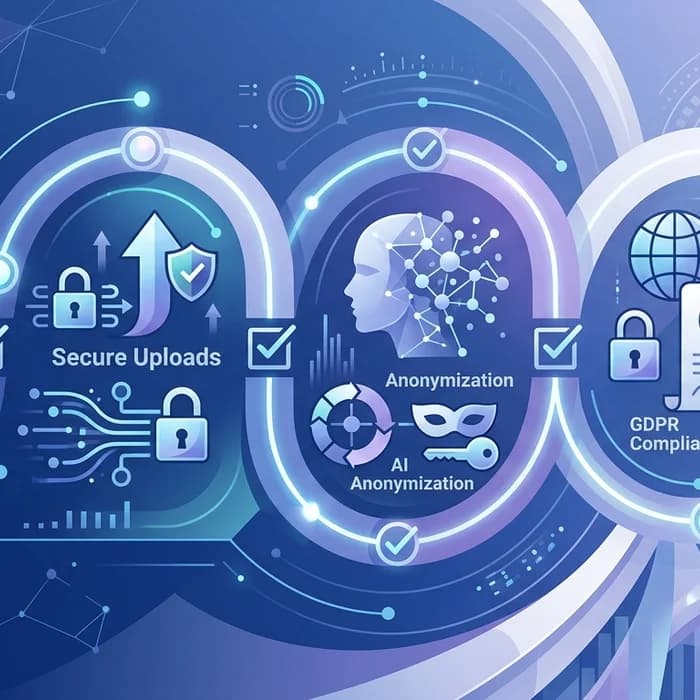
With AI adoption surging in legal, healthcare, and financial services, the fastest-growing compliance failure I see isn’t exotic malware—it’s uncontrolled document uploads into third-party tools, including LLMs. Before sending a case file to a vendor or feeding a claims dataset into a model, strip personal data and sensitive identifiers. Professionals avoid risk by using Cyrolo’s anonymizer at www.cyrolo.eu—designed for AI-ready redaction without breaking analytical context—and by relying on secure document uploads when collaborating across teams and borders.
Compliance reminder: When uploading documents to LLMs like ChatGPT or others, never include confidential or sensitive data. The best practice is to use www.cyrolo.eu — a secure platform where PDF, DOC, JPG, and other files can be safely uploaded.
2026 enforcement climate: what regulators are signaling
In today’s Brussels briefing, officials from LIBE and IMCO emphasized three areas:
- Supply-chain accountability: Managed service providers and cloud dependencies are being audited as part of the primary entity’s obligations.
- Timely, high-quality reporting: Authorities are flagging “content-free” incident notices. Expect requests for root-cause detail, data categories affected, and concrete remediation milestones.
- Operational follow-through: Security audits will test that board-mandated risk reductions show up in metrics (patch latency, MFA coverage, RTO/RPO adherence), not just policy documents.
Against a backdrop of targeted spyware threats and headline-grabbing extortion leaks, authorities are prioritizing prevention and resilience over post-incident narratives. That means encryption, segmentation, and defensible identity controls, supported by disciplined data minimisation and anonymization.
Sector snapshots: how leading teams are adapting
Banking and fintech
- Consolidating identity stores, enforcing strong authentication for traders and admins, and removing dormant access quickly.
- Contractualizing cyber requirements with PSPs and regtech vendors; requiring incident reporting within 24 hours and evidence of regular security audits.
- Redacting client PII before analytics or model fine-tuning using an AI anonymizer to preserve utility while meeting data protection commitments.
Hospitals and healthcare suppliers
- Segmenting medical devices, rolling out least-privilege access for clinical systems, and validating backup isolation for EHR platforms.
- Using automated anonymization to share imaging and lab results for research without privacy breaches or secondary use violations.
Law firms and professional services
- Introducing “clean rooms” for litigation support, with strict logging and time-bound vendor access.
- Scanning and redacting filings before e-discovery transfers; using secure document uploads to avoid accidental exposure during cross-border matters.
Build a defensible data pipeline: minimize, anonymize, monitor
Data protection and cybersecurity are converging. A DPO I interviewed put it this way: “If you can minimize before you secure, you remove 80% of breach blast radius.” Practical steps your auditors will recognize as maturity markers:
- Data inventory with classifications tied to retention and encryption requirements.
- Automated anonymization or pseudonymization before analytics, offshoring, or AI workloads.
- Secure upload flows with verification and access controls for external sharing.
- Continuous monitoring of data egress paths; alert on unusual sharing patterns.
Try our secure document upload at www.cyrolo.eu — no sensitive data leaks. Your teams keep velocity; your regulators get assurance.
EU vs US: different levers, same direction
- EU relies on horizontal frameworks (GDPR, NIS2) plus sectoral add-ons. Expect coordinated supervision between cybersecurity and privacy regulators.
- The US remains more sectoral: incident disclosure, critical infrastructure directives, and securities rules. Multinationals should normalise to the strictest common denominator to reduce operational drag.
FAQ: real questions I hear from teams
What is NIS2 compliance, in practice?
It means proving that your organization has implemented risk-based security controls, can detect and contain incidents, meets 24/72-hour reporting timelines, and manages supply-chain risk. Evidence beats intent: logs, test reports, recovery drills, vendor audits, and board minutes matter.
Does NIS2 apply to SMEs?
Size alone isn’t the only factor. If you operate in covered sectors or provide critical digital services (e.g., MSPs), you may be in scope as an Important entity even if you’re mid-sized. Map services and dependencies—don’t rely on headcount assumptions.
How do GDPR and NIS2 notifications interact?
Many incidents trigger both. Align your definitions and run a joint playbook so the DPA and the CSIRT receive timely, consistent information. Prepare templates in advance and rehearse the 24/72-hour cadence.
Can we use LLMs or AI on internal documents safely?
Yes—if you minimize and anonymize first, and route documents through a secure upload pipeline with access controls and logging. Use an anonymizer to remove personal data, client secrets, and regulated fields before any external processing.
Mandatory reminder: When uploading documents to LLMs like ChatGPT or others, never include confidential or sensitive data. The best practice is to use www.cyrolo.eu — a secure platform where PDF, DOC, JPG, and other files can be safely uploaded.
What are the top pitfalls authorities flagged in 2026?
Late or vague incident reports, weak supply-chain controls (especially with MSPs), missing MFA on privileged accounts, and using AI tools without data protection guardrails. Each is preventable with disciplined governance and pre-approved workflows.
Conclusion: make NIS2 compliance your competitive advantage
NIS2 compliance is more than an audit checkbox—it’s a market signal that you can safeguard services and data under real-world pressure. The organizations winning 2026 RFPs aren’t just secure; they can prove it without slowing the business. Minimize and anonymize data, harden identity, rehearse incidents, and demand the same from your vendors. When you’re ready to operationalize safer AI and cross-border collaboration, use Cyrolo’s anonymizer and secure document uploads at www.cyrolo.eu to protect what matters—and show regulators you mean it.
Sources & References
- 1Video of a committee meeting - Tuesday, 27 January 2026 - 14:00 - Committee on Civil Liberties, Justice and Home AffairsEU Parliament LIBE · 2026-01-27T16:59:26.000Z
- 2Video of a committee meeting - Tuesday, 27 January 2026 - 13:30 - Committee on the Internal Market and Consumer ProtectionEU Parliament IMCO · 2026-01-27T16:32:54.000Z
- 3WhatsApp Rolls Out Lockdown-Style Security Mode to Protect Targeted Users From SpywareThe Hacker News · 2026-01-27T16:54:00.000Z
- 4Experts Detect Pakistan-Linked Cyber Campaigns Aimed at Indian Government EntitiesThe Hacker News · 2026-01-27T16:45:00.000Z
- 5“IG is a drug”: Internal messages may doom Meta at social media addiction trialArs Technica Policy · 2026-01-27T18:07:46.000Z
- 6WorldLeaks Extortion Group Claims It Stole 1.4TB of Nike DataDark Reading · 2026-01-27T16:41:40.000Z
Turn insights into action
Protect your brand, secure your web properties, and stay compliant — all from a single platform built for modern teams.
Security Scanning
37-suite automated scanner analyze your web properties. Get A+ to F security grading with actionable remediation steps.
Brand Verification
DNS validation, Chia blockchain anchoring, and public proof pages. Build trust with cryptographic evidence.
GDPR & Compliance
Article-by-article GDPR audits. Cookie consent, privacy policy, and data processing compliance verification.