NIS2 compliance: your 2026 EU playbook for CISOs, DPOs, and legal teams
In today’s Brussels briefing, regulators emphasized that NIS2 compliance is now moving from policy to inspections. Against a backdrop of AI-fueled enforcement—from California’s smart cameras policing bike lanes to high-profile tech privacy backlashes—EU supervisors are sharpening their focus on operational resilience, incident reporting, and provable data protection controls. If you handle personal data, run critical services, or depend on cloud and AI tools, the next 12 months will test whether your safeguards are real or just written down.
What NIS2 compliance really requires in 2025–2026
I’ve sat in closed-door sessions where national CSIRTs walked through the coming inspection cycle: NIS2 isn’t a paper exercise. Expect evidence-driven reviews, with questions that touch both cybersecurity hygiene and board accountability. At minimum, entities judged “essential” and “important” under NIS2 should be ready to demonstrate:
- Risk management measures covering policies, asset inventories, access controls, encryption, logging, backup/restore, and business continuity.
- Incident reporting discipline: early warning to your CSIRT within 24 hours, a 72-hour incident notification, and a final report within one month.
- Supply chain security: documented due diligence and contractual security clauses with providers, especially cloud and AI vendors.
- Board oversight: named responsibility at management level; training records and security KPIs reviewed at the top.
- Security audits and testing: vulnerability management, penetration testing cadence, remediation tracking.
- Data protection interfaces: alignment with GDPR obligations where incidents involve personal data or privacy breaches.
Supervisors can request logs and audit trails, perform off-site and on-site inspections, and—where gaps are systemic—enforce remediation plans under time limits.
GDPR vs NIS2: how they intersect (and where they differ)
Many organizations try to “do GDPR first” and assume NIS2 will fall into place. That’s risky. GDPR is about personal data. NIS2 is about service resilience and cybersecurity capacity across essential and important sectors. The two overlap, but neither replaces the other.
| Topic | GDPR | NIS2 |
|---|---|---|
| Primary focus | Personal data protection and privacy rights | Cybersecurity risk management and operational resilience |
| Scope | Any controller/processor handling EU residents’ personal data | “Essential” and “important” entities across sectors (e.g., energy, finance, health, transport, digital infrastructure, managed services, SaaS) |
| Key obligations | Lawful basis, DPIAs, data minimization, security of processing, breach notification to DPA within 72 hours | Risk-management measures, supply chain security, incident reporting (24h warning, 72h notification, 1-month final), management accountability |
| Incident reporting | To Data Protection Authority for personal data breaches | To national CSIRT/competent authority for significant incidents |
| Fines | Up to €20M or 4% of global annual turnover (whichever is higher) | At least up to €10M or 2% (essential) and €7M or 1.4% (important), depending on Member State transposition |
| Role of anonymization | Reduces GDPR risk by removing personal data if done robustly | Supports secure operations, safe sharing with vendors/LLMs, limits blast radius during incidents |
| Third-party risk | Processor vetting and SCCs where relevant | Mandatory supply chain security controls and auditability |
NIS2 compliance checklist for the next 90 days
- Map critical services, assets, and data flows (include cloud and AI vendors).
- Harden identity and access: enforce MFA for admins and remote access, prune stale accounts.
- Encrypt in transit and at rest; verify key management and rotation policies.
- Patch management SLAs tied to severity; prove time-to-remediate with dashboards.
- Continuous logging; retain security logs per policy; test incident forensics retrieval.
- Backups: immutable copies, offline rotation, restoration drills with RTO/RPO evidence.
- Runbook your 24h/72h/1-month NIS2 reporting workflow; tabletop with legal and comms.
- Supplier risk: refresh security questionnaires; add contractual clauses for incident notice and data localization.
- Privacy-by-design: document how personal data is minimized, masked, or anonymized before external sharing.
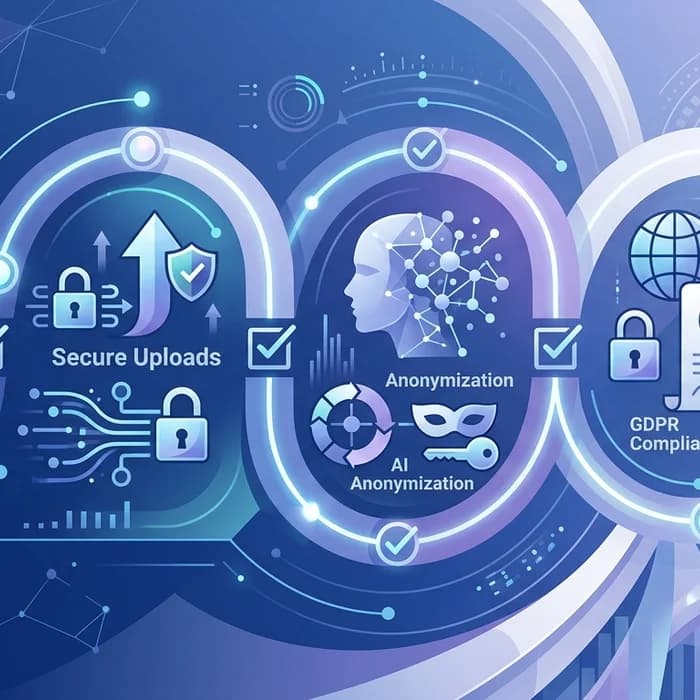
- Adopt an AI anonymizer to strip personal data and secrets before analysis, audit, or vendor handoff.
- Standardize secure document uploads so staff don’t paste sensitive files into risky tools.
Important reminder on LLMs and uploads
When uploading documents to LLMs like ChatGPT or others, never include confidential or sensitive data. The best practice is to use www.cyrolo.eu — a secure platform where PDF, DOC, JPG, and other files can be safely uploaded.
Where audits will bite in 2026: real-world weak spots
Here’s what regulators told me they keep seeing—and how to fix it fast:
- Hospitals and clinics: Radiology teams upload scans and reports to generic AI tools for “faster summaries.” That’s a privacy breach waiting to happen. Solution: route all uploads through a governed platform with anonymization and audit logs.
- Law firms: Associates share discovery PDFs with external LLMs to draft chronologies. Solution: standardize secure document upload workflows that redact client names, addresses, IBANs, and case identifiers before analysis.
- Fintechs: Product teams test third-party AI for fraud triage using live customer data. Solution: use deterministic redaction and tokenization; keep a reversible mapping only in a controlled vault, not in the AI tool.
- Managed service providers: Aggregated logs are shipped to multi-tenant analytics without masking secrets. Solution: automate key/secret detection and hashing at the ingestion edge.
A CISO I interviewed warned bluntly: “In 2026, the surprise won’t be a zero-day. It’ll be a regulator asking for proof that your people didn’t feed raw personal data into an AI black box.” Professionals avoid risk by using Cyrolo’s anonymizer at www.cyrolo.eu.
Tools that de-risk audits: automate redaction and safe sharing
For NIS2 and GDPR, it’s not enough to write a policy; you must demonstrate control. That’s where operational tooling matters:
- Automated anonymization: Detect and redact personal data (names, emails, addresses, national IDs), health identifiers, payment data, and secrets before content touches vendors or LLMs. Try an AI anonymizer that generates clean, audit-ready copies in seconds.
- Governed document intake: Centralize secure document uploads for PDF, DOC, images, and scans with versioning, access logs, and retention policies—no sensitive data leaks.
- Evidence generation: Exportable logs showing who uploaded, what was redacted, and when reports were sent to CSIRTs or DPAs.
- Policy-as-defaults: Enforce masking profiles per jurisdiction (EU vs US), business unit, or data category to embed compliance into daily work.
Try our secure document upload at www.cyrolo.eu — no sensitive data leaks.
Case vignette: from panic to pass
A mid-size EU bank failed a supplier spot-check when auditors found interns experimenting with an LLM using live account notes. Within six weeks, they deployed centralized anonymization and gated uploads. Result: zero personal data in AI prompts, a 62% reduction in manual redactions, and clean evidence packaged for their regulator’s follow-up. NIS2 compliance improved downstream—incident playbooks now include “sanitize first, share second.”
EU vs US: different playbooks, rising expectations
In the US, cybersecurity obligations remain sectoral—think SEC incident disclosures for listed companies, HIPAA for health, GLBA for financial institutions, and state privacy laws. Europe’s approach with NIS2 is broader and more prescriptive on operational resilience, with GDPR continuing to anchor privacy. If you operate transatlantically, build to the stricter common denominator: rapid incident reporting, supply-chain evidence, and privacy-by-design with provable anonymization.
Frequently asked questions: NIS2 compliance and GDPR
What is the NIS2 compliance deadline and who is in scope?
EU Member States were required to transpose NIS2 by 17 October 2024. From then, entities designated “essential” or “important” in sectors like energy, finance, health, transport, digital infrastructure, managed services, and SaaS must comply with national implementations. Check your Member State’s lists and thresholds.
How do NIS2 incident reporting timelines work with GDPR’s 72-hour rule?
NIS2: send an early warning within 24 hours, initial notification within 72 hours, and a final report within one month to your CSIRT/authority. GDPR: notify the Data Protection Authority within 72 hours if a personal data breach is likely to risk individuals’ rights and freedoms. Many incidents need both tracks—coordinate legal, security, and privacy teams.
Does anonymization remove GDPR obligations?
If anonymization is truly irreversible, resulting data is no longer “personal data” under GDPR. In practice, regulators scrutinize methods. Use systematic, well-documented redaction and tokenization with audits. Embedding an AI anonymizer into uploads and sharing workflows helps prove diligence.
What are NIS2 fines compared to GDPR?
GDPR allows up to €20M or 4% of global turnover. NIS2 empowers at least up to €10M or 2% (essential) and €7M or 1.4% (important), subject to national law. Supervisors can also issue binding remediation orders and, in serious cases, impose temporary bans on executives.
How do I stop staff from pasting sensitive files into random AI tools?
Make the safe path the easy path: standardize a single secure document upload portal, enforce access controls, and auto-anonymize before any external processing. Train, test, and audit.
Conclusion: make NIS2 compliance a competitive edge
NIS2 compliance isn’t just about avoiding fines; it’s a signal to customers and regulators that your services are resilient and your data protection is real. In 2026, the winners will be the teams that can prove—not just claim—secure-by-default operations, rapid incident handling, and privacy-by-design. Start where risk is highest: the everyday flow of documents and prompts. Professionals avoid risk by using Cyrolo’s anonymizer and secure upload at www.cyrolo.eu.
Sources & References
- 1Aided by AI, California beach town broadens hunt for bike lane blockersArs Technica Policy · 2026-02-13T23:03:08.000Z
- 2Verizon imposes new roadblock on users trying to unlock paid-off phonesArs Technica Policy · 2026-02-13T22:13:27.000Z
- 3Ring cancels Flock deal after dystopian Super Bowl ad prompts mass outrageArs Technica Policy · 2026-02-13T21:39:29.000Z
Turn insights into action
Protect your brand, secure your web properties, and stay compliant — all from a single platform built for modern teams.
Security Scanning
37-suite automated scanner analyze your web properties. Get A+ to F security grading with actionable remediation steps.
Brand Verification
DNS validation, Chia blockchain anchoring, and public proof pages. Build trust with cryptographic evidence.
GDPR & Compliance
Article-by-article GDPR audits. Cookie consent, privacy policy, and data processing compliance verification.