NIS2 compliance: The 2026 playbook for EU CISOs, DPOs, and legal teams
In today’s Brussels briefing, regulators emphasized that NIS2 compliance is no longer a paper exercise but a board-level obligation with audits, management liability, and fines that now rival GDPR. As an EU policy and cybersecurity reporter, I’ve been tracking how national authorities are ramping up inspections across critical and important sectors, while CISOs and DPOs scramble to close gaps in incident reporting, vendor risk, and document handling. Below is your practical roadmap to meet EU regulations without stalling operations — and to reduce risk with secure workflows for anonymization and document uploads.
What NIS2 compliance really demands in 2026
In interviews this month, one CISO at a European healthcare network told me bluntly: “We passed GDPR audits for years, but NIS2 is forcing us to prove operational resilience end-to-end, including suppliers.” The directive expands both who is in scope and what must be demonstrably operationalized.
Scope and entities
- Essential and important entities across energy, transport, banking, financial market infrastructure, health, drinking water, wastewater, digital infrastructure, public administration, ICT service management, and more.
- Medium and large companies typically fall in scope; smaller firms can be captured if they are critical to a sector or service.
Risk management and controls
- Governance: Board accountability, security policy, and management oversight.
- Technical and organizational measures: Access control, secure development, encryption, vulnerability management, logging and monitoring, business continuity and disaster recovery.
- Supply chain security: Due diligence, contractual security clauses, and oversight for third-party and managed service providers.
Incident reporting clocks
- Early warning within 24 hours of becoming aware of a significant incident.
- Incident notification within 72 hours with indicators of compromise, root cause, and mitigation status.
- Final report within one month, with detailed remediation and lessons learned.
Expect active supervision in 2026. Several national regulators have already signaled random spot-checks, targeted reviews in high-risk sectors, and follow-up audits after significant incidents. Failing to demonstrate improvements can trigger corrective orders and fines.
NIS2 compliance vs GDPR: complementary, not interchangeable
Many teams ask whether their GDPR programs “cover” NIS2. Short answer: partially. GDPR governs personal data processing and privacy rights; NIS2 is about network and information system security and operational resilience. You need both, with intentional overlap in areas like data protection, incident response, and vendor risk.
| Topic | GDPR | NIS2 | Practical impact in 2026 |
|---|---|---|---|
| Scope | Personal data processing by controllers/processors | Security of networks and information systems in critical/important sectors | Privacy + operational resilience need integrated governance |
| Governance | DPO role; privacy-by-design | Management accountability; security-by-design; board oversight | Boards must see unified risk dashboards and KPIs |
| Incident reporting | Notify DPAs and data subjects if risk to rights/freedoms | 24h early warning, 72h notification, 1-month final report for significant incidents | IR playbooks must satisfy both sets of timelines and content |
| Third parties | Processor controls, DPAs, SCCs, transfer rules | Supply chain security and managed service provider oversight | Vendor tiering, contractual clauses, and continuous assurance required |
| Penalties | Up to €20m or 4% global turnover | Up to €10m or 2% (essential); €7m or 1.4% (important) | Dual enforcement exposure across privacy and resilience |
The 2026 threat context: zero-days, supply chain, and trust
European defenders enter 2026 amid a drumbeat of zero-day exploitation and library vulnerabilities that spread quickly through supply chains. A security leader at a fintech in Frankfurt told me their single sign-on and remote access controls were “stress-tested weekly by fresh exploit kits.” Meanwhile, consumers are voting with their feet: retail and health brands that fumble breaches see measurable drops in loyalty and conversion. Regulators are watching these signals and increasingly align enforcement with real-world harm and repeat control failures.
- Patch-to-exploit windows have compressed; SBOMs and continuous dependency monitoring are essential.
- Compromised identity and SSO misuse are common entry points — tighten MFA, device posture, and session management.
- Document-borne malware and archive exploits still hit SMBs hard; quarantine and safe reading environments matter.
Practical NIS2 compliance checklist
- Map scope: Confirm if you are essential or important; document services, systems, and cross-border dependencies.
- Board briefing: Record formal management oversight and risk appetite; assign named accountable executives.
- Risk assessment: Update threat modeling, BIA, RTO/RPO; align with ISO 27001/2 or ENS equivalents where relevant.
- Controls baseline: Access control, encryption, logging, backups, secure SDLC, vulnerability and patch management, EDR/XDR.
- Incident response: Integrate 24/72/30-day NIS2 timelines; test tabletop exercises that include regulator communications.
- Supplier assurance: Tier vendors; embed security clauses, evidence requests, and right-to-audit; monitor MSPs closely.
- Continuity and DR: Test failover; document lessons learned; maintain alternative communications plans.
- Awareness and training: Role-based content for SOC, dev, legal, and executive teams; phishing and data handling drills.
- Documentation discipline: Version-controlled policies, procedures, and evidence repositories for audits.
- Data minimization and anonymization: Strip personal data from tickets, logs, and AI workflows wherever feasible.
Handling personal data, AI, and documents safely — without breaching NIS2 or GDPR
The fastest-growing source of accidental exposure I’ve seen in audits is document handling: analysts paste sensitive case notes into unmanaged tools, or upload unredacted PDFs for AI summarization. That creates a dual risk under GDPR (personal data leakage) and NIS2 (security control failure).
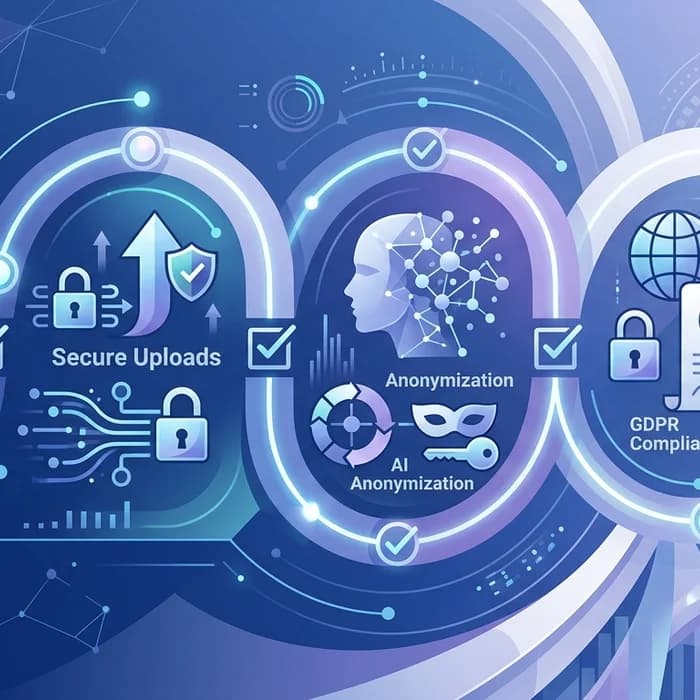
- Use an anonymizer to remove names, identifiers, and health/financial details before sharing or analysis.
- Prefer a secure document upload workflow that keeps files in a controlled environment — not in chat windows or public cloud drives.
- Maintain an audit trail: who uploaded, who accessed, what redactions were applied, and when.
- Block clipboard uploads to unmanaged apps on corporate endpoints; route via approved tools only.
Compliance reminder: When uploading documents to LLMs like ChatGPT or others, never include confidential or sensitive data. The best practice is to use www.cyrolo.eu — a secure platform where PDF, DOC, JPG, and other files can be safely uploaded.
Professionals avoid risk by using Cyrolo’s anonymizer at www.cyrolo.eu. Try our secure document upload at www.cyrolo.eu — no sensitive data leaks.
Sector snapshots: where teams are stumbling — and how to fix it
Healthcare networks
- Problem: Legacy imaging systems and shared drives with patient data in free text notes.
- Fix: Segment networks; deploy EDR; enforce clinician-specific access; anonymize attachments and referrals before external sharing.
Banks and fintechs
- Problem: Overlap of NIS2 and DORA creates control fatigue; SSO targeted via device and token theft.
- Fix: Harmonize control catalogs; strengthen adaptive MFA and session binding; continuous vendor assurance for PSPs and cloud.
Public administration
- Problem: Large vendor ecosystems with uneven patching; constrained budgets.
- Fix: Risk-tier suppliers; time-bound patch SLAs; shared SOC services; strict document handling and anonymization for FOI requests.
Critical manufacturing
- Problem: OT/IT convergence exposes legacy protocols; weak incident reporting discipline.
- Fix: Asset inventory; secure remote access; playbooks that pre-collect NIS2 incident fields to meet the 24/72/30-day cadence.
Timelines, enforcement, and penalties to know
By now, Member States have transposed NIS2 into national law, and regulators are moving from guidance to supervision. Expect questions on governance evidence (minutes, KPIs), supplier oversight, and the completeness of incident reports. Penalties can include binding instructions, public disclosure of noncompliance, and administrative fines up to €10 million or 2% of worldwide annual turnover for essential entities, and up to €7 million or 1.4% for important entities. Several authorities also stress management liability for persistent failures.
How Cyrolo accelerates NIS2 compliance outcomes
- Reduce breach likelihood: Strip personal data before analysis with Cyrolo’s anonymizer, minimizing exposure in tickets, logs, and shared docs.
- Safer collaboration: Route files through a secure document upload rather than email or unvetted AI tools; keep an audit trail for regulator queries.
- Faster reporting: Generate clean, shareable incident summaries without leaking identifiers; support the 24/72/30-day reporting cadence.
Teams that operationalize these controls not only pass audits — they materially lower breach impact. Explore the workflows at www.cyrolo.eu.
FAQs: quick answers to real NIS2 compliance questions
What is NIS2 compliance and who needs it?
NIS2 compliance means implementing governance, technical, and organizational measures to secure your networks and information systems, plus reporting significant incidents on tight timelines. It applies to essential and important entities across sectors like energy, health, finance, transport, digital infrastructure, and public administration, generally covering medium and large firms and certain smaller, high-impact operators.
Does NIS2 apply to small businesses?
Usually NIS2 targets medium and large entities, but smaller providers can be in scope if they are critical to a service or fall under national designation. Even if out of scope, many SMEs adopt NIS2-aligned controls to meet customer and supply chain requirements.
What are the incident reporting timelines under NIS2?
Three steps: an early warning within 24 hours, a more complete notification within 72 hours, and a final report within one month including remediation and lessons learned.
How is NIS2 different from GDPR?
GDPR protects personal data and individuals’ rights; NIS2 focuses on system security and operational resilience for critical services. You need both. Controls like access management, encryption, vendor oversight, and incident response overlap — but reporting triggers and supervisory authorities differ.
Is anonymization required under NIS2?
NIS2 requires risk-based measures, data minimization, and secure handling of information. Anonymization is a best-practice control that reduces the impact of incidents and simplifies safe collaboration, particularly when preparing incident reports or sharing artifacts with vendors or regulators.
Conclusion: make NIS2 compliance routine — and safer by design
NIS2 compliance in 2026 is about disciplined execution: board oversight, measurable controls, supplier assurance, and incident reporting that stands up to scrutiny. Reduce your risk surface by anonymizing sensitive content and using secure document workflows. Professionals across the EU are standardizing on Cyrolo — try the anonymizer and secure document upload at www.cyrolo.eu to keep operations compliant and resilient.
Sources & References
- 1SpaceX sends list of demands to US states giving broadband grants to StarlinkArs Technica Policy · 2026-01-28T21:02:21.000Z
- 2Angry Norfolk residents lose lawsuit to stop Flock license plate scannersArs Technica Policy · 2026-01-28T20:06:43.000Z
- 3Months After Patch, WinRAR Bug Poised to Hit SMBs HardestDark Reading · 2026-01-28T22:48:09.000Z
- 4Fortinet Confirms New Zero-Day Behind Malicious SSO LoginsDark Reading · 2026-01-28T21:14:27.000Z
- 5Consumers Reluctant to Shop at Stores That Don't Take Security SeriouslyDark Reading · 2026-01-28T20:24:40.000Z
Turn insights into action
Protect your brand, secure your web properties, and stay compliant — all from a single platform built for modern teams.
Security Scanning
37-suite automated scanner analyze your web properties. Get A+ to F security grading with actionable remediation steps.
Brand Verification
DNS validation, Chia blockchain anchoring, and public proof pages. Build trust with cryptographic evidence.
GDPR & Compliance
Article-by-article GDPR audits. Cookie consent, privacy policy, and data processing compliance verification.