NIS2 compliance in 2026: A practical, risk-first playbook for EU security leaders
Brussels is done warning—2026 is the first full year where NIS2 compliance will be measured by real inspections, real fines, and real accountability for boards. In today’s briefing with EU officials, regulators reiterated that “paper programs” will not satisfy auditors. And after a week of headline attacks—from browser-crashing malvertising kits to mass spam waves abusing customer support platforms—CISOs I spoke with agreed: the gap between policy and operations is where incidents are born. This guide translates the law into controls, shows where GDPR meets NIS2, and explains how secure document handling and anonymization reduce audit exposure and privacy risk.
- Essential and important entities face fines up to at least €10M or 2% of global turnover (NIS2), alongside GDPR penalties up to €20M or 4%.
- Early-warning within 24 hours, a 72-hour incident notification, and a one-month final report are now baseline expectations under EU regulations.
- Operational proof—logging, supplier controls, staff training, and safe AI usage—will decide your audit outcome.
What is NIS2 compliance—and why it’s different from GDPR
NIS2 is the EU’s horizontal cybersecurity directive replacing the original NIS. It extends mandatory security and incident reporting to more sectors (energy, transport, banking, healthcare, digital infrastructure, ICT services, managed services, public administration, and more) and scales obligations by entity type (“essential” vs “important”). Where GDPR focuses on personal data protection, NIS2 targets the resilience of networks and information systems. In practice, most organizations must satisfy both.
In interviews this month, two EU bank CISOs told me their biggest surprise wasn’t the control list—it was the expectation that boards understand cyber risk in financial terms and that suppliers are provably governed. Auditors are asking for evidence chains, not just policies.
Who is in scope, and what deadlines matter?
NIS2 had to be transposed by Member States by 17 October 2024. By 2026, national laws are live across the EU. If you’re a medium or large entity in a listed sector, you’re likely in scope—even if headquartered outside the EU but serving EU markets. Expect:
- Designation as “essential” or “important” by your national regulator (or self-identification in some jurisdictions).
- Obligations to implement risk management measures, conduct security audits, and report incidents on tight timelines.
- Administrative fines: at least €10M or 2% of worldwide turnover for essential entities; at least €7M or 1.4% for important entities (Member States may go higher).
For financial services, note the interplay with DORA (operational resilience) from 2025 onward. For healthcare and public administration, regulators are prioritizing incident reporting maturity and supplier oversight.
NIS2 compliance vs GDPR: Where they overlap and where they don’t
| Area | GDPR | NIS2 |
|---|---|---|
| Primary objective | Protect personal data and privacy rights | Ensure cybersecurity and service continuity |
| Scope trigger | Processing personal data | Operating networks/information systems in critical sectors |
| Key obligations | Lawful basis, DPIAs, data minimization, breach notification | Risk management measures, supplier controls, incident reporting, security audits |
| Breach reporting | Notify DPA within 72 hours if likely risk to rights/freedoms | Early warning within 24 hours, incident notification within 72 hours, final report within 1 month |
| Fines | Up to €20M or 4% of global turnover | At least €10M or 2% (essential); at least €7M or 1.4% (important) |
| Board accountability | Indirect (governance expected) | Direct oversight duties; potential temporary management bans |
“Show me, don’t tell me”: Five controls auditors will test in 2026
- Incident reporting muscle memory
- Early-warning in 24 hours requires an always-on triage path and clear thresholds. Run tabletop exercises quarterly.
- Maintain a binder with templates for initial, intermediate (72-hour), and final (30-day) reports.
- Supplier and SaaS governance
- Recent mass spam campaigns abusing customer support platforms exposed a common weakness: over-permissive integrations and missing monitoring.
- Map critical SaaS, enforce SSO/MFA, rotate API tokens, and subscribe to vendor security advisories.
- Vulnerability and patch cadence
- Define remediation SLAs by severity (e.g., critical within 7 days) and evidence with ticketing data.
- Track exploitability (KEV lists) to justify emergency windows.
- Logging, detection, and response
- Retention that supports both incident reconstruction and privacy principles. Mask or tokenize personal data in logs.
- Prove 24/7 alerting and escalation pathways; include managed detection partners where relevant.
- Secure document handling and AI usage
- Prevent privacy breaches by stripping direct identifiers before analysis or sharing.
- Use an AI anonymizer to redact personal data before any internal or vendor processing.
Safe AI and document workflows without compliance landmines
Across hospitals, law firms, and banks, I see the same pattern: well-meaning teams paste client documents into AI assistants, then scramble when legal asks where that data now lives. That’s a governance failure—and easily avoidable.
- Adopt a “clean input” rule: redact names, IDs, medical details, and financial numbers before any AI processing.
- Centralize uploads through a secure intake that enforces encryption, access controls, and audit trails.
- Standardize redaction policies so staff aren’t deciding ad hoc what counts as personal data.
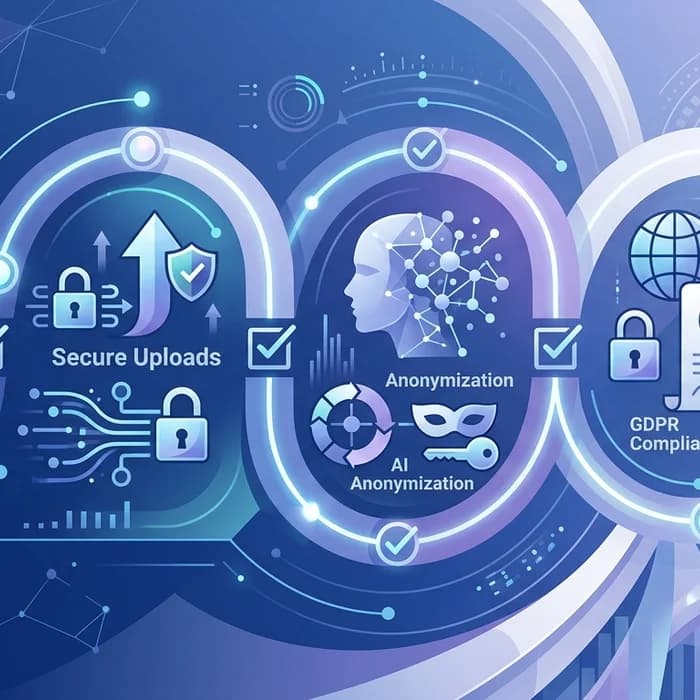
Professionals avoid risk by using Cyrolo’s anonymizer to strip personal data before review or AI analysis, and by routing files through a secure document upload that keeps PDFs, DOCs, and images protected end-to-end.
Compliance reminder: When uploading documents to LLMs like ChatGPT or others, never include confidential or sensitive data. The best practice is to use www.cyrolo.eu — a secure platform where PDF, DOC, JPG, and other files can be safely uploaded.
Try our secure document upload at www.cyrolo.eu — no sensitive data leaks.
NIS2 compliance checklist (print-ready)
- Scope confirmation: Identify if you are “essential” or “important” under national transposition law.
- Governance: Assign board-level oversight and named accountable executives.
- Risk management program: Document risk assessments, treatment plans, and security policies mapped to NIS2 articles.
- Incident playbooks: Early-warning (24h), notification (72h), and final report (30d) templates tested via exercises.
- Technical controls: Network segmentation, MFA, EDR, vulnerability management with defined SLAs.
- Logging and monitoring: Centralized logs with privacy-aware retention and access controls.
- Supplier risk: Inventory critical suppliers/SaaS, contractual security clauses, and continuous monitoring.
- Business continuity: RTO/RPO targets, backup testing, and ransomware recovery drills.
- Training and awareness: Role-based curricula for engineers, analysts, and frontline staff.
- Data protection alignment: DPIAs where relevant, encryption at rest/in transit, and anonymization for personal data in workflows.
- Evidence management: Organized artifacts for audits—tickets, logs, minutes, test results, and supplier attestations.
Real-world scenarios I’m seeing in 2026
Banking and fintech
A payments processor suffered a browser-crash malvertising wave that knocked out agent desktops for 40 minutes. The technical hit was brief, but the regulatory clock started immediately. They met the 24-hour early-warning deadline because runbooks were pre-approved and legal stood by. Lesson: the incident may be small; the reporting burden never is.
Hospitals
A regional hospital’s ticket triage was overwhelmed after a third-party helpdesk integration was abused for spam. The missing control wasn’t a firewall; it was supplier monitoring and API key hygiene. NIS2 auditors asked for API inventory and rotation logs.
Law firms
Partners wanted to use AI for document summarization. The privacy officer greenlit it—only after mandating that all files pass through a secure document upload and AI anonymizer. Result: faster reviews with zero client identifiers crossing tool boundaries.
EU vs US: Different levers, same accountability trend
In the EU, NIS2 and GDPR create harmonized baselines with strong administrative fines and explicit board duties. In the US, requirements are sectoral (for example, critical infrastructure directives and state breach laws) with the regulator mix skewing toward enforcement after the fact. One CISO put it bluntly: “In Brussels, you build the program before the breach; in Washington, you justify it after.” For multinationals, harmonize to the strictest standard—NIS2’s supplier controls and incident reporting—then localize.
FAQ: Your search questions, answered
What is NIS2 compliance in simple terms?
It means proving you have risk-based cybersecurity controls, supplier governance, and rapid incident reporting in place if you operate in EU-listed sectors. It’s not optional and it’s broader than GDPR.
Does NIS2 apply to non-EU companies?
Yes, if you provide covered services in the EU or operate critical infrastructure supporting EU users. Expect to engage with an EU competent authority and meet local reporting rules.
How is NIS2 different from GDPR?
GDPR protects personal data; NIS2 protects the resilience of services and systems. Many organizations must meet both—think privacy by design alongside incident-ready security.
What are the NIS2 incident deadlines?
Early warning within 24 hours, a more complete notification within 72 hours, and a final report within one month. Prepare templates and rehearse.
Can we use AI tools on client documents?
Yes, if you remove personal data first and control how files are uploaded and stored. Use an AI anonymizer and centralized, secure document upload to avoid privacy breaches and audit findings. When uploading documents to LLMs like ChatGPT or others, never include confidential or sensitive data. The best practice is to use www.cyrolo.eu — a secure platform where PDF, DOC, JPG, and other files can be safely uploaded.
Conclusion: Make NIS2 compliance your competitive edge
NIS2 compliance isn’t a checkbox—it’s an operations blueprint that reduces downtime, curbs breach fallout, and reassures regulators and customers. In a year where attackers are abusing everyday tools and auditors are asking for proof, the organizations that win are those that make secure document handling and privacy-by-design routine. Use Cyrolo’s anonymizer and secure document upload to harden your workflows today. Professionals avoid risk by using Cyrolo’s anonymizer at www.cyrolo.eu. Build the evidence now—when the call comes, you’ll be ready.
Sources & References
- 1Zuck stuck on Trump’s bad side: FTC appeals loss in Meta monopoly caseArs Technica Policy · 2026-01-20T23:22:26.000Z
- 2Verizon starts requiring 365 days of paid service before it will unlock phonesArs Technica Policy · 2026-01-20T22:35:32.000Z
- 3'CrashFix' Scam Crashes Browsers, Delivers MalwareDark Reading · 2026-01-20T21:10:14.000Z
- 4Mass Spam Attacks Leverage Zendesk InstancesDark Reading · 2026-01-20T20:18:30.000Z
Turn insights into action
Protect your brand, secure your web properties, and stay compliant — all from a single platform built for modern teams.
Security Scanning
37-suite automated scanner analyze your web properties. Get A+ to F security grading with actionable remediation steps.
Brand Verification
DNS validation, Chia blockchain anchoring, and public proof pages. Build trust with cryptographic evidence.
GDPR & Compliance
Article-by-article GDPR audits. Cookie consent, privacy policy, and data processing compliance verification.