NIS2 compliance in 2026: What CISOs, DPOs, and legal teams must do now
Brussels is starting the year with a sharp focus on operational resilience: draft committee agendas for late February flag fresh scrutiny of cybersecurity and data-protection files. For organizations already navigating NIS2 compliance, the message is clear—enforcement is maturing, supply‑chain risk is surging, and boards are expected to prove they can prevent, detect, and report incidents on time. In this briefing, I unpack what’s changed in 2026, map NIS2 to GDPR, share a compliance checklist, and show how to operationalize safe document handling with anonymization and secure uploads—without leaking sensitive data.
- Fines under NIS2 can reach at least €10 million or 2% of global annual turnover, whichever is higher.
- Incident reporting under NIS2 is faster than GDPR: early warning within 24 hours, follow-up within 72 hours, final report within one month.
- Developers and third-party tools are now a prime attack vector; security leaders must verify extension integrity and SBOM coverage.
What NIS2 compliance means in 2026
After the October 2024 transposition deadline, Member States have been rolling out detailed rules, sectoral guidance, and penalties throughout 2025–2026. In today’s Brussels briefings, regulators emphasized three realities companies still underestimate:
- Executive accountability: NIS2 expects board-level oversight, training, and the ability to approve and oversee risk management measures. Repeated failures can trigger temporary management bans in some jurisdictions.
- Supply-chain security: “Essential” and “important” entities must manage third‑party and ICT supplier risks, including secure development, testing, and contractual controls. A CISO I interviewed this month put it bluntly: “If your developer workstation runs unvetted extensions, your SBOM is theatre.”
- Swift reporting: Authorities now look for 24-hour early warnings on significant incidents, not polished post‑mortems. Expect tight timelines and follow-up evidence of containment and lessons learned.
Recent headlines—critical flaws in widely used developer extensions and exploitation of virtualized recovery platforms—underscore that “business as usual” practices won’t meet supervisory expectations in 2026. CISOs should assume auditors will ask how developer tools, plugins, and code assistants are vetted, sandboxed, and monitored.
GDPR vs NIS2: Where your controls can do double duty
Many organizations run parallel GDPR and NIS2 programs. Smart teams consolidate shared capabilities—incident response, vendor risk, logging—to reduce audit fatigue and cost. Here’s how the frameworks compare:
| Aspect | GDPR | NIS2 |
|---|---|---|
| Primary focus | Protection of personal data and data subject rights | Cybersecurity of networks and information systems for essential/important entities |
| Scope trigger | Processing of personal data | Sector and size criteria (e.g., energy, healthcare, finance, digital infra, managed services) |
| Fines | Up to €20M or 4% of global annual turnover | At least €10M or 2% of global annual turnover (Member State–specific ceilings apply) |
| Incident reporting timeline | 72 hours after becoming aware of a personal data breach | Early warning within 24 hours; follow-up within 72 hours; final report within 1 month |
| Management liability | Implicit via accountability principle | Explicit governance duties; possible management sanctions |
| Third-party risk | Processors and joint controllers contracts, DPIAs | Supplier risk management, secure development, and testing obligations |
| Data minimization/anonymization | Core principle to reduce personal data exposure | Supports resilience by limiting breach impact and scope of reportable data |
Key takeaway
- Use GDPR’s data minimization and anonymization discipline to shrink breach impact and ease NIS2 incident handling.
- Unify playbooks: one cross-functional incident response process with branching for GDPR and NIS2 notifications.
NIS2 compliance meets a tougher 2026 threat model
The 2026 landscape is brutally pragmatic: attackers chase the shortest path to privilege, often through developers and virtualized recovery tools. Security researchers have flagged critical issues in widely installed code extensions and zero-days in VM recovery solutions exploited for months. Supervisors will increasingly ask whether you:
- Vet developer environments: Who can install extensions? Are marketplace sources verified? Is there code signing and allowlisting?
- Harden recovery tooling: Is your disaster recovery platform segmented, patched, and monitored as a Tier-0 asset?
- Control AI-assisted coding and document use: Are prompts, logs, and output sanitized to avoid sensitive data leakage?
Handling documents safely under NIS2 and GDPR
Most incidents I review still start with a document: a misrouted attachment, an overshared briefing, or a helpful-but-risky AI summary of a sensitive PDF. Two practical moves reduce risk immediately:
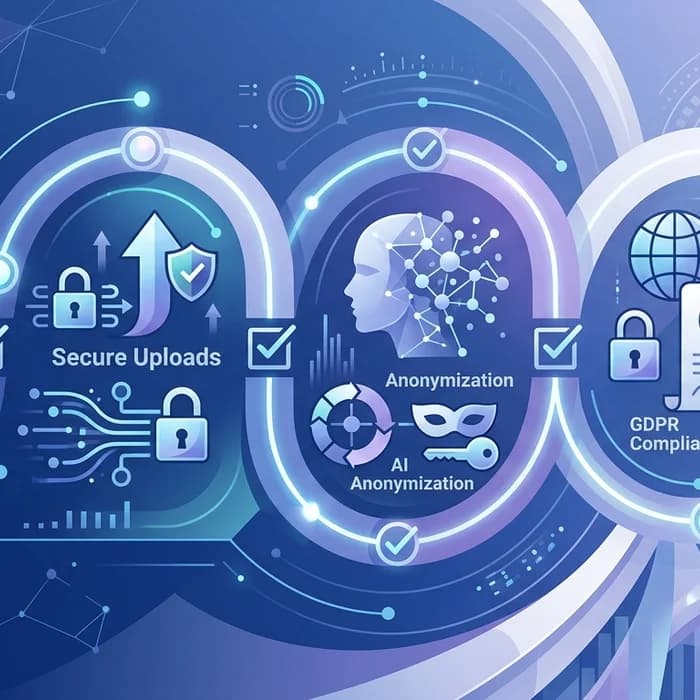
- Anonymize before sharing: Strip or mask personal data, identifiers, and secrets before exchanging with vendors, auditors, or AI tools. Professionals avoid risk by using Cyrolo’s anonymizer at www.cyrolo.eu.
- Use secure document uploads: Keep files in a controlled, encrypted workflow with strict access and deletion policies. Try our secure document upload at www.cyrolo.eu — no sensitive data leaks.
When uploading documents to LLMs like ChatGPT or others, never include confidential or sensitive data. The best practice is to use www.cyrolo.eu — a secure platform where PDF, DOC, JPG, and other files can be safely uploaded.
Practical workflow example
Scenario: A hospital (essential entity) must share incident artifacts with a forensics provider within 24 hours while assessing GDPR exposure.
- Stage 1 (0–6h): Use Cyrolo’s anonymizer to mask patient identifiers in logs and screenshots. Maintain an internal keyed mapping, not shared externally.
- Stage 2 (6–24h): Upload redacted evidence via secure document uploads for cross-team review; record chain of custody and access logs.
- Stage 3 (24–72h): Prepare NIS2 follow-up and GDPR 72‑hour notification drafts using anonymized artifacts to reduce legal exposure and scope creep.
NIS2 compliance checklist (2026-ready)
- Governance and accountability
- Board-approved cybersecurity risk management policy and training for executives
- Named accountable person for NIS2; clear RACI across CISO, DPO, Legal, IT Ops
- Risk management and controls
- Asset inventory and criticality mapping (including developer tools, extensions, recovery platforms)
- Network segmentation, MFA for all admins, PAM for Tier‑0 systems
- Secure SDLC with SBOMs, dependency scanning, and signed builds
- Supply-chain security
- Vendor risk tiers; security clauses for incident reporting, testing, and audit rights
- Extension/plugin allowlists; marketplace provenance checks; periodic re‑validation
- Monitoring and incident response
- 24/7 detection with playbooks aligned to NIS2 timelines: 24h/72h/1‑month
- Exercise at least annually with cross-border notification rehearsal
- Data protection alignment
- Data minimization and AI anonymizer baked into workflows
- Retention and secure deletion policies for shared evidence and reports
- Documentation and assurance
- Audit-ready records of risk assessments, decisions, and control effectiveness
- Annual independent security audit or certification where applicable
Regulatory watch: What Brussels is signaling
Joint committee agendas in late February point to tighter coordination among economic, environment, and civil liberties committees—an unmistakable sign that cybersecurity, data protection, and resilience are being treated as a single policy stack. Expect supervisors to press entities on:
- How NIS2 programs integrate with GDPR, DORA (for financial entities), and sectoral rules
- Evidence that third‑party and open-source dependencies are governed, not just inventoried
- Controls for AI usage in development and back-office document handling
One regulator put it to me this week: “If you can’t show us how a sensitive PDF moves through your environment—who sees it, how it’s masked, when it’s deleted—you’re not yet resilient.” This is where secure document uploads and consistent anonymization become audit-friendly proof, not just good hygiene.
How Cyrolo helps you pass audits without leaking data
- AI-grade anonymization: Mask personal data, identifiers, and contextual clues across PDFs, DOCs, images, and logs—before sharing internally or with vendors. Start with the anonymizer at www.cyrolo.eu.
- Secure document handling: Centralize document uploads for reviews, investigations, and audit packs—reducing shadow IT and email sprawl.
- Audit trail: Demonstrate who accessed what, when; enforce retention and secure deletion windows aligned to GDPR and NIS2 expectations.
FAQ: NIS2 compliance, reporting timelines, and document safety
What companies fall under NIS2 in 2026?
“Essential” and “important” entities across sectors like energy, healthcare, transport, banking/financial market infra, digital infrastructure, managed services, and public administration. Size thresholds and sector definitions are set in national laws based on the EU directive.
How fast do I need to report incidents under NIS2?
Significant incidents require an early warning to the competent authority within 24 hours of awareness, a more detailed report within 72 hours, and a final report within one month. These timelines are stricter than GDPR’s 72‑hour breach notification alone.
Does anonymizing data reduce my NIS2 reporting burden?
Anonymization doesn’t remove the duty to report a significant incident, but it can materially reduce legal exposure and the scope of personal data implicated—simplifying both GDPR assessment and evidence sharing with vendors and authorities.
Can we use LLMs to summarize incident documents?
Only with strict controls. Never paste sensitive or confidential data into public LLMs. Use a secure workflow: anonymize first, then work within a controlled environment. A safe default is to process files via secure document uploads at www.cyrolo.eu.
What will auditors ask about developer tools and extensions?
Expect questions on marketplace provenance, code signing, allowlists, sandboxing, and monitoring. You should be able to prove you can rapidly disable, patch, or roll back risky extensions and that developers don’t bypass controls.
Conclusion: Make NIS2 compliance your 2026 advantage
NIS2 compliance is no longer a paperwork exercise—it’s a competitive signal to customers, regulators, and insurers that you can withstand the real attacks of 2026. Unify GDPR and NIS2 controls, harden the developer and recovery toolchain, and treat every document as a potential breach vector. Then prove your discipline with safe-by-default workflows: anonymize sensitive content and centralize evidence handling. Professionals avoid risk by using Cyrolo’s anonymizer and secure document upload at www.cyrolo.eu.
Sources & References
- 1
- 2Draft agenda - Wednesday, 25 February 2026 - PE784.490v01-00 - Committee on Economic and Monetary Affairs , Committee on Civil Liberties, Justice and Home AffairsEU Parliament LIBE · 2026-02-18T10:06:57.000Z
- 3Critical Flaws Found in Four VS Code Extensions with Over 125 Million InstallsThe Hacker News · 2026-02-18T13:16:00.000Z
- 4Cybersecurity Tech Predictions for 2026: Operating in a World of Permanent InstabilityThe Hacker News · 2026-02-18T11:58:00.000Z
- 5Dell RecoverPoint for VMs Zero-Day CVE-2026-22769 Exploited Since Mid-2024The Hacker News · 2026-02-18T10:32:00.000Z
- 63 Ways to Start Your Intelligent Workflow Program The Hacker News · 2026-02-18T10:30:00.000Z
- 7Inside the DHS forum where ICE agents trash talk one anotherArs Technica Policy · 2026-02-18T14:14:06.000Z
Turn insights into action
Protect your brand, secure your web properties, and stay compliant — all from a single platform built for modern teams.
Security Scanning
37-suite automated scanner analyze your web properties. Get A+ to F security grading with actionable remediation steps.
Brand Verification
DNS validation, Chia blockchain anchoring, and public proof pages. Build trust with cryptographic evidence.
GDPR & Compliance
Article-by-article GDPR audits. Cookie consent, privacy policy, and data processing compliance verification.