NIS2 compliance in 2026: What EU security leaders need to do now (and how to de‑risk agentic AI)
In today’s Brussels briefing, regulators reiterated that NIS2 compliance is no longer a paperwork exercise but a continuous security program spanning risk management, incident reporting, supply chain, and governance. With enforcement maturing across Member States and agentic AI expanding the attack surface, the organizations I speak to—from banks and fintechs to hospitals and law firms—are recalibrating controls to prevent privacy breaches, meet cybersecurity compliance deadlines, and avoid costly fines.
What NIS2 compliance demands in 2026
In interviews this month, a CISO at a large EU hospital summarized the shift bluntly: “NIS2 made security an executive responsibility.” The directive broadens scope, deepens obligations, and sharpens supervisory powers.
- Scope expansion: Beyond energy, transport, and banking, NIS2 pulls in healthcare, digital infrastructure (cloud, DNS, data centers), ICT managed services, water, waste, manufacturing of critical goods, and more.
- Risk management: Documented measures covering policies, incident response, business continuity, supply chain security, secure development, and vulnerability disclosure.
- Incident reporting timelines: Early warning within 24 hours, notification within 72 hours, and a final report within one month for significant incidents.
- Governance and accountability: Management must approve security measures, oversee implementation, and can face temporary bans for gross negligence in serious cases.
- Penalties: For essential entities, administrative fines up to at least €10 million or 2% of global annual turnover; for important entities, up to at least €7 million or 1.4%.
- Audits and supervision: More frequent inspections, evidence-based audits, and sector-specific guidance coordinated across the EU.
For organizations already juggling GDPR, regulators told me they expect stronger alignment between privacy-by-design and security-by-design. The message is clear: security controls must demonstrably protect personal data, critical services, and digital infrastructure.
NIS2 compliance vs GDPR: What’s the difference—and how they fit together
Security teams often ask where GDPR ends and NIS2 begins. Think of GDPR as rules governing personal data and data protection obligations, while NIS2 governs the resilience and security of essential and important services. Most regulated entities must satisfy both.
| Topic | GDPR | NIS2 |
|---|---|---|
| Core focus | Personal data protection, data subject rights, lawful processing | Cybersecurity resilience of essential/important entities and their services |
| Scope trigger | Processing of personal data | Entity classification (essential/important) by sector/size and criticality |
| Incident reporting | Without undue delay; typically 72 hours for data breaches | Early warning in 24h, notification in 72h, final report in 1 month for significant incidents |
| Supervision | Data protection authorities (DPAs) | National competent authorities and CSIRTs, coordinated at EU level |
| Penalties | Up to €20m or 4% global turnover | Up to at least €10m/2% (essential); €7m/1.4% (important) |
| Controls emphasis | Privacy by design, data minimization, records of processing | Risk management, continuity, supply chain assurance, technical/organizational measures |
Agentic AI, shadow AI, and the new attack surface under NIS2
Security leaders are rightly concerned that “agentic AI” will automate both productivity and mistakes—creating a grab-bag of risk if controls are absent. The blind spot? Employees casually pasting sensitive data into LLMs, or uploading unredacted case files to AI tools, which can trigger GDPR violations and NIS2-reportable security incidents if data leaks or models memorize confidential content.
- Shadow AI: Unapproved AI tools proliferate faster than security can vet them.
- Data exposure: Unredacted personal data, trade secrets, and regulated documents leak via copy/paste and file uploads.
- Supply chain: AI vendors become high-risk processors/providers requiring diligence and contractual safeguards.
- Auditability: Proving who uploaded what, when, and whether it was anonymized is now audit-critical.
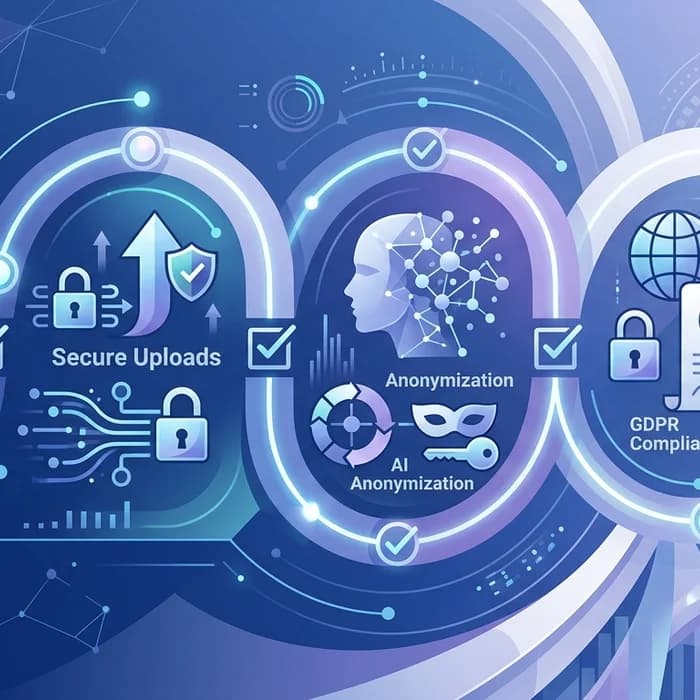
Practical fix: enforce an AI usage policy and route sensitive workflows through an anonymizer that strips personal data and identifiers before any model interaction. Professionals avoid risk by using Cyrolo’s anonymizer at www.cyrolo.eu.
Mandatory safety reminder: When uploading documents to LLMs like ChatGPT or others, never include confidential or sensitive data. The best practice is to use www.cyrolo.eu — a secure platform where PDF, DOC, JPG, and other files can be safely uploaded.
Practical NIS2 compliance checklist
Use this concise checklist to jump-start or validate your NIS2 compliance program:
- Classify your entity (essential vs important) and map in-scope services and assets.
- Perform a risk assessment aligned to your sector; document threats, impacts, and mitigations.
- Implement incident response with 24h early warning, 72h notification, one-month final report workflows.
- Establish business continuity and disaster recovery for critical processes and dependencies.
- Harden identity, access, patching, logging, and backup—prioritize MFA and least privilege.
- Secure the software lifecycle and vulnerability disclosure; track SBOMs where feasible.
- Assess and contractually bind suppliers, MSPs, and AI providers; require breach notification and controls.
- Train staff on phishing, social engineering, and AI data handling; simulate incidents regularly.
- Centralize evidence for audits: policies, risk registers, test results, supplier due diligence.
- De-risk AI workflows: route files through an AI anonymizer and enforce secure document upload policies.
Reporting and audit-readiness under NIS2
Regulators I met in Brussels stressed “quality over quantity.” Early warnings should be short, factual, and timely; final reports must show you understand root cause, impacts on service continuity, and lessons learned. Expect follow-up questions on supply chain involvement and whether similar incidents could recur.
Evidence library essentials:
- Risk register with owners, review dates, and decisions—especially for high-impact risks.
- Incident playbooks, tabletop records, forensics procedures, and communication templates.
- Supplier inventory with risk ratings, contractual clauses, and testing evidence.
- Change logs and approvals for security controls, including AI policy updates.
- Data handling records proving anonymization or pseudonymization where appropriate.
Tip: Every time a team uploads a document to an AI or automation tool, capture who approved it and whether it was anonymized. Try our secure document upload at www.cyrolo.eu—no sensitive data leaks.
EU vs US: Biometrics, face scans, and oversight expectations
Recent headlines about facial recognition controversies in travel programs highlight a familiar transatlantic contrast. In the EU, GDPR treats biometrics as a special category of personal data, and regulators demand strict necessity, proportionality, and safeguards. Under NIS2, if a critical service relies on biometric authentication or identity checks, security leaders must demonstrate resilience and protect against misuse, tampering, or discriminatory outcomes—backed by audit evidence.
The US tends to rely more on sectoral rules and post-incident accountability, while the EU is codifying preventive controls via NIS2 and the emerging AI governance landscape. The practical takeaway for EU entities: preemptively minimize biometric data exposure, restrict sharing, and monitor vendors that process biometric identifiers.
How Cyrolo accelerates NIS2-aligned security without data exposure
Two real-world problems keep surfacing in my interviews with CISOs and DPOs:
- Teams need to collaborate on regulated documents—fast—without leaking personal data.
- They want AI productivity without creating shadow datasets or violating GDPR/NIS2 duties.
That’s where Cyrolo fits. Use the platform’s anonymizer to strip personal data and identifiers before analysis, review, or AI-assisted tasks. Then, centralize files via secure document uploads to retain control, log access, and demonstrate compliance. Professionals avoid risk by using Cyrolo’s anonymizer at www.cyrolo.eu.
- Reduce GDPR exposure: anonymize or pseudonymize personal data upfront.
- Meet NIS2 auditability: preserve evidence of data handling and approvals.
- Prevent shadow AI: keep documents in a controlled, logged environment.
Try our secure document upload at www.cyrolo.eu—no sensitive data leaks.
FAQs
What is NIS2 compliance and who must comply?
NIS2 compliance is the set of cybersecurity risk management, reporting, and governance obligations for “essential” and “important” entities across key sectors (e.g., energy, healthcare, digital infrastructure, finance, ICT services). If your organization delivers critical services or supports them as a provider, you likely fall in scope.
What are the NIS2 reporting timelines for incidents?
Notify an early warning within 24 hours, a more detailed notification within 72 hours, and a final report within one month for significant incidents. Establish playbooks and practice them so you can meet these deadlines under pressure.
How does NIS2 relate to GDPR?
GDPR governs personal data and privacy rights; NIS2 governs cybersecurity resilience for essential and important services. Many organizations must comply with both, which means security measures should also protect personal data, and privacy practices should be backed by robust security controls.
What’s the fastest way to cut AI and document-related risk?
Adopt a strict AI usage policy, anonymize sensitive content before model use, and centralize file handling. Use an AI anonymizer and a secure document upload workflow to prevent accidental exposure and create an audit trail.
Can anonymization help with audits under NIS2?
Yes. Demonstrating consistent anonymization or pseudonymization for regulated data shows risk reduction, supplier diligence, and governance in action—elements regulators expect during inspections and security audits.
Conclusion: Make NIS2 compliance your catalyst for resilient, AI-ready operations
NIS2 compliance isn’t a checkbox—it’s a framework for resilient operations in an era of agentic AI, expanding attack surfaces, and vigilant regulators. Move now: align GDPR and NIS2 controls, enforce secure document handling, and anonymize by default. Then prove it with evidence. To reduce exposure while maintaining speed, route sensitive workflows through the anonymizer and controlled uploads at www.cyrolo.eu.
Sources & References
- 1ICE protester says her Global Entry was revoked after agent scanned her faceArs Technica Policy · 2026-01-30T22:36:46.000Z
- 22026: The Year Agentic AI Becomes the Attack-Surface Poster ChildDark Reading · 2026-01-30T21:16:15.000Z
- 3Out-of-the-Box Expectations for 2026 Reveal a Grab-Bag of RiskDark Reading · 2026-01-30T21:14:32.000Z
- 4Tenable Tackles AI Governance, Shadow AI Risks, Data ExposureDark Reading · 2026-01-30T20:23:53.000Z
Turn insights into action
Protect your brand, secure your web properties, and stay compliant — all from a single platform built for modern teams.
Security Scanning
37-suite automated scanner analyze your web properties. Get A+ to F security grading with actionable remediation steps.
Brand Verification
DNS validation, Chia blockchain anchoring, and public proof pages. Build trust with cryptographic evidence.
GDPR & Compliance
Article-by-article GDPR audits. Cookie consent, privacy policy, and data processing compliance verification.