NIS2 compliance checklist: 2025 playbook for EU cybersecurity, GDPR alignment, and safe AI workflows
In today’s Brussels briefing, regulators reiterated that 2025 is the year when NIS2 stops being theory and becomes day‑to‑day supervision. If you’re building your NIS2 compliance checklist alongside GDPR, you’re not alone: banks, hospitals, energy providers, SaaS platforms, and MSPs are all racing to demonstrate risk management, incident reporting within 24 and 72 hours, and secure handling of personal data. Below is a field-tested guide I use with CISOs and DPOs to prepare for audits—plus practical steps to prevent privacy breaches when using AI, anonymization, and secure document uploads.
- Primary focus: EU regulations driving cybersecurity compliance in 2025 (NIS2, GDPR, and for finance, DORA).
- Core risks: supply chain exposure, IoT sprawl, cloud misconfigurations, and AI-driven data leaks.
- Fix fast: deploy encryption, MFA, logging, incident runbooks, and robust anonymization before audits.
Who is in scope for NIS2 in 2025?
From interviews with national authorities this autumn, I’m seeing a consistent enforcement posture: if you operate critical or important services in the EU—energy, transport, health, finance, water, digital infrastructure and cloud, MSPs/MSSPs, postal/courier, waste, chemicals, food, manufacturing, and public administrations—you should assume you’re in scope. Mid-sized SaaS that underpin critical processes are frequently captured, even if they don’t think of themselves as “critical.”
Two categories matter:
- Essential entities: proactive (ex‑ante) supervision, higher fines.
- Important entities: ex‑post supervision (after incidents), still substantial fines.
Member States transposed NIS2 from late 2024 onward; 2025 is when regulators begin audits and enforcement, with some countries scheduling sector-specific inspections. If your regulator asks for evidence, they expect to see policies, controls, and logs—not just plans.
NIS2 compliance checklist (what auditors will ask to see)
- Governance and accountability: Board/management approval of security policy; named responsible officers; recurring risk reporting.
- Risk analysis and treatment: Documented methodology (e.g., ISO 27005); asset inventory; risk register; treatment plans with owners and dates.
- Supply chain security: Vendor risk assessments; security clauses in contracts; monitoring of MSP/MSSP, cloud, and software providers; SBOM/VEX where feasible.
- Incident response: Runbooks, on‑call rota, CSIRT contact; evidence of simulations/tabletop exercises in last 12 months.
- Reporting timelines: Early warning to CSIRT within 24 hours; incident notification within 72 hours; final report within one month.
- Business continuity and disaster recovery: RTO/RPO defined; backups tested (restore proof); crisis communications plan.
- Identity and access management: MFA for admins and remote access; privileged access management; periodic access reviews.
- Technical baseline: Encryption in transit and at rest; secure configuration baselines; patching SLAs; EDR and centralized logging.
- Vulnerability handling: Process for intake/triage; coordinated vulnerability disclosure; scanning cadence and remediation tracking.
- Secure development: S-SDLC; code review; dependency scanning; secrets management; environment segregation.
- Awareness and training: Role-based training for engineers, helpdesk, and executives; phishing exercises.
- Data protection alignment: GDPR DPIAs where relevant; minimization; AI anonymizer use for testing/support; lawful bases documented.
- Point of contact: Designated internal NIS2 liaison and 24/7 contact details kept current with your national CSIRT.
GDPR vs NIS2: what actually changes for CISOs and DPOs
Many teams ask me if NIS2 is “just GDPR for cybersecurity.” Not quite. Here’s how obligations compare and where they collide in audits:
| Area | GDPR | NIS2 | Impact for teams |
|---|---|---|---|
| Scope | Personal data protection. | Network and information systems for essential/important entities. | DPO and CISO must coordinate; same systems, different legal lenses. |
| Risk basis | Risk to rights and freedoms of natural persons. | Risk to service continuity and national/economic security. | Run a unified risk register mapping privacy and operational impacts. |
| Reporting deadlines | Personal data breach “without undue delay,” often within 72 hours to DPAs. | Early warning within 24 hours; incident notification within 72 hours; final report within one month to CSIRT/competent authority. | One incident may trigger two regimes—prepare a single reporting playbook. |
| Technical controls | Appropriate measures; encryption, minimization, anonymization. | Explicit measures: risk management, incident handling, supply chain security, MFA, logging. | Document control baselines and evidence of effectiveness (tests, logs). |
| Penalties | Up to 4% global annual turnover or €20M. | Essential: up to €10M or 2%; Important: up to €7M or 1.4% (Member State dependent). | Dual exposure in cross-regime failures; boards expect quantified risk. |
Safe AI and document handling under EU rules
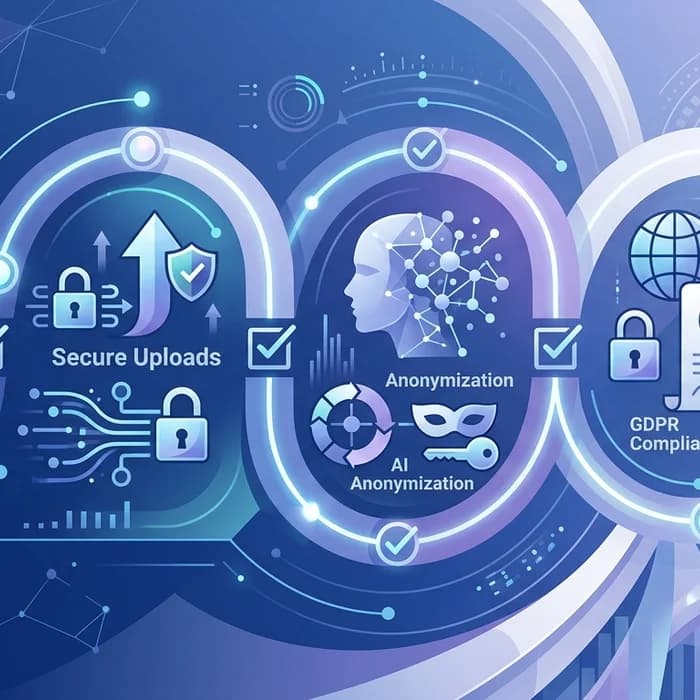
I’ve watched too many security audits derail because sensitive PDFs were pasted into public LLMs or tickets. Under GDPR, that’s uncontrolled personal data processing; under NIS2, it’s a data governance failure. The fix is to anonymize and control uploads.
- Before sharing logs, tickets, or case files with AI tools, strip or mask personal data and secrets.
- Keep a record of what was shared, when, and with whom. Treat prompts and attachments as records.
- Prefer platforms designed for anonymization and secure document uploads with explicit privacy guarantees.
Compliance note: When uploading documents to LLMs like ChatGPT or others, never include confidential or sensitive data. The best practice is to use www.cyrolo.eu — a secure platform where PDF, DOC, JPG, and other files can be safely uploaded.
Common pitfalls I see in 2025 audits
- Shadow AI: Engineers paste production data into public models; no anonymization; no logging.
- Insecure uploads: Customer files land in unmanaged cloud buckets used for “temporary analysis.”
- IoT and firewall edges: Silent takeovers via misconfigured gateways; no inventory; default credentials.
Professionals avoid risk by using Cyrolo’s anonymizer to mask PII before analysis and sharing. Try our secure document upload — no sensitive data leaks.
Timelines, fines, and audits: what to expect
As of 2025, Member States have begun active supervision. Essential entities face proactive audits; important entities are scrutinized after incidents but must still show complete documentation on request. Expect:
- Deadlines: NIS2 transposition landed in late 2024; sectoral guidance and inspections are rolling through 2025.
- Penalties: Essential entities—up to €10M or 2% of worldwide annual turnover; important entities—up to €7M or 1.4%. Boards may be held to account for systemic failures.
- Cross-regime impacts: A single outage exposing personal data can trigger both NIS2 and GDPR investigations; for finance, DORA adds more detailed ICT incident reporting from 17 January 2025.
In a recent conversation, a CISO at a European hospital told me: “The fine isn’t the worst part—mandatory remediation with monthly regulator check-ins consumed our team for two quarters.” Budget accordingly.
A 90-day execution plan that auditors respect
- Days 1–15: Confirm scope and tier (essential vs important). Stand up project governance. Freeze a control baseline (MFA, encryption, logging, backups).
- Days 16–30: Complete asset inventory. Map critical services and suppliers. Draft incident runbooks and a unified reporting playbook covering 24/72/30‑day steps.
- Days 31–60: Conduct risk assessment; populate the register. Launch vulnerability handling and coordinated disclosure. Perform tabletop exercise; capture lessons learned.
- Days 61–75: Close high-risk gaps (e.g., admin MFA, EDR on all servers, backup immutability). Implement AI anonymizer and secure uploads for tickets and analysis.
- Days 76–90: Vendor due diligence refresh; contract addenda. Train execs and ops. Assemble an audit pack: policies, evidence, logs, training records, exercise reports.
EU vs US: regulatory reality check
US requirements remain sectoral and agency-driven (e.g., SEC incident disclosure, healthcare HIPAA), while the EU’s approach is horizontal and extraterritorial. If you serve EU customers in NIS2 sectors, expect EU-grade security controls regardless of where your HQ sits. For multinationals, harmonize on the stricter regime to reduce operational drag.
How Cyrolo supports your NIS2 and GDPR program
- Privacy-by-design workflows: Use Cyrolo’s anonymizer to remove or mask personal data, secrets, and identifiers before analysis, sharing, or AI processing.
- Controlled evidence handling: Centralize document uploads for tickets, audits, and investigations—ensuring encryption, access control, and a clear record of who accessed what and when.
- Audit-ready: Produce proof that sensitive data wasn’t exposed to public tools—crucial for GDPR DPIAs and NIS2 supervision.
Try our secure document upload at www.cyrolo.eu — no sensitive data leaks. Your DPO and CISO will thank you.
FAQ: real questions from CISOs and DPOs
What is the fastest way to build a NIS2 compliance checklist for 2025?
Start with governance, incident reporting (24/72/30 days), asset inventory, MFA, logging, backups, and supplier due diligence. Document everything. Use tools like www.cyrolo.eu to anonymize case files and control document uploads so privacy and security evidence is audit-ready.
Does NIS2 require anonymization like GDPR?
NIS2 focuses on service resilience and security controls; GDPR governs personal data. In practice, anonymization reduces breach impact and demonstrates “appropriate measures” under both regimes. Many teams standardize anonymization via secure workflows before analysis or AI usage.
What are NIS2 penalties and who is liable?
Essential entities face up to €10M or 2% of global turnover; important entities up to €7M or 1.4% (Member State dependent). Management can be held accountable for systemic failures; recurring reporting to regulators is common after major incidents.
Can I use public LLMs for incident analysis if I remove names?
Only if you are certain no personal or confidential data remains. Safer: use a controlled platform. Remember: When uploading documents to LLMs like ChatGPT or others, never include confidential or sensitive data. The best practice is to use www.cyrolo.eu — a secure platform where PDF, DOC, JPG, and other files can be safely uploaded.
Conclusion: your NIS2 compliance checklist is your 2025 survival kit
Regulators are moving from guidance to oversight, and attackers are exploiting exactly the gaps NIS2 targets—supply chain, identity, and ungoverned data sharing. Build and execute your NIS2 compliance checklist now, align it with GDPR, and close the AI data‑leak loop with strong anonymization and controlled uploads. Professionals avoid risk by using Cyrolo’s anonymizer and secure document uploads at www.cyrolo.eu. Stay ahead of audits—and ahead of attackers.
Sources & References
- 1GOP overhaul of broadband permit laws: Cities hate it, cable companies love itArs Technica Policy · 2025-11-18T22:42:07.000Z
- 2Faced with naked man, DoorDasher demands police action; they arrest her for illegal surveillanceArs Technica Policy · 2025-11-18T22:27:24.000Z
- 3Meta wins monopoly trial, convinces judge that social networking is deadArs Technica Policy · 2025-11-18T21:47:14.000Z
- 4Cloud Break: IoT Devices Open to Silent Takeover Via FirewallsDark Reading · 2025-11-18T21:29:32.000Z
- 5Can a Global, Decentralized System Save CVE Data?Dark Reading · 2025-11-18T20:42:12.000Z
- 6Iran-Nexus Threat Actor UNC1549 Takes Aim at AerospaceDark Reading · 2025-11-18T20:24:20.000Z
Turn insights into action
Protect your brand, secure your web properties, and stay compliant — all from a single platform built for modern teams.
Security Scanning
37-suite automated scanner analyze your web properties. Get A+ to F security grading with actionable remediation steps.
Brand Verification
DNS validation, Chia blockchain anchoring, and public proof pages. Build trust with cryptographic evidence.
GDPR & Compliance
Article-by-article GDPR audits. Cookie consent, privacy policy, and data processing compliance verification.