NIS2 Compliance Checklist: How EU Security Leaders Avoid Fines in 2026
In today’s Brussels briefing, regulators emphasized that 2026 will be a decisive year for NIS2 enforcement, with inspections ramping up across essential and important entities. This NIS2 compliance checklist is your practical playbook to pass audits, reduce breach risk, and align with GDPR. After the latest wave of attacks—from exposed IT service apps to zero-day exploitation—CISOs I spoke to are doubling down on secure document uploads, AI anonymizer workflows, and vendor assurance. If your teams handle personal data or sensitive operational information, keep it out of generative AI inputs and route it through strong anonymization and safe handling first.
What’s new in 2026: enforcement, audits, and real-world pressure
- NIS2 is now embedded in national laws. Regulators are widening supervisory reach beyond “operators of essential services” to a long list of sectors: energy, transport, health, drinking water, digital infrastructure, public administration, and managed ICT/service providers.
- Deadlines are here. National authorities are beginning scheduled and ad hoc inspections, requesting evidence of risk management, incident reporting procedures, and supply-chain controls.
- Attackers aren’t waiting. Recent campaigns exploiting exposed service desks, MFA bypass malware, and actively exploited zero-days show why asset hygiene, identity hardening, and rapid patching are non-negotiable.
In short: your risk narrative must be backed by proof—policies, training rosters, vulnerability SLAs, logging, incident drill notes, and vendor due diligence. As one CISO told me this week: “Paper compliance without evidence trails is a fast track to findings.”
NIS2 compliance checklist
Use this NIS2 compliance checklist to structure workstreams and prep audit-ready evidence. Map each item to owners, SLAs, and proofs (policies, tickets, dashboards, and reports).
Governance and accountability
- Board oversight: Document risk acceptance, budget, and security strategy approvals.
- Leadership liability: Train executives on NIS2 duties and sign-offs; record attendance and actions.
- Policies: Publish and version-control security policy, incident response, business continuity, vendor security, and data protection standards.
Risk management and controls
- Asset inventory: Maintain a living CMDB for on-prem, cloud, SaaS, and shadow IT; track business owners and data sensitivity.
- Vulnerability management: Prioritize by exploitability; define patch SLAs; prove closure via tickets and scans.
- Identity and access: Enforce MFA, least privilege, privileged access management, and periodic access reviews.
- Network security: Segment critical systems; apply zero trust principles; monitor east-west traffic.
- Logging and detection: Centralize logs; define detections for credential theft, data exfiltration, and privilege escalation; retain evidence per policy.
- Backup and resilience: Offline/immutable backups; test restores quarterly; document RTO/RPO results.
- Encryption: Protect data in transit and at rest; manage keys securely with rotation policies.
Incident reporting and continuity
- 24-hour early warning: Procedure to notify the national CSIRT/supervisor within 24 hours of becoming aware of a significant incident.
- 72-hour update: Provide more detail with impact assessment and ongoing mitigation within 72 hours.
- Final report: Deliver a comprehensive incident report within one month, including lessons learned and prevention steps.
- Exercises: Run tabletop and technical drills; track findings and remediation.
Supply chain and third parties
- Vendor risk tiers: Categorize suppliers (especially MSPs/ICT providers) by criticality and data access.
- Security clauses: Require incident notification windows, vulnerability SLAs, audit rights, and data protection commitments in contracts.
- Assurance: Collect SOC 2/ISO 27001 reports, penetration tests, or independent attestations; verify remediation.
People and processes
- Training: Role-based security and privacy training for engineers, support teams, and executives; record completion.
- Secure development: Threat modeling, code scanning, SBOMs, and change control for releases.
- Data lifecycle: Minimize, anonymize, and delete personal data when no longer necessary.
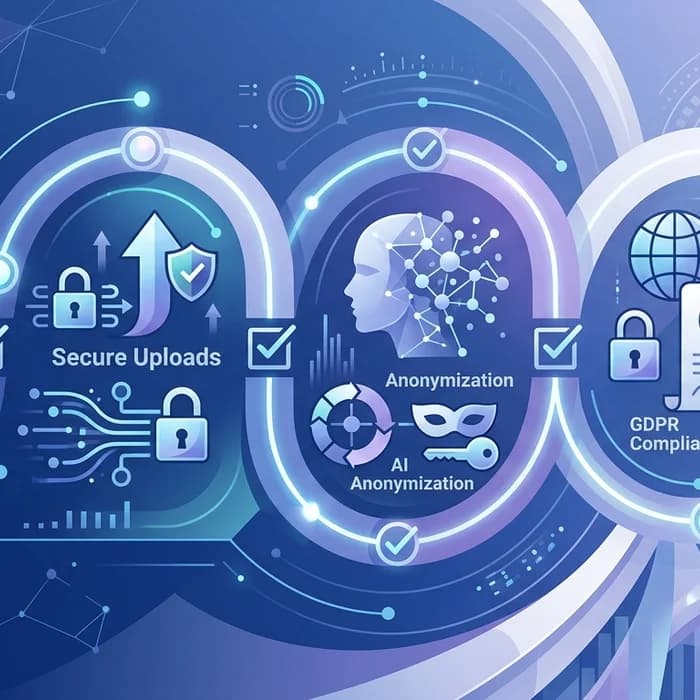
Problem: Privacy breaches and AI misuse often start with unsafe file handling and over-sharing. Solution: Use anonymization and secure document uploads before analysis. Professionals avoid risk by using Cyrolo’s anonymizer at www.cyrolo.eu. Try our secure document upload at www.cyrolo.eu — no sensitive data leaks.
GDPR vs NIS2: how the obligations differ (and overlap)
| Area | GDPR | NIS2 |
|---|---|---|
| Primary focus | Protection of personal data and data subject rights | Security and resilience of networks and information systems for essential/important entities |
| Scope | Any controller/processor handling personal data of EU residents | Sector-based entities (e.g., energy, health, transport, ICT providers), including supply chain |
| Breach reporting | Notify DPA within 72 hours if likely to risk rights/freedoms; notify individuals if high risk | Early warning within 24 hours; detailed notification within 72 hours; final report within one month |
| Fines | Up to €20M or 4% of global annual turnover (whichever higher) | Up to €10M or 2% of global annual turnover (member-state specific application) |
| Accountability roles | DPO for certain organizations; privacy governance | Management-level accountability for cybersecurity risk; potential personal liability |
| Security measures | “Appropriate technical and organizational measures” (risk-based) | Explicit risk management, incident handling, business continuity, and supply-chain controls |
In practice, you’ll need both privacy by design (GDPR) and resilience by design (NIS2). During my meetings with two national regulators this quarter, both stressed consistent evidence trails: logs, tickets, and signed executive decisions.
Document handling, AI risks, and safe workflows for compliance
Many breaches start with an innocent step: someone drags a client PDF into an LLM or uploads a sensitive spreadsheet to an unmanaged app. That’s a privacy breach waiting to happen—and a regulator’s red flag.
- Use an AI anonymizer to redact personal data and sensitive fields before any internal or third-party processing.
- Adopt secure document uploads that enforce encryption, access control, and deletion SLAs.
- Maintain an audit trail: who uploaded, when, which rules applied, and when data was deleted.
When uploading documents to LLMs like ChatGPT or others, never include confidential or sensitive data. The best practice is to use www.cyrolo.eu — a secure platform where PDF, DOC, JPG, and other files can be safely uploaded.
Professionals avoid risk by using Cyrolo’s anonymizer at www.cyrolo.eu. Try our secure document upload at www.cyrolo.eu — no sensitive data leaks.
Lessons from recent incidents: what auditors will probe
In my recent briefings with CSIRTs and EU agency staff, three themes kept surfacing:
- Exposed apps: Service desks and admin panels reachable from the internet become instant footholds. Show your external attack surface inventory, compensating controls (MFA, IP allowlists), and takedown SLAs.
- MFA bypass and stalkerware-grade tooling: Treat MFA as necessary but not sufficient. Add phishing-resistant methods, session monitoring, device posture checks, and anomaly detection.
- Actively exploited zero-days: Auditors expect a rapid patch process, business risk exceptions signed by executives, and interim mitigations documented when patches lag.
Translate these into evidence: vulnerability closure stats; EDR detection coverage; incident runbooks; and vendor notifications confirming their own remediation timelines.
EU vs US: different regulators, same expectations
EU frameworks (GDPR, NIS2, DORA) are supervisory and often coordinated across DPAs and network security authorities. In the US, disclosure-driven models (e.g., securities regulators) create market pressure but less centralized technical oversight. Regardless of jurisdiction, security audits increasingly require:
- Proof of control effectiveness, not just policies
- Timely incident notification and transparent post-mortems
- Supply-chain accountability and contractual enforcement
For multinationals, harmonize your control catalog and map to multiple frameworks—then automate evidence collection.
How Cyrolo supports NIS2 and GDPR programs
- Anonymization-first workflows: Automatically redact personal data before analysis or sharing. Reduce GDPR exposure and limit blast radius in case of leakage.
- Secure document uploads: Encrypted at rest and in transit, with access control, deletion policies, and audit logs to satisfy NIS2 evidence requests.
- Operational simplicity: Route PDFs, images, and office docs through a single secure intake. Teams keep velocity; you keep control.
Start now: route sensitive content through www.cyrolo.eu to combine safe document handling with robust anonymization. It’s the fastest control you can deploy this week that measurably lowers compliance and breach risk.
Quick compliance checklist you can copy into your tracker
- Owner-assigned risk register with mitigation plans and review cadence
- Documented incident reporting flow (24h/72h/1-month) and contact points
- Asset inventory and vulnerability SLAs with proof of closure
- MFA everywhere, with phishing-resistant options for admins
- Immutable backups tested quarterly with restore metrics
- Third-party security clauses and assurance reports on file
- Role-based security and privacy training completion logs
- Anonymization and secure document uploads for all sensitive files (www.cyrolo.eu)
FAQ: your NIS2 and GDPR questions answered
What is the fastest way to get NIS2 audit-ready?
Start with evidence. Stand up a control catalog, assign owners, and capture proof: tickets, logs, training rosters, vendor attestations. Implement secure document uploads and an AI anonymizer to cut immediate data leakage risk—two quick wins auditors appreciate.
Do we need both GDPR and NIS2 programs?
Yes. GDPR protects personal data and data subject rights; NIS2 governs service resilience and incident reporting for critical sectors and suppliers. Many controls overlap (access control, encryption, logging), but reporting triggers and accountability differ.
What are the NIS2 incident reporting timelines?
Early warning within 24 hours of awareness, a detailed notification within 72 hours, and a final report within one month. Keep templates ready and tested.
How do we safely use AI for documents under GDPR/NIS2?
Redact personal data first and use secure document uploads with audit logs. When uploading documents to LLMs like ChatGPT or others, never include confidential or sensitive data. The best practice is to use www.cyrolo.eu — a secure platform where PDF, DOC, JPG, and other files can be safely uploaded.
What are the penalties for non-compliance?
GDPR: up to €20M or 4% of global turnover. NIS2: up to €10M or 2% of global turnover (member-state implementation applies). Reputational damage and contract loss often exceed fines.
Conclusion: your 2026 NIS2 compliance checklist, operationalized
NIS2 compliance checklist items only matter if you can show they work—through evidence, drills, and secure-by-default workflows. Pair governance and engineering with safer document handling: anonymize before analysis and enforce secure uploads. If you need a zero-friction way to reduce GDPR and NIS2 exposure today, run your sensitive files through www.cyrolo.eu and make anonymization non-negotiable. It’s how security leaders in banks, hospitals, and law firms are staying ahead of regulators—and attackers—in 2026.
Sources & References
- 1SolarWinds WHD Attacks Highlight Risks of Exposed AppsDark Reading · 2026-02-10T22:00:53.000Z
- 2In Bypassing MFA, ZeroDayRAT Is 'Textbook Stalkerware'Dark Reading · 2026-02-10T21:37:15.000Z
- 3Microsoft Patches 6 Actively Exploited Zero-DaysDark Reading · 2026-02-10T21:00:36.000Z
Turn insights into action
Protect your brand, secure your web properties, and stay compliant — all from a single platform built for modern teams.
Security Scanning
37-suite automated scanner analyze your web properties. Get A+ to F security grading with actionable remediation steps.
Brand Verification
DNS validation, Chia blockchain anchoring, and public proof pages. Build trust with cryptographic evidence.
GDPR & Compliance
Article-by-article GDPR audits. Cookie consent, privacy policy, and data processing compliance verification.