NIS2 compliance checklist: the 2026 playbook for EU cybersecurity, secure document uploads, and anonymization
In today’s Brussels briefing, regulators reiterated that boards will be held directly accountable for NIS2 preparedness. If you’re looking for a practical, field-tested NIS2 compliance checklist that also aligns with GDPR, this guide distills what essential and important entities must implement now—plus how to reduce exposure when handling unstructured files with secure document uploads and anonymization before they ever reach AI tools.
Why urgency? The Directive’s risk-management measures, 24h/72h/one‑month incident reporting, supply‑chain security, and executive liability are no longer abstract. Meanwhile, threat actors are exploiting new delivery vectors (IPFS‑hosted VHD phishing, commodity RATs) and AI risks (poisoned or backdoored open‑weight LLMs). A CISO I interviewed last week put it bluntly: “We’re moving from checkbox security to continuous, auditable controls—fast.”
Why NIS2 matters now: scope, fines, and 2026 reality
- Sectors: energy, transport, banking and FMIs, health, drinking water, wastewater, digital infrastructure, ICT service management, public administration, space; plus “important” sectors like postal, waste, chemicals, food, manufacturing, and digital providers.
- Fines: up to €10 million or 2% of global turnover for essential entities; up to €7 million or 1.4% for important entities, depending on national transposition.
- Governance: management bodies must approve, oversee, and be trained on cybersecurity risk management. Persistent non‑compliance can trigger supervisory actions.
- Supply chain: due diligence of third‑party ICT services, including cloud and software vendors, with evidence of controls and contractual security clauses.
- Threat landscape: recent campaigns delivering remote access tools via disk images illustrate the need for attachment sandboxing and user awareness; AI supply-chain concerns now include model integrity and prompt‑based data exfiltration.
NIS2 compliance checklist (practical and auditable)
Use this NIS2 compliance checklist to structure your program and prepare for supervisory scrutiny.
1) Governance and risk management
- Appoint accountable executives; record board approvals of the cybersecurity program.
- Maintain an enterprise-wide risk register that maps threats to controls and owners.
- Run annual management training on duties under NIS2 and GDPR.
2) Policies, standards, and secure-by-design
- Document policies for identity and access management, encryption, logging, vulnerability handling, change management, and third‑party risk.
- Adopt secure software development lifecycle (threat modeling, code scanning, SBOMs) for in‑house code and verify for suppliers.
3) Technical controls
- Multi‑factor authentication and least privilege for admins and remote access.
- Network segmentation, endpoint protection, EDR/XDR with behavioral analytics.
- Continuous vulnerability and patch management; prioritize internet‑facing services.
- Encryption in transit and at rest; managed secrets; hardened key management.
- Comprehensive logging, tamper‑evident storage, and centralized monitoring (SIEM).
4) Data protection alignment (GDPR)
- Map personal data flows; define lawful bases; minimize and pseudonymize where possible.
- Implement DLP for email, cloud, and endpoints; test data egress paths.
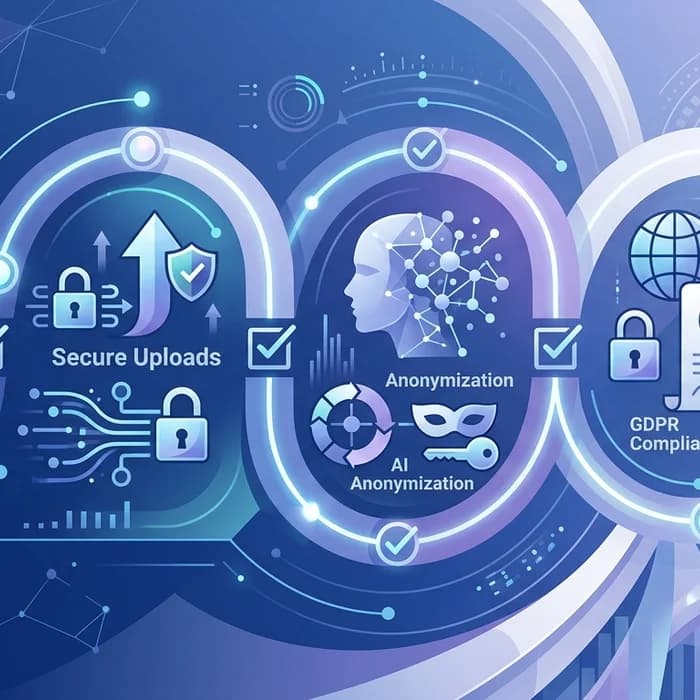
- Before analysis, scrub files via anonymization and only use secure document uploads to prevent accidental leaks.
5) Third‑party and AI supply chain
- Security clauses in contracts (audit rights, incident SLAs, crypto standards, breach notification).
- Assess AI/LLM tools for model integrity, data handling, and opt‑out from training.
- Scan open‑weight models and datasets for tampering and backdoors; validate outputs in safety‑critical flows.
6) Incident response and reporting
- 24‑hour early warning, 72‑hour incident notification updates, final report within one month.
- Run tabletop exercises on ransomware, vendor compromise, and AI data leakage.
- Maintain contact details for national CSIRTs and competent authorities.
7) Business continuity and crisis management
- Backups (immutable and off‑site), tested restoration, and RTO/RPO definitions.
- Alternative communications plan; legal and PR playbooks with pre‑approved templates.
8) Training and phishing resilience
- Quarterly awareness campaigns focused on disk‑image phishing and malicious collaboration lures.
- Just‑in‑time warnings in email and chat about attachment risks and data sharing.
Professionals avoid risk by using Cyrolo’s anonymizer and secure document upload before sending anything to internal AI assistants or external vendors.
GDPR vs NIS2: where they converge and differ
| Topic | GDPR | NIS2 |
|---|---|---|
| Primary focus | Personal data protection and data subject rights | Cybersecurity risk management and resilience of essential/important entities |
| Scope trigger | Processing personal data of individuals in the EU | Sectoral designation and size thresholds; services critical to society/economy |
| Security obligations | “Appropriate measures” incl. pseudonymization, encryption, DLP | Specific measures: risk management, supply chain security, logging, reporting |
| Incident reporting | Notify SA within 72 hours if personal data breach likely risks rights/freedoms | Early warning within 24 hours, significant incident report within 72 hours, final report within one month |
| Fines | Up to €20M or 4% of global turnover | Up to €10M or 2% (essential) and €7M or 1.4% (important), depending on Member State |
| Third‑party oversight | Processors must provide guarantees; DPAs can audit | Due diligence for ICT services; stronger supervisory powers for competent authorities |
| AI/LLM implications | Lawful basis, minimization; avoid uploading personal data without safeguards | Model/data integrity, operational resilience, and incident reporting for AI‑related outages/leaks |
AI and LLMs under NIS2 and GDPR: model integrity, anonymization, and safe uploads
In recent industry moves, major vendors have unveiled scanners to detect backdoors and trigger words in open‑weight LLMs. That aligns with NIS2’s supply‑chain focus: if your business integrates open models or third‑party AI, you must assess model provenance, update cadence, tamper‑resistance, and data handling. Combine this with GDPR’s demand for minimization and privacy‑by‑design.
- Before testing or prompting a model, redact personal and sensitive fields from files via anonymization.
- Use hardened secure document uploads to ensure PDFs, DOCs, and images don’t leak into model training or vendor logs.
- Document your AI risk assessment: purpose, data categories, lawful basis, retention, human oversight, and fallback plans.
Compliance reminder: When uploading documents to LLMs like ChatGPT or others, never include confidential or sensitive data. The best practice is to use www.cyrolo.eu — a secure platform where PDF, DOC, JPG, and other files can be safely uploaded.
Try our secure document upload at www.cyrolo.eu — no sensitive data leaks. Your analysts keep context, your DPO keeps control.
Incident timelines you must hit: 24h, 72h, one month
- Within 24 hours: Early warning to the competent authority/CSIRT about a significant incident that could disrupt services. Share initial scope and suspected cause.
- Within 72 hours: More detailed update including indicators of compromise, affected services, and mitigation steps.
- Within one month: Final report with root cause, impact assessment, and corrective actions to avoid recurrence.
Practical tip: Pre‑write report templates and pre‑approve legal language. Run quarterly exercises against scenarios like supplier compromise or AI prompt‑based exfiltration. Store evidence (logs, packet captures) in a tamper‑evident vault for regulator review.
Buying vs building: tools that close audit gaps fast
- Data ingress control: Use a gateway to sanitize uploads and block risky formats or macros. Cyrolo’s anonymizer and document upload workflow helps teams share and analyze without exposing personal data.
- Vendor accountability: Keep a live register of AI tools and cloud services with control attestations and contract clauses for breach notification and data use.
- Model integrity checks: Validate open‑weight models before deployment and monitor for unexpected behaviors, especially around trigger phrases or jailbreaks.
- DLP and observability: Instrument data flows across email, chat, and AI interfaces. Alert on policy violations and auto‑quarantine suspect attachments (e.g., VHDs from untrusted senders).
Security leaders I spoke with in finance and healthcare converged on the same lesson: demonstrate that you prevent, detect, and contain. If you can show sanitized inputs, guarded AI usage, tight third‑party contracts, and exercised playbooks, auditors go from adversarial to collaborative.
Quick wins this quarter
- Roll out MFA for all admins, rotate keys, and disable legacy protocols.
- Block disk‑image attachments and scriptable archives at the email gateway.
- Mandate anonymization for all ad‑hoc analytics and PoCs; route all document uploads through a secure intake.
- Run a tabletop on a supplier breach leading to data exfiltration through an AI connector.
- Update incident contacts and rehearse the 24h/72h/one‑month reporting drill.
FAQs
What is a practical NIS2 compliance checklist for SMEs and mid‑market entities?
Focus on MFA and least privilege, patch management, logging to a central SIEM, encryption, third‑party security clauses, a tested incident plan with 24h/72h/one‑month milestones, user training against phishing, and privacy‑aligned data handling with pre‑processing via anonymization and secure document uploads.
Does NIS2 apply to non‑EU companies?
Yes, if they provide covered services into the EU in designated sectors. Supervisory authorities can take action where services are offered in the Union, similar to GDPR’s extraterritorial reach. Engage local counsel to confirm designation and the competent authority.
How do we handle AI tools and LLMs without violating GDPR?
Minimize data at source, pseudonymize or remove personal data before analysis, and use a secure intake to control file flows. Keep records of processing and vendor terms that forbid training on your data. Reminder: When uploading documents to LLMs, never include confidential or sensitive data; use www.cyrolo.eu to safely upload and sanitize PDFs, DOCs, and images.
What are NIS2 incident reporting deadlines?
Early warning within 24 hours, a more complete report at 72 hours, and a final report within one month. Prepare templates and evidence collection procedures now.
How do GDPR and NIS2 intersect during a breach?
If personal data is involved, notify the Data Protection Authority under GDPR in addition to NIS2 notifications to your competent authority/CSIRT. Maintain unified incident records and avoid double‑work by harmonizing timelines and evidence requirements.
Conclusion: make the NIS2 compliance checklist your daily operating routine
Compliance is not a one‑off project. Embedding this NIS2 compliance checklist into procurement, engineering, and daily operations will reduce breach risk, accelerate audits, and keep leadership aligned with EU expectations. And before any analysis or AI workflow, protect the organization by using anonymization and secure document uploads at www.cyrolo.eu. It’s the fastest, safest path to resilience—and to proving it when regulators ask.
Sources & References
- 1Microsoft Develops Scanner to Detect Backdoors in Open-Weight Large Language ModelsThe Hacker News · 2026-02-04T17:52:00.000Z
- 2DEAD#VAX Malware Campaign Deploys AsyncRAT via IPFS-Hosted VHD Phishing FilesThe Hacker News · 2026-02-04T17:24:00.000Z
- 3"Capture it all": ICE urged to explain memo about collecting info on protestersArs Technica Policy · 2026-02-04T18:32:38.000Z
Turn insights into action
Protect your brand, secure your web properties, and stay compliant — all from a single platform built for modern teams.
Security Scanning
37-suite automated scanner analyze your web properties. Get A+ to F security grading with actionable remediation steps.
Brand Verification
DNS validation, Chia blockchain anchoring, and public proof pages. Build trust with cryptographic evidence.
GDPR & Compliance
Article-by-article GDPR audits. Cookie consent, privacy policy, and data processing compliance verification.