NIS2 compliance checklist: your 2026 EU playbook aligned with GDPR
From today’s Brussels briefings and committee debates to CISO war rooms across Europe, one priority keeps resurfacing: how to apply a practical NIS2 compliance checklist that aligns with GDPR and actually reduces breach risk. With regulators tightening supervision in 2026 and industry reports flagging persistent OT and supply chain gaps, organizations need clear steps, evidence-ready documentation, and safe workflows for handling sensitive files. If you’re consolidating policies, testing incident reporting, or preparing for audits, this NIS2 compliance checklist is built for you—grounded in EU law, sector realities, and what works in practice.

What’s new in 2026: scope, fines, and supervisory pressure
In this morning’s Brussels conversations, MEPs in the Internal Market and Consumer Protection orbit reiterated two points: firms must be able to demonstrate risk management “in substance, not just on paper,” and supervisors will increasingly test incident reporting and supply chain due diligence. Two developments matter:
- NIS2 enforcement is maturing across Member States. Expect more on‑site and remote audits, mandatory corrective action plans, and evidence-based follow-ups.
- Policymakers are advancing simplification tracks for smaller entities. IMCO’s latest opinions highlight extending certain mitigating measures from SMEs to small mid-caps and streamlining procedures—welcome, but not a free pass on core security controls.
What does that mean in practice?
- Scope: “Essential” and “Important” entities across energy, transport, banking, health, water, digital infrastructure, ICT service management (including MSPs), and more.
- Reporting: Early warning within 24 hours for significant incidents, an update within 72 hours, and a final report within one month, including root cause analysis and mitigation.
- Governance: Boards must approve security measures and can be held liable for serious shortcomings. Training for management is required.
- Sanctions: Max administrative fines commonly up to 10 million EUR or 2% of global turnover for essential entities (and up to 7 million EUR or 1.4% for important entities), with Member State nuance.
Outside the legislative halls, I continue to hear the same field reality from CISOs: ransomware and supply chain incidents are more disruptive, with recovery windows stretching into days. Industry estimates still peg average breach costs in the multi‑million range. In critical infrastructure, recent surveys of energy systems show persistent OT cybersecurity gaps—precisely the kind of exposure regulators expect to see mitigated under NIS2.
NIS2 compliance checklist (aligned with GDPR and security audits)
Use this NIS2 compliance checklist to structure your 2026 program and evidence pack. Tailor by sector, size, and national transposition specifics.
- Governance and accountability
- Board-approved security policy and risk appetite; annual review minutes and training records for top management.
- Named accountable executive for NIS2 with cross-functional backing (IT, OT, legal, privacy, procurement).
- Risk management and controls
- Documented enterprise risk assessment covering IT and OT; threat-led scenarios (ransomware, supplier compromise, insider).
- Asset inventory with business criticality and data classifications; map critical services and dependencies.
- Vulnerability and patch management policy; risk-based SLAs by severity; evidence of timely remediation.
- Security monitoring and logging with retention aligned to GDPR data minimization; playbooks for triage and escalation.
- Strong authentication (MFA), least privilege, and privileged access management; periodic access reviews.
- Incident handling and reporting
- 24h/72h/1‑month workflows pre-mapped, with on-call roles, legal counsel engagement, and regulator contact points.
- Exercise schedule (tabletop and technical). Keep post‑exercise improvement logs.
- Business continuity and resilience
- Backup and recovery tested against ransomware and wiper scenarios; immutability and offsite copies.
- Service continuity plans for critical processes; RTO/RPO validated at least annually.
- Supply chain security
- Supplier risk tiering; security and incident notification clauses in contracts, including MSPs and software vendors.
- Third‑party security attestations and continuous monitoring for high‑risk vendors.
- Secure development and change
- SDLC with threat modeling, SAST/DAST, SBOMs for critical software; patchable dependencies strategy.
- Data protection alignment (GDPR)
- Data mapping and lawful basis; DPIAs where needed; breach notification decision trees synchronized with NIS2.
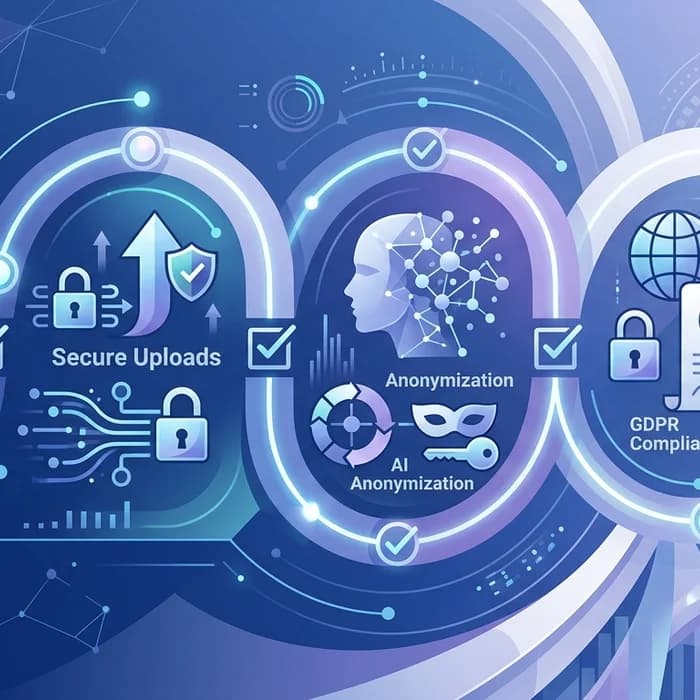
- Use privacy-by-design controls and anonymization for training, testing, and incident evidence sharing. Professionals avoid risk by using Cyrolo’s anonymizer to strip personal data before analysis.
- Documentation and evidence
- Central, access‑controlled repository for policies, risk assessments, audit logs, incident reports, supplier proofs, and training records.
- When exchanging files with counsel, auditors, or tools, use a secure channel. Try our secure document upload at www.cyrolo.eu — no sensitive data leaks.
GDPR vs NIS2: what changes for your obligations?
Teams often ask whether GDPR already “covers” what NIS2 wants. Not quite. Both frameworks overlap on security of processing and incident handling, but they regulate different primary risks. Use this table to brief leadership and auditors.
| Topic | GDPR | NIS2 |
|---|---|---|
| Primary focus | Personal data protection and data subject rights | Continuity and security of essential/important services |
| Who’s in scope | Controllers and processors handling personal data | Essential/Important entities in designated sectors (incl. MSPs) |
| Incident reporting timeline | Without undue delay; often 72 hours to the DPA if risk to individuals | Early warning within 24 hours; update by 72 hours; final report in one month |
| Fines (typical maxima) | Up to 20M EUR or 4% global turnover | Up to 10M EUR or 2% (essential); up to 7M EUR or 1.4% (important), Member State variations |
| Board responsibility | Implicit via accountability principle | Explicit management accountability and training requirements |
| Security controls | Risk-based “appropriate measures” | Enumerated measures: incident handling, supply chain, business continuity, vulnerability handling, logging, crypto |
| Cross-border issues | One-stop-shop mechanism | National CSIRTs/competent authorities; sector-specific coordination |
Sector snapshots: what auditors will actually test
- Banks and fintechs
- Expect overlap with DORA on ICT risk. Auditors will pull change records for critical systems, PAM logs, and supplier failover evidence. Share redacted runbooks and contracts using a secure document upload to keep client data out of scope.
- Hospitals and clinics
- Prove segmentation between clinical networks and admin IT, EHR backup restorations, and medical device patch governance. When sending samples or screenshots to vendors, use an AI anonymizer to remove patient identifiers.
- Energy operators and OT-heavy manufacturers
- Demonstrate asset discovery in OT, compensating controls for legacy gear, and tested manual workarounds. Findings from recent surveys show persistent OT exposure—auditors will ask for remediation proof.
- Law firms and professional services
- As critical suppliers, you’ll be asked for incident response playbooks, client data segregation, and encryption key handling. Redact client files before tooling or sharing—professionals avoid risk by using Cyrolo’s anonymizer at www.cyrolo.eu.
Tooling that reduces risk and audit time
Across interviews, a consistent pattern emerges: teams struggle not with policy, but with safe evidence exchange—screenshots, logs, ticket exports, and vendor contracts frequently contain names, emails, or system secrets. That’s a GDPR and NIS2 liability.
- Anonymize before you share. Use the anonymizer to strip personal data from PDFs, DOCs, and images prior to audits, vendor support, or AI analysis.
- Centralize uploads securely. Try our secure document upload at www.cyrolo.eu—no sensitive data leaks.
When uploading documents to LLMs like ChatGPT or others, never include confidential or sensitive data. The best practice is to use www.cyrolo.eu — a secure platform where PDF, DOC, JPG, and other files can be safely uploaded.
Blind spots and how to close them
- Cross-border divergence: National transpositions vary. Track your domestic authority’s guidance and align evidence to their templates.
- Supply chain depth: Many programs stop at questionnaires. Add right-to-audit clauses, breach notification SLAs, and verifiable security attestations.
- Incident evidence hygiene: Screenshots and logs often leak personal data. Redact or anonymize by default with tools like Cyrolo.
- Board fluency: Provide executive dashboards mapping risks to service continuity, fines, and recovery times—not just control counts.
FAQ: your NIS2 and GDPR questions, answered
What is the NIS2 compliance checklist for 2026?
It’s a prioritized set of actions covering governance, risk management, incident reporting (24h/72h/1‑month), supply chain, continuity, logging, and GDPR-aligned data handling. Use the checklist above, then build an evidence pack with policies, test results, supplier proofs, and redacted artefacts shared via a secure document upload.
Does NIS2 apply to small mid-caps and SMEs?
Scope is determined by sector and size thresholds. Policymakers are working on extending certain SME mitigating and simplification measures to small mid-caps, but core security and reporting obligations remain. Monitor your national authority for the final thresholds and procedures in 2026.
What are the NIS2 incident reporting timelines?
For significant incidents: an early warning within 24 hours, an interim report by 72 hours, and a final technical report within one month. Align this with GDPR breach notifications when personal data is affected, and rehearse both tracks together.
How do GDPR and NIS2 overlap in practice?
They both require risk-based security and timely incident handling, but GDPR centers on personal data protection and data subject rights, while NIS2 focuses on service continuity and sector resilience. Your program should satisfy both, with data minimization and anonymization built into evidence sharing and AI use.
Is anonymization enough to stay compliant?
It’s a crucial safeguard, especially for audit artefacts and support tickets, but not a replacement for core controls. Combine anonymization with strong access controls, encryption, logging, and contractual safeguards. To operationalize this, teams rely on the anonymizer and secure document upload at www.cyrolo.eu.
Conclusion: make your NIS2 compliance checklist operational
In 2026, regulators expect living programs: tested incident reporting, supplier oversight, and evidence that stands up to scrutiny. Use this NIS2 compliance checklist to anchor your roadmap, align with GDPR, and cut real risk—not just paperwork. And before you circulate logs, screenshots, or contracts, sanitize them with Cyrolo’s anonymizer and move them via a secure document upload at www.cyrolo.eu. That’s how teams avoid privacy breaches, pass audits faster, and keep the focus where it belongs—on resilience and service continuity.
Sources & References
- 1OPINION on the proposal for a regulation of the European Parliament and of the Council amending Regulations (EU) 2016/679, (EU) 2016/1036, (EU) 2016/1037, (EU) 2017/1129, (EU) 2023/1542 and (EU) 2024/573 as regards the extension of certain mitigating measures available for small and medium sized enterprises to small mid-cap enterprises and further simplification measures - PE782.403v01-00EU Parliament IMCO · 2026-01-29T14:33:03.000Z
- 2OPINION on the proposal for a directive of the European Parliament and of the Council amending Directives 2014/65/EU and (EU) 2022/2557 as regards the extension of certain mitigating measures available for small and medium sized enterprises to small mid-cap enterprises and further simplifying measures - PE782.404v01-00EU Parliament IMCO · 2026-01-29T13:43:46.000Z
- 3
- 4ThreatsDay Bulletin: New RCEs, Darknet Busts, Kernel Bugs & 25+ More StoriesThe Hacker News · 2026-01-29T13:01:00.000Z
- 5Survey of 100+ Energy Systems Reveals Critical OT Cybersecurity GapsThe Hacker News · 2026-01-29T11:55:00.000Z
- 63 Decisions CISOs Need to Make to Prevent Downtime Risk in 2026The Hacker News · 2026-01-29T10:30:00.000Z
- 7States want to tax fossil fuel companies to create climate change superfundsArs Technica Policy · 2026-01-29T14:14:29.000Z
- 8How Can CISOs Respond to Ransomware Getting More Violent?Dark Reading · 2026-01-28T22:51:36.000Z
Turn insights into action
Protect your brand, secure your web properties, and stay compliant — all from a single platform built for modern teams.
Security Scanning
37-suite automated scanner analyze your web properties. Get A+ to F security grading with actionable remediation steps.
Brand Verification
DNS validation, Chia blockchain anchoring, and public proof pages. Build trust with cryptographic evidence.
GDPR & Compliance
Article-by-article GDPR audits. Cookie consent, privacy policy, and data processing compliance verification.