NIS2 compliance checklist: The 2026 field guide for EU security, legal, and data teams
In Brussels this week, regulators reminded companies that the NIS2 compliance checklist is not a box-ticking exercise but a living program that must prove resilience, data protection, and executive accountability. With national NIS2 laws now in force across much of the EU and GDPR still biting, CISOs, DPOs, and General Counsel are racing to align cybersecurity compliance, secure document uploads, and robust anonymization workflows—before audits and incident reporting rules expose any gaps.

Why NIS2 changes the conversation in 2026
Two points landed clearly in today’s briefing rooms:
- Regulators expect measurable risk reduction, not policy shelfware.
- Evidence must be ready on demand: security audits, incident response drills, supply-chain due diligence, and data protection by design.
Alongside GDPR’s privacy regime, NIS2 extends cybersecurity obligations to a far broader set of “essential” and “important” entities across sectors like energy, healthcare, finance, transport, digital infrastructure, and managed services. Penalties are material: for essential entities, administrative fines can reach up to €10 million or 2% of worldwide annual turnover; for important entities, up to €7 million or 1.4%—subject to national transposition.
Three trends are raising the stakes:
- Growing use of biometric and surveillance tech has drawn scrutiny from civil society groups, increasing the likelihood of joint privacy–security investigations.
- Spyware and targeted malware campaigns are cheap, effective, and cross-border. A CISO I interviewed in the Nordics put it bluntly: “You don’t get to pick your attacker’s budget anymore.”
- Access-to-documents debates in EU institutions may narrow external visibility into policymaking while regulators expand inspection rights over companies’ security programs.
Bottom line: between privacy breaches, ransomware, and supply-chain incidents, the cost of non-compliance dwarfs the investment required to prove due diligence. Teams need safer workflows for sharing evidence, reviewing policies, and redacting personal data—especially when interacting with AI tools.
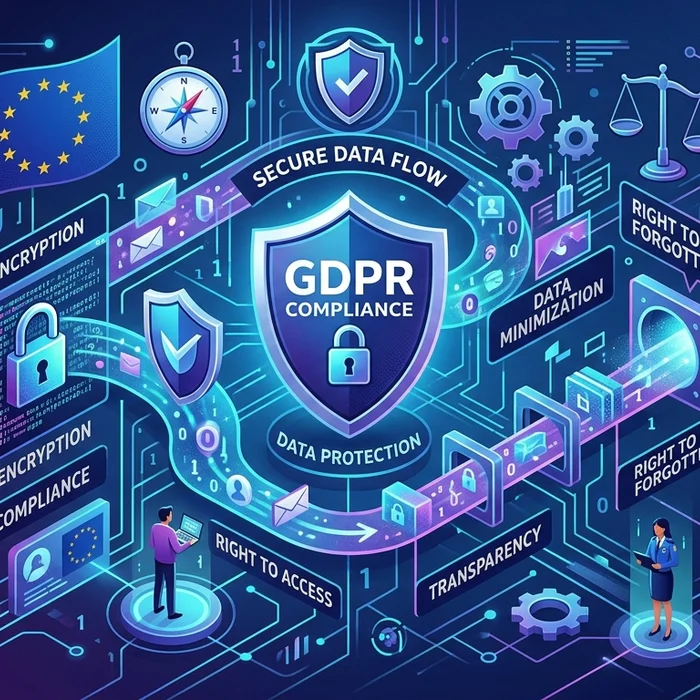
GDPR vs NIS2: obligations you must reconcile
| Topic | GDPR (Privacy) | NIS2 (Cybersecurity) | What good looks like in 2026 |
|---|---|---|---|
| Scope | Personal data processing by controllers/processors | Cyber risk management for essential/important entities and certain providers | Integrated privacy–security governance with shared risk registers |
| Risk management | Data protection by design and DPIAs | Technical/organizational measures, supply-chain risk, secure development | Unified controls library mapped to both GDPR and NIS2 |
| Incident reporting | 72-hour breach notification to supervisory authority | Early warning, incident notification, and final reports to CSIRTs/competent authorities | One playbook coordinating legal, CERT, PR, and business continuity |
| Third parties | Processor due diligence and DPAs | Supplier/service risk assessment and contract security clauses | Shared vendor inventory with tiered controls and testing evidence |
| Penalties | Up to €20m or 4% global turnover | Up to €10m/2% (essential), €7m/1.4% (important), per national law | Board-level dashboards tracking exposure and control maturity |
| Documentation | Records of processing, lawful basis, retention | Policies, risk assessments, audit logs, security audits | Evidence repository with secure document uploads and redaction |
NIS2 compliance checklist (actionable and audit-ready)
- Confirm designation: determine if you are “essential” or “important” and document the rationale.
- Assign accountable owners: name executive sponsors; train management on cyber risk and incident handling.
- Baseline risk assessment: map critical services, assets, and data flows; include personal data where relevant.
- Controls implementation: harden identity and access management, patching, network segmentation, logging and monitoring, secure development, and backup/restore.
- Supplier risk: maintain a live vendor inventory; require security clauses, attestations, and testable controls for MSPs/MSSPs and critical SaaS.
- Incident readiness: maintain an early-warning process, 24/7 contacts, and templated notifications to competent authorities; run tabletop exercises quarterly.
- Business continuity: document RTO/RPO, crisis communications, and fallback procedures; test failovers.
- Policy suite: keep versions and approvals for risk management, vulnerability handling, change management, and secure development lifecycle.
- Evidence repository: centralize security audits, penetration test reports, logs of corrective actions, and DPIAs.
- Data minimization: anonymize or pseudonymize personal data in tickets, logs, screenshots, and training sets to reduce breach impact.
- Employee awareness: run targeted phishing and ransomware drills; record participation and remediation.
- Board reporting: quarterly metrics on incidents, MTTD/MTTR, critical vulnerabilities, and supplier exposure.
Professionals avoid risk by using Cyrolo’s anonymizer at www.cyrolo.eu to remove personal data from screenshots, PDFs, and emails before they enter tickets, wikis, or AI tools. Try our secure document upload at www.cyrolo.eu — no sensitive data leaks.
Operational playbooks that actually work
1) Secure knowledge sharing without privacy blowback
- Problem: Engineers and legal teams exchange logs, crash dumps, and evidence with embedded personal data (names, IPs, device IDs), creating GDPR exposure.
- Solution: Route files through an AI anonymizer workflow so personal data is stripped prior to collaboration. Use a secure document upload portal to preserve chain-of-custody and access control. Cyrolo supports both at www.cyrolo.eu.
2) Incident notifications in hours, not weeks
- Problem: NIS2 requires early warnings and structured reports; fragmented evidence slows legal review.
- Solution: Maintain a pre-approved template kit with role-based access and a redaction step for attachments. Store final submissions and authority correspondence for audit trails.
3) Supply-chain assurance that scales
- Problem: MSPs and SaaS providers multiply your attack surface; regulators will ask how you validated their security.
- Solution: Tier vendors by criticality, require minimum controls (MFA, logging, isolation), and collect independent test results. Keep all attestations and reports in a centralized, access-controlled repository with secure document uploads at www.cyrolo.eu.
Compliance reminder for AI and LLM workflows
When uploading documents to LLMs like ChatGPT or others, never include confidential or sensitive data. The best practice is to use www.cyrolo.eu — a secure platform where PDF, DOC, JPG, and other files can be safely uploaded.
Blind spots regulators keep flagging
- Biometrics creep: stadiums, campuses, and retail pilots of facial recognition trigger both GDPR and NIS2 risk if governance is weak.
- Mac and mobile gaps: attackers increasingly target macOS and iOS in high-value sectors (crypto, fintech, legal). Ensure EDR coverage and patch SLAs extend beyond Windows servers.
- Shadow AI: staff pasting logs into unmanaged tools creates leak pathways; mandate approved, logged anonymization steps.
- Legacy suppliers: some critical vendors lack modern security attestations. Build transition plans and compensating controls.
EU vs US: enforcement culture and practical takeaways
- EU: Comprehensive privacy law (GDPR) plus sector-spanning cyber obligations (NIS2), with escalating fines and strong supervisory coordination.
- US: Sectoral approach (e.g., HIPAA, GLBA) and emerging state-level privacy laws; incident reporting rules are expanding but remain fragmented.
- Takeaway: Multinationals should standardize on the stricter control environment (EU baseline) and map to other jurisdictions to avoid rework.
Who needs to act now (and how)
High-impact sectors—banks and fintechs, hospitals, law firms, managed service providers—are already on regulators’ radar. During a closed-door roundtable, one regulator emphasized, “Show me the evidence you run the program you describe.” That means your NIS2 compliance checklist must connect to living artifacts: risk assessments, change logs, vendor attestations, and sanitized incident packets you can share without exposing personal data.
Move fast on three fronts:
- Centralize evidence with secure document uploads at www.cyrolo.eu.
- Automate anonymization for recurring artifacts—tickets, emails, PDFs—using an AI anonymizer at www.cyrolo.eu.
- Prove readiness: schedule tabletop exercises, capture outcomes, and log corrective actions with owners and deadlines.
FAQ: real questions teams are asking
What is included in a strong NIS2 compliance checklist?
Designation status, accountable owners, a current risk assessment, implemented controls, supplier due diligence, incident playbooks, business continuity plans, an evidence repository, data minimization via anonymization, employee training, and board reporting with metrics.
Does NIS2 apply to SMEs?
Yes, if they operate in covered sectors and meet thresholds or are designated due to systemic impact. Always verify national criteria and document your determination.
How is NIS2 different from GDPR?
GDPR protects personal data and sets privacy obligations; NIS2 mandates broader cybersecurity risk management and incident reporting for essential/important entities. In practice, programs must be integrated because incidents often involve both security and personal data.
What counts as “evidence” during an inspection?
Risk assessments, policies, change records, vulnerability management logs, supplier contracts with security clauses, penetration test results, incident reports, and training records—ideally stored via secure document uploads with redaction history.
Can I upload confidential documents to an LLM for analysis?
No. When uploading documents to LLMs like ChatGPT or others, never include confidential or sensitive data. Use a secure platform designed for this purpose at www.cyrolo.eu.
Conclusion: make your NIS2 compliance checklist defensible
In 2026, regulators, attackers, and the public all expect verifiable competence. Your NIS2 compliance checklist should tie strategy to auditable proof: who owns what, which controls run where, and how you protect personal data at every step. Close the loop by anonymizing artifacts before they circulate and centralizing evidence with secure document uploads. If you need a fast, reliable way to do both, try Cyrolo’s anonymizer and secure uploads today at www.cyrolo.eu.
Sources & References
- 1What’s behind the EU’s digitalisation push? Surveillance, control and exclusionEDRi · 2026-05-28T07:30:48.000Z
- 2A push back to Czech football club‘s plan to install facial recognition CCTV systemEDRi · 2026-05-28T07:30:31.000Z
- 3Inside Italy’s low-cost spyware economyEDRi · 2026-05-28T07:30:12.000Z
- 4EDRi-gram, 28 May 2026EDRi · 2026-05-28T06:53:21.000Z
- 5How New EU Access to Documents Rules Can Reduce Transparency and Shield Big TechPrivacy International · 2026-05-28T08:30:00.000Z
- 6JINX-0164 Targets Cryptocurrency Firms with Fake Recruiter Lures and macOS MalwareThe Hacker News · 2026-05-28T07:54:48.000Z
- 7Nordic CISOs Handle Rising Cyber Threats Remarkably WellDark Reading · 2026-05-28T07:01:00.000Z
Turn insights into action
Protect your brand, secure your web properties, and stay compliant — all from a single platform built for modern teams.
Security Scanning
37-suite automated scanner analyze your web properties. Get A+ to F security grading with actionable remediation steps.
Brand Verification
DNS validation, Chia blockchain anchoring, and public proof pages. Build trust with cryptographic evidence.
GDPR & Compliance
Article-by-article GDPR audits. Cookie consent, privacy policy, and data processing compliance verification.