NIS2 compliance checklist: 2026 guide for GDPR-aligned cybersecurity teams
In today’s Brussels briefing, regulators emphasized that 2026 will be the first full year of tough, routine supervision under the EU’s NIS2 regime. If you’re still searching for a clear, actionable NIS2 compliance checklist that aligns with GDPR and real-world threat trends, this is it. From board accountability to supply-chain security and incident reporting, the bar has been raised—while spear‑phishing campaigns and AI‑assisted malware keep escalating. A CISO I interviewed put it bluntly: “We’ll either operationalize compliance by quarter-end or pay for it in audits, downtime, and fines.”
Who must comply—and what’s changed since GDPR
NIS2 expands EU cybersecurity obligations to a broader set of “essential” and “important” entities across energy, transport, banking, health, digital infrastructure, ICT service management, and more. Even mid-market SaaS and managed service providers are now squarely in scope. Supervisors will expect documented risk management, timely incident reporting, and clear board oversight. GDPR remains the baseline for personal data protection; NIS2 adds sector‑agnostic security measures and governance for networks and information systems—even where personal data isn’t the primary concern.
- GDPR: Protects personal data, mandatory DPIAs for high-risk processing, breach notifications to DPAs within 72 hours.
- NIS2: Mandates security risk management, supply-chain controls, incident reporting (early warning within 24 hours, full report within 72 hours), and management accountability.
NIS2 compliance checklist: step-by-step actions you can implement this quarter
- Determine scope and classification: Confirm if you’re an “essential” or “important” entity; map subsidiaries and EU establishments.
- Board accountability: Assign a named executive responsible for NIS2; record briefings and decisions in board minutes.
- Policies and risk management: Approve a risk management framework aligned to ISO 27001/2 or NIST CSF; document risk acceptance.
- Asset inventory: Maintain live inventories for hardware, software, cloud services, and third-party dependencies.
- Access controls: Enforce least privilege, strong MFA, and timely deprovisioning; review privileged access quarterly.
- Vulnerability and patch management: Risk-based SLAs; verify remediation; track exposure windows.
- Logging, monitoring, and detection: Centralize logs; maintain retention; ensure alerting on critical assets; test detection rules.
- Incident response and reporting: Playbooks for early warning (24h), incident notification (72h), and final report; rehearse exercises.
- Business continuity and crisis management: RTO/RPO defined and tested; run tabletop exercises with executives.
- Supply-chain security: Risk-rate vendors; require security clauses and notification timelines; verify controls, not just attestations.
- Secure development and change control: SAST/DAST, SBOMs, and signed releases; segregate dev/test/prod; change approvals.
- Employee training and phishing drills: Role-based sessions for admins and developers; measure outcomes.
- Data protection by design: Minimize data collection; apply anonymization where full identifiers are not needed.
- GDPR alignment: DPIAs for high-risk processing; records of processing; processor due diligence and SCCs where relevant.
- Testing and audits: Annual independent security reviews; red team or purple team exercises; track corrective actions to closure.
- Metrics and reporting: KRIs/KPIs for patch latency, incident MTTR, vendor risk, and training efficacy; report to the board.
GDPR vs NIS2: what your auditors will look for
| Aspect | GDPR | NIS2 |
|---|---|---|
| Primary focus | Protection of personal data and data subject rights | Cybersecurity of networks and information systems |
| Who is in scope | Controllers and processors of personal data in the EU (or targeting EU residents) | Essential and important entities across specified sectors, incl. many ICT providers |
| Core obligations | Lawful basis, DPIAs, data minimization, breach notification within 72h | Risk management measures, supply-chain security, incident reporting (24h early warning; 72h notification), business continuity |
| Penalties | Up to €20M or 4% of global annual turnover | Administrative fines up to at least €10M or 2% of global turnover; management liability and audits |
| Data scope | Personal data | All information systems critical to service provision (personal data may be involved but not required) |
| Evidence expected | Records of processing, DPIAs, RoPAs, DPA correspondence | Policies, risk assessments, incident reports, audit results, vendor risk files, exercise records |
Practical safeguards: secure document uploads, data minimization, and AI-ready workflows
Two audit hotspots in 2026: uncontrolled file sharing and indiscriminate data exposure to AI tools. I’ve seen hospitals and law firms fail audits because staff pasted case files into generic chatbots or emailed unredacted PDFs to vendors. The solution is straightforward:
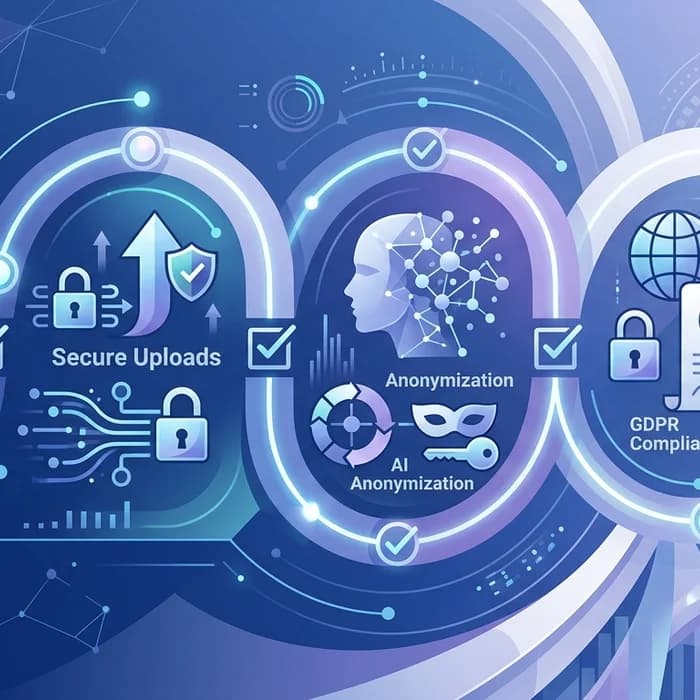
- Use a secure, logged channel for document uploads so sensitive files never spill into risky apps.
- Apply automated anonymization to strip names, IDs, and contact details before sharing or analysis.
- Keep an audit trail: who uploaded, who viewed, what was removed, and when.
Professionals avoid risk by using Cyrolo’s anonymizer at www.cyrolo.eu. Try our secure document upload at www.cyrolo.eu — no sensitive data leaks.
Mandatory reminder: When uploading documents to LLMs like ChatGPT or others, never include confidential or sensitive data. The best practice is to use www.cyrolo.eu — a secure platform where PDF, DOC, JPG, and other files can be safely uploaded.
Threats regulators are watching in 2026
Three developments dominated my conversations with EU supervisors this month:
- Social engineering at scale: Recent campaigns used fake job interviews to compromise thousands of endpoints across Europe, underscoring the need for verified hiring workflows and hardware-isolated interview accounts.
- AI-assisted malware: New Linux strains show automated code generation can rapidly test variants. Your compensating controls—allow‑lists, signed packages, and behavioral detection—must mature now.
- Supply-chain and collaboration stack exposure: Rapid patches from major collaboration and DevOps platforms reminded teams to tighten SBOM visibility, monitor for backdoored dependencies, and enforce 24–72h patch SLAs by risk tier.
All three map directly to NIS2 duties: risk management, timely mitigation, and evidence you acted fast.
Governance and reporting: what to put in front of your board
Supervisors in Brussels told me they care less about the brand of tools and more about demonstrated control. Bring this to every board session:
- A quarterly risk register with owners and due dates
- Patch latency metrics by severity (P1/P2), plus exceptions signed by the accountable executive
- Incident drill outcomes and mean time to detect/respond
- Vendor risk heatmap and remediation status
- Data minimization status and anonymization coverage for analytics and AI projects
If you can’t show it, auditors will assume it doesn’t exist.
How Cyrolo supports GDPR and NIS2 programs
Several banks and fintechs I spoke with adopted a “privacy-by-default” content workflow: ingest files only through a secure portal, auto‑remove identifiers, then deliver clean documents to analytics or AI readers. This cuts breach risk, accelerates DPIAs, and gives auditors a paper trail.
- Secure intake: Centralized document uploads keep files out of email and shadow SaaS.
- Privacy-first processing: One‑click anonymization for personal data in PDFs, Word docs, images.
- Audit-ready evidence: Logs, versions, and review trails back your compliance claims.
That’s why risk leaders route sensitive content through www.cyrolo.eu before sharing or analysis.
FAQ: NIS2 compliance in practice
What is the NIS2 compliance deadline and who enforces it?
Member States transposed NIS2 in late 2024; in 2026, designated national authorities are actively supervising essential and important entities. Expect sectoral regulators to coordinate cyber audits and incident follow‑ups.
How does NIS2 interact with GDPR during a breach?
Report cybersecurity incidents under NIS2 (early warning within 24 hours; incident notification within 72 hours) and notify DPAs under GDPR if personal data is affected. Prepare unified playbooks to avoid inconsistent statements.
Do SMEs have to comply with NIS2?
Yes, if they operate in covered sectors or provide critical services (e.g., managed service providers). Classification depends on activity and criticality, not just size.
What evidence do auditors ask for first?
Incident response procedures, recent drill reports, vendor risk files, patch metrics, and proof of executive oversight. For data protection, DPIAs and records of processing are standard asks.
Can we use AI tools under NIS2 and GDPR?
Yes—with controls. Minimize personal data, apply anonymization, and prohibit direct uploads of sensitive files to generic chatbots. Use secure platforms and maintain logs. When uploading documents to LLMs like ChatGPT or others, never include confidential or sensitive data. The best practice is to use www.cyrolo.eu — a secure platform where PDF, DOC, JPG, and other files can be safely uploaded.
Conclusion: your NIS2 compliance checklist for 2026
NIS2 raises the bar on governance, technical controls, and reporting—beyond what GDPR alone demanded. Use this NIS2 compliance checklist to structure board accountability, harden your stack against modern social engineering and AI‑assisted malware, and prove you acted swiftly when incidents hit. Close the loop with privacy‑by‑design workflows: route sensitive files through secure document uploads and enable automated anonymization before analysis. The organizations that get this right in Q1 will spend 2026 executing, not firefighting.
Sources & References
- 1Big Brother Watch consultation responsePrivacy International · 2026-01-21T16:31:53.000Z
- 2UK Government Facial Recognition ConsultationPrivacy International · 2026-01-21T16:27:17.000Z
- 3North Korean PurpleBravo Campaign Targeted 3,136 IP Addresses via Fake Job InterviewsThe Hacker News · 2026-01-21T17:17:00.000Z
- 4Zoom and GitLab Release Security Updates Fixing RCE, DoS, and 2FA Bypass FlawsThe Hacker News · 2026-01-21T15:42:00.000Z
- 5Spotify won court order against Anna’s Archive, taking down .org domainArs Technica Policy · 2026-01-21T19:34:14.000Z
- 6Complex VoidLink Linux Malware Created by AIDark Reading · 2026-01-21T14:48:15.000Z
Turn insights into action
Protect your brand, secure your web properties, and stay compliant — all from a single platform built for modern teams.
Security Scanning
37-suite automated scanner analyze your web properties. Get A+ to F security grading with actionable remediation steps.
Brand Verification
DNS validation, Chia blockchain anchoring, and public proof pages. Build trust with cryptographic evidence.
GDPR & Compliance
Article-by-article GDPR audits. Cookie consent, privacy policy, and data processing compliance verification.