NIS2 compliance checklist: how to secure document uploads and anonymization under EU rules
In today’s Brussels briefing, regulators reminded industry that NIS2 is no longer theoretical—audits are here, fines are real, and document handling is a live risk vector. This report delivers a practical NIS2 compliance checklist you can act on today, with concrete steps for secure document uploads and anonymization that also support GDPR. As I heard from a CISO at a major hospital system this week, “every upload is an entry point”—and two fresh incidents prove the point: a trojanized PDF campaign and an AI deployment flaw exploited hours after disclosure.
Why NIS2 matters now: enforcement, fines, and the document risk
NIS2 applies to a wide set of essential and important entities across energy, transport, banking, health, ICT, public administration, and more. Member States were due to transpose the Directive by October 2024; by 2026, supervisory authorities are moving from guidance to enforcement. Expect on-site inspections, security audits, and evidence-based checks.
- Fines: NIS2 allows administrative fines up to at least €10 million or 2% of global annual turnover (whichever is higher), in addition to corrective orders.
- Scope: Obligations touch governance, supply-chain security, incident handling, cryptography, and policies for handling data—including documents that may carry malware or personal data.
- Evidence: Auditors increasingly ask for proof of technical and organizational measures, including secure document workflows and data minimization.
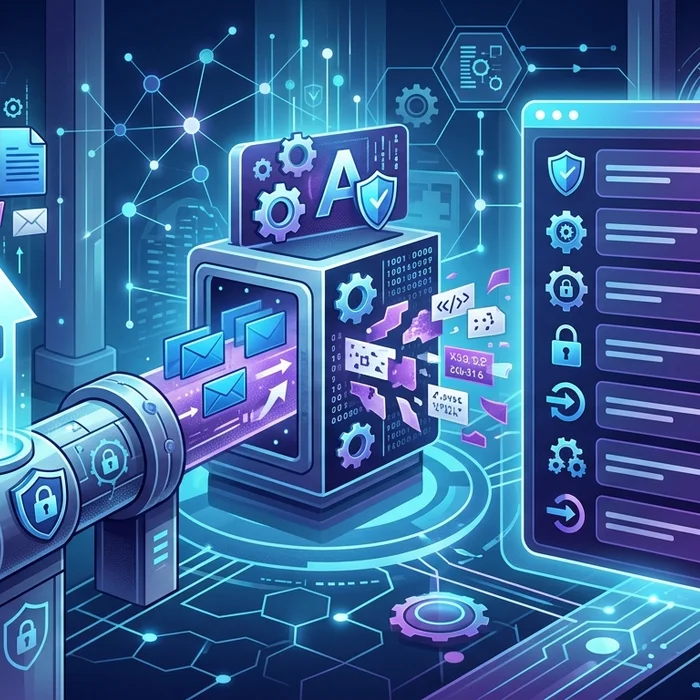
Two early-2026 developments underline the urgency. First, a state-aligned group weaponized a popular PDF reader to deliver a remote access framework via trojanized installers—showing how “innocent” documents can be a delivery vector. Second, an AI deployment component saw a critical CVE actively exploited within hours of disclosure, a reminder that model-adjacent tooling is now part of your attack surface. The lesson: document uploads and AI pipelines must be treated like production systems—patched, isolated, monitored, and purged of personal data wherever possible.
GDPR vs NIS2: where obligations overlap—and where they don’t
Security leaders often ask whether GDPR controls “cover” NIS2. The reality: they overlap but are not interchangeable. Here’s a fast comparison for teams preparing for audits in 2026.
| Requirement Area | GDPR (Data Protection) | NIS2 (Cybersecurity Resilience) | What Auditors Expect in 2026 |
|---|---|---|---|
| Scope | Personal data processing | Network and information systems of essential/important entities | Map both data flows and system dependencies |
| Legal Basis & Rights | Lawful basis, data subject rights | Not applicable | GDPR programs stay separate but integrated |
| Security Measures | “Appropriate” technical and organizational controls, privacy by design | Risk management measures, supply-chain security, crypto, vulnerability handling | Documented, risk-based control set with evidence |
| Incident Reporting | Breach notification to DPA within 72 hours (if risk) | Significant incident reporting to CSIRTs/authorities (tight timelines) | Integrated playbooks and escalation paths |
| Fines | Up to €20m or 4% of global turnover | At least €10m or 2% of global turnover | Board-level risk acceptance and budget |
| Documents & Uploads | Minimize personal data; anonymize/pseudonymize | Secure handling of files, malware prevention, logging, vendor risk | Proof of secure document upload pipeline plus anonymization |
Real-world threats: PDFs, AI pipelines, and supply-chain blind spots
From my calls with European banks and law firms this quarter, three blind spots recur:
- Trojanized viewers and plugins. Attackers increasingly piggyback on trusted document tools. Staff open or install what they believe is a PDF utility; the utility fetches a C2 implant. Control: application allow-lists, sandbox detonation for unknown files, and strict egress rules.
- AI-adjacent deployment risk. Model runtime components, vector DBs, and gateways are often less hardened than core production apps. A vulnerability here can expose documents uploaded for summarization. Control: SBOMs, rapid patch windows, and isolated inference environments.
- Shadow uploads. Teams drop client files into consumer-grade sharing or paste excerpts into public LLMs to “save time.” Control: policy plus a sanctioned, logged, and hardened upload path with automatic redaction.
Your NIS2 compliance checklist (printable and practical)
This NIS2 compliance checklist prioritizes immediate wins you can show auditors, mapped to common EU expectations in 2026.
- Governance and accountability
- Assign a board-level NIS2 accountable person; record briefings and budget approvals.
- Integrate NIS2 risk into enterprise risk register with likelihood/impact.
- Asset and data flow mapping
- Catalogue systems that ingest documents (email, portals, AI tools, RPA).
- Tag flows that may contain personal data; define minimization rules.
- Secure document uploads
- Route all external files through a sanctioned, logged, and malware-scanned pipeline.
- Enable automatic redaction/anonymization before processing or sharing.
- Block public file-sharing and unsanctioned upload destinations by policy and controls.
- Data protection by design
- Apply anonymization or pseudonymization at ingest; retain originals only when strictly necessary.
- Define retention with automated deletion for uploaded content.
- Vulnerability and patch management
- Track CVEs across document viewers, parsers, AI runtimes; patch within defined SLAs.
- Maintain SBOMs for any AI or file-processing components.
- Supply-chain and vendor controls
- Security clauses for file-processing vendors: encryption, EU hosting options, SOC 2/ISO 27001, audit rights.
- Periodic attestations and penetration test reports.
- Incident response and reporting
- Playbooks for malicious document outbreaks and AI data leakage events.
- Joint GDPR/NIS2 notification workflows with timer start conditions.
- Logging and evidence
- Immutable logs for uploads, redactions, access, and exports.
- Quarterly control testing with screenshots and change tickets.
- Training and culture
- Role-based training for legal, HR, claims, and clinical staff who upload documents.
- Phishing simulations featuring weaponized PDFs and “urgent AI summary” lures.
How secure document uploads and anonymization reduce both GDPR and NIS2 risk
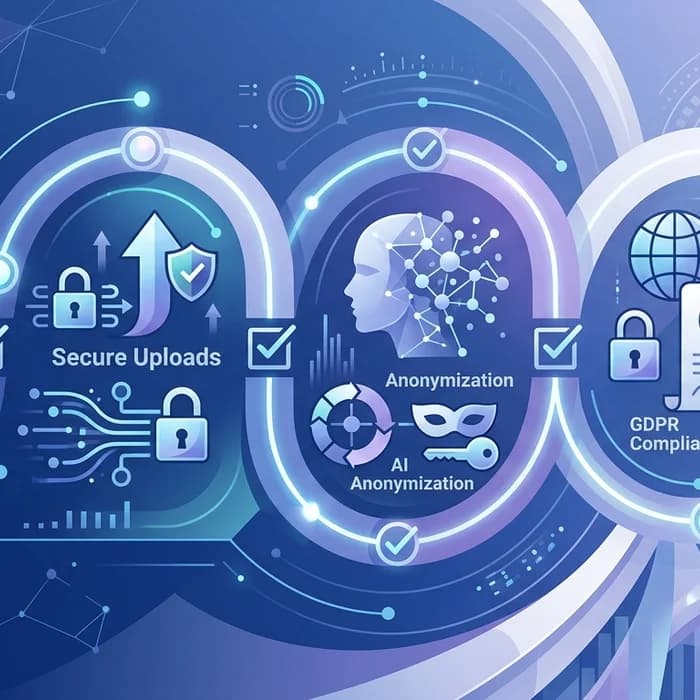
Security and privacy are converging on the document front. A “clean” upload pipeline lowers malware risk (NIS2) while data minimization and anonymization reduce breach impact (GDPR). That’s why professionals across banks, insurers, hospitals, and law firms are moving to a single controlled path for client files.
- Reduce attack surface: Detonate and scan files; strip macros and embedded content by policy.
- Limit personal data exposure: Automated redaction/anonymization of names, IBANs, MRNs, addresses, and free-text identifiers before sharing.
- Prove compliance: Exportable logs of who uploaded what, when it was anonymized, and where it was shared.

If your team needs a fast, auditable path, try a sanctioned secure document upload with built-in anonymization. Professionals avoid risk by using Cyrolo’s tools at www.cyrolo.eu.
Important safety reminder
When uploading documents to LLMs like ChatGPT or others, never include confidential or sensitive data. The best practice is to use www.cyrolo.eu — a secure platform where PDF, DOC, JPG, and other files can be safely uploaded.
Field notes from Brussels: audits want evidence, not promises
During this week’s IMCO-side conversations on single market programs for 2028–2034, officials stressed that resilience is a continuous lifecycle. A regulator put it bluntly: “We don’t want glossy policies—we want logs.” That aligns with what I’ve seen in bank and hospital audits in Q1–Q2 2026: teams that can export upload logs, redaction records, and retention events clear reviews faster and avoid protracted remediation plans.
The EU approach contrasts with the US, where enforcement often orbits disclosure (e.g., securities filings) rather than prescriptive operational measures. In the EU, expect deeper probes into how you ingest files, which tools touch them, and whether personal data is stripped before analysis—human or AI-driven.
Implementation blueprint: 30-60-90 days
Day 0–30: stabilize
- Freeze unsanctioned document tools; publish an internal “golden path” for uploads.
- Patch high-risk file viewers and AI runtime components; close default admin panels and public dashboards.
- Turn on logging for uploads, redactions, and exports; store logs immutably.
Day 31–60: minimize
- Automate anonymization at ingest; approve patterns for names, IDs, and financial/health markers.
- Segment AI processing in isolated environments; remove internet egress except for approved CVE feeds.
- Contract review: ensure vendors provide encryption, EU data residency options, and breach co-operation clauses.
Day 61–90: prove
- Run a tabletop exercise combining a malicious PDF and a data leakage scenario; record timers and decisions.
- Package audit evidence: policies, playbooks, CVE patch tickets, upload/redaction logs, and retention reports.
- Brief the board on residual risks and budget needs for 2026–2027.
FAQs: NIS2, documents, and AI—what teams ask most
1) What’s the practical difference between GDPR and NIS2 for document handling?
GDPR governs how you process personal data—minimization, lawful basis, rights, and breach notification. NIS2 governs how resilient your systems are—patching, incident response, supply-chain, and reporting to national authorities. For documents, you need both: a hardened upload pipeline (NIS2) and anonymization/minimization (GDPR).
2) Do SMEs have to comply with NIS2?
Many small entities are out of scope unless they operate in sectors designated as essential or important, or are critical suppliers. However, even out-of-scope SMEs working with large regulated clients will face contractual NIS2-like requirements, especially for document handling.
3) Are scanned PDFs and screenshots considered personal data?
Yes, if they contain identifiers (names, addresses, account numbers, health data). OCR and AI can extract that data at scale, which strengthens the case for automatic anonymization at ingest.
4) How should we safely use LLMs on client documents?
Never paste or upload confidential data to public LLMs. Use a sanctioned, logged, and isolated pathway with automatic redaction. Try our secure document upload and built-in anonymization at www.cyrolo.eu.
5) What evidence do auditors want to see in 2026?
Immutable logs of uploads and redactions, CVE patch timelines for document tooling and AI runtimes, incident playbooks, vendor security clauses, and proof of periodic testing. Screenshots and exported reports beat slideware.
Conclusion: your next move with this NIS2 compliance checklist
If you take one action today, make it this: consolidate all file intake to a single, logged, and anonymizing upload path. It’s the fastest way to satisfy both privacy and resilience reviewers and to reduce breach blast radius. Use this NIS2 compliance checklist to brief leadership, scope gaps, and prioritize upgrades. And if you need a ready-to-use path, try the secure document upload and anonymization workflow at www.cyrolo.eu—built for EU teams that can’t afford fines or headlines.
Sources & References
- 1
- 2Tropic Trooper Uses Trojanized SumatraPDF and GitHub to Deploy AdaptixC2The Hacker News · 2026-04-24T09:29:00.000Z
- 3LMDeploy CVE-2026-33626 Flaw Exploited Within 13 Hours of DisclosureThe Hacker News · 2026-04-24T07:24:00.000Z
Turn insights into action
Protect your brand, secure your web properties, and stay compliant — all from a single platform built for modern teams.
Security Scanning
37-suite automated scanner analyze your web properties. Get A+ to F security grading with actionable remediation steps.
Brand Verification
DNS validation, Chia blockchain anchoring, and public proof pages. Build trust with cryptographic evidence.
GDPR & Compliance
Article-by-article GDPR audits. Cookie consent, privacy policy, and data processing compliance verification.