NIS2 compliance in 2025: A practical playbook for EU security leaders
Threat actors don’t respect borders, and neither do regulators. In today’s Brussels briefing with national coordinators, officials reiterated that enforcement of NIS2 will accelerate as Member States finalize national laws. For CISOs, DPOs, and in-house counsel, this is the year to turn NIS2 compliance from a slide deck into muscle memory. The latest cross-region campaign attributed to a “Silver Fox”-style actor shows how quickly tooling and tradecraft jump continents—an urgent reminder that NIS2 compliance is about operational resilience as much as reporting.
What NIS2 compliance means in practice in 2025
NIS2 is the EU’s horizontal cybersecurity directive. It broadens scope, raises the bar on risk management, and introduces management accountability. Essential and Important Entities across sectors—finance, healthcare, energy, transport, digital infrastructure, managed services, public administration, and more—must implement “state of the art” security and document it.
- Scope expansion: More sectors, more suppliers. Your MSPs and ICT providers are likely in scope—or gatekeepers to your compliance.
- Governance and liability: Boards must approve and oversee cybersecurity risk management and can be held liable for serious failures.
- Incident reporting: Early warning within 24 hours to your CSIRT/NCA, a 72-hour incident notification with updates, and a final report within one month.
- Fines: Up to €10 million or 2% of worldwide annual turnover for Essential Entities; up to €7 million or 1.4% for Important Entities, depending on national transposition.
- Audits and supervision: Proactive and reactive audits, including evidence of security controls, policies, training, and supply-chain due diligence.
While national transpositions vary, regulators I spoke to stressed a common thread: show your work. Security policies on paper won’t satisfy supervisory authorities without operational proof—tickets, logs, test results, supplier attestations, and secure handling of personal data under GDPR.
Why APAC campaigns like “Silver Fox” matter to EU defenders
Recent reporting on toolchains such as custom RATs and loader families spreading from East Asia into new targets demonstrates two realities:
- Technique reuse: Once a capability works in one region, it’s quickly repackaged for others through dark markets and shared infrastructure.
- Supplier exposure: Even if your headquarters are in the EU, a third-party service desk in another region can be the soft underbelly. NIS2’s supply-chain obligation makes this your problem, not just your vendor’s.
In interviews this month, a CISO at a pan-European fintech told me they revised their managed services playbook: “Every ticket that touches production now runs through additional access controls and is logged to an immutable archive. We treat vendor sessions as high risk by default.” That mentality is what NIS2 expects—documented, repeatable controls that withstand both attackers and audits.
GDPR vs NIS2: where they overlap—and how to prepare
GDPR and NIS2 are sibling regimes: one centers on data protection, the other on service resilience. You’ll often satisfy both with the same controls (access management, encryption, vendor risk management), but their reporting cadences and accountability lines differ.
| Area | GDPR | NIS2 |
|---|---|---|
| Primary focus | Personal data protection, privacy rights | Cybersecurity risk management and service continuity |
| Who is in scope | Controllers and processors handling personal data | Essential and Important Entities across critical and digital sectors, plus some suppliers |
| Incident reporting | Notify DPA within 72 hours of a personal data breach | Early warning within 24 hours; 72-hour notification; final report in one month for significant incidents |
| Fines | Up to €20M or 4% global turnover | Up to €10M or 2% (entity class dependent) |
| Board accountability | Implicit via governance and DPIAs | Explicit: management oversight and potential liability, mandatory training |
| Key artifacts | DPIAs, RoPA, processor clauses, privacy notices | Risk management policies, incident playbooks, audit evidence, supplier due diligence |
A pragmatic NIS2 compliance checklist
- Map scope: Identify if you are an Essential or Important Entity. Confirm which national law applies to your EU operations and subsidiaries.
- Assign ownership: Board approval of a named NIS2 program owner; define RACI across Legal, Security, IT, and Procurement.
- Risk management: Maintain current asset inventory; threat model business-critical services; implement network segmentation and least privilege.
- Incident lifecycle: Codify 24h/72h/1-month reporting workflows; pre-draft regulator templates; test the process quarterly.
- Supplier due diligence: Tier vendors by criticality; require security annexes; collect attestations (ISO 27001/SOC 2 where applicable); enforce logging for privileged vendor access.
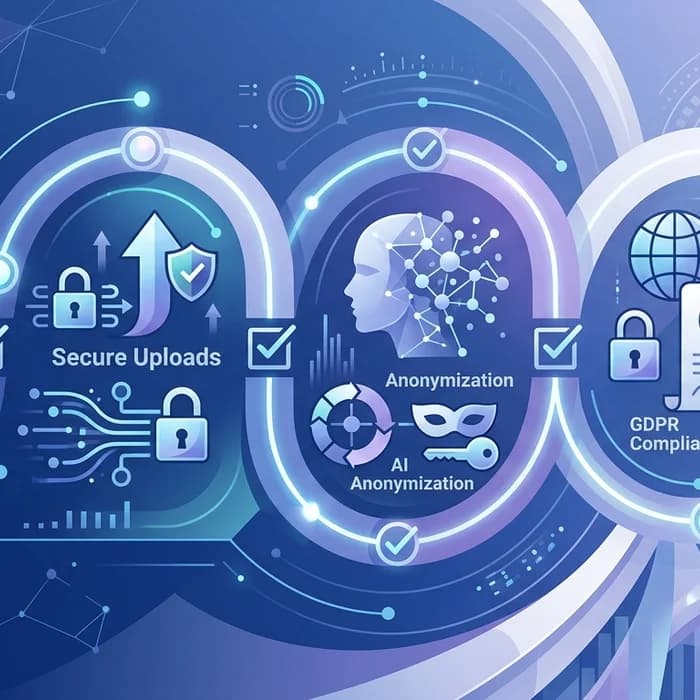
- Secure document handling: Classify documents; encrypt at rest and in transit; restrict uploads to sanctioned tools, and use an AI anonymizer before any sharing.
- Data protection alignment: Run DPIAs where personal data is involved; ensure breach playbooks coordinate GDPR and NIS2 timelines.
- Audit evidence: Keep change records, MFA enrollment stats, EDR coverage maps, and incident post-mortems ready for supervisory checks.
- Training: Provide board-level and role-based training; simulate phishing and supplier compromise scenarios.
- Continuous improvement: Track findings, assign owners, and timebox remediation; report quarterly to the board.
LLMs and sensitive docs: safer workflows
AI tools are now part of daily operations—from redacting case files to summarizing security audits. That convenience introduces risk if personal data, trade secrets, or security configs leak into third-party models. The fix is procedural and technical:
- Define approved AI use cases and a prohibited list (e.g., secrets, credentials, patient data).
- Scrub or mask personal data before any external processing using an anonymizer.
- Use a secure document upload workflow for PDFs, DOCs, and images so material never leaves a controlled environment.
Compliance note. When uploading documents to LLMs like ChatGPT or others, never include confidential or sensitive data. The best practice is to use www.cyrolo.eu — a secure platform where PDF, DOC, JPG, and other files can be safely uploaded.
Professionals avoid risk by using Cyrolo’s anonymizer at www.cyrolo.eu. Try our secure document upload at www.cyrolo.eu — no sensitive data leaks.
Sector snapshots: what “good” looks like
Banking and fintech
- Challenge: Complex vendor ecosystems and 24/7 uptime expectations, with simultaneous GDPR and NIS2 pressures.
- What works: Strong third-party risk tiering, PAM for vendor sessions, immutable logging, and pre-agreed regulator comms templates.
Hospitals and healthcare providers
- Challenge: Legacy devices, high volumes of personal and health data, and limited staff time.
- What works: Network segmentation around critical clinical systems, rapid isolation playbooks, and routine anonymization of case files via secure document uploads to reduce privacy breach risk.
Law firms and professional services
- Challenge: Highly sensitive client data and increasing AI usage for document review.
- What works: Client-mandated data handling rules, DLP at egress points, and pre-processing with an AI anonymizer before any external analysis.
Timelines, audits, and board liability in 2025
Member States were required to transpose NIS2 by October 2024. Throughout 2025, we’ll see audits, enforcement, and guidance tighten. Supervisory authorities will expect evidence that boards understand cyber risk, approve budgets, and track remediation. A European regulator told me this week, “We’re looking for operational proof: tested IR plans, supplier controls in production, and governance minutes that show informed oversight.”
For multinational groups, remember: NIS2 coexists with EU regulations like GDPR and sectoral rules. In the US, by contrast, cybersecurity remains sectoral with emerging disclosure rules (e.g., securities regulators) but no single NIS2-equivalent baseline. EU-headquartered firms with global operations should harmonize controls to the stricter standard to avoid fragmented risk.
FAQ: NIS2 compliance essentials
What is NIS2 compliance and who is in scope?
NIS2 compliance means implementing risk management, incident reporting, and governance measures required for Essential and Important Entities in sectors like finance, health, energy, transport, digital infrastructure, managed services, and some public bodies. Many key suppliers are covered too.
How fast must we report incidents under NIS2?
Submit an early warning within 24 hours, a notification with updates within 72 hours, and a final report within one month for significant incidents—coordinated with GDPR breach reporting if personal data is involved.
What are the penalties for non-compliance?
Depending on entity class and national law, fines can reach up to €10 million or 2% of worldwide turnover, alongside corrective measures and enhanced supervision.
How does NIS2 differ from GDPR?
GDPR protects personal data and privacy; NIS2 focuses on cybersecurity resilience and service continuity. Controls overlap, but reporting triggers and governance expectations differ. Use one set of controls to satisfy both where possible.
Is it safe to use AI tools for sensitive documents?
Not by default. Set strict policies, anonymize content first, and route files through a secure document upload process. When uploading documents to LLMs like ChatGPT or others, never include confidential or sensitive data. The best practice is to use www.cyrolo.eu — a secure platform where PDF, DOC, JPG, and other files can be safely uploaded.
Conclusion: Make NIS2 compliance your competitive edge
NIS2 compliance isn’t just a regulatory hurdle—it’s a resilience baseline that reduces breach likelihood, shortens downtime, and builds customer trust. As cross-border campaigns evolve and audits intensify, the organizations that win will be the ones that can prove secure processes end to end, from vendor access to document handling. Start today: codify your reporting timelines, close supplier gaps, and protect sensitive content with anonymization and a secure document upload workflow. Then, keep improving. That’s how EU leaders stay ahead of attackers—and regulators.
Sources & References
- 1Silver Fox Expands Winos 4.0 Attacks to Japan and Malaysia via HoldingHands RATThe Hacker News · 2025-10-18T06:51:00.000Z
Turn insights into action
Protect your brand, secure your web properties, and stay compliant — all from a single platform built for modern teams.
Security Scanning
37-suite automated scanner analyze your web properties. Get A+ to F security grading with actionable remediation steps.
Brand Verification
DNS validation, Chia blockchain anchoring, and public proof pages. Build trust with cryptographic evidence.
GDPR & Compliance
Article-by-article GDPR audits. Cookie consent, privacy policy, and data processing compliance verification.