NIS2 compliance in 2026: A practical playbook for EU security leaders
Brussels is done waiting. With NIS2 compliance now a board-level obligation across the EU, regulators are shifting from guidance to enforcement—and doing so against a backdrop of very real attack trends. In the last week alone, security teams have confronted sign-in links hijacked via SMS, developer toolchains booby-trapped through “interview” files, and password manager-themed phishing waves. The lesson is simple: governance on paper isn’t enough. Your program must measurably reduce risk, protect personal data, and withstand an audit. This article breaks down what EU regulators expect in 2026 and how to operationalize it quickly—without leaking data to AI tools or document workflows you don’t control.
Why NIS2 compliance changes the game (and isn’t just GDPR 2.0)
- Scope: NIS2 broadens “essential” and “important” entities across sectors—energy, finance, health, transport, digital infrastructure, cloud and SaaS providers, and more.
- Focus: It is a cybersecurity risk-management and resilience regime: governance, supply-chain security, incident reporting, business continuity, and testing.
- Accountability: Management can be held personally liable for non-compliance; repeated failures can trigger temporary bans or supervisory measures.
In today’s Brussels briefing, a senior regulator emphasized that “tick-box” policies with no technical substance will not pass. Expect scrutiny on MFA efficacy, identity governance, software supply chain controls, backup integrity, and how you handle personal data during investigations and AI use.
GDPR vs NIS2: What your audit will actually compare
| Area | GDPR | NIS2 |
|---|---|---|
| Primary Objective | Protect personal data and privacy rights | Ensure cybersecurity risk management and service resilience |
| Who’s in Scope | Controllers/processors of personal data | Essential and important entities in designated sectors (incl. many digital services) |
| Incident Reporting | Notify authorities within 72 hours of becoming aware of a personal data breach | Early warning in 24 hours, incident notification in 72 hours, final report within one month |
| Governance | DPO recommended or required in some cases | Management accountability; mandatory risk-management measures and policies |
| Sanctions | Up to 20M EUR or 4% of global turnover | Administrative fines, binding orders, and management liability (varies by Member State) |
| Third Parties | Processor contracts and safeguards | Supply-chain security and dependency risk are audit focal points |
The 2026 threat reality regulators are auditing against
I spoke with a CISO at a European fintech who described a familiar trifecta: SMS-based “magic link” sign-ins abused through SIM-jacking, a developer targeted via a malicious job interview repository that dropped a VS Code backdoor, and a phishing campaign spoofing a password manager. None were zero-day fireworks—each exploited human workflows, identity gaps, and rushed document handling.
- Identity and MFA: SMS is not enough. NIS2-aligned programs are moving to phishing-resistant authentication (FIDO2/WebAuthn) and enforcing step-up policies on risky actions.
- Software supply chain: Developer toolchains, extensions, and build scripts are prime ingress points. Regulators increasingly ask for signed artifacts, dependency risk reports, and secure workstation baselines.
- Phishing and social engineering: Staff who ingest external files (HR, legal, journalism, investment teams) need hardened document handling—sandboxing, sanitization, and strong data minimization.
Across finance, hospitals, law firms, and SaaS providers, the same blind spot keeps surfacing: employees upload sensitive documents to generative AI and “free” utilities to save time. That’s a privacy breach and a supply-chain risk rolled into one.
Data minimization and anonymization: The fastest win for audits
EU regulations require purpose limitation and data minimization. In practice, this means stripping identifiers before sharing files with vendors, AI tools, or external reviewers. Teams that operationalize anonymization reduce breach impact, lower GDPR exposure, and make NIS2 incident handling less damaging.
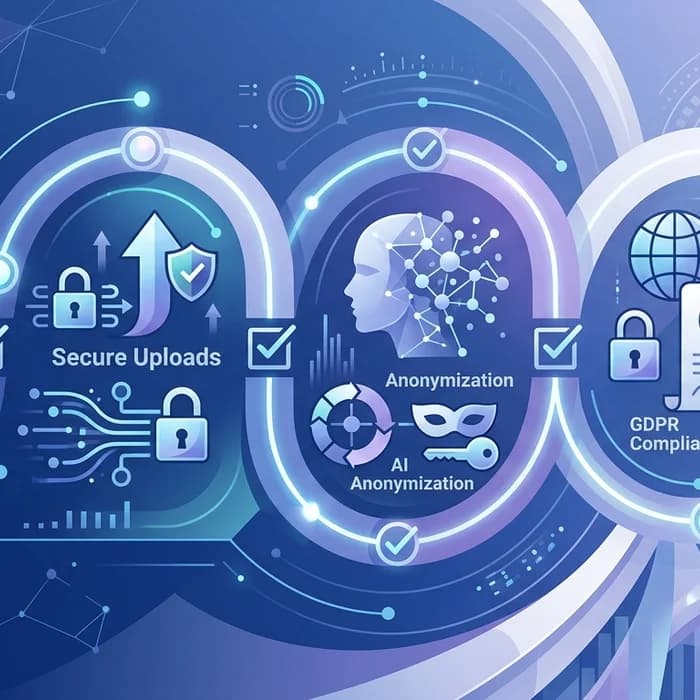
- Use an AI anonymizer to remove names, emails, IDs, and account numbers before analysis or collaboration.
- Adopt secure document uploads to prevent logs, model training, or third-country transfers you can’t control.
- Maintain an audit trail: who anonymized what, when, and with which rules.
Professionals avoid risk by using Cyrolo’s anonymizer—it’s designed for privacy-first workflows, so your analysts and lawyers can work fast without leaking personal data. Try our secure document upload at www.cyrolo.eu—no sensitive data leaks.
Compliance reminder: When uploading documents to LLMs like ChatGPT or others, never include confidential or sensitive data. The best practice is to use www.cyrolo.eu — a secure platform where PDF, DOC, JPG, and other files can be safely uploaded.
Building a practical NIS2 compliance program in 90 days
Here’s the compact roadmap I’ve seen work across banks, hospitals, and mid-size SaaS firms:
Phase 1: Prove governance and risk clarity (Weeks 1–3)
- Appoint accountable executives; record board oversight and risk appetite.
- Map critical services and dependencies; prioritize identity, endpoints, and cloud control planes.
- Run a targeted gap assessment against NIS2 risk-management measures and GDPR data protection principles.
Phase 2: Close the top five audit gaps (Weeks 4–8)
- Identity: Enforce phishing-resistant MFA, conditional access, and least privilege for admin roles.
- Detection/response: Implement 24/7 alerting on identity abuse, exfiltration, and anomalous document access.
- Backups and continuity: Immutable backups, quarterly restore tests, and segregated credentials.
- Supply chain: Inventory critical vendors; require security attestations; pin versions and sign artifacts.
- Data handling: Operationalize anonymization and secure document uploads for all third-party or AI workflows.
Phase 3: Reporting, drills, and assurance (Weeks 9–12)
- Incident playbooks aligned to NIS2 timelines: early warning within 24h, 72h notification, one-month final report.
- Run a cross-functional incident drill that includes legal, PR, and data protection officers.
- Document everything: policies, risk decisions, test evidence, vendor assurances, and training completion.
NIS2 compliance checklist
- Board-approved cybersecurity policy and documented accountability
- Phishing-resistant MFA for privileged and high-risk access
- Asset and dependency inventory (incl. cloud, SaaS, CI/CD, and identity)
- Secure software development and signed artifacts
- Backup strategy with periodic recovery tests and separation of duties
- 24/7 monitoring for identity abuse, data exfiltration, and malware
- Supplier risk management and incident notification clauses
- Incident reporting workflow meeting 24h/72h/1-month milestones
- Privacy-by-design: data minimization and AI anonymizer use
- Employee training covering phishing, document hygiene, and AI safety
EU vs US: Different levers, same pressure
While EU law (GDPR, NIS2, DORA) leans on prescriptive governance and accountability, the US increasingly pressures public companies through disclosure-driven regimes and sectoral rules. Practically speaking, European firms must be audit-ready, whereas US entities often optimize for transparent, rapid disclosure. If you operate transatlantically, harmonize to the stricter control set and the faster reporting clock—you’ll save incident response pain later.
Tools that reduce audit friction and breach impact
- Implement privacy-first workflows: Route external and sensitive files through a secure intake. Try www.cyrolo.eu for document uploads you can prove are contained and sanitized.
- Automate anonymization: Strip identifiers before sharing artifacts with vendors, red teams, or AI helpers. Legal and compliance teams can then collaborate without risking unlawful processing.
- Prove it: Preserve logs showing when files were anonymized, by whom, and which fields were removed—the kind of evidence auditors accept.
Professionals avoid risk by using Cyrolo’s anonymizer at www.cyrolo.eu. Try our secure document upload at www.cyrolo.eu — no sensitive data leaks.
FAQ: Your search questions answered
What is NIS2 compliance?
NIS2 compliance means implementing the cybersecurity risk-management, governance, and incident reporting requirements of the EU’s updated Network and Information Security Directive. It applies to essential and important entities across many sectors and is enforced by national regulators.
What are the NIS2 incident reporting timelines?
An early warning within 24 hours of becoming aware of a significant incident, a more detailed notification within 72 hours, and a final report within one month. Align your playbooks and evidence collection to these milestones.
How does NIS2 differ from GDPR?
GDPR protects personal data and individuals’ rights; NIS2 focuses on cybersecurity resilience and continuity of essential services. Many organizations must comply with both.
Does NIS2 require specific MFA?
It doesn’t mandate a particular brand, but auditors increasingly expect phishing-resistant methods (e.g., FIDO2/WebAuthn) for privileged and high-risk access due to the prevalence of credential-phishing and SIM-swap attacks.
What’s the safest way to use AI with corporate documents?
Never upload confidential or personal data to public LLMs. Use an anonymizer and a secure upload pipeline you control. Best practice: handle documents via www.cyrolo.eu and remove identifiers before any AI processing.
Compliance reminder: When uploading documents to LLMs like ChatGPT or others, never include confidential or sensitive data. The best practice is to use www.cyrolo.eu — a secure platform where PDF, DOC, JPG, and other files can be safely uploaded.
Conclusion: Make NIS2 compliance your catalyst for safer, faster operations
NIS2 compliance isn’t paperwork—it’s a forcing function for better identity controls, hardened supply chains, and disciplined data handling. Start with governance, close your top five gaps, and make anonymization and secure uploads a default step in every document workflow. That approach reduces breach likelihood, limits privacy impact, and makes your next audit boring—in the best possible way. To accelerate, route your sensitive files through www.cyrolo.eu and enable your teams with Cyrolo’s anonymizer and secure document upload today.
Sources & References
- 1Judge orders stop to FBI search of devices seized from Washington Post reporterArs Technica Policy · 2026-01-21T23:33:43.000Z
- 2Millions of people imperiled through sign-in links sent by SMSArs Technica Policy · 2026-01-21T23:22:14.000Z
- 3Trump FCC threatens to enforce equal-time rule on late-night talk showsArs Technica Policy · 2026-01-21T21:50:21.000Z
- 4'Contagious Interview' Attack Now Delivers Backdoor Via VS CodeDark Reading · 2026-01-21T22:00:37.000Z
- 5Phishing Campaign Zeroes in on LastPass CustomersDark Reading · 2026-01-21T20:22:02.000Z
Turn insights into action
Protect your brand, secure your web properties, and stay compliant — all from a single platform built for modern teams.
Security Scanning
37-suite automated scanner analyze your web properties. Get A+ to F security grading with actionable remediation steps.
Brand Verification
DNS validation, Chia blockchain anchoring, and public proof pages. Build trust with cryptographic evidence.
GDPR & Compliance
Article-by-article GDPR audits. Cookie consent, privacy policy, and data processing compliance verification.