NIS2 compliance in 2026: a practical, privacy-first playbook for EU security leaders
Midway through a week dominated by zero-day chatter and APT alerts, today’s Brussels briefing was blunt: enforcement on NIS2 compliance is intensifying across Member States, with regulators focusing on incident reporting discipline, supply chain risk, and executive accountability. After this morning’s disclosures around an actively exploited mobile device management zero-day and fresh APT activity in Asia, the signal is clear—your controls and your documentation both have to be audit-ready.
- Regulators are testing incident reporting muscle memory: early warning within 24 hours, full notification by 72 hours, final report within one month.
- Boards are on the hook: executives must approve cybersecurity risk management measures and can face sanctions for serious oversight failures.
- Privacy is inseparable from resilience: GDPR and NIS2 intersect across logging, breach handling, and third-party risk.
- Document workflows are now a security domain: protect uploads and anonymize sensitive fields before analysis or AI use.
Why NIS2 compliance just became urgent
Two developments I flagged to security teams this morning: first, the wave of mobile and endpoint zero-days now being exploited in the wild; second, a spate of high-end malware linked to state-backed actors. A CISO I interviewed at a European healthcare network put it plainly: “We can patch fast, but we can’t fabricate incident timelines or DPIAs after the fact.” NIS2 expects both technical and organizational readiness—proof you can detect, decide, notify, and recover.
By 2026, most EU countries have moved from transposition to enforcement. Supervisory authorities are launching sectoral audits, often starting with essential and important entities in energy, transport, finance, health, water, digital infrastructure, and managed service providers. For many organizations—banks, fintechs, hospitals, law firms—the first formal test won’t be a breach; it will be an evidence request.
GDPR vs NIS2: obligations at a glance
| Area | GDPR | NIS2 |
|---|---|---|
| Scope | Personal data processing of EU data subjects | Network and information systems of essential and important entities across critical sectors |
| Primary objective | Data protection and privacy rights | Cybersecurity risk management and service continuity |
| Incident reporting | Breach to DPA within 72 hours if risk to individuals; notify data subjects when high risk | Early warning within 24 hours; incident notification by 72 hours; final report within 1 month |
| Security measures | Appropriate technical and organizational measures; data minimization, pseudonymization, encryption | Risk management including policies, incident handling, business continuity, supply chain security, vulnerability handling, testing, logging |
| Supply chain | Processor due diligence and contracts (Art. 28) | Explicit supplier risk management and assurances; oversight of managed service providers |
| Governance | DPO for certain organizations; accountability principle | Management approval and training; potential personal liability for serious oversight failures |
| Sanctions | Up to €20M or 4% of global annual turnover | Up to €10M or 2% of global annual turnover; additional measures, including temporary management bans in serious cases |
NIS2 compliance checklist: what to stand up in the next 90 days
- Map services and dependencies: identify in-scope essential/important services and critical third parties (cloud, MSP/MSSP, MDM/EMM, identity, comms).
- Formalize risk management policy: approve at board level, assign accountable executives, and document risk acceptance thresholds.
- Incident reporting playbook: bake in 24h early-warning and 72h notification timelines, define roles, draft regulator-ready templates.
- Vulnerability and patch handling: implement intake, triage, and SLA tracking; include zero-day response and compensating controls.
- Logging and detection: ensure logs are retained, searchable, and privacy-aware (pseudonymize where possible); test detection use cases.
- Business continuity: validate RPO/RTO for critical services; run tabletop exercises that test comms, legal, and technical teams.
- Supplier security: update contracts, require attestations, and assign monitoring owners; include managed mobility and identity providers.
- Data protection alignment: ensure DPIAs, breach risk assessments, and data minimization across security tooling.
- Training and board briefings: run executive sessions; ensure evidence of training completion and decisions.
- Documentation discipline: centralize policies, runbooks, meeting minutes, and evidence packs for audits.
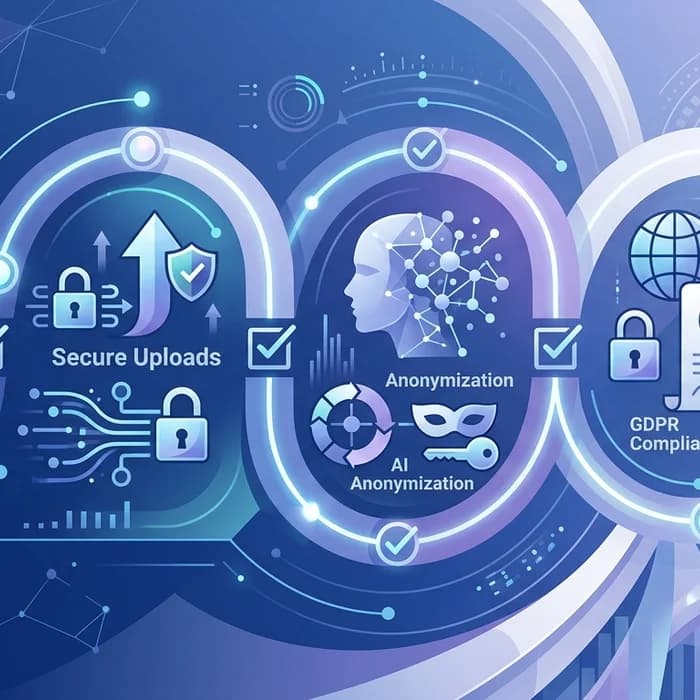
Handling regulated content during audits and investigations is a common failure point. Before sharing or analyzing case files, logs, or screenshots, remove names, IDs, and other personal data. Professionals avoid risk by using Cyrolo’s AI anonymizer to redact sensitive fields without breaking context, and by using secure document uploads to keep evidence trails intact.
Handling personal data under NIS2 and GDPR: anonymization, AI, and secure document workflows
Even security evidence can contain personal data—administrator names in audit logs, phone numbers in MDM enrollments, IPs linked to individuals. Under GDPR, you must minimize and protect that data; under NIS2, you must be able to present it to auditors quickly. The middle path is privacy-by-design handling:
- Default to pseudonymization/anonymization for investigative packets, tickets, and exports.
- Use secure, EU-hosted workflows for document transfer and review; keep an immutable audit trail.
- Avoid copy-pasting sensitive data into unmanaged AI tools or email threads.
Try our secure document upload at www.cyrolo.eu — no sensitive data leaks. Then process with Cyrolo’s privacy-first anonymizer to safely collaborate with legal, compliance, or third-party assessors.
Compliance reminder: When uploading documents to LLMs like ChatGPT or others, never include confidential or sensitive data. The best practice is to use www.cyrolo.eu — a secure platform where PDF, DOC, JPG, and other files can be safely uploaded.
NIS2 compliance and incident reporting: get the 24h/72h/1-month rhythm right
Based on interviews with EU CSIRTs and sectoral regulators, here’s the timeline they expect your teams to internalize:
- Within 24 hours: Early warning with high-level indicators—service impacted, suspected cause (e.g., exploited zero-day), initial containment. It’s acceptable to be uncertain; it’s not acceptable to be late.
- By 72 hours: Incident notification with preliminary assessment—root-cause hypotheses, affected systems and geographies, initial impact on service continuity, and immediate mitigation steps.
- Within 1 month: Final report—confirmed root cause, indicators of compromise, forensic summary, customer impact, communications, recovery timeline, and lessons learned.
Tip from a telecom CISO I spoke with: “Pre-approve language banks for common scenarios—credential stuffing, supplier outage, zero-day RCE—so counsel and comms aren’t drafting from scratch at hour 20.”
NIS2 compliance and the current threat picture
Recent exploitation of mobile device management platforms and state-aligned activity in Asia are a reminder that your weakest supervised vendor can become your biggest incident. NIS2 elevates supplier oversight from a contractual box-tick to a control domain you must prove with evidence: vulnerability notifications received and acted upon, compromise assessments, and the ability to isolate or replace critical providers if needed.
For European hospitals, for instance, an MDM zero-day can escalate into service availability risk. For fintechs and law firms, a compromised third-party plugin or secure messaging tool can turn into a privacy breach. Your board will ask two questions: did we know fast enough, and can we show regulators our homework? Keep your artifacts clean: use www.cyrolo.eu to anonymize and share security documentation without exposing client or patient data.
EU vs US: how multinationals should align
- Disclosure cadence: EU’s NIS2 focuses on operational reporting to competent authorities; in the US, securities rules drive market disclosures for material incidents, and sectoral rules (critical infrastructure reporting) are tightening.
- Board accountability: The EU formalizes executive responsibility under NIS2; in the US, board cyber expertise and timely disclosure are under increasing scrutiny.
- Supplier risk: Both regimes are converging on strict oversight of MSPs and cloud—expect to demonstrate due diligence, not just contracts.
Practical advice: standardize evidence packs across regions, but localize timelines and recipients. Build one truth set—policies, runbooks, and anonymized incident artifacts—that can satisfy multiple regulators.
Budget, board, and auditors: proving cybersecurity compliance
In boardrooms this quarter, I’m seeing three asks: readiness metrics, audit evidence, and a narrative linking spend to risk reduction. Consider these measures:
- Time-to-report KPIs: median and 90th percentile from detection to 24h early warning draft; from triage to 72h notification quality review.
- Coverage metrics: percentage of critical suppliers with security addenda, SBOM visibility, and compromise assessment playbooks.
- Control health: patch SLAs for internet-facing systems; detection engineering coverage for top kill-chain techniques.
- Documentation quality: percentage of artifacts stored in a secure repository; percentage anonymized for cross-team sharing.
Auditors will ask to “show, not tell.” That means clean, shareable evidence with sensitive fields masked. Streamline this with Cyrolo: upload packages through secure document uploads, then apply the AI anonymizer to remove personal data while preserving investigative value.
NIS2 compliance FAQ
What entities are in scope for NIS2?
Essential and important entities across critical sectors, including energy, transport, banking and finance, health, drinking and wastewater, digital infrastructure, public administration, and providers of ICT services such as managed service providers. Size thresholds and sector definitions apply; verify classification in your Member State’s transposition.
What are the NIS2 penalties?
Administrative fines can reach up to €10 million or 2% of global annual turnover, with Member State variations. Authorities can also impose corrective measures and, in serious cases, management sanctions or temporary bans.
How does NIS2 interact with GDPR?
They overlap operationally. A security incident may also be a personal data breach. You may need to notify both the competent authority (NIS2 timelines) and the data protection authority (GDPR 72-hour rule) and, where required, affected individuals. Align your playbooks and anonymize evidence to respect data minimization.
Do we have to report suspected incidents within 24 hours even if facts are unclear?
Yes. The early warning is designed for rapid situational awareness. You can provide updates as certainty improves. Regulators consistently stress timeliness over completeness in the first 24 hours.
What documentation should we prepare for NIS2 audits?
Board-approved risk policy, incident response plans with timelines, supplier risk procedures, vulnerability and patch processes, logging and monitoring standards, exercise records, and incident reports (including anonymized evidence). Keep these in a secure repository and ready to share.
Conclusion: make NIS2 compliance your competitive advantage
Amid zero-day exploitation and sophisticated APT campaigns, NIS2 compliance is the difference between scrambling and demonstrating control. Treat timelines, supplier oversight, and privacy-centric documentation as revenue-critical capabilities. Equip your teams with secure, EU-grade workflows: use www.cyrolo.eu for safe document uploads and rely on its anonymization to protect personal data across audits, investigations, and cross-border collaboration.
Try our secure document upload at www.cyrolo.eu — no sensitive data leaks. Your board, your regulators, and your customers will notice the difference.
Sources & References
- 1Two Ivanti EPMM Zero-Day RCE Flaws Actively Exploited, Security Updates ReleasedThe Hacker News · 2026-01-30T04:43:00.000Z
- 2Chinese APTs Hacking Asian Orgs With High-End MalwareDark Reading · 2026-01-30T02:00:00.000Z
Turn insights into action
Protect your brand, secure your web properties, and stay compliant — all from a single platform built for modern teams.
Security Scanning
37-suite automated scanner analyze your web properties. Get A+ to F security grading with actionable remediation steps.
Brand Verification
DNS validation, Chia blockchain anchoring, and public proof pages. Build trust with cryptographic evidence.
GDPR & Compliance
Article-by-article GDPR audits. Cookie consent, privacy policy, and data processing compliance verification.