NIS2 cybersecurity compliance: what today’s Linux and NGINX flaws mean for EU risk owners
Two fresh zero-to-root headlines this morning — a Linux kernel local privilege escalation dubbed “Fragnesia” and an 18‑year‑old NGINX rewrite module bug allowing unauthenticated remote code execution — are a blunt reminder that NIS2 cybersecurity compliance is not a paperwork exercise. It’s about demonstrable control over vulnerabilities, suppliers, and incident reporting. In today’s Brussels briefing, regulators emphasized that critical and important entities must prove they can detect, respond, and notify within strict timelines, or face fines and management liability.
What NIS2 cybersecurity compliance demands in 2026
Across energy, finance, health, digital infrastructure, managed services, postal and waste sectors (and more), NIS2 sets out governance-level expectations. The law has been transposed across the EU since late 2024, and supervisors are now moving from guidance to audits.
- Board accountability: directors must approve and oversee security policies; training for management is mandatory.
- Risk management measures: asset inventory, vulnerability handling, secure development, incident response, business continuity, supply-chain security.
- Reporting deadlines: early warning within 24 hours, incident notification within 72 hours, and a final report within one month for significant incidents.
- Supply-chain duty: evaluate and contractually require security from providers (e.g., reverse proxies, kernels, CI/CD tooling).
- Administrative fines: up to €10 million or 2% of global turnover for “important entities” (higher ceilings may apply to “essential” entities), plus supervisory orders and temporary bans.
- Security audits: regulators can mandate audits, documentation reviews, and corrective measures.
From headlines to controls: responding to kernel LPE and NGINX RCE under NIS2
Today’s disclosures — a page cache corruption path to root in the Linux kernel and an unauthenticated RCE via legacy NGINX rewrite behavior — map neatly to NIS2’s core controls. A CISO I interviewed this morning put it plainly: “If you can’t enumerate where NGINX and vulnerable kernels run by close of business, you don’t have NIS2-grade asset control.”
- Inventory and exposure review:
- Locate all NGINX instances (containers, edge nodes, legacy VMs) and check if the rewrite module is enabled or reachable from the internet.
- Identify Linux kernel versions across fleets and prioritize internet‑facing and multi-tenant hosts where LPEs have the greatest blast radius.
- Patch and configuration management:
- Apply vendor patches or mitigations; if patching lags, disable or isolate the vulnerable NGINX module and reduce privileges for worker processes.
- Harden kernels: enable LSMs, enforce minimal capabilities, and isolate untrusted workloads via containers/VMs.
- Threat detection and logging:
- Instrument logs for suspicious rewrite invocations, odd worker crashes, or unexpected outbound connections from reverse proxies.
- Hunt for local privilege escalation artifacts: abnormal setuid transitions, orphaned root shells, or tampered credentials stores.
- Supplier and MSP coordination:
- Obtain written attestations from hosting, CDN, and managed service providers on their exposure and remediation timelines. Under NIS2, this is not optional.
- Notification readiness:
- Pre-draft your 24/72-hour templates with impact, indicators, and mitigation sections. Test the on-call rota for legal and communications.
GDPR vs NIS2: how the obligations compare

| Topic | GDPR | NIS2 |
|---|---|---|
| Primary focus | Personal data protection and privacy rights | Security and resilience of networks and information systems |
| Scope | Controllers/processors of personal data | Essential and important entities across specified sectors (including digital infrastructure and managed services) |
| Breach/incident reporting | Supervisory authority within 72 hours if risk to personal data | Early warning within 24 hours; incident notification within 72 hours; final report within 1 month for significant incidents |
| Supply-chain duties | Ensure processors provide sufficient guarantees | Assess, select, and contract suppliers with security controls; monitor and address third‑party cyber risk |
| Management liability | Implicit accountability | Explicit board oversight duties and possible personal consequences via supervisory measures |
| Fines | Up to €20M or 4% global turnover | Up to €10M or 2% global turnover (higher supervisory pressure for essential entities) |
| Audits | Data protection audits on processing | Security audits on risk management, technical controls, and incident handling |
Compliance checklist for your next NIS2 audit
- Verified asset inventory: every NGINX endpoint and Linux kernel version mapped to business services.
- Documented vulnerability handling process (including intake from cert advisories and CVD/VDP).
- Patch SLAs by criticality; evidence of timely remediation or compensating controls.
- Network segmentation and least privilege for proxy tiers and host workloads.
- Incident response runbooks with 24/72‑hour regulator notification templates.
- Third‑party risk assessments and contractual security clauses for MSPs and cloud providers.
- Regular security audits and management training records.
- Backup/restore tests and business continuity exercises with measured RTO/RPO.
- Data protection alignment with GDPR where incidents involve personal data.
- Evidence of secure document handling and data minimization in investigations.
Documentation without data leaks: practical workflows that pass EU scrutiny
Incident handling requires sharing logs, configs, and screenshots with responders and outside counsel — exactly when errors happen and pressure is highest. That’s when privacy breaches and disclosure mistakes occur. The fix is to operationalize data minimization and secure tooling.
Reduce exposure with AI-powered anonymization
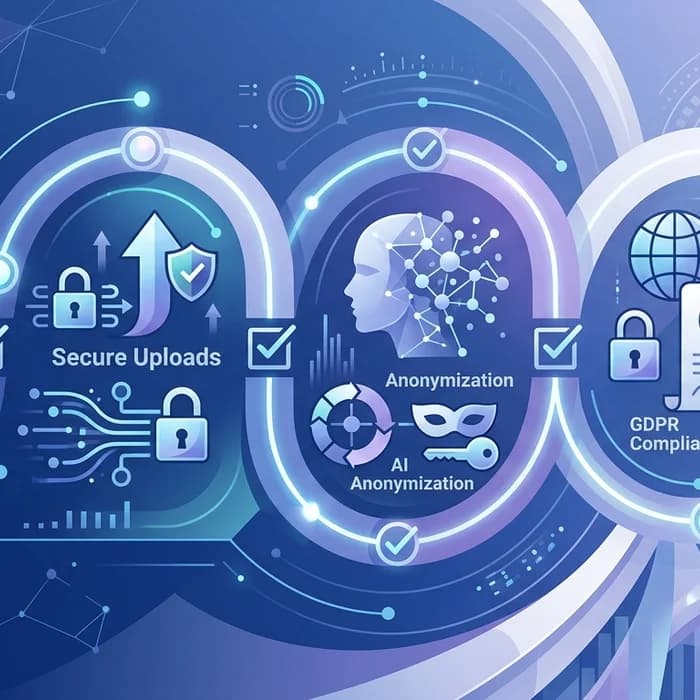
Before you circulate tickets, PDFs, or console captures, scrub personal data and secrets. Professionals avoid risk by using AI anonymizer at www.cyrolo.eu to automatically redact names, emails, IPs, access tokens, and customer identifiers while preserving context for analysts. It’s faster than manual redaction and aligned with GDPR data protection by design.

Move evidence safely with secure document uploads
Contain spillage by centralizing evidence exchange. Try our secure document upload at www.cyrolo.eu — no sensitive data leaks. Legal teams, SOCs, and external responders can share files without shadow IT or risky consumer links.
Compliance Note: When uploading documents to LLMs like ChatGPT or others, never include confidential or sensitive data. The best practice is to use www.cyrolo.eu — a secure platform where PDF, DOC, JPG, and other files can be safely uploaded.
Sector snapshots: how auditors will judge you
- Bank/fintech: expect questions on internet-facing NGINX appliances, kernel hardening on trading gateways, and proof of 24-hour early warnings to regulators for major outages.
- Hospital: regulators will review segmentation between clinical systems and public web portals, patch windows for life-critical endpoints, and cross-over with GDPR where patient data is implicated.
- Law firm: focus lands on secure document handling, DLP, and anonymization of case materials shared with eDiscovery vendors; NIS2 applies if you provide managed services in critical supply chains.
- Cloud/MSP: you are squarely in scope; be ready with customer notifications, back-to-back SLAs, and infrastructure-level kernel patch cadences.
EU vs US: disclosure and oversight
EU NIS2 centers on resilience and regulator-led audits; GDPR overlays privacy. In the US, public companies face securities-led disclosure duties on material cyber events, and critical infrastructure operators see incident reporting under evolving federal rules. The net effect converges: faster notifications, more board visibility, and verifiable controls. Multinationals should harmonize toward the stricter elements — NIS2’s 24/72-hour cadence and formal supplier security clauses — to avoid rework.

FAQs
What is NIS2 cybersecurity compliance in practice?
It’s demonstrable governance, risk management, and incident reporting for networks and information systems. You must inventory assets, manage vulnerabilities, secure the software supply chain, and notify regulators within 24/72 hours for significant incidents.
Do Linux kernel and NGINX bugs trigger NIS2 reporting?
Not automatically. Reporting hinges on impact and likelihood. If exploitation disrupts services, compromises confidentiality, or significantly affects users, you may need to file an early warning within 24 hours and a notification within 72.
How does NIS2 interact with GDPR?
If a cyber incident affects personal data, both regimes can apply: notify under NIS2 for service impact and under GDPR for data breaches. Prepare integrated playbooks to avoid duplicate effort and missed deadlines.
What are the penalties for noncompliance?
For important entities, fines can reach €10M or 2% of global turnover; essential entities face even higher supervisory pressure. Management can be ordered to undergo training, and entities may be subject to audits and corrective measures.
How can we safely share evidence during an incident?
Use redaction and a secure exchange platform. An AI anonymizer reduces privacy risk, and a secure document upload channel prevents leaks and shadow sharing.
Conclusion: make NIS2 cybersecurity compliance real before the next headline
Kernel LPEs and NGINX RCEs will keep surfacing. What distinguishes resilient organizations is how fast they inventory exposure, mitigate, and notify — with paperwork and proofs ready for auditors. Treat NIS2 cybersecurity compliance as an operational program: board-trained, supplier-aware, and evidence-driven. And when you must share files, protect your people and customers by anonymizing and uploading securely via www.cyrolo.eu.
Sources & References
- 1New Fragnesia Linux Kernel LPE Grants Root Access via Page Cache CorruptionThe Hacker News · 2026-05-14T07:06:15.000Z
- 218-Year-Old NGINX Rewrite Module Flaw Enables Unauthenticated RCEThe Hacker News · 2026-05-14T06:00:09.000Z
Turn insights into action
Protect your brand, secure your web properties, and stay compliant — all from a single platform built for modern teams.
Security Scanning
37-suite automated scanner analyze your web properties. Get A+ to F security grading with actionable remediation steps.
Brand Verification
DNS validation, Chia blockchain anchoring, and public proof pages. Build trust with cryptographic evidence.
GDPR & Compliance
Article-by-article GDPR audits. Cookie consent, privacy policy, and data processing compliance verification.