Secure Document Upload Lessons from the Notepad++ Hosting Breach: An EU Compliance Playbook for 2026
When a popular open‑source editor’s hosting infrastructure is breached and attributed to a state-linked group, it’s a wake-up call for anyone moving files across developer portals, vendor ticketing systems, and AI assistants. The Notepad++ hosting breach tied to the China-linked “Lotus Blossom” cluster underscores a simple truth: secure document upload is not a convenience—it’s a control. In today’s Brussels briefing, regulators emphasized that under GDPR and NIS2, organizations must prove they exercised due care across the entire data and software supply chain, from uploads to anonymization and onward sharing.
Why this breach matters for secure document upload and AI workflows
In interviews I conducted with CISOs at a bank and a medtech manufacturer this week, both independently flagged the same pattern: attackers target the points where humans exchange files—build artifacts, support bundles, logs, and contracts. A compromised hosting platform or poisoned download link is enough to turn routine document uploads into initial access.
- Supply-chain risk: Even trustworthy tools rely on third-party hosting, mirrors, and CDNs; one weak link can cascade.
- Privilege pivot: Uploaded crash dumps and config files often contain tokens, API keys, and personal data that enable lateral movement.
- Regulatory exposure: GDPR and NIS2 don’t care whether the breach starts with open source or a vendor—if personal data or essential services are impacted, you own the incident response and notifications.
A CISO I interviewed warned, “If your engineers or legal teams are dragging files into consumer AI tools, you’ve just created a shadow channel that your SOC can’t see—and your DPO can’t defend.”
What we know about the attack pattern
While forensics are still being analyzed, the TTPs resemble classic supply-chain and watering‑hole techniques: compromise a trusted distribution point, alter downloads or redirect links, harvest credentials from unsuspecting users, and wait for privileged uploads. Whether you run a fintech, a hospital, or a law firm, this is your reminder to harden every ingress point where files are accepted, scanned, or forwarded to third parties or LLMs.
GDPR and NIS2: your twin obligations in a hosting or supply-chain incident
EU regulators have sharpened expectations since 2024—by 2026, enforcement actions emphasize provable controls and documented decisions. Here’s how GDPR and NIS2 align and diverge when secure file handling is in scope:
| Requirement | GDPR (Data Protection) | NIS2 (Network & Information Security) |
|---|---|---|
| Scope | Personal data processing across controllers/processors | Security of essential/important entities’ networks and services |
| Risk focus | Confidentiality, integrity, availability of personal data | Continuity and resilience of services; supply‑chain security |
| Incident reporting | Notify SA within 72 hours if personal data breach likely risks rights/freedoms | Early warning within 24h, notification within 72h, final report within 1 month |
| Sanctions | Up to €20M or 4% of global turnover | Up to €10M or 2% of global turnover; management liability possible |
| Supply‑chain controls | Processor due diligence and DPAs; data minimization; DPIAs | Mandatory risk management for suppliers; security-by-design; audits |
In practice: if your team downloads a compromised installer and later uploads logs containing personal data to a ticketing portal or AI tool, you could trigger both GDPR (data breach) and NIS2 (service impact/supply‑chain) duties—especially in critical sectors like finance and healthcare.
Build a defensible pipeline for secure document upload
Security leaders I spoke with are converging on a simple, defensible pattern that maps cleanly to audits and post‑incident reviews:
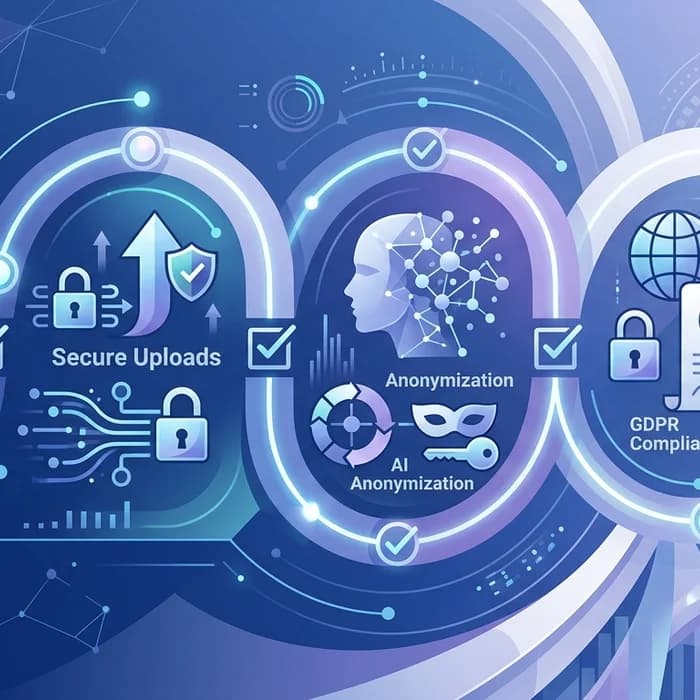
- Pre‑upload controls
- Data minimization by default: strip personal data, tokens, and keys from files before they leave your workstation.
- Automated PII redaction with an anonymizer to remove names, emails, MRNs, IBANs, and free‑text identifiers across PDFs, DOCs, and images.
- Local malware scan and sandboxing before any external transfer.
- Trusted upload channels
- Use signed upload endpoints with mTLS or at least strong TLS and modern cipher suites.
- Apply content DLP policies and size/type restrictions; quarantine unknown formats.
- Encrypt at rest; enforce time‑bound, scoped access for recipients.
- AI/LLM isolation
- Route files destined for AI through a governed gateway; keep prompts and attachments segregated from production data.
- Use vendor terms that guarantee no training on your data—or keep AI completely tenant‑isolated.
- Logging and proof
- Maintain immutable logs of who uploaded what, when, to which endpoint, with which redactions.
- Attach redaction reports and hash values to tickets for forensic traceability.
Professionals avoid risk by using Cyrolo’s anonymizer at www.cyrolo.eu. Try our secure document upload at www.cyrolo.eu — no sensitive data leaks.
AI anonymization and the Notepad++ lesson
The breach story isn’t just about downloads; it’s about what you upload next. After a compromise, attackers hunt for the files your team shares: screenshots, SQL exports, patient referrals, board decks. Before you pass any of that to an AI assistant, scrub it.
- Automated entity detection: personal names, contact info, health identifiers, card numbers, and location data.
- Context‑aware masking: preserve utility (dates, ranges, structure) while removing identifiers.
- Auditability: generate a redaction manifest for regulators and in‑house counsel.
When uploading documents to LLMs like ChatGPT or others, never include confidential or sensitive data. The best practice is to use www.cyrolo.eu — a secure platform where PDF, DOC, JPG, and other files can be safely uploaded.
EU vs US: who expects what in 2026?
From Brussels to Washington, expectations are converging but not identical. The EU’s GDPR and NIS2 create unified baselines across Member States: strict timelines, supply‑chain accountability, and heavy fines. The US remains a patchwork—state privacy acts, critical infrastructure directives, sectoral rules—and with tighter SEC incident disclosure expectations, timing can be brutal for listed companies. The common denominator: demonstrable controls around file handling and uploads. Regulators in both jurisdictions now ask, “Show us the evidence your uploads were minimized, sanitized, and logged.”
Compliance checklist: prove diligence on day one
- Map every place employees perform secure document upload internally and externally (support portals, vendor RMM, AI tools).
- Adopt a standard redaction policy and tool for PII/PHI, keys, and secrets across file types.
- Enforce malware scanning, file‑type allowlists, and DLP rules at the upload edge.
- Require vendor attestations on data handling; update DPAs and security addenda.
- Implement incident‑time playbooks for GDPR 72h and NIS2 24h/72h/1‑month reports.
- Train engineers, legal, and support teams on “no raw data” uploads; validate with spot checks.
- Centralize immutable logs and redaction manifests for audits and regulators.
Practical scenarios: where breaches actually start
- Banks: a developer uploads a database error dump with IBANs to a public Git issue. A month later, fraud spikes. Minimizing and anonymizing would have prevented exposure.
- Hospitals: radiology images sent to an AI tool for triage still include embedded DICOM tags with patient identifiers. Automated scrubbing closes the gap.
- Law firms: counsel shares a PDF bundle with hidden metadata and tracked changes revealing client names. Scrubbing and flattening fix both risks.
- Fintechs: vendor asks for “full logs” to reproduce a bug. Policy restricts to 48‑hour windows, with PII masked and secrets removed.
FAQs: your most-searched questions, answered
What does the Notepad++ hosting breach mean for EU companies under GDPR and NIS2?
It highlights that file exchange points are prime targets. If compromised downloads lead to risky uploads of personal data or service disruption, you may trigger both GDPR breach duties and NIS2 incident reporting. Prove you minimized, anonymized, scanned, and logged every transfer.
How fast do I need to report incidents?
GDPR: within 72 hours to your supervisory authority if there’s a likely risk to individuals. NIS2: early warning in 24 hours, a fuller notification in 72 hours, and a final report in one month. Prepare templates and evidence in advance.
Is secure document upload enough, or do I also need anonymization?
Both. Transport security protects the channel; anonymization reduces breach impact if data escapes. Regulators increasingly look for data minimization and privacy‑by‑design, not just encrypted pipes.
Can open-source maintainers fall under NIS2?
NIS2 targets essential and important entities; many small OSS projects are outside direct scope. But their hosting providers and downstream operators are in scope. Given supply‑chain risk, expect due‑diligence questions and security baselines even for community projects. The Cyber Resilience Act also tightens expectations for products with digital elements, with carve‑outs for non‑commercial OSS.
How do I safely use LLMs with internal files?
Redact first, route through a governed gateway, and block sensitive categories. When uploading documents to LLMs like ChatGPT or others, never include confidential or sensitive data. The best practice is to use www.cyrolo.eu — a secure platform where PDF, DOC, JPG, and other files can be safely uploaded.
Conclusion: make secure document upload your first control, not your last
The Notepad++ breach is a timely reminder that attackers exploit the mundane: a download link here, an upload there. In 2026, the organizations that pass audits and avoid fines are the ones that treat secure document upload as a governed workflow—paired with automated anonymization, scanning, and immutable logging. If you need a fast, defensible starting point, try Cyrolo’s anonymizer and document uploads at www.cyrolo.eu and bring your GDPR/NIS2 posture up to the level today’s regulators—and adversaries—demand.
Sources & References
- 1Notepad++ Hosting Breach Attributed to China-Linked Lotus Blossom Hacking GroupThe Hacker News · 2026-02-03T04:55:00.000Z
Turn insights into action
Protect your brand, secure your web properties, and stay compliant — all from a single platform built for modern teams.
Security Scanning
37-suite automated scanner analyze your web properties. Get A+ to F security grading with actionable remediation steps.
Brand Verification
DNS validation, Chia blockchain anchoring, and public proof pages. Build trust with cryptographic evidence.
GDPR & Compliance
Article-by-article GDPR audits. Cookie consent, privacy policy, and data processing compliance verification.