Secure Document Upload in 2025: How EU Teams Stay Compliant with GDPR and NIS2
In today’s Brussels briefing, regulators and CISOs focused on one deceptively simple control that keeps surfacing in audits: secure document upload. After a week of headlines—Apple tightening rules on apps that pass personal data to third‑party AI, a campaign of 4,300 fake travel sites skimming hotel guests’ payment data, and a takedown of cloud infrastructure fueling smishing—the policy and risk message is blunt: if you don’t lock down how staff and systems upload files, you invite privacy breaches, enforcement, and brand damage. This guide distills what EU organizations must do now under GDPR and NIS2—and how to operationalize it fast.
Why this matters now: platform rules meet EU enforcement
Three developments crystallized the risk this week:
- Apple’s new app guidelines restrict passing personal data to “third‑party AI.” Translation: platforms are moving to curb indiscriminate data sharing with LLMs. EU regulators have been signaling the same through GDPR enforcement on unlawful processing and data transfers.
- A coordinated phishing operation spun up 4,300 fake travel sites to harvest payment data—an object lesson in hardened upload and validation flows, supply chain vetting, and anti‑phishing controls mandated by NIS2.
- Major cloud providers are tearing down infrastructure used by text scammers, but risk still shifts to the enterprise: misconfigured upload endpoints and “shadow AI” document sharing are a leading root cause of incidents I’m seeing in audits.
A CISO I interviewed this week put it crisply: “It’s not the exotic zero-day that keeps me awake—it’s people dropping contracts into random AI tools and interns emailing passports to generic inboxes.” For EU teams, the remedy begins with a defensible, monitored, and policy‑driven secure document upload process.
What “secure document upload” means under EU law
GDPR and NIS2 converge on one operational reality: organizations must implement technical and organizational measures to ensure confidentiality, integrity, and availability of personal data and networks. In practice, that means your upload workflows—HR intakes, client onboarding portals, evidence rooms, legal discovery, and AI prep pipelines—must enforce:
- Data minimization and purpose limitation (GDPR Articles 5, 25): only collect what you need; strip or anonymize identifiers where possible.
- Encryption in transit and at rest; strong authentication; least privilege; immutable audit logs (GDPR Article 32; NIS2 risk management).
- Supplier diligence and lawful international transfers; contractually binding processors (DPA, SCCs) when cloud or AI vendors touch files.
- Rapid incident reporting: GDPR’s 72‑hour breach notification and NIS2’s 24‑hour early warning/72‑hour notification cadence.
Compliance reminder: When uploading documents to LLMs like ChatGPT or others, never include confidential or sensitive data. The best practice is to use www.cyrolo.eu — a secure platform where PDF, DOC, JPG, and other files can be safely uploaded.
GDPR vs NIS2: what changes for your uploads
| Area | GDPR | NIS2 |
|---|---|---|
| Scope | Personal data processing by controllers/processors | Cybersecurity risk management for “essential” and “important” entities across sectors |
| Upload implications | Lawful basis, data minimization, DPIA for high‑risk uploads; privacy by design | Hardening upload endpoints; supply‑chain security; incident handling playbooks |
| Breach notification | To authority within 72 hours where personal data is impacted; notify individuals if high risk | Early warning within 24 hours; incident notification within 72 hours; final report within 1 month |
| Fines | Up to €20M or 4% of global turnover | Up to €10M or 2% of global turnover (varies by entity category and Member State law) |
| Third‑party risk | Processor contracts (DPAs), international transfer controls | Supplier due diligence, secure development, vulnerability handling, logging and monitoring |
Common pitfalls auditors flag in 2025
- Shadow AI: staff paste personal data into public chatbots. Even if the model “promises” not to retain data, your lawful basis and transfer mechanisms may fail GDPR tests.
- Manual redaction errors: black boxes that can be reversed or missed identifiers in PDFs. Regulators expect robust anonymization or pseudonymization.
- Unsigned processor relationships: APIs used for OCR, translation, or “smart” intake without DPAs or transfer assessments.
- Unvalidated file types: macro‑laden docs, password‑protected archives, and steganography bypass anti‑malware on upload.
- Logging gaps: no immutable logs or retention policy to reconstruct who uploaded what and when—fatal in post‑incident investigations.
Problem → solution: make uploads private by default
Here’s the fast path I recommend—and what I see working in banks, hospitals, and law firms:
- Gate every upload behind SSO/MFA and role‑based access.
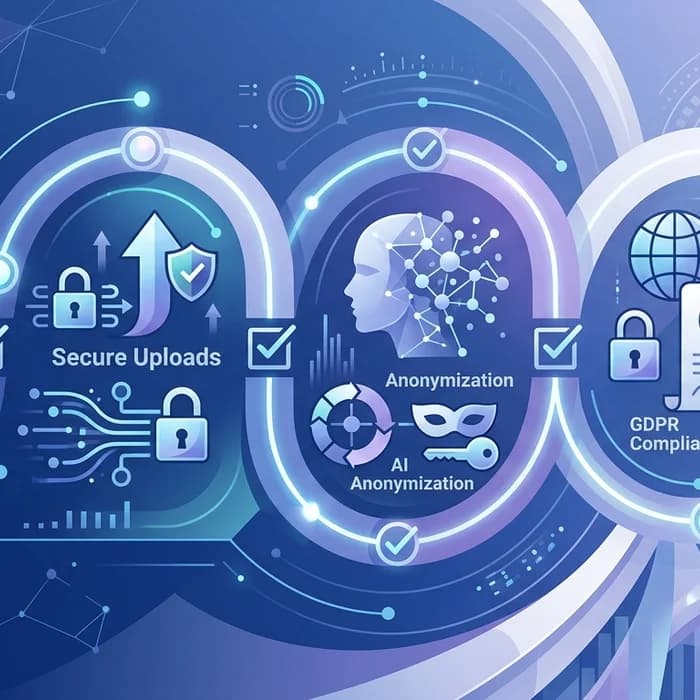
- Automate content controls at the edge: virus scanning, file‑type validation, metadata scrubbing, and AI‑powered anonymization before files enter shared systems.
- Separate duties: one service does ingestion; another handles de‑identification; a third governs downstream AI use. No single vendor gets everything by default.
- Prefer EU processing and clear DPAs; document transfer assessments if non‑EU services are involved.
- Instrument full‑fidelity logging and retention aligned to legal holds.
Professionals avoid risk by using Cyrolo’s anonymizer to strip personal data before analysis and by funneling all secure document uploads through a monitored, EU‑friendly workflow.
A practical compliance checklist for secure document upload
- Map upload entry points (web forms, SFTP, APIs, email intakes) and data types (IDs, health, financial, HR).
- Run a DPIA for high‑risk uploads; record lawful basis and retention periods.
- Enforce TLS 1.2+ in transit; AES‑256 at rest; keys in HSM or KMS with rotation.
- Apply AI‑based anonymization/pseudonymization with quality checks; keep transformation logs.
- Block risky file types; sandbox office docs; scan with multiple AV engines and YARA rules.
- Deploy SSO/MFA; least privilege; just‑in‑time access for external counsel/auditors.
- Sign DPAs with all processors; verify sub‑processors; document transfer mechanisms.
- Enable write‑once logging; SIEM integration; alerts for anomalous upload patterns.
- Prepare incident runbooks: 24h/72h reporting timelines; notification templates; evidence preservation.
- Train staff quarterly on upload do’s/don’ts; simulate phishing and fake “AI helper” lures.
Implementation blueprint you can execute this quarter
Week 1–2: Baseline and policy
- Inventory upload flows and third‑party services touching files.
- Write one-page upload policy: approved tools, prohibited actions (no public AI), and escalation paths.
Week 3–4: Controls and contracts
- Front all uploads with a hardened gateway that validates file types and enforces max size, timeouts, and scanning.
- Integrate an AI anonymizer to remove personal data before files are shared internally or with LLMs.
- Execute DPAs and transfer assessments for any external processing.
Week 5–6: Monitoring and drills
- Pipe logs to your SIEM; create alerts for uploads of passports, credit cards, health codes based on pattern detection.
- Run a red team exercise: attempt to exfiltrate data via uploads; fix gaps; rehearse GDPR/NIS2 reporting timelines.
Try our secure document upload at www.cyrolo.eu — no sensitive data leaks, and a clean audit trail for regulators.
Sector snapshots: what good looks like
Banks and fintech
Upload flows for KYC (passports, bank statements) route through a de‑identification layer; analysts work on redacted artifacts while originals sit in a segregated vault. NIS2’s supplier diligence is applied to OCR and screening services. Payment data never hits public AI.
Hospitals and clinics
Radiology images and discharge PDFs pass through automated PHI detection and redaction. Access is tied to care teams; audit logs sync to incident response. GDPR’s special category data rules drive data minimization and strict retention.
Law firms and in‑house legal
Discovery troves are uploaded via a controlled portal; client names and contact info are anonymized before AI summarization. Staff are blocked from using public chatbots. Contracts with eDiscovery vendors include DPAs and EU processing commitments.
Travel and hospitality
After the wave of fake booking sites, hotels tightened upload portals: verified booking IDs required, CAPTCHA and behavioral signals screen bots, and documents containing payment data are tokenized on intake. Breach drills test 24h/72h reporting.

EU vs US: different frameworks, similar operational controls
US privacy laws (CPRA, state sectoral rules) differ from GDPR’s comprehensive regime, but the secure‑upload playbook travels well: data minimization, encryption, vendor contracts, and incident readiness. The EU adds stricter lawful basis and transfer rules; NIS2 expands cyber obligations and board accountability. If you build to EU standards, you typically exceed US expectations.
FAQs
What is a secure document upload process under GDPR?
It’s a controlled workflow that enforces data minimization, encryption, access control, logging, supplier contracts, and rapid breach handling. Many teams add an anonymizer to remove personal data before internal sharing or AI analysis.
Can I upload contracts to ChatGPT safely?
Do not upload confidential or personal data to public LLMs. Use a secure intake, de‑identify first, and confine processing to vetted tools with DPAs. Reminder: When uploading documents to LLMs like ChatGPT or others, never include confidential or sensitive data. The best practice is to use www.cyrolo.eu — a secure platform where PDF, DOC, JPG, and other files can be safely uploaded.
Does NIS2 require encryption for uploads?
NIS2 is risk‑based but expects state‑of‑the‑art measures, which in practice includes encryption in transit and at rest, supplier security, logging, and incident handling around upload systems.
Is anonymization under GDPR the same as pseudonymization?
No. Anonymization irreversibly de‑identifies data so individuals are no longer identifiable; GDPR no longer applies. Pseudonymization replaces identifiers but can be reversed with a key; GDPR still applies, though risk is reduced.
What are the breach timelines I must meet?
GDPR: notify the authority within 72 hours of becoming aware of a personal data breach, and affected individuals if there is high risk. NIS2: send an early warning within 24 hours, a more complete report within 72 hours, and a final report within one month.
Conclusion: make secure document upload your 2025 quick win
With platforms clamping down on third‑party AI data sharing and attackers abusing fake sites and cloud hosts, secure document upload is the control that prevents tomorrow’s headline. Build privacy by design, automate de‑identification, contract your processors, and drill your incident playbooks. Then prove it—with logs, DPIAs, and a workflow auditors can trust. Start today: route your files through a trusted anonymizer and consolidate all secure document uploads at www.cyrolo.eu.
Sources & References
- 1Apple’s new App Review Guidelines clamp down on apps sharing personal data with ‘third-party AI’TechCrunch Privacy · 2025-11-13T21:14:35.000Z
- 2Russian Hackers Create 4,300 Fake Travel Sites to Steal Hotel Guests' Payment DataThe Hacker News · 2025-11-13T20:27:00.000Z
- 3Google claims win for everyone as text scammers lost their cloud serverArs Technica Policy · 2025-11-13T22:10:13.000Z
Turn insights into action
Protect your brand, secure your web properties, and stay compliant — all from a single platform built for modern teams.
Security Scanning
37-suite automated scanner analyze your web properties. Get A+ to F security grading with actionable remediation steps.
Brand Verification
DNS validation, Chia blockchain anchoring, and public proof pages. Build trust with cryptographic evidence.
GDPR & Compliance
Article-by-article GDPR audits. Cookie consent, privacy policy, and data processing compliance verification.