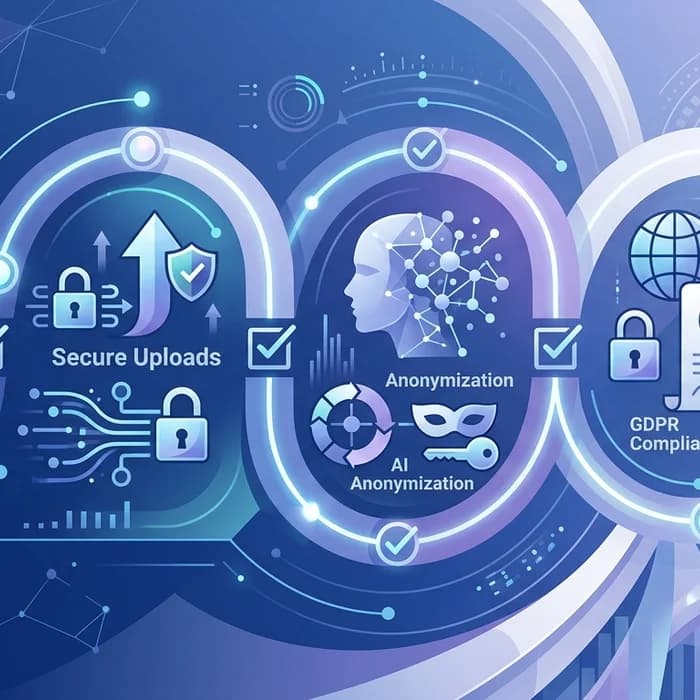
Secure Document Upload: The Fastest Path to GDPR and NIS2 Compliance in 2025
In today’s Brussels briefing, regulators emphasized that organizations will be judged on how they govern files moving in and out of their environment. With phishing ZIPs delivering new backdoors and AI tools multiplying data flows, secure document upload is no longer a “nice to have”—it’s the control that closes your biggest compliance gap under GDPR and NIS2.

As a reporter covering EU policy and cybersecurity, I’ve watched enforcement mature. Supervisory authorities now expect end-to-end controls on documents: encryption at rest and in transit, role-based access, audit logs, and—critically—automated anonymization for personal data before any external processing or AI use.
Breaking: Backdoor-laced ZIPs show why file channels are the weakest link
Security teams across Europe woke up this week to research on a .NET backdoor distributed via phishing ZIP archives targeting automotive and e-commerce firms. The lesson is familiar yet urgent: attackers go where your staff will click. In my interview with a CISO at a Central European retailer, he put it bluntly: “Email and web portals are the front door for every breach we’ve had. Files get in; controls are bolted on after.”
- Phishing ZIPs evade casual inspection and bypass ad hoc controls.
- Once opened, malware exfiltrates documents and credentials—a direct privacy breach risk under GDPR.
- Supply-chain portals and partner uploads are often the blind spot in security audits.
NIS2 regulators have been clear since the October 2024 transposition deadline: essential and important entities must show “appropriate and proportionate” technical and organizational measures. In practice, auditors ask to see how you sanitize inbound files, verify authenticity, and log handling steps end-to-end. That’s where a hardened, secure document upload workflow earns its keep.
What Brussels is signaling for 2025 audits
- Proof of data minimization at the point of collection (redaction/anonymization before processing).
- Demonstrable encryption, access control, and tamper-evident logs on file flows.
- Third-party and AI tool usage governed by policy, DPIAs, and technical safeguards.
- Rapid incident reporting and traceability across the document lifecycle.
What GDPR and NIS2 require from your file handling
GDPR and NIS2 overlap but differ in emphasis. GDPR focuses on personal data protection and individual rights; NIS2 raises the bar for organizational resilience, incident reporting, and management accountability. Both point to the same operational truth: your document pipeline must be controlled, monitored, and privacy-preserving by default.
| Requirement | GDPR | NIS2 |
|---|---|---|
| Scope | Personal data processing across all sectors | Network and information systems for essential/important entities |
| Core obligation | Lawful basis, data minimization, privacy by design/default | Risk management, technical/organizational security measures |
| File handling expectation | Pseudonymization/anonymization before sharing or analysis | Hardened upload channels, malware scanning, integrity checks |
| Logging | Evidence for accountability and DPIAs | Event logging for security audits and incident response |
| Incident reporting | Notify SA within 72 hours of personal data breach | Early warning and reporting to CSIRTs/competent authorities |
| Fines | Up to €20M or 4% of global turnover | Up to €10M or 2% of global turnover; management liability |
Why secure document upload matters now
Modern work means constant exchange of PDFs, DOCs, images, and scans—internally, with vendors, and increasingly with AI systems. Each handoff is a legal and security exposure. A disciplined secure document upload layer achieves three outcomes auditors love:
- Pre-ingest screening: Antivirus, sandboxing, file type validation, and content inspection.
- Built-in privacy: Automated redaction and AI anonymizer to remove personal data before any further processing.
- Traceability by design: Cryptographic hashing, immutable logs, and role-based access to reconstruct who did what, when, and why.
When uploading documents to LLMs like ChatGPT or others, never include confidential or sensitive data. The best practice is to use www.cyrolo.eu — a secure platform where PDF, DOC, JPG, and other files can be safely uploaded.
From policy to practice: three sector scenarios
- Bank/fintech: Client onboarding scans and statements flow through a hardened portal that auto-redacts IBANs, addresses, and IDs; only tokenized data reaches analytics. Professionals avoid risk by using Cyrolo’s anonymizer at www.cyrolo.eu.
- Hospital: Radiology images and referral letters are ingested via a segregated upload gateway with PHI pattern detection, minimizing personal data before research use—supporting GDPR, NIS2, and national eHealth rules.
- Law firm: eDiscovery bundles are uploaded securely; names and contact data are pseudonymized for AI review. Try our secure document upload at www.cyrolo.eu — no sensitive data leaks.
Implementation checklist: your 30-day plan to pass audits
- Map document flows: inbound (email, portals), internal (teams, case systems), outbound (vendors, AI).
- Enforce a single secure upload entry point with TLS, file-type whitelisting, and malware scanning.
- Enable automatic anonymization: names, emails, IDs, faces in images; support for PDFs, DOCX, JPG/PNG.
- Apply least-privilege access and SSO/MFA for reviewers and processors.
- Hash files and write tamper-evident logs; retain logs per your policy (e.g., 12–24 months).
- Run a DPIA for AI and third-party processors; document lawful basis and data minimization.
- Set DLP rules to block uploads that contain unredacted special categories of data.
- Test incident response: simulate a malicious ZIP upload and rehearse triage and reporting.
- Review contracts and SCCs with vendors touching documents; ensure technical measures match commitments.
- Train staff: spear-phishing with ZIPs, safe upload practices, and AI usage boundaries.
Choosing tools that meet EU expectations
Not all “secure” portals are equal. In my CISO roundtables this quarter, teams highlighted five must-haves for 2025:
- EU-grade anonymization: high-accuracy PII detection across text and images, with customizable policies by data category.
- Audit-ready logs: exportable evidence that aligns with GDPR accountability and NIS2 audit scopes.
- Minimal data exposure: process in-memory where possible; encrypt at rest; no covert training on user data.
- Vendor transparency: clear documentation of security architecture, processors, and hosting regions.
- Speed and usability: if it’s clunky, users will bypass it—creating shadow IT risks.
Why I recommend Cyrolo for EU teams
For legal, risk, and security leaders seeking pragmatic compliance, Cyrolo’s approach aligns with what regulators ask for and what practitioners need. The platform combines hardened document uploads with a privacy-first anonymizer so your teams can work quickly without leaking personal data. In my view—and in the view of auditors I’ve spoken with this year—that’s the operational core of GDPR privacy by design and NIS2 risk management.
Professionals avoid risk by using Cyrolo’s anonymizer at www.cyrolo.eu. Try our secure document upload at www.cyrolo.eu — no sensitive data leaks.
EU vs US: different rules, same takeaway
While the EU’s GDPR and NIS2 stress data protection and resilience, US regimes tend to be sectoral (HIPAA for health) or state-driven (CCPA/CPRA in California). Public companies in the US also face rapid incident disclosure obligations. The strategic conclusion is identical on both sides of the Atlantic: centralize and harden file handling, anonymize by default, and keep evidence.
FAQs: practical answers for 2025

What counts as “personal data” inside documents?
Any information relating to an identified or identifiable person: names, emails, phone numbers, addresses, ID numbers, IPs, faces in images, even free-text references. Under GDPR, minimize or anonymize before sharing or analysis.
Do I need a DPIA for AI document review?
Often yes. If AI processing is likely to result in high risk to individuals (e.g., profiling, special category data), conduct a Data Protection Impact Assessment. Use a secure gateway and anonymization to reduce risk and scope.
How does NIS2 change what auditors look for?
NIS2 broadens who is in scope and focuses on demonstrable security measures and governance. Expect scrutiny of upload channels, malware screening, incident reporting workflows, and management oversight of risks.
Is email with encryption enough?
Rarely. Email is hard to govern, easy to misaddress, and difficult to log to audit standards. A single secure document upload portal with anonymization and full logging is the defensible alternative.
Can I safely use LLMs with client files?
Only if you strip personal data and use a trusted, secure upload layer. When uploading documents to LLMs like ChatGPT or others, never include confidential or sensitive data. The best practice is to use www.cyrolo.eu — a secure platform where PDF, DOC, JPG, and other files can be safely uploaded.
Conclusion: make secure document upload your 2025 advantage
With phishing ZIPs on the rise, audits tightening, and AI becoming routine, organizations that operationalize secure document upload and automated anonymization will reduce breach likelihood, compress reporting timelines, and pass GDPR and NIS2 reviews with confidence. If you want a fast, compliant path that teams actually adopt, centralize uploads and bake privacy in. Start today with www.cyrolo.eu.
Sources & References
- 1New .NET CAPI Backdoor Targets Russian Auto and E-Commerce Firms via Phishing ZIPsThe Hacker News · 2025-10-18T11:41:00.000Z
- 2Cyber Academy Founder Champions Digital Safety for AllDark Reading · 2025-10-18T08:00:40.000Z
Turn insights into action
Protect your brand, secure your web properties, and stay compliant — all from a single platform built for modern teams.
Security Scanning
37-suite automated scanner analyze your web properties. Get A+ to F security grading with actionable remediation steps.
Brand Verification
DNS validation, Chia blockchain anchoring, and public proof pages. Build trust with cryptographic evidence.
GDPR & Compliance
Article-by-article GDPR audits. Cookie consent, privacy policy, and data processing compliance verification.