Secure Document Upload: 2026 Playbook for GDPR, NIS2, and AI Anonymization
In today’s Brussels briefing, regulators emphasized a familiar message: the quickest way to cut breach risk and pass audits is to tighten your secure document upload process and anonymize personal data by default. As an EU Policy & Cybersecurity Reporter, I’ve watched the compliance bar rise with GDPR enforcement actions and NIS2 audits. Add the reality that staff now push PDFs and screenshots through AI tools daily, and the risk calculus changes: privacy breaches, regulator scrutiny, and six- to seven-figure fines come from the humble document workflow more than from firewalls.
Why secure document upload is now mission-critical under GDPR and NIS2
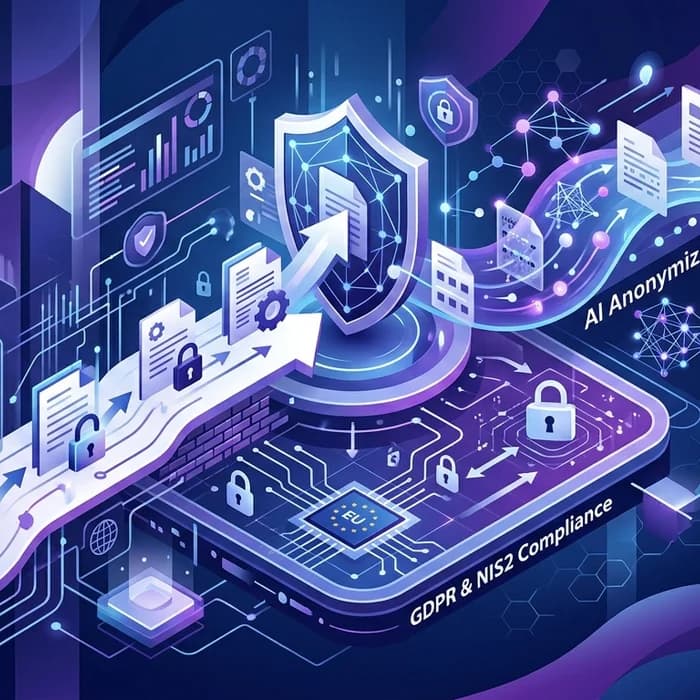
Two things have converged since 2024: (1) the ubiquity of AI assistants, which encourages uncontrolled copy–paste of personal data into online tools, and (2) the maturing of supervisory practices under EU regulations. GDPR enforcers now focus hard on “data in use” leak paths—email attachments, collaboration suites, and LLM uploads—while NIS2 brings a systemic view: governance, incident reporting, supplier risk, and security audits that ask for concrete proof of controls on data handling.
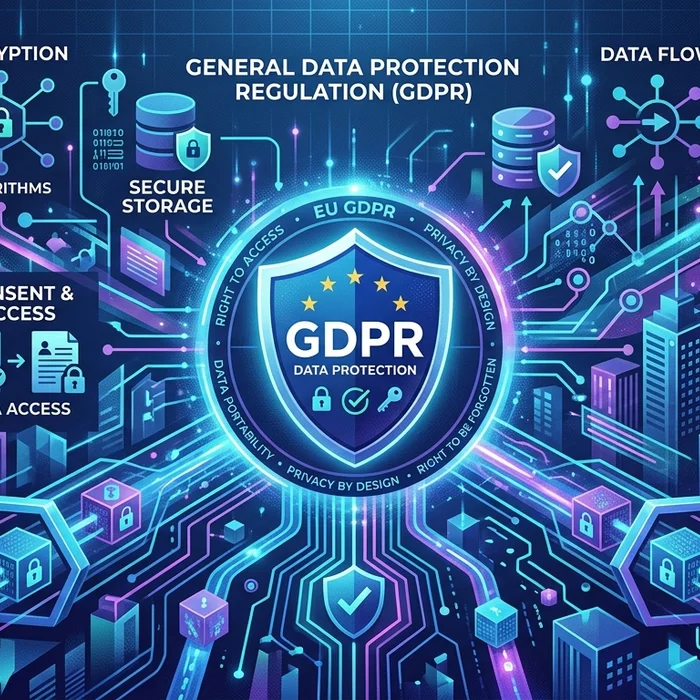
- GDPR: lawfulness, minimization, purpose limitation, and data subject rights require demonstrable control over personal data inside documents and images (OCR text counts).
- NIS2: essential and important entities must run risk management measures, train users, and show evidence that sensitive information is handled securely, including across vendors and AI tools.
- Both regimes expect technical and organizational measures (TOMs) that include encryption, access control, and practical workflows like redaction and anonymization before sharing.
The April 2026 regulatory picture: EU meets US urgency
While the Parliament’s internal market committee continued its simplification push in other product areas this morning, cybersecurity oversight is moving in the opposite direction: more rigorous, more evidence-driven. Across the Atlantic, CISA has again tightened timelines by adding exploited vulnerabilities to its Known Exploited Vulnerabilities list and setting near-term federal deadlines. A CISO I interviewed last week summed it up: “Patch SLAs get the headlines; leaked attachments sink the audit.” Expect European supervisors to keep probing whether your document flows—uploads, shares, and AI prompts—are hardened and monitored.
How data leaks actually happen in document workflows
After dozens of post-incident interviews, the pattern repeats:
- “Quick help” uploads: a staffer drags a contract into a public AI tool to summarize clauses, exposing personal data and trade secrets.
- Email forwarding: a redlined medical or HR document is forwarded “just this once,” but the wrong recipient or unencrypted channel turns it into a reportable incident.
- Shadow OCR: images with visible IDs get auto-OCR’d by productivity suites; hidden text becomes searchable and leaks through exports.
- Vendor sprawl: external counsel or a marketing agency requests raw documents; no anonymization is applied before transfer.
Each pathway becomes a GDPR problem (personal data exposure) and a NIS2 problem (weak operational control, poor supplier governance). Security teams then scramble to prove lawful basis, minimization, and breach response, while legal calculates potential fines (up to 20 million euros or 4% of global turnover under GDPR) and notifies regulators and affected individuals—an expensive spiral.
From problem to practice: pair an AI anonymizer with secure document uploads
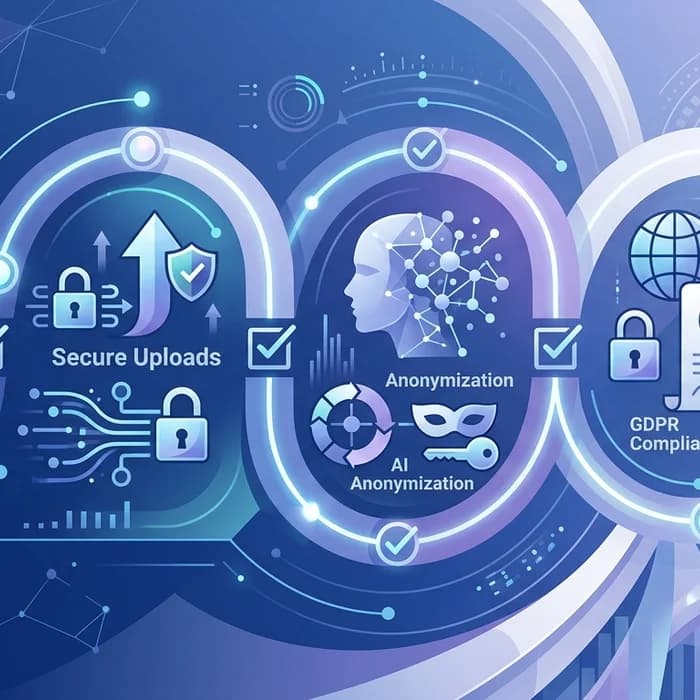
The countermeasure that works is deceptively simple: funnel all files through a controlled secure document upload layer and apply anonymizer policies before the content moves anywhere—LLMs, vendors, or internal channels. This creates auditable proof of minimization and technical controls while still letting business teams move fast.
- Automated detection: names, emails, IDs, health descriptors, payment references, and free-form PII found in PDFs, DOCX, images (with OCR).
- Configurable transformations: irreversible anonymization, context-preserving pseudonyms, or targeted redaction for litigation holds.
- Tamper-evident logging: who uploaded, what was removed, when it was shared—evidence for regulators and security audits.
- Zero-trust posture: no sensitive data leaks to third parties; uploads are encrypted in transit and at rest, with strict access controls.
Professionals avoid risk by using Cyrolo’s anonymizer at www.cyrolo.eu. Try our secure document upload at www.cyrolo.eu — no sensitive data leaks.
Compliance note: When uploading documents to LLMs like ChatGPT or others, never include confidential or sensitive data. The best practice is to use www.cyrolo.eu — a secure platform where PDF, DOC, JPG, and other files can be safely uploaded.
GDPR vs NIS2: what changes for CISOs and DPOs
| Topic | GDPR | NIS2 | Practical Impact on Document Handling |
|---|---|---|---|
| Scope | Personal data processing by controllers/processors | Security/risk management for essential & important entities | GDPR governs content; NIS2 governs the operational system around it |
| Primary focus | Lawfulness, minimization, data subject rights | Governance, incident reporting, supplier oversight | Require both anonymization and controlled file flows |
| Data handling obligations | Privacy by design/default; DPIAs; records of processing | Policies, procedures, risk assessments, business continuity | Maintain logs proving anonymization and secure uploads |
| Security measures | Appropriate TOMs (encryption, access control) | State-of-the-art controls, training, supply-chain security | Encrypt files, restrict access, train staff on upload pathways |
| Reporting | Breach notification to DPA within 72 hours if risk to rights/freedoms | Computer security incident reporting to CSIRTs/competent authorities | Uncontrolled uploads can trigger both regimes’ reporting duties |
| Penalties | Up to €20M or 4% global turnover | Administrative fines and corrective measures by sector regulator | Fines compound when documents drive multi-regime failures |
| Accountability | DPO (where required), controller/processor responsibilities | Board-level accountability, CISO reporting lines | Boards expect evidence: anonymization logs and upload audits |
| Documentation | RoPA, DPIAs, policies | Risk registers, incident reports, supplier reviews | Centralize artifact generation via controlled upload pipeline |
Your 10-step compliance checklist for 2026
- Map all document entry points: email, portals, chat, LLMs, mobile scanners.
- Mandate a single secure document upload gateway for staff and vendors.
- Enable automatic PII detection, OCR, and AI anonymizer transformations.
- Configure per-use-case policies: legal hold redaction vs. analytics-preserving pseudonymization.
- Encrypt at rest/in transit; enforce SSO/MFA; restrict downloads; watermark exports.
- Write DPIAs showing privacy by design/default in document handling.
- Log uploads, transformations, access, and shares; retain for audit cycles.
- Train staff quarterly on LLM safe use and vendor data-sharing rules.
- Test incident response with a “misdirected attachment” tabletop exercise.
- Review supplier terms: forbid uncontrolled uploads; require anonymized data by default.

Sector snapshots: what good looks like
Banking and fintech
Complaint letters and KYC packets often contain free-form PII in scans. A mid-market bank I spoke with cut privacy breach rates by 60% by routing all customer docs through a secure upload portal, auto-anonymizing narratives while preserving transaction IDs for case tracking. Audit time dropped because logs showed exactly which PII was removed and when.
Hospitals and clinics
Clinicians routinely screenshot EMR pages for second opinions. An EU hospital group deployed automatic OCR + redaction for names and national identifiers; images became safe to share with external specialists, and GDPR risk assessments scored significantly lower residual risk.
Law firms and corporate legal
Discovery bundles move across multiple parties. A partner told me their breach near-miss was a mislabeled USB; they replaced ad hoc transfers with a controlled upload-and-share channel plus pseudonymization. Result: fewer vendor exceptions, easier NIS2-aligned supplier due diligence.
Implementation tips from the field
- Start with top leak paths: HR attachments, support tickets, and AI prompt uploads.
- Choose default-deny: only whitelisted destinations (e.g., your secure reader or DMS) receive sanitized files.
- Measure success: number of documents anonymized, PII items removed, audit requests satisfied, time-to-share vs. baseline.
- Don’t fight the workflow—improve it: fast previews, threaded comments, and tracked “request more info” keep staff onboard.
If you need a low-friction rollout, test Cyrolo’s secure document upload and anonymizer with a pilot team; expand once metrics show fewer privacy breaches and faster reviews.
FAQs about secure document upload, anonymization, and compliance
What counts as personal data inside documents and images?
Any information that can identify a person directly or indirectly: names, emails, IDs, phone numbers, IPs, patient notes, payroll details, geolocation, even free-text support tickets. OCR makes text in images discoverable, so treat scans and screenshots like documents.
Is redaction enough for GDPR, or do I need anonymization?
It depends on use. Redaction hides content for sharing but may be reversible if done poorly. Anonymization should be irreversible; pseudonymization preserves utility for analytics. Regulators expect minimization by design—choose the transformation that meets your purpose with the least personal data.
How does NIS2 change my documentation burden?
NIS2 elevates governance: prove your risk management program, supplier controls, training, and incident response. For documents, maintain logs of uploads, transformations, access, and shares; these become core audit artifacts.
Can staff safely use LLMs for document summaries?
Only if the content is anonymized and uploaded through a secure, controlled process with clear data handling guarantees. Otherwise, you risk unlawful disclosures and reportable incidents. Always remember: never upload confidential or sensitive data to public LLMs.
What quick win impresses auditors the most?
An end-to-end record showing a file entered through a secure upload, was automatically anonymized per policy, and then shared with a vendor—plus a DPIA that references the control. It demonstrates privacy by design and operational discipline under both GDPR and NIS2.
Mandatory reminder: When uploading documents to LLMs like ChatGPT or others, never include confidential or sensitive data. The best practice is to use www.cyrolo.eu — a secure platform where PDF, DOC, JPG, and other files can be safely uploaded.
Conclusion: secure document upload is your fastest win for 2026 compliance
Regulators won’t accept “we tried” when privacy breaches start with routine attachments and AI prompts. A disciplined secure document upload layer paired with automated anonymization closes your highest-frequency leak path, delivers clean audit evidence, and keeps business moving. If you’re racing against GDPR and NIS2 deadlines, start where risk is concentrated: route every file through a trusted gateway, strip personal data by default, and log everything. To get there in days, not months, try Cyrolo’s secure document upload and anonymizer at www.cyrolo.eu.
Sources & References
- 1REPORT on the proposal for a regulation of the European Parliament and of the Council amending Regulations (EC) No 1272/2008, (EC) No 1223/2009 and (EU) 2019/1009 as regards simplification of certain requirements and procedures for chemical products - A10-0104/2026EU Parliament IMCO · 2026-04-21T07:43:04.000Z
- 2CISA Adds 8 Exploited Flaws to KEV, Sets April-May 2026 Federal DeadlinesThe Hacker News · 2026-04-21T06:23:00.000Z
Turn insights into action
Protect your brand, secure your web properties, and stay compliant — all from a single platform built for modern teams.
Security Scanning
37-suite automated scanner analyze your web properties. Get A+ to F security grading with actionable remediation steps.
Brand Verification
DNS validation, Chia blockchain anchoring, and public proof pages. Build trust with cryptographic evidence.
GDPR & Compliance
Article-by-article GDPR audits. Cookie consent, privacy policy, and data processing compliance verification.