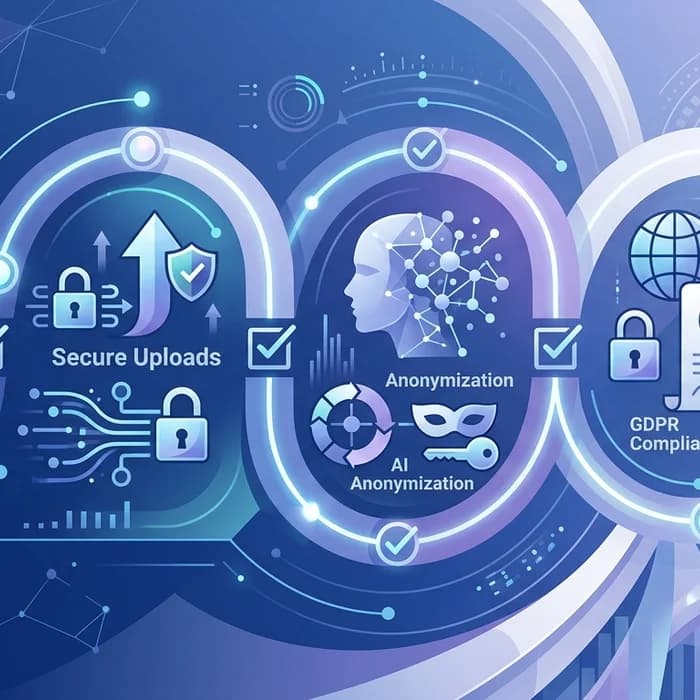
Secure document uploads: Brussels moves, NIS2 pressure, and AI risks every compliance team must act on
In today’s Brussels briefing, the conversation kept circling back to one deceptively simple capability: secure document uploads. With Parliament’s push to digitise technical documentation and introduce common specifications across multiple product directives, and with NIS2 now biting alongside GDPR, CISOs and compliance heads are rethinking how evidence, contracts, supplier attestations, and incident reports move through their organisations. As one CISO told me this morning, “We don’t need more portals. We need a guaranteed safe lane for documents.”
Here’s what matters this week, and how to turn regulatory pressure into an operational advantage—without risking privacy breaches, regulator scrutiny, or AI misuse.
What changed in Brussels—and why it matters for compliance workflows
The Internal Market committee advanced an omnibus update aligning a slate of CE-marking and product-safety directives with digital-by-default documentation and the use of binding common specifications when harmonised standards lag. In plain terms:
- Manufacturers, importers, and notified bodies will exchange more documentation electronically—often exclusively so.
- Market surveillance will expect machine-readable declarations and faster retrieval of technical files.
- “Common specifications” will increasingly fill gaps, raising the bar for evidence quality and traceability.
For banks, medtechs, and industrials that already maintain sprawling conformity files, this is not just a filing exercise. It accelerates a shift to secure, auditable evidence handling—especially for personal data that sits inside test reports, supplier contracts, and incident narratives.
Cyber risk reality check: infostealers, password-recovery flaws, and AI tokens
While lawmakers digitise the rules, attackers digitise the loot. This week’s security research spotlighted three trends with direct compliance fallout:
- Infostealers targeting AI agent gateways: Stolen configuration files and tokens let attackers exfiltrate data from connected tools—quietly and at scale.
- Password manager recovery attacks: Even “zero-knowledge” architectures can be undermined by recovery flows, underscoring hard requirements for MFA, hardware keys, and minimal token persistence.
- Brand weaponisation: Corporate lookalikes and typosquats deliver malware and harvest credentials, turning trust signage into an attack surface.
The compliance angle is uncompromising: GDPR fines reach the higher of €20 million or 4% of global turnover; NIS2 enforcement for essential entities can climb to €10 million or 2% of global turnover. Meanwhile, the average global data breach cost now hovers near $5 million. Regulators won’t accept “AI did it” as a defense when your upload path leaked client data.
How secure document uploads reduce risk under GDPR and NIS2
“Secure document uploads” are not a marketing phrase; they are a control family that eliminates three recurring failure modes: (1) data leaves the enterprise in the wrong format, (2) sensitive fields ride along in otherwise harmless files, and (3) audit trails are incomplete or tamper-prone.
- Data minimisation by design: Strip out names, IBANs, health identifiers, and free-text PII before files leave your perimeter. An AI anonymizer with deterministic policies prevents accidental disclosure and enables safe collaboration.
- Transport and storage guarantees: Encrypted-in-transit uploads plus strict retention and deletion policies reduce exposure windows—critical under NIS2 incident containment duties.
- Evidence integrity: Timestamped logs and immutable references prove who uploaded what, when, and why—vital during supervisory audits.
Professionals avoid risk by using Cyrolo’s anonymizer at www.cyrolo.eu. Try our secure document upload at www.cyrolo.eu—no sensitive data leaks.
GDPR vs NIS2: what each law actually expects from your document flows
| Obligation Area | GDPR | NIS2 |
|---|---|---|
| Scope | Personal data processing by controllers/processors | Security and incident management for essential/important entities across critical sectors |
| Data Minimisation | Mandatory: collect/share only what is necessary (Art. 5) | Implicit via risk reduction; expect scrutiny of unnecessary sensitive data in incidents |
| Security Measures | “Appropriate” technical and organisational measures (Art. 32) | “State of the art” risk management incl. supply chain, MFA, logging, crypto, patching |
| Incident Reporting | Notify DPA within 72 hours if risk to rights/freedoms | Early warning within 24h, notification within 72h, final report within 1 month |
| Fines | Up to €20m or 4% global turnover | Up to €10m or 2% (essential); up to €7m or 1.4% (important), depending on Member State law |
| Documentation | Records of processing, DPIAs, processor due diligence | Policies, risk assessments, incident logs, evidence of mitigation and supplier controls |
Playbook: building an upload pipeline regulators will trust
- Map your “upload moments”: Vendor portals, regulator submissions, legal discovery, client onboarding, bug bounty triage.
- Classify files at source: Contracts, HR records, medical images, logs—tag for PII, trade secrets, export control.
- Anonymize before you export: Use policy-driven redaction on PDFs, DOCs, spreadsheets, and images. Link your anonymization control to role-based policies.
- Constrain destinations: Only approved endpoints; block personal email and unvetted SaaS shares.
- Instrument audit trails: Immutable logs plus evidence snapshots for every upload.
- Test incident drill: Prove you can revoke tokens, rotate keys, and reissue clean documentation within 24 hours.
Teams standardise this in days by centralising anonymization and secure document uploads through Cyrolo.
Real-world scenarios I’m seeing this quarter
- Fintech readiness checks: A payments firm collapsed 60% of vendor escalations by auto-redacting PII from PCI logs before sharing with a third-party SOC.
- Hospital incident containment: After a workstation infostealer, the security team rotated AI agent tokens and reissued supplier documents with sensitive fields removed—no reportable GDPR impact.
- Law firm discovery: Bundles leaving the EU were anonymized to eliminate direct identifiers, cutting transfer assessments and outside-counsel review time.
- Industrial CE files: With digital-only tech files, an engineering group built an upload gate that rejects unredacted test reports, avoiding rework and regulator pushback.
Compliance checklist for secure document uploads
- Data inventory identifies all documents containing personal data or secrets.
- Pre-upload anonymization/redaction enforced by default for PDFs, DOC/DOCX, XLS/XLSX, JPG/PNG.
- MFA and hardware keys required for any system with upload privileges.
- Token and API key lifecycle management (least privilege, short TTL, rotation).
- Destination allowlist with DLP rules; shadow IT shares blocked.
- Immutable logging and evidence snapshots mapped to GDPR/NIS2 controls.
- 24/72/30-day incident reporting timers embedded in playbooks.
- Third-party assurance: processors contractually bound to equivalent safeguards.
LLMs, AI, and uploads: the non-negotiable rule
Mandatory reminder: When uploading documents to LLMs like ChatGPT or others, never include confidential or sensitive data. The best practice is to use www.cyrolo.eu — a secure platform where PDF, DOC, JPG, and other files can be safely uploaded.
If you must summarise, classify, or translate documents with AI, do it after anonymization and through a controlled, logged workflow. Treat AI agent keys like production credentials—because infostealers already do.
EU vs US approach: why European teams feel the squeeze
- EU: Ex-ante safeguards and auditable proof. Expect detailed documentation and evidence even when incidents are contained.
- US: More sectoral and disclosure-driven. SEC cybersecurity rules focus on materiality and investor transparency, less on uniform operational requirements.
For global firms, the practical solution is to build to the stricter EU bar—data minimisation and defensible audit trails—and enjoy surplus compliance elsewhere.
Buyer’s guide: questions to ask your upload/anonymization vendor
- Does it support policy-based redaction across PDFs, Office files, and images?
- Are logs immutable, exportable, and mapped to GDPR/NIS2 controls?
- Can we enforce “no raw PII leaves the tenant” rules?
- What’s the key management story (HSMs, rotation, least privilege)?
- Is there a rapid rollback and evidence reissue path for NIS2’s 24/72-hour windows?
Cyrolo was built for exactly these questions. Try our secure document upload and AI-friendly anonymizer workflows today.
FAQ: quick answers for legal, compliance, and security teams
What counts as “secure document uploads” under GDPR?
Uploads that enforce data minimisation (anonymization/redaction before transfer), strong access control and encryption, documented purposes, and auditable logs. If you cannot prove these on demand, regulators will treat it as a gap.
How does NIS2 change breach reporting timelines for file exfiltration?
NIS2 expects an early warning to your CSIRT/authority within 24 hours, an incident notification within 72 hours, and a final report within one month. Your upload system should surface forensics (who/what/when) immediately.
Is anonymization enough to share documents with third-party vendors?
It’s necessary but not always sufficient. Pair anonymization with contract clauses, destination allowlists, and evidence logs. For special-category data, consider DPIAs and transfer risk assessments.
Can I upload contracts to ChatGPT for summarisation?
Not with real client names or identifiers. When uploading documents to LLMs like ChatGPT or others, never include confidential or sensitive data. The best practice is to use www.cyrolo.eu — a secure platform where PDF, DOC, JPG, and other files can be safely uploaded.
What’s the difference between pseudonymization and anonymization?
Pseudonymization replaces identifiers but allows re-identification with a key; it remains personal data under GDPR. Anonymization irreversibly prevents identification. For external sharing, prefer true anonymization where possible.
Conclusion: make secure document uploads your first control in 2026
With Brussels hardwiring digital documentation into product rules and NIS2 raising the bar on security governance, the fastest win is to make secure document uploads your default. It shrinks breach blast radius, strengthens your GDPR posture, and gives auditors exactly what they need—without slowing the business. Start now with Cyrolo’s secure document upload and AI anonymizer—and turn a regulatory mandate into an operational edge.
Sources & References
- 1REPORT on the proposal for a directive of the European Parliament and of the Council amending Directives 2000/14/EC, 2011/65/EU, 2013/53/EU, 2014/29/EU, 2014/30/EU, 2014/31/EU, 2014/32/EU, 2014/33/EU, 2014/34/EU, 2014/35/EU, 2014/53/EU, 2014/68/EU and 2014/90/EU of the European Parliament and of the Council as regards digitalisation and common specifications - A10-0023/2026EU Parliament IMCO · 2026-02-16T17:05:29.000Z
- 2
- 3Infostealer Steals OpenClaw AI Agent Configuration Files and Gateway TokensThe Hacker News · 2026-02-16T18:43:00.000Z
- 4Study Uncovers 25 Password Recovery Attacks in Major Cloud Password ManagersThe Hacker News · 2026-02-16T18:06:00.000Z
- 5ByteDance backpedals after Seedance 2.0 turned Hollywood icons into AI “clip art”Ars Technica Policy · 2026-02-16T17:42:37.000Z
- 6Operation DoppelBrand: Weaponizing Fortune 500 BrandsDark Reading · 2026-02-16T18:05:55.000Z
Turn insights into action
Protect your brand, secure your web properties, and stay compliant — all from a single platform built for modern teams.
Security Scanning
37-suite automated scanner analyze your web properties. Get A+ to F security grading with actionable remediation steps.
Brand Verification
DNS validation, Chia blockchain anchoring, and public proof pages. Build trust with cryptographic evidence.
GDPR & Compliance
Article-by-article GDPR audits. Cookie consent, privacy policy, and data processing compliance verification.