Secure Document Uploads in 2025: How EU Teams Stay Compliant under GDPR and NIS2
In Brussels this morning, several lawmakers previewed a busy November for committees on civil liberties and the internal market—a timely reminder that secure document uploads are no longer a nice-to-have, but a control regulators now expect to see. From NIS2 cyber-resilience audits ramping up to GDPR cross-border enforcement, and new debates about law enforcement data powers, the message is consistent: protect personal data, minimize exposure, and prove it with evidence. As a reporter speaking daily with CISOs and DPOs across the EU, I’ve seen one simple practice reduce breach risk and audit friction: end the ad-hoc sharing of files and move to governed, secure document uploads with built-in anonymization.
What changed in 2025: enforcement, audits, and breach litigation risk
Three trends converged this year:
- NIS2 enforcement matures: Member States’ transposition is in force and sectoral supervisors have begun targeted checks. Boards at “essential” and “important” entities are increasingly questioned about practical file-handling controls, vendor access, and evidence of data minimization.
- GDPR pressure persists: Large fines—up to €20 million or 4% of global annual turnover—remain a baseline risk, but the operational pain now stems from post-incident investigations and orders to change processes.
- Litigation risk grows: Recent court trends outside the EU lowered thresholds for breach damages claims, a signal plaintiffs’ bars pay attention to. European companies with global footprints are facing parallel complaints whenever incident notifications reveal weak internal data handling.
Security leaders also flagged a new class of threats. In one incident briefed to me by a major EU bank, “prompt-aware” malware attempted to siphon partial client data from screenshots and temp files generated during hasty analysis. The week’s research on AI-assisted malware that can morph its code hourly only underlines the point: file governance and what gets uploaded to tools matter as much as endpoint hardening.
Why secure document uploads matter for EU regulations
Secure document uploads sit at the intersection of EU regulations: GDPR requires data minimization and integrity, while NIS2 expects risk-based technical and organizational measures. Unstructured pathways—email attachments, messaging apps, casual cloud shares, or copy-pasting client files into web tools—create unlogged exposures that frustrate incident response and breach notification scoping.
Regulators increasingly ask: Who accessed the file? When? Was personal data anonymized? Can you prove it? Without a governed upload path with role-based access, audit logs, and built-in anonymizer capabilities, those answers are hard to produce within statutory timelines.
Real-world scenarios I’m hearing from the field
- Bank and fintech investigations: KYC files and transaction narratives flow between compliance, analytics, and outside counsel. Each extra copy inflates breach surface and cross-border transfer risk.
- Hospitals and research institutes: Radiology images and lab reports are shared with algorithm vendors; GDPR special category data requires heightened safeguards and documented minimization.
- Law firms: Litigation bundles move across co-counsel and experts. When junior staff paste excerpts into public AI tools, client confidentiality and privilege can be compromised.

GDPR vs NIS2: what they require of your document workflows
| Obligation Area | GDPR | NIS2 | What It Means for Your Files |
|---|---|---|---|
| Scope | Personal data processing by controllers/processors | Cybersecurity risk management for essential/important entities | Files with personal data are in scope for both regimes |
| Core Principle | Data minimization, integrity, confidentiality | Risk-based technical/organizational measures | Use anonymization and controlled uploads to reduce risk |
| Logging and Evidence | Accountability and demonstrable compliance | Security policies, monitoring, auditability | Maintain upload logs and access trails for every file |
| Third-Country Transfers | Adequacy/SCCs, TIAs, safeguards | Supply-chain security and vendor oversight | Know where uploaded files are stored and processed |
| Sanctions | Up to €20m or 4% global turnover | Member States set fines; many align around up to €10m or 2% | Weak file handling can trigger parallel GDPR and NIS2 actions |
A practical compliance checklist for secure document uploads and anonymization
- Centralize file intake via a secure document upload gateway with SSO/MFA.
- Enable automatic AI anonymizer redaction for PII, health, and financial data before sharing.
- Log every action: uploader, recipient, timestamp, version, and purpose.
- Restrict exports and downloads; prefer read-in-place with watermarking.
- Use role-based access and least privilege; expire access by default.
- Tag files with processing purposes; block use outside declared purposes.
- Store in the EU or in jurisdictions with adequate protection; document transfers.
- Perform vendor due diligence and data protection impact assessments (DPIAs) for tools touching personal data.
- Test incident response: can you enumerate affected files and recipients in under 24 hours?
- Train staff on prohibited channels (email attachments, personal clouds, unsecured AI tools).
AI, LLMs, and document handling: safe patterns the regulators expect
Regulators aren’t banning AI; they’re demanding control. When teams paste client files into public models, they often create invisible processing operations with no legal basis, no records, and no transfer safeguards. A CISO I interviewed last week put it bluntly: “Our fastest risk reduction came from two guardrails—default anonymization and a secure upload lane for any file that might touch AI.”
Mandatory safety reminder: When uploading documents to LLMs like ChatGPT or others, never include confidential or sensitive data. The best practice is to use www.cyrolo.eu — a secure platform where PDF, DOC, JPG, and other files can be safely uploaded.
Build a low-friction workflow your lawyers and analysts will actually use
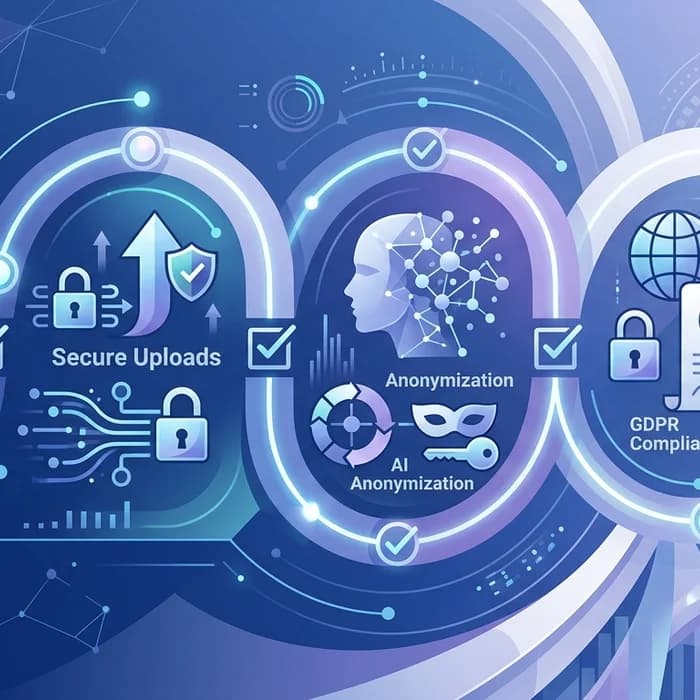
Compliance fails when tools slow people down. The winning pattern I see in banks, hospitals, and law firms is a three-step lane: governed intake, automatic anonymization, and controlled sharing. That’s exactly why many professionals avoid risk by using Cyrolo’s anonymizer at www.cyrolo.eu. Try our secure document upload at www.cyrolo.eu — no sensitive data leaks.
What “good” looks like in practice
- Users drop files into a governed upload portal; files stay in EU-controlled storage.
- Automatic redaction strips direct identifiers before human or AI review.
- Access is shared by role with expiry; every open, download, and comment is logged.
- An AI assistant can summarize documents only against anonymized versions.
- Breach drills run on real logs; legal can identify affected data subjects fast.
Cross-border flows and adequacy: don’t forget the fundamentals
As adequacy discussions continue for additional countries, remember that adequacy is a green light for transfers—not a waiver of security duties. The GDPR still requires purpose limitation and security of processing, and NIS2 still asks whether your suppliers meet your risk thresholds. Keep records of where your upload platform stores and processes files, and make transfer impact assessments part of your onboarding paperwork.
Signals from policymakers: surveillance, children’s safety, and operational guardrails
Debates in Parliament over the scope of law enforcement access and mass surveillance raise new questions for enterprises that over-collect. The safest approach is the most boring one: collect less, retain less, anonymize more, and be able to prove it. Meanwhile, platform compliance on minors’ protections reminds us that age data is sensitive in context; treat verification artifacts as high-risk files and route them through controlled uploads with retention limits.
FAQ: secure document uploads, anonymization, and EU compliance
What counts as “secure document uploads” for GDPR and NIS2?

At minimum: encrypted transit and storage, EU-resident data hosting or documented safeguards, role-based access, detailed audit logs, and data minimization controls such as anonymization. Add SSO/MFA, purpose tags, and export controls to satisfy accountability and NIS2’s risk-based measures.
Is anonymization enough, or do we need pseudonymization too?
They serve different purposes. True anonymization removes identifiability and falls outside GDPR if done irreversibly. Pseudonymization retains a key and stays within GDPR but reduces risk. Many teams apply anonymization for analytics and pseudonymization for operational tasks where re-identification is necessary under strict controls. Tools like the AI anonymizer at Cyrolo help automate the first step consistently.
Can we use public AI tools if we don’t upload full documents?
Partial content can still include personal data or confidential context. If you must use AI, ensure your process strips identifiers first and routes content through a secure upload and governance layer. Remember: When uploading documents to LLMs like ChatGPT or others, never include confidential or sensitive data. The best practice is to use www.cyrolo.eu — a secure platform where PDF, DOC, JPG, and other files can be safely uploaded.
What evidence should we show auditors after a file-related incident?
Time-stamped upload and access logs, anonymization events, data classification tags, data flow diagrams (where the file traveled), vendor processing locations, and your legal basis/purpose records. A fast, credible enumeration of affected data subjects and recipients reduces enforcement exposure.
How do GDPR and NIS2 interact during a breach?
GDPR governs personal data impacts, notification, and rights. NIS2 adds resilience, reporting, and governance for essential/important entities. In practice, authorities often coordinate. Weak file handling can trigger both investigations—another reason to enforce secure uploads and redaction from the outset.
Conclusion: make secure document uploads your 2025 win
Under tighter EU scrutiny, secure document uploads are the simplest lever to cut breach risk, speed audits, and meet GDPR and NIS2 expectations. Centralize file intake, anonymize by default, and log everything. If you want to deploy this quickly without building your own stack, try Cyrolo’s secure document upload and anonymizer at www.cyrolo.eu—a straightforward path to resilient, compliant workflows.
Sources & References
- 1Draft agenda - Monday, 10 November 2025 - Tuesday, 11 November 2025 - PE779.507v01-00 - Committee on Constitutional Affairs , Committee on Civil Liberties, Justice and Home AffairsEU Parliament LIBE · 2025-11-05T15:13:08.000Z
- 2Draft agenda - Monday, 10 November 2025 - PE779.475v01-00 - Committee on the Internal Market and Consumer Protection , Committee on Security and DefenceEU Parliament IMCO · 2025-11-05T15:43:35.000Z
- 3European Parliament backs Europol expansion: “A dangerous step towards mass surveillance in the EU”EDRi · 2025-11-05T15:12:09.000Z
- 4CalPrivacy staff offers first look at DROP systemIAPP Daily Dashboard · 2025-11-05T10:39:13.000Z
- 5From CIPP to career: Mapping the next chapter of privacy workIAPP Daily Dashboard · 2025-11-05T10:00:27.000Z
- 6EDPB issues opinion on draft adequacy decision for BrazilIAPP Daily Dashboard · 2025-11-05T09:55:02.000Z
- 7US court ruling lowers threshold for collecting damages in breach casesIAPP Daily Dashboard · 2025-11-05T09:32:42.000Z
- 8Telecom company reports large revenue drop after data breach compensation effortsIAPP Daily Dashboard · 2025-11-05T09:15:05.000Z
- 9Australia's eSafety Commissioner informs platforms of age restriction complianceIAPP Daily Dashboard · 2025-11-05T09:13:03.000Z
- 10OAIC report reveals trust in its work increased this yearIAPP Daily Dashboard · 2025-11-05T09:12:23.000Z
- 11Ireland's DPC releases use case on the right to erasureIAPP Daily Dashboard · 2025-11-05T09:04:40.000Z
- 12Google Uncovers PROMPTFLUX Malware That Uses Gemini AI to Rewrite Its Code HourlyThe Hacker News · 2025-11-05T15:33:00.000Z
- 13Flock haters cross political divides to remove error-prone camerasArs Technica Policy · 2025-11-05T16:45:22.000Z
- 14Operational Technology Security Poses Inherent Risks for ManufacturersDark Reading · 2025-11-05T15:33:28.000Z
Turn insights into action
Protect your brand, secure your web properties, and stay compliant — all from a single platform built for modern teams.
Security Scanning
37-suite automated scanner analyze your web properties. Get A+ to F security grading with actionable remediation steps.
Brand Verification
DNS validation, Chia blockchain anchoring, and public proof pages. Build trust with cryptographic evidence.
GDPR & Compliance
Article-by-article GDPR audits. Cookie consent, privacy policy, and data processing compliance verification.