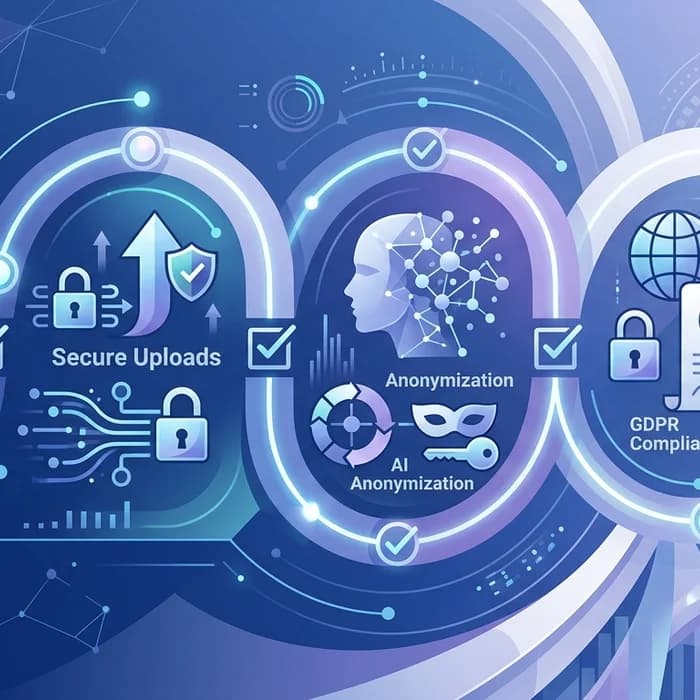
Secure Document Uploads: The 2025 EU Playbook for GDPR, NIS2 and the AI Act
In today’s Brussels briefing, officials again stressed that the most common compliance failures begin with sloppy handling of files. Secure document uploads are now a frontline control for GDPR, NIS2 and the AI Act, especially as regulators step up checks and attackers sharpen credential theft and supply‑chain exploits. In the last weeks alone, Czech police reportedly turned off facial recognition at Prague airport under the AI Act, Austrian privacy enforcement has been strained by budget cuts, and several open‑source packages were caught stealing developer secrets. The message to CISOs and DPOs I’ve interviewed is consistent: lock down the way your teams move documents, or expect audits, incidents, and fines.

Why secure document uploads are your first line of defense
Three overlapping risk vectors make document handling critical in 2025:
- Regulatory scope expansion: GDPR still governs personal data; NIS2 now imposes strict security and reporting requirements on a wider set of “essential” and “important” entities; and the AI Act introduces obligations when using or developing AI, including limits on biometric systems and strict record‑keeping.
- Threat evolution: Recent developer credential theft via compromised packages and active exploitation of enterprise apps show adversaries target the very workflows where staff upload, share, and parse files.
- Human error with AI tools: Staff paste documents into LLMs or third‑party readers, often without anonymization or secure routing, creating privacy and trade secret exposure.
A CISO I interviewed last week called it the “upload gap”: organizations invest heavily in perimeter and detection, but leave everyday uploads to unmanaged browsers and consumer tools. That’s where privacy breaches and security audits begin.
Compliance reminder: When uploading documents to LLMs like ChatGPT or others, never include confidential or sensitive data. The best practice is to use www.cyrolo.eu — a secure platform where PDF, DOC, JPG, and other files can be safely uploaded.
Enforcement in 2025: Prague’s cameras off, budgets tight — risk still on you
This month’s development in Prague — facial recognition cameras reportedly switched off at the airport due to the AI Act — underscores how quickly authorities can intervene when a system crosses into prohibited or high‑risk categories. Even as some DPAs face resource pressure (Austria’s watchdog has been flagged over budget constraints), companies should not assume softer scrutiny. Under the EU framework:
- GDPR: Fines up to 4% of global annual turnover for major infringements, plus mandatory breach notification within 72 hours to the DPA when personal data is impacted.
- NIS2: Risk management, supply‑chain security, and incident reporting obligations, with penalties that can reach up to 2% of global turnover for essential entities, plus management liability.
- AI Act: Prohibited practices carry fines up to approximately €35 million or 7% of global turnover; other breaches up to €15 million or 3%. Record‑keeping, risk management, data governance, and transparency duties apply depending on system risk category.

In other words: enforcement is real and rising, even if uneven. The safer approach is to build provable controls now — starting with secure document uploads and automated anonymization that you can show a regulator.
GDPR vs NIS2: who owes what on data and incidents
| Topic | GDPR | NIS2 |
|---|---|---|
| Scope | Personal data processing by controllers/processors | Security of network and information systems for essential/important entities |
| Core obligation | Lawful, fair, transparent processing; data minimization and integrity | Risk management, incident prevention, supply‑chain security, business continuity |
| Data handling | Privacy by design; pseudonymization/anonymization encouraged | Technical/organizational measures; secure handling of operational and log data |
| Incident reporting | Notify DPA within 72 hours of personal data breach, if risk to rights/freedoms | Early warning within 24 hours; incident notification within 72 hours; final report within 1 month |
| Fines | Up to 4% global turnover or €20m (whichever is higher) | Up to 2% global turnover for essential entities; management accountability |
Secure document uploads: a pragmatic, auditable workflow
Here is the operational blueprint I see working inside banks, hospitals, and law firms:
- Route all uploads through a secure gateway. Replace ad‑hoc file sharing with a controlled platform offering encryption in transit and at rest, access logs, and consented processing. Try secure document uploads via www.cyrolo.eu — no sensitive data leaks.
- Automate anonymization before analysis. Strip direct and indirect identifiers prior to internal review or AI processing. Professionals avoid risk by using Cyrolo’s anonymizer at www.cyrolo.eu to remove personal data and sensitive fields.
- Tag files with legal bases and retention. On upload, capture purpose, legal basis (e.g., contract, legal obligation), and retention timer. This supports GDPR accountability and NIS2 documentation.
- Control AI usage with policy + tooling. Allow only vetted models and require pre‑anonymized inputs. Block public tools for raw uploads; document exceptions via DPO sign‑off.
- Log everything for audits. Keep immutable records of who uploaded, who accessed, what was masked, and what model analyzed the file. These logs are gold during regulatory inquiries and security audits.
Compliance checklist for CISOs and DPOs
- Map all document flows (ingress, processing, egress) across business units and vendors.
- Mandate secure document uploads with encryption, access control, and audit logs.
- Enable AI anonymizer tooling that handles PDFs, scans, and images (OCR) reliably.
- Implement role‑based access and least privilege for sensitive repositories.
- Set incident playbooks: 24‑hour early warning (NIS2), 72‑hour GDPR notice decision tree.
- Run quarterly red‑team style tests against upload workflows and supply‑chain components.
- Record retention and deletion automation tied to legal basis and case status.
- Vendor governance: contractual clauses banning unapproved data transfers to AI processors.
- Executive reporting: risk metrics on upload volumes, anonymization rates, and violations.
Real‑world scenarios: problems and solutions
Bank onboarding team shares PDFs with a third‑party KYC tool
Problem: Staff email ID scans and utility bills to a vendor that quietly uses a public LLM for extraction. A regulator asks for records, but there’s no anonymization or audit trail.
Solution: Force uploads through a secure gateway with automatic redaction of MRZs, addresses, and account numbers. Log the transformation before forwarding only the minimum data required. Use www.cyrolo.eu to standardize secure document uploads and anonymization across KYC workflows.
Hospital research unit exports datasets for model training
Problem: Clinicians export partial EHRs to analyze outcomes. Quasi‑identifiers remain, re‑identification risk is high, and NIS2 requires stronger access control and monitoring.
Solution: Apply robust de‑identification and document pseudonymization policies. Only anonymized exports can leave the clinical network; each export receives a risk score and approval. Professionals avoid risk by using Cyrolo’s anonymizer at www.cyrolo.eu to remove personal data before analysis.
Law firm uses generative AI to summarize discovery files
Problem: Associates paste client documents into an LLM, violating confidentiality and GDPR principles of data minimization.
Solution: Create a walled garden: documents uploaded via a secure platform, auto‑anonymized, then summarized by vetted models with logging and retention controls. Try safe, audited document uploads at www.cyrolo.eu.
AI Act nuances to watch in 2025
- Biometrics and public spaces: The Prague airport example shows authorities are ready to act where biometric identification is unlawful or insufficiently justified.
- High‑risk system documentation: Expect scrutiny of training data provenance, testing logs, and risk assessments. Secure uploads with traceable data lineage will save you during audits.
- General‑purpose AI (GPAI): Even when not “high‑risk,” providers and deployers may bear transparency and copyright‑related duties. Keep input/output records and anonymize upstream documents.

FAQ
What are secure document uploads, and why do they matter for GDPR and NIS2?
Secure document uploads route files through an encrypted, access‑controlled, and logged workflow that can enforce anonymization, retention, and least‑privilege access. This supports GDPR’s accountability and minimization principles, and NIS2’s risk management and incident reporting requirements.
Is it safe to upload client documents to ChatGPT or other LLMs?
Not by default. You should never paste confidential or personal data into unmanaged AI tools. Use a secure gateway that anonymizes first and logs access. When uploading documents to LLMs like ChatGPT or others, never include confidential or sensitive data. The best practice is to use www.cyrolo.eu — a secure platform where PDF, DOC, JPG, and other files can be safely uploaded.
How does anonymization differ from pseudonymization under GDPR?
Anonymization irreversibly prevents identification and typically falls outside GDPR if truly irreversible. Pseudonymization replaces identifiers but may still be reversible with additional information, so GDPR continues to apply. Most organizations need both, depending on purpose and risk.
What NIS2 deadlines should I plan around?
National transposition took effect in late 2024, and 2025 is the year of audits and enforcement ramp‑up across sectors. Essential and important entities should already have incident reporting channels, supply‑chain security measures, and executive accountability in place.
Can secure document uploads reduce breach costs?
Yes. By eliminating “shadow” file sharing, automatically removing sensitive fields, and preserving forensic logs, organizations can shorten investigation timelines, reduce data exfiltration exposure, and demonstrate diligence to regulators — all of which dampen costs.
Conclusion: make secure document uploads your 2025 compliance advantage
From Prague’s halted facial recognition to intensifying supply‑chain attacks, the EU’s message is clear: the way you move and process files is now a regulated security function. By standardizing secure document uploads and pairing them with automated anonymization, you reduce breach risk, satisfy GDPR, align with NIS2, and prepare for AI Act audits. Try the safer path today: use www.cyrolo.eu for encrypted uploads and Cyrolo’s anonymizer to strip sensitive data before any analysis.
Sources & References
- 1Czech police forced to turn off facial recognition cameras at the Prague airport thanks to the AI ActEDRi · 2025-10-29T08:30:37.000Z
- 2Budget cuts incapacitate Austrian DPA: NGOs complaint to the EU CommissionEDRi · 2025-10-29T08:30:17.000Z
- 3A Privacy Nightmarе: Understanding Spyware, a new book by SHARE FoundationEDRi · 2025-10-29T08:30:06.000Z
- 410 npm Packages Caught Stealing Developer Credentials on Windows, macOS, and LinuxThe Hacker News · 2025-10-29T08:34:00.000Z
- 5Active Exploits Hit Dassault and XWiki — CISA Confirms Critical Flaws Under AttackThe Hacker News · 2025-10-29T07:44:00.000Z
- 6Cybersecurity Firms See Surge in AI-Powered Attacks Across AfricaDark Reading · 2025-10-29T06:00:00.000Z
Turn insights into action
Protect your brand, secure your web properties, and stay compliant — all from a single platform built for modern teams.
Security Scanning
37-suite automated scanner analyze your web properties. Get A+ to F security grading with actionable remediation steps.
Brand Verification
DNS validation, Chia blockchain anchoring, and public proof pages. Build trust with cryptographic evidence.
GDPR & Compliance
Article-by-article GDPR audits. Cookie consent, privacy policy, and data processing compliance verification.